Within Edge Computer
When should a sky station hit record?
A stronger trigger asks whether video, infrared, acoustic, radio, weather and aircraft data agree before an event is promoted.
On this page
- Why motion alone is a weak trigger
- How sensor coincidences raise confidence
- When triggers should reject bad data
Page outline Jump by section
Introduction
A sky station should not begin high-value recording simply because a camera detects motion. Birds, insects, satellites, aircraft, cloud edges, rain, camera shake and sensor glitches all create convincing-looking clips when viewed in isolation. The purpose of multi-sensor trigger rules is to require independent agreement between different instruments before an event is promoted for long-term storage or human review. Instead of asking, “Did something move?”, the station asks, “Do multiple, synchronised measurements describe the same event?”
 This approach aligns with the direction recommended by NASA’s independent UAP study, which argues that reliable investigation depends on calibrated sensors, multiple measurements, complete metadata and systematic data collection rather than isolated images.[NASA Science]science.nasa.govScience Independent Study Team ReportNASA ScienceIndependent Study Team ReportSeptember 13, 2023 — The study of Unidentified Anomalous Phenomena (UAP) presents a unique scien…
Why motion alone is a weak trigger
Computer vision can reliably detect moving pixels, but movement alone says little about what caused it. A bright insect passing close to the lens, an autofocus adjustment, a wind-induced vibration or a rapidly changing cloud edge may all satisfy a simple motion detector while having no scientific value.
For an automated instrumented sky station, recording every such event quickly overwhelms storage and produces thousands of “mystery clips” that later turn out to have ordinary explanations. The real challenge is therefore not detecting movement but deciding whether that movement deserves preservation at full quality.
A stronger trigger policy separates three questions:
- Did something change? (basic motion detection)
- Did more than one sensor observe a compatible event? (cross-validation)
- Is the event inconsistent with known ordinary explanations? (context filtering)
Only after passing all three stages should the station preserve extended recordings, request higher-resolution observations or notify downstream analysis systems.
How sensor coincidences raise confidence
The strongest trigger is usually not a single threshold but a coincidence rule. Independent sensors fail in different ways, so simultaneous agreement greatly reduces the probability that an event is merely an artefact.
A practical station might combine information from:
- visible-light cameras
- infrared cameras
- acoustic microphones
- radio-frequency monitoring
- weather sensors
- ADS-B aircraft broadcasts
- GPS-disciplined timestamps
- internal health sensors such as vibration or orientation
The station does not require every sensor to respond. Instead, it looks for combinations that make physical sense.
For example:
ObservationTypical interpretationVisible motion onlyLow confidence; could be insects, birds or image artefactsVisible + infrared trackHigher confidence that a real object crossed the fieldVisible + ADS-B aircraft matchOrdinary aircraft; archive briefly but do not promoteVisible + wind gust + camera vibrationLikely camera motion rather than airborne objectRF spike onlyProbably local interference unless supported by other sensorsVisible object + weather confirms lightningNatural atmospheric event rather than unknown target
The goal is not to prove what an object is in real time. Instead, it is to avoid promoting events that already have adequate ordinary explanations.
Time synchronisation is as important as the sensors
Coincidence rules only work if every measurement shares a common clock.
An infrared camera detecting a target two seconds before the visible camera, or an ADS-B message arriving with an unknown delay, can produce false matches or hide genuine ones. Scientific systems therefore place considerable emphasis on precise timestamps and complete metadata.
NASA’s UAP study repeatedly identifies accurate metadata, calibration and multiple simultaneous measurements as prerequisites for meaningful analysis, noting that some apparent anomalies disappear once sensor calibration and contextual metadata are examined.[NASA+2Wikisource]nasa.govupdate nasa shares uap independent study report names directorUPDATE: NASA Shares UAP Independent Study Report14 Sept 2023 — We found that NASA can help the whole-of-government UAP effort through…
For this reason, trigger logic should compare events within carefully defined time windows rather than assuming perfect simultaneity. A visible track and infrared detection occurring within tens or hundreds of milliseconds may represent the same object, whereas events separated by several seconds usually should not be fused automatically.
When triggers should reject bad data
Good trigger rules reject technically invalid observations before attempting to classify them.
Common rejection conditions include:
- Loss of GPS timing or clock synchronisation.
- Camera saturation from the Sun, Moon or bright floodlights.
- Rain, condensation or ice covering the optics.
- Excessive camera vibration measured by onboard accelerometers.
- Missing calibration information.
- Sensors reporting internal faults or overheating.
- Network interruptions that leave incomplete datasets.
Rejecting these conditions may seem conservative, but preserving known-poor data often wastes review effort while reducing confidence in genuinely unusual observations.
NASA similarly emphasises that incomplete metadata and poorly characterised sensors limit scientific interpretation even when interesting imagery exists.[NASA Science]science.nasa.govScience Independent Study Team ReportNASA ScienceIndependent Study Team ReportSeptember 13, 2023 — The study of Unidentified Anomalous Phenomena (UAP) presents a unique scien…
Practical trigger policies instead of fixed thresholds
The most effective systems use layered policies rather than a single sensitivity setting.
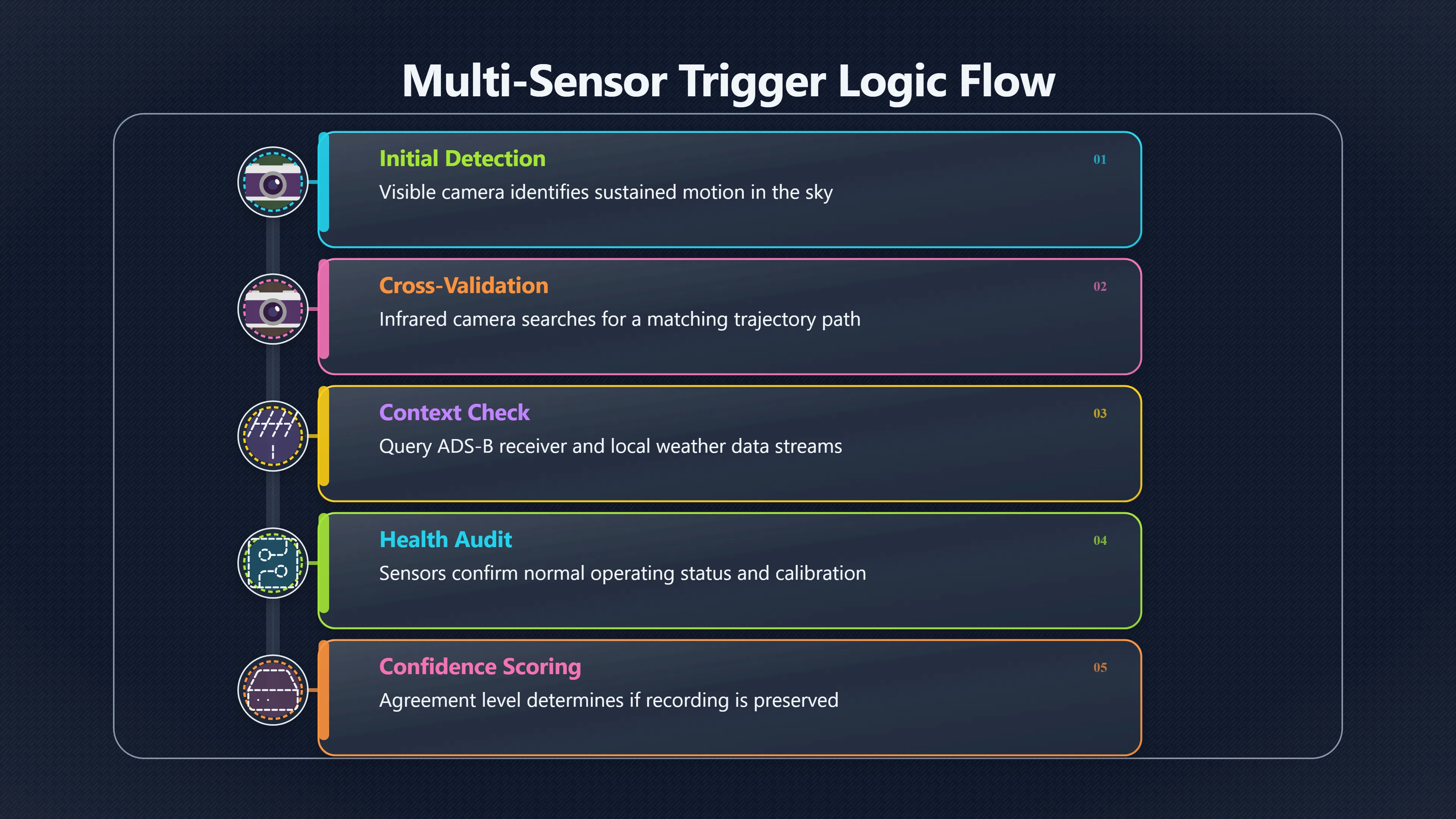
A representative policy could work as follows:
- Initial detection: Visible camera identifies sustained motion.
- Cross-check: Infrared camera searches for a matching trajectory.
- Context check: ADS-B receiver, satellite predictions and local weather are queried.
- Instrument health check: Sensors confirm normal operating status.
- Confidence scoring: Agreement between independent measurements determines whether recording is extended, compressed or discarded.
Rather than a simple yes-or-no trigger, each observation receives a confidence level. Low-confidence events may retain only a few seconds of compressed video, while higher-confidence events preserve raw imagery, infrared frames and all associated sensor streams.
This layered approach keeps ordinary events available for later auditing without allowing them to dominate storage capacity.
Existing systems point towards multi-sensor triggering
Commercial and research-oriented UAP instrumentation has increasingly moved towards integrated trigger architectures rather than standalone cameras.
UFODAP’s Optical Tracking Data Acquisition Unit (OTDAU) generates triggers when qualified tracking events begin, while its Multi-Sensor Data Acquisition Unit (MSDAU) can also trigger from non-optical sensors, including configurable radio-frequency measurements. The accompanying documentation explicitly describes comparing signals across multiple sensors during trigger periods rather than relying on a single observation.[Handprint+2UFODAP]handprint.comPreliminary addition to the UFODAP User Guide With…December 5, 2024 — In the case of the OTDAU, a trigger occurs when a quali…
Similarly, the Galileo Project’s observatory architecture combines multiple calibrated sensing modalities with edge computing so that local systems can evaluate events before forwarding them for more extensive analysis. Recent technical papers describe calibration methods using ADS-B aircraft data and emphasise integrated, multimodal observations rather than isolated camera footage.[arXiv+2arXiv]arxiv.org1 Introduction30 May 2025 — A system designed for the comprehensive scientific study of aerial phenomena which integrates multiple s…
Governance principles for trigger rules
Trigger rules are not merely engineering settings; they are governance decisions that determine which observations become part of the scientific record.
A robust policy should therefore ensure that:
- trigger criteria are documented rather than hidden inside proprietary software;
- calibration procedures are repeatable and version-controlled;
- threshold changes are logged for later auditing;
- rejected events retain enough metadata to explain why they were discarded;
- confidence scores can be reproduced from archived sensor data.
Transparent trigger governance reduces confirmation bias. It prevents operators from manually promoting only dramatic-looking videos while discarding ordinary events that are equally important for understanding detector performance.
The objective is not to maximise the number of unidentified clips. It is to maximise the number of well-calibrated, independently corroborated observations that remain scientifically interpretable long after the event has passed.
Amazon book picks
Further Reading
Books and field guides related to When should a sky station hit record?. Use these as the next step if you want deeper reading beyond the article.
Artificial Intelligence
Rating: 4.5/5 from 10 Google Books ratings
Useful background for probabilistic sensor fusion.

eBay marketplace picks
Marketplace Samples
Example marketplace items related to this page. Use the search link to explore similar finds on eBay.
Endnotes
1.
Source: science.nasa.gov
Title: Science Independent Study Team Report
Link:https://science.nasa.gov/wp-content/uploads/2023/09/uap-independent-study-team-final-report.pdf
Source snippet
NASA ScienceIndependent Study Team ReportSeptember 13, 2023 — The study of Unidentified Anomalous Phenomena (UAP) presents a unique scien...
Published: September 13, 2023
2.
Source: nasa.gov
Title: update nasa shares uap independent study report names director
Link:https://www.nasa.gov/news-release/update-nasa-shares-uap-independent-study-report-names-director/
Source snippet
UPDATE: NASA Shares UAP Independent Study Report14 Sept 2023 — We found that NASA can help the whole-of-government UAP effort through...
3.
Source: en.wikisource.org
Title: Responses to Statement of Task
Link:https://en.wikisource.org/wiki/NASA_Unidentified_Anomalous_Phenomena%3A_Independent_Study_Team_Report/Responses_to_Statement_of_Task
Source snippet
Unidentified Anomalous Phenomena: Independent...14 Oct 2023 — Indeed, several apparent UAP have been demonstrated to be sensor artifacts...
4.
Source: handprint.com
Link:https://www.handprint.com/UFO/UFODAP_User_Guide.pdf
Source snippet
Preliminary addition to the UFODAP User Guide With...December 5, 2024 — In the case of the OTDAU, a trigger occurs when a quali...
Published: December 5, 2024
5.
Source: ufodap.com
Link:https://ufodap.com/technology
Source snippet
Dap Camera, Science and TechnologyThe MSDAU contains a high-speed Linux-based computer and a suite of precision sensors and Ethernet conn...
6.
Source: ufodap.myshopify.com
Title: UFODAPMulti-Sensor Data Acquisition Unit (MSDAU)
Link:https://ufodap.myshopify.com/collections/multi-sensor-data-acquisition-unit-msdau
Source snippet
Multi-Sensor Data Acquisition Unit (MSDAU) - ufodapThe Multi-Sensor Data Acquisition Unit (MSDAU) hardware consists of a waterproof enclo...
7.
Source: arxiv.org
Link:https://arxiv.org/html/2506.00125v1
Source snippet
1 Introduction30 May 2025 — A system designed for the comprehensive scientific study of aerial phenomena which integrates multiple s...
Published: May 2025
8.
Source: arxiv.org
Link:https://arxiv.org/abs/2411.07956
Source snippet
Commissioning An All-Sky Infrared Camera Array for...by L Dominé · 2024 · Cited by 11 — Their calibration includes a novel extrinsic cal...
9.
Source: arxiv.org
Title: arXiv A Hardware and Software Platform for Aerial Object Localization
Link:https://arxiv.org/abs/2305.18555
10.
Source: en.wikisource.org
Title: Page:UAP Independent Study Team Final Report
Link:https://en.wikisource.org/wiki/Page%3AUAP_Independent_Study_Team_-_Final_Report.pdf/15
Source snippet
wikisource.orgPage:UAP Independent Study Team - Final Report.pdf/1512 Nov 2023 — Indeed, several apparent UAP have been demonstrated to b...
11.
Source: en.wikisource.org
Title: Page:UAP Independent Study Team Final Report
Link:https://en.wikisource.org/wiki/Page%3AUAP_Independent_Study_Team_-_Final_Report.pdf/31
Source snippet
Status of Existing Data. NASA collects an enormous amount of data using highly-calibrated, validated equipment from a variety of...Read...
12.
Source: science.nasa.gov
Link:https://science.nasa.gov/uap/
Source snippet
nasa.govUAP9 Jun 2022 — The study will focus on identifying available data, how best to collect future data, and how NASA can use that da...
13.
Source: science.nasa.gov
Link:https://science.nasa.gov/mission/galileo/
Source snippet
the entire Galileo mission with this 3D simulation that uses real spacecraft data to recreate the mission's historic flight path. NASA/VT...
14.
Source: arxiv.org
Link:https://arxiv.org/html/2312.00558v4
Source snippet
ntific instrumentation, but its software is not reliable for object tracking and...Read more...
15.
Source: pwkinternational.com
Title: uap unidentified anomaly or demand signal
Link:https://pwkinternational.com/2025/11/11/uap-unidentified-anomaly-or-demand-signal/
Source snippet
UAP | An [Uncertainty]({{ 'uncertainty/' | relative_url }}) Tax & Demand Signal |11 Nov 2025 — Not just better cameras or radars — sensor packages that generate actionable meta...
Additional References
16.
Source: aerpaw.org
Link:https://aerpaw.org/dataset/multi-modal-rf-sensor-and-radar-dataset-for-uav-tracking/
Source snippet
Multi-Modal RF Sensor and Radar Dataset for UAV TrackingThe combined dataset provides ground-truth trajectories, RF sensor position estim...
17.
Source: radacontrols.com
Link:https://www.radacontrols.com/media/0ncns3fz/1143307-w2-d-rada-outlook-piezo-hand-sensor.pdf
Source snippet
PRODUCT MANUALIsolate the power supply to the Sensor Box. BEFORE connecting the sensor wires. Minimum 150 mm. Dripping shower heads may c...
18.
Source: avi-loeb.medium.com
Link:https://avi-loeb.medium.com/commissioning-data-on-half-a-million-objects-in-the-sky-from-the-galileo-project-observatory-are-a23bd084233a
Source snippet
Data on Half a Million Objects in the Sky from...The GP Observatories offer an array of multi-modal, multi-spectral sensors that continu...
19.
Source: drbriankeating.medium.com
Link:https://drbriankeating.medium.com/the-galileo-project-systematically-searching-for-evidence-of-extraterrestrial-technological-cb4535c6f351
Source snippet
Galileo Project: Systematically Searching for Evidence of...The Galileo Project aims to identify the nature of UAP and 'Oumuamua-like in...
20.
Source: st.com
Link:https://www.st.com/resource/en/user_manual/um2133-timeofflight-longdistance-ranging-sensor-with-advanced-multizone-and-multiobject-detection-stmicroelectronics.pdf
Source snippet
UM213316 Oct 2020 — The purpose of this user manual is to describe the possible integration models, and for each of them, the set of func...
21.
Source: knowledge.faro.com
Link:https://knowledge.faro.com/Hardware/Laser_Tracker/Tracker/Remote_Triggering_Device_Control_and_Measurements_with_the_Vantage_Laser_Trackers
Source snippet
Triggering, Device Control and Measurements...18 Oct 2023 — This article guides you through Remote Triggering, Device Control and Measur...
22.
Source: metabunk.org
Title: avi loebs galileo project posts first results to near total silence.13795
Link:https://www.metabunk.org/threads/avi-loebs-galileo-project-posts-first-results-to-near-total-silence.13795/
Source snippet
Avi Loeb's Galileo Project posts first results to near total...1 Dec 2024 — It is clear to the [NASA] panel that establishing a more rob...
23.
Source: youtube.com
Link:https://www.youtube.com/watch?v=bRuNVIVkd1A
Source snippet
REPLAY! NASA UAP MeetingOutlining how to evaluate and study UAP by using data, technology, and the tools of science is a NASA priority. I...
24.
Source: youtube.com
Link:https://www.youtube.com/watch?v=TQcqOW39ksk
Source snippet
Unidentified Anomalous Phenomena Independent Study ReportNASA commissioned an independent study team to examine unidentified anomalous ph...
25.
Source: skepticalinquirer.org
Link:https://skepticalinquirer.org/2021/10/the-galileo-project/
Source snippet
The Galileo ProjectThe Galileo Project is billed as “the systematic scientific search for evidence of extraterrestrial technological arti...
Topic Tree