Within Calibration
What Galileo learned from ordinary planes
The Galileo Project's aircraft dataset shows why ordinary planes are essential for measuring real detector performance, not just excluding false alerts.
On this page
- Why the Galileo system used aircraft as test objects
- What acceptance and detection efficiency measure
- How a baseline changes later anomaly claims
Page outline Jump by section
Introduction
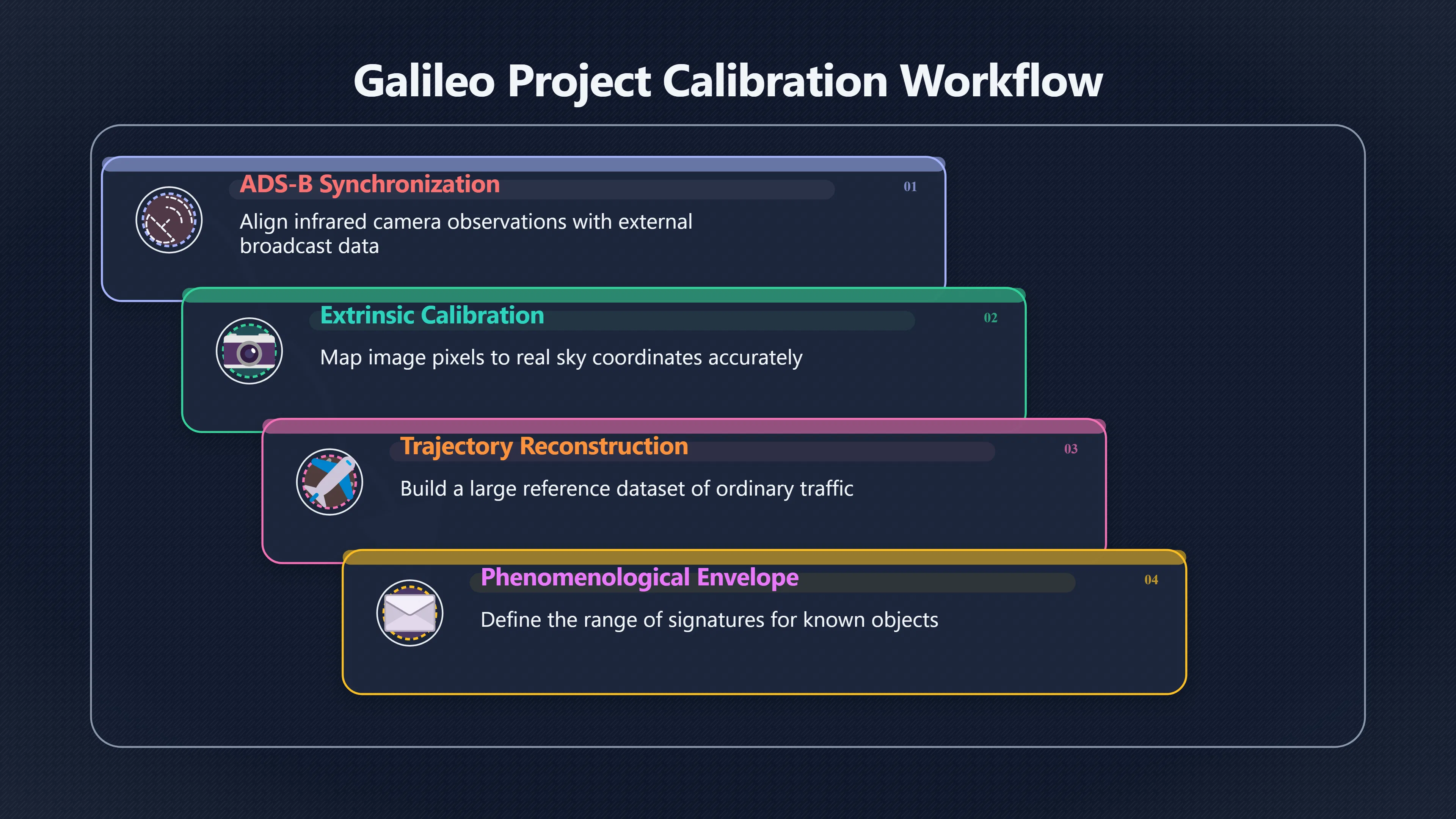
For automated instrumented UFO or UAP detectors, the Galileo Project’s aircraft baseline is important because it transforms ordinary aeroplanes from objects to be filtered out into tools for measuring whether the observatory is working correctly. During the commissioning of its first all-sky infrared observatory, the Galileo team used aircraft with known ADS-B (Automatic Dependent Surveillance–Broadcast) positions to test camera calibration, tracking accuracy and detection performance under real operating conditions. Rather than beginning with claims about anomalies, the project first built a large reference dataset of ordinary aerial traffic. The resulting baseline showed not only what the system could detect, but also where it failed, how weather affected performance and how frequently known aircraft were missed. That information is crucial because any later claim that an object is unusual depends on understanding the detector’s behaviour on normal targets first.[MDPI]mdpi.comCommissioning an All-Sky Infrared Camera Array for…by L Domine · 2025 · Cited by 11 — This paper describes the innovative commissi…
Why the Galileo system used aircraft as test objects
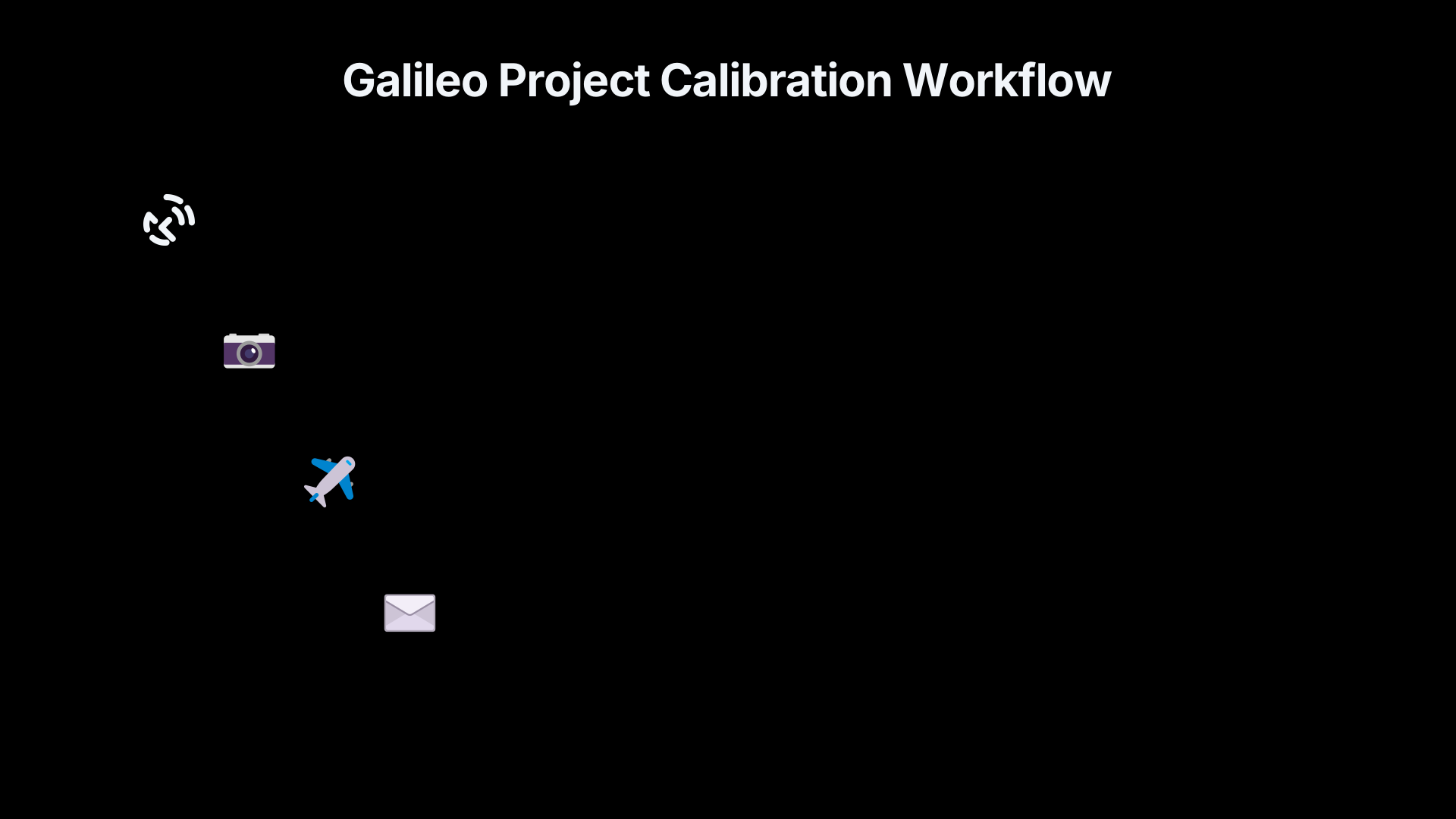
A recurring problem in UAP research is the lack of calibrated, ground-truthed observations. Aircraft provide something rare in sky-surveillance work: an independently measured object whose location, altitude and trajectory are already known through external data. The Galileo Project exploited this advantage by synchronising its infrared camera observations with ADS-B broadcasts received on site. Those broadcasts allowed the team to compare what the cameras should have seen with what they actually recorded.[MDPI+2arXiv]mdpi.comCommissioning an All-Sky Infrared Camera Array for…by L Domine · 2025 · Cited by 11 — This paper describes the innovative commissi…
This approach solved several commissioning challenges simultaneously:
- It enabled extrinsic camera calibration, meaning the alignment between image pixels and real sky coordinates.
- It provided thousands of real moving targets across different ranges, headings and elevations.
- It allowed performance measurements under changing atmospheric conditions.
- It created a statistically meaningful dataset far larger than any collection of alleged anomalous events.[MDPI]mdpi.comCommissioning an All-Sky Infrared Camera Array for…by L Domine · 2025 · Cited by 11 — This paper describes the innovative commissi…
One of the notable technical contributions reported by the project was the development of an infrared calibration method based on ADS-B aircraft. Conventional astronomical calibration often relies on stars, but stars are not easily visible in the long-wave infrared imagery used by the Dalek camera array. Aircraft therefore became the practical calibration reference for orienting and validating the system.[MDPI]mdpi.comCommissioning an All-Sky Infrared Camera Array for…by L Domine · 2025 · Cited by 11 — This paper describes the innovative commissi…
What acceptance and detection efficiency measure
The most revealing aspect of the aircraft baseline is that it produced quantitative measures of system performance rather than subjective judgments.
The Galileo team reported an acceptance rate of approximately 41% for ADS-B-equipped aircraft. In this context, acceptance rate means the fraction of aircraft passing through the effective field of view that were successfully recorded by at least one camera. They also reported a mean frame-by-frame detection efficiency of roughly 36%, meaning that even when aircraft appeared in recorded imagery, the automated detection pipeline identified them in only about a third of relevant frames on average.[Medium+2LinkedIn]avi-loeb.medium.comCommissioning Data on Half a Million Objects in the Sky from…Airplane positions from Automatic Dependent Surveillance–Broadcast…
At first glance these numbers may seem surprisingly low. However, that is precisely why the baseline is valuable. The measurements revealed that performance depends strongly on factors such as:
- Weather and atmospheric transparency.
- Distance to the aircraft.
- Aircraft size.
- Viewing geometry.
- Infrared contrast between the aircraft and background sky.[LinkedIn]linkedin.comSensors MDPI's Postwe find an acceptance rate of 41% for ADS-B-equipped aircraft, and a mean frame-by-frame aircraft detection ef…
Without this baseline, an observer might incorrectly assume that every aircraft in the sky should be detected with near-perfect reliability. The commissioning data demonstrated that real-world surveillance systems have complex performance envelopes. A detector can miss perfectly ordinary objects for understandable physical reasons. Knowing those limits is essential before interpreting any unexplained observation.
What the five-month aerial census revealed
The aircraft baseline was not based on a handful of examples. During approximately five months of commissioning, the observatory reconstructed around half a million aerial-object trajectories. The resulting dataset linked sensor observations to environmental conditions and known aircraft behaviour, creating a detailed map of what the local airspace looked like to the instrument.[MDPI]mdpi.comCommissioning an All-Sky Infrared Camera Array for…by L Domine · 2025 · Cited by 11 — This paper describes the innovative commissi…
This census accomplished something more important than simply identifying aeroplanes. It characterised the normal operating environment of the observatory. Researchers could see how detection rates changed with weather, how tracking algorithms behaved under different conditions and how reconstructed trajectories compared with known aircraft movements.[MDPI]mdpi.comCommissioning an All-Sky Infrared Camera Array for…by L Domine · 2025 · Cited by 11 — This paper describes the innovative commissi…
In practical terms, the project was establishing the detector’s phenomenological envelope: the range of signatures produced by known objects under real observing conditions. That envelope becomes the benchmark against which future candidate anomalies are judged.[World Scientific]worldscientific.comWe are developing a multi-modal…
How a baseline changes later anomaly claims
The most significant lesson from the Galileo aircraft dataset is methodological rather than astronomical. The baseline shifts the burden of proof.
In many historical UFO cases, unusual appearance alone was treated as evidence that something unusual existed. The Galileo approach reverses that logic. Before asking whether an object is anomalous, researchers first ask whether the detector is behaving as expected when observing known targets. A claimed anomaly must therefore be compared against measured detector performance, known failure modes and established distributions of ordinary objects.[MDPI]mdpi.comCommissioning an All-Sky Infrared Camera Array for…by L Domine · 2025 · Cited by 11 — This paper describes the innovative commissi…
The commissioning paper explicitly frames aircraft-derived datasets as a way to establish performance envelopes and support statistical outlier searches. In other words, the project is not merely using aircraft to reject false positives. It is using them to define what “normal” looks like quantitatively so that any future outlier can be evaluated against a calibrated reference population.[MDPI]mdpi.comCommissioning an All-Sky Infrared Camera Array for…by L Domine · 2025 · Cited by 11 — This paper describes the innovative commissi…
This distinction matters. An unexplained object detected by a system with unknown efficiency tells researchers very little. An unexplained object detected by a system whose response to hundreds of thousands of ordinary targets has already been measured is potentially far more informative. The Galileo baseline therefore serves as a credibility framework: any future anomaly claim can be judged against known detection rates, known uncertainties and known observational biases rather than against intuition alone.[MDPI]mdpi.comCommissioning an All-Sky Infrared Camera Array for…by L Domine · 2025 · Cited by 11 — This paper describes the innovative commissi…
The broader lesson for automated UFO detectors
The Galileo Project’s aircraft baseline demonstrates that ordinary aircraft are not merely background clutter. They are calibration standards, performance probes and statistical reference points. By measuring how a detector responds to thousands of known targets, researchers can estimate detection efficiency, identify blind spots and quantify uncertainty before searching for anything genuinely unusual.[MDPI+2arXiv]mdpi.comCommissioning an All-Sky Infrared Camera Array for…by L Domine · 2025 · Cited by 11 — This paper describes the innovative commissi…
For automated instrumented UFO detection systems, this may be the most important result of the commissioning phase. The project showed that the path toward credible anomaly detection begins not with extraordinary events but with a large, carefully measured catalogue of ordinary ones. Aircraft provided the reference population that made such measurement possible, turning calibration from a technical detail into a foundational requirement for any serious search for aerial anomalies.[MDPI+2Medium]mdpi.comCommissioning an All-Sky Infrared Camera Array for…by L Domine · 2025 · Cited by 11 — This paper describes the innovative commissi…
Amazon book picks
Further Reading
Books and field guides related to What Galileo learned from ordinary planes. Use these as the next step if you want deeper reading beyond the article.
Extraterrestrial
Connects directly to Loeb’s scientific case for systematic observation of unusual aerial or interstellar phenomena.
American Cosmic
Explores how technology, belief and scientific communities shape the interpretation of anomalous aerial evidence.
The Demon-Haunted World
Supports the page’s emphasis on baselines, measurement discipline and avoiding premature anomaly claims.

UFOs : Generals, Pilots, and Government Officials Go on the R...
Provides the reporting context for why calibrated, credible observation matters in UAP research.
eBay marketplace picks
Marketplace Samples
Example marketplace items related to this page. Use the search link to explore similar finds on eBay.


Endnotes
1.
Source: mdpi.com
Link:https://www.mdpi.com/1424-8220/25/3/783
Source snippet
Commissioning an All-Sky Infrared Camera Array for...by L Domine · 2025 · Cited by 11 — This paper describes the innovative commissi...
2.
Source: arxiv.org
Link:https://arxiv.org/abs/2411.07956
Source snippet
Commissioning An All-Sky Infrared Camera Array for...by L Dominé · 2024 · Cited by 11 — Their calibration includes a novel extrinsic cal...
3.
Source: arxiv.org
Link:https://arxiv.org/html/2411.07956v1
Source snippet
1 Introduction12 Nov 2024 — One of the key instruments is an all-sky infrared camera array using eight uncooled long-wave infrared FLIR B...
4.
Source: avi-loeb.medium.com
Link:https://avi-loeb.medium.com/commissioning-data-on-half-a-million-objects-in-the-sky-from-the-galileo-project-observatory-are-a23bd084233a
Source snippet
Commissioning Data on Half a Million Objects in the Sky from...Airplane positions from Automatic Dependent Surveillance–Broadcast...
5.
Source: linkedin.com
Link:https://www.linkedin.com/posts/sensors-mdpi_commissioning-an-all-sky-infrared-camera-activity-7467448571252895745-PmR7
Source snippet
Sensors MDPI's Postwe find an acceptance rate of 41% for ADS-B-equipped aircraft, and a mean frame-by-frame aircraft detection ef...
6.
Source: arxiv.org
Link:https://arxiv.org/html/2506.00125v1
Source snippet
1 Introduction30 May 2025 — Objects detected by detection cameras are correlated with ADS-B receiver data using camera extrinsic calibrat...
Published: May 2025
7.
Source: youtube.com
Title: The Galileo Project’s Search for UAP
Link:https://www.youtube.com/watch?v=87POecVP-s4
Source snippet
The Galileo Project...
8.
Source: youtube.com
Title: The Galileo Project
Link:https://www.youtube.com/watch?v=YSxF8SuTBtU
Source snippet
In Search for Technological Interstellar Objects...
9.
Source: worldscientific.com
Link:https://www.worldscientific.com/doi/10.1142/S2251171723400020?srsltid=AfmBOoo_LzB2SZw7ExidU9ae5VQRrfVqvDZBtV4Znhl1BQEE8ABNDCH0
10.
Source: worldscientific.com
Link:https://www.worldscientific.com/doi/full/10.1142/S2251171723400081?srsltid=AfmBOopWBm-IS0bKx4HC3VglOqIYUiuERZ_uyuvu9JakR58_SI3Iusnv
Source snippet
We are developing a multi-modal...
11.
Source: ui.adsabs.harvard.edu
Link:https://ui.adsabs.harvard.edu/abs/arXiv%3A2411.07956
Source snippet
In addition to performing...Read more...
Additional References
12.
Source: researchgate.net
Link:https://www.researchgate.net/publication/388466760_Commissioning_an_All-Sky_Infrared_Camera_Array_for_Detection_of_Airborne_Objects
Source snippet
(PDF) Commissioning an All-Sky Infrared Camera Array for...10 Jan 2025 — Galileo Project is designing, building, and commissioning a mul...
13.
Source: thedebrief.org
Link:https://thedebrief.org/galileo-project-releases-commissioning-data-on-half-a-million-aerial-objects-are-any-of-them-uap/
Source snippet
Galileo Project Releases Commissioning Data on Half a...12 Nov 2024 — The Galileo Project has released the commissioning data from its f...
14.
Source: digitalcameraworld.com
Link:https://www.digitalcameraworld.com/photography/astrophotography/harvard-researchers-are-using-this-strange-looking-camera-to-look-for-extraterrestrial-evidence-in-the-skies
Source snippet
Harvard researchers are using this strange-looking...11 Apr 2025 — The researchers' goal is to scan the sky across infrared, optical, ra...
15.
Source: aireon.com
Title: White Paper Independent Estimation of Aircraft Positions
Link:https://aireon.com/wp-content/uploads/2025/04/Aireon-White-Paper-Independent-Estimation-of-Aircraft-Positions.pdf
Source snippet
Independent estimation of aircraft positions using space-...by G Sirigu · 2025 — Aireon has developed an algorithm able to independently...
16.
Source: reddit.com
Link:https://www.reddit.com/r/UFOs/comments/1gphsg7/link_to_new_galileo_project_article_under_peer/
Source snippet
Sky Infrared Camera Array for Detection Of Airborne Objects'.Read more...
17.
Source: youtube.com
Link:https://www.youtube.com/watch?v=QYl9d8wjjKM
Source snippet
The Galileo Project's First Data on Half a Million Objects with Avi Loeb...
18.
Source: youtube.com
Title: The Galileo Project’s First Data on Half a Million Objects with Avi Loeb
Link:https://www.youtube.com/watch?v=uJtER5ahdPY
Source snippet
The Galileo Project's Search for UAP - with Andy Mead | Merged EP0115...
19.
Source: nvlpubs.nist.gov
Title: jresv45n1p1 A1b
Link:https://nvlpubs.nist.gov/nistpubs/jres/045/jresv45n1p1_A1b.pdf
Source snippet
of precision airplane mapping camerasby FE Washer · Cited by 19 — This instrument was designed and built to make the calibration of preci...
20.
Source: youtube.com
Title: The Galileo Project: In Search for Technological Interstellar Objects
Link:https://www.youtube.com/watch?v=ePxdVE8TCIs
Source snippet
The Galileo Project's Search for UAP - with Andy Mead | Merged EP0115 - YouTube Merged Podcast · 46K views...
21.
Source: semanticscholar.org
Link:https://www.semanticscholar.org/paper/Commissioning-an-All-Sky-Infrared-Camera-Array-for-Domin%C3%A9-Biswas/847f764c0f580f631ac16f5e37b42ba40688301d
Source snippet
[PDF] Commissioning an All-Sky Infrared Camera Array for...The Galileo Project's acoustic monitoring, omni-directional system (AMOS) aid...
Topic Tree