Within Starlink
The Geometry Behind a Starlink Flash
A detector needs Sun-satellite-observer geometry, not just a satellite track, to judge whether a bright flash was expected.
On this page
- Diffuse reflection versus mirror like glint
- Why brightness changes with angle
- What a detector should log
Page outline Jump by section
Introduction
For an automated instrumented UFO detector, identifying a satellite is only half the task. The more important question is whether the Sun–satellite–observer geometry predicts that the satellite should have been bright at the exact time and location of the observation. A Starlink spacecraft that is almost invisible one second can become dazzling the next if sunlight is reflected towards the observer at the correct angle. Conversely, a satellite passing directly through a camera’s field of view may remain too faint to detect if the geometry is unfavourable. A robust anomaly pipeline should therefore treat brightness as a geometric prediction rather than a surprise, reducing false positives caused by expected optical reflections.[AARO+2arXiv]aaro.milAARO Satellite Flaring Paper 508 FINAL 04222025Correlations of Starlink Satellite Flaring with UAP…by A An · 2024 — This paper discusses specular and diffuse reflection of sunli…

The Geometry Behind a Starlink Flash
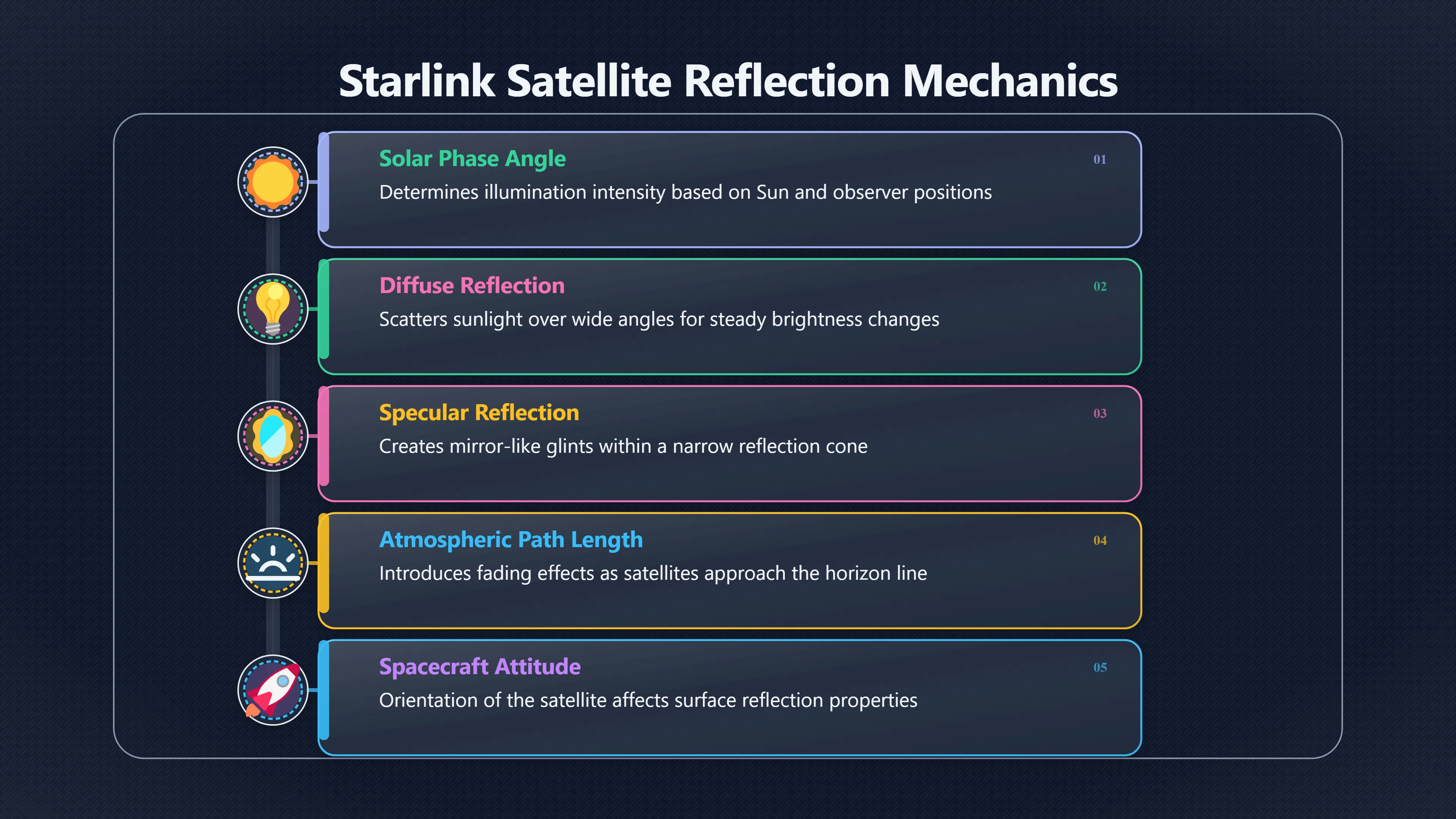
Satellite flares are not random bursts of light. They arise from predictable relationships between three positions:
- the Sun,
- the satellite, and
- the observer.
If these positions align so that reflected sunlight reaches the observer, the spacecraft brightens. If they do not, the same satellite may be barely detectable or completely invisible. This means that a detector relying only on orbital tracks is incomplete. It must also evaluate whether the reflection geometry makes a bright appearance physically expected.[AARO]aaro.milAARO Satellite Flaring Paper 508 FINAL 04222025Correlations of Starlink Satellite Flaring with UAP…by A An · 2024 — This paper discusses specular and diffuse reflection of sunli…
Modern Starlink satellites complicate this because they contain several reflective surfaces with different optical behaviour. Their apparent brightness depends not only on orbital position but also on spacecraft attitude, surface properties and the changing illumination geometry throughout twilight and darkness. Millions of photometric measurements have shown that these geometric effects dominate observed brightness variations.[arXiv]arxiv.orgar Xiv11 IntroductionThis work presents a photometric model of the Starlink satellites based on the Bidirectional Reflectance Distribution…
Diffuse reflection versus mirror-like glint
A detector should distinguish between two fundamentally different reflection mechanisms.
Diffuse reflection scatters sunlight over a wide range of directions. The satellite remains visible across a relatively broad viewing region, with brightness changing gradually as geometry evolves. This produces the familiar appearance of a steadily moving satellite whose brightness slowly rises and falls.[AARO]aaro.milAARO Satellite Flaring Paper 508 FINAL 04222025Correlations of Starlink Satellite Flaring with UAP…by A An · 2024 — This paper discusses specular and diffuse reflection of sunli…
Specular reflection, often called a glint or flare, behaves much more like a mirror. Only observers located within a narrow reflection cone receive the concentrated beam of sunlight. When that cone sweeps across a camera or observer, brightness can increase dramatically for only a few seconds before fading just as quickly.[AARO+2arXiv]aaro.milAARO Satellite Flaring Paper 508 FINAL 04222025Correlations of Starlink Satellite Flaring with UAP…by A An · 2024 — This paper discusses specular and diffuse reflection of sunli…
For automated anomaly detection this distinction is important because a sudden flash is not necessarily evidence of unusual motion. It is often evidence that the observer briefly intersected the specular reflection geometry.

Why Brightness Changes with Angle
Brightness is controlled by geometry far more than by the satellite’s intrinsic appearance.
One important quantity is the solar phase angle—the angle between the Sun, the satellite and the observer. Lower phase angles generally correspond to stronger illumination of surfaces visible from the observer’s position, while larger phase angles tend to produce fainter observations. Long-term measurements of Starlink satellites consistently show brightness varying with this angle rather than remaining constant throughout an orbit.[OUP Academic]academic.oup.comOUP AcademicBrightness evolution of LEO Starlink mega-constellation…by P Longa-Peña · 2026 — The solar phase angle α (Sun–satellite–ob…
For specular flares, an even stricter condition applies. The observer must lie extremely close to the mirror-reflection direction from the reflecting surface. Small angular differences can change the apparent brightness by several magnitudes, explaining why one aircraft crew or ground station may report an intense flash while another observer only a short distance away sees nothing unusual.[arXiv]arxiv.orgExtreme Flaring of Starlink Satellitesby A Mallama · 2024 · Cited by 1 — Abstract. Starlink satellites can become extremely bright w…
Distance also matters. Two identical satellites under identical illumination will appear different if one is significantly farther away. Elevation above the horizon changes both the propagation distance and the atmospheric path length, introducing additional fading near the horizon. These effects combine with reflection geometry rather than replacing it.[arXiv]arxiv.orgOpen source on arxiv.org.
The result is that satellite brightness cannot be inferred reliably from orbital position alone. Any detector attempting to classify unexpected luminous events should predict expected brightness before assigning an observation to an anomaly category.
What a Detector Should Log
An automated UFO detection system benefits from treating flare prediction as a separate validation stage after orbit matching.
Useful information to record includes:
- satellite identity and propagated orbit at the observation time;
- observer position and altitude;
- solar position, including whether the satellite remains sunlit while the observer is in darkness;
- Sun–satellite–observer phase angle;[academic.oup.com]academic.oup.comOUP AcademicBrightness evolution of LEO Starlink mega-constellation…by P Longa-Peña · 2026 — The solar phase angle α (Sun–satellite–ob…
- expected illumination state and predicted brightness range;
- estimated likelihood of diffuse reflection versus specular glint;
- observed light curve, including rise time, peak brightness and fade rate;
- angular track and apparent motion relative to the predicted satellite path.
These parameters allow later investigators to distinguish between an unexplained luminous event and a geometrically expected satellite flare even when the brightness itself appears extraordinary.[AARO+2arXiv]aaro.milAARO Satellite Flaring Paper 508 FINAL 04222025Correlations of Starlink Satellite Flaring with UAP…by A An · 2024 — This paper discusses specular and diffuse reflection of sunli…
Why Geometry Should Come Before an Anomaly Label
Several widely discussed pilot reports illustrate why geometric validation is essential. Detailed reconstructions have shown that unusually bright Starlink flares can match observations initially reported as unidentified aerial phenomena. In these analyses, researchers combined satellite ephemerides with reflection geometry and empirical brightness models, concluding that the observed flashes were consistent with specular reflections from Starlink spacecraft rather than unexplained objects.[arXiv]arxiv.orgExtreme Flaring of Starlink Satellitesby A Mallama · 2024 · Cited by 1 — Abstract. Starlink satellites can become extremely bright w…
The lesson for automated systems is straightforward. A detector should not ask only, “Was a satellite present?” It should also ask, “Should that satellite have been capable of producing a flash of this brightness from this exact viewing geometry?” If the answer is yes, the event belongs in the category of expected optical behaviour rather than unexplained activity.
As satellite constellations continue to expand, incorporating geometric flare prediction into automated pipelines becomes increasingly important. Systems that combine orbital propagation with illumination modelling are substantially less likely to classify ordinary satellite reflections as anomalous, allowing genuinely unusual observations to receive greater analytical attention.[AARO+2OUP Academic]aaro.milAARO Satellite Flaring Paper 508 FINAL 04222025Correlations of Starlink Satellite Flaring with UAP…by A An · 2024 — This paper discusses specular and diffuse reflection of sunli…
Amazon book picks
Further Reading
Books and field guides related to The Geometry Behind a Starlink Flash. Use these as the next step if you want deeper reading beyond the article.

The handbook of astronomical image processing
Relevant to measuring brightness accurately.
eBay marketplace picks
Marketplace Samples
Example marketplace items related to this page. Use the search link to explore similar finds on eBay.


Endnotes
1.
Source: aaro.mil
Title: AARO Satellite Flaring Paper 508 FINAL 04222025
Link:https://www.aaro.mil/Portals/136/PDFs/Information%20Papers/AARO_Satellite_Flaring_Paper_508_FINAL_04222025.pdf
Source snippet
Correlations of Starlink Satellite Flaring with UAP...by A An · 2024 — This paper discusses specular and diffuse reflection of sunli...
2.
Source: arxiv.org
Link:https://arxiv.org/abs/2003.07805
3.
Source: arxiv.org
Title: ar Xiv1
Link:https://arxiv.org/html/2403.05831v1
Source snippet
1 IntroductionThis work presents a photometric model of the Starlink satellites based on the Bidirectional Reflectance Distribution...
4.
Source: academic.oup.com
Link:https://academic.oup.com/mnras/article/548/2/stag552/8540255
Source snippet
OUP AcademicBrightness evolution of LEO Starlink mega-constellation...by P Longa-Peña · 2026 — The solar phase angle α (Sun–satellite–ob...
5.
Source: starlink.com
Link:https://starlink.com/public-files/BrightnessMitigationBestPracticesSatelliteOperators.pdf?srsltid=AfmBOoq45eD_U2_dp4gtFL-oR4TxZ6maJrpQk2Skh2K8FnP9NELsdWaM
Source snippet
Specular light is reflected at a single angle like a mirror. In contrast, diffuse...Read more...
6.
Source: arxiv.org
Link:https://arxiv.org/pdf/2405.13091
Source snippet
Extreme Flaring of Starlink Satellitesby A Mallama · 2024 · Cited by 1 — Abstract. Starlink satellites can become extremely bright w...
7.
Source: arxiv.org
Title: arXiv Starlink Mini Satellite Brightness Distributions Across the Sky
Link:https://arxiv.org/abs/2401.01546
8.
Source: arxiv.org
Title: arXiv Simulated impact on LSST data of Starlink V1.5 and V2 satellites
Link:https://arxiv.org/abs/2506.19092
9.
Source: aaro.mil
Title: Satellite Flaring Paper
Link:https://www.aaro.mil/Portals/136/PDFs/Information%20Papers/AARO_Satellite_Flaring_Paper.pdf
Source snippet
Correlations of Starlink Satellite Flaring with UAP...by A An · 2024 — This paper discusses specular and diffuse reflection of sunlight...
10.
Source: Wikipedia
Title: Satellite flare
Link:https://en.wikipedia.org/wiki/Satellite_flare
Source snippet
Satellite flareSatellite flare, also known as satellite glint, is a brief and bright "flare" in [visibility]({{ 'visibility/' | relative_url }}) of an satellite. It is caus...
Additional References
11.
Source: science.nasa.gov
Link:https://science.nasa.gov/earth/earth-observatory/the-science-of-sunglint-84333/
Source snippet
NASA ScienceThe Science of SunglintThat gleam is caused by sunglint, an optical phenomenon that occurs when sunlight reflects off the sur...
12.
Source: catchingtime.com
Link:https://catchingtime.com/starlink-satellite-swarm-from-37n-latitude/
Source snippet
4/10/24: Starlink Satellite Swarm from 37°N latitudeFlares of this type are essentially direct specular reflections of the sun (which lie...
13.
Source: thedebrief.org
Link:https://thedebrief.org/spacex-starlink-extreme-flaring-increases-reported-uap-sightings-and-poses-aviation-risks-new-research-finds/
Source snippet
SpaceX Starlink "Extreme Flaring" Increases Reported...28 May 2024 — New research shows SpaceX's Starlink satellites can cause extreme f...
Published: May 2024
14.
Source: satobs.org
Link:https://www.satobs.org/iridium.html
Source snippet
Iridium FlaresWith only a normal brightness of magnitude (binoculars are useful to spot it), occasionally some of the Iridium satellites...
15.
Source: universetoday.com
Title: starlinks can produce surprisingly bright flares to pilots
Link:https://www.universetoday.com/articles/starlinks-can-produce-surprisingly-bright-flares-to-pilots
Source snippet
27 May 2024 — For the study, the researchers conducted a geometrical analysis of the brightness of Starlink satellites based on the Sun's...
Published: May 2024
16.
Source: reddit.com
Title: Correlations of Starlink1 Satellite Flaring with UAP
Link:https://www.reddit.com/r/UFOs/comments/1i91pz4/aaro_publishes_information_paper_correlations_of/
Source snippet
Paper: Correlations of Starlink1 Satellite Flaring... This paper discusses specular and diffuse reflection of sunlight from man-made sat...
17.
Source: facebook.com
Link:https://www.facebook.com/groups/2365809903441367/posts/5791923450829978/
Source snippet
light being reflected from the base of the Starlink spacecraft...Read more...
18.
Source: newspaceeconomy.ca
Title: Are We Chasing Aliens or Just Starlink?
Link:https://newspaceeconomy.ca/2025/02/06/are-we-chasing-aliens-or-just-starlink-the-role-of-satellite-flares-in-uap-reports/
Source snippet
The Role of Satellite...6 Feb 2025 — The AARO report provides a detailed analysis of how Starlink flares occur, when they are most visib...
19.
Source: spaceref.com
Link:https://spaceref.com/science-and-exploration/spacex-publishes-update-on-starlink-satellite-brightness-issue/
Source snippet
SpaceX Publishes Update on Starlink Satellite Brightness...29 Apr 2020 — There are two types of reflections off of Starlink satellites...
20.
Source: aerospace.org
Title: Riesbeck SatLightPollution 03122020
Link:https://aerospace.org/sites/default/files/2020-03/Riesbeck_SatLightPollution_03122020.pdf
Source snippet
luc h. riesbeck12 Mar 2020 — To model the effects of satellite reflection of sunlight, we used the mathematical description of the optica...
Topic Tree