Within Timing
Do the Video and Logs Tell One Story?
Shared timestamps let analysts test whether a video track lines up with aircraft messages, weather readings and other recorded signals.
On this page
- Why matching event windows matters
- How aircraft and environment logs support or reject a sighting
- Common mismatches caused by delay and buffering
Page outline Jump by section
Introduction
For an automated instrumented UFO or UAP detector, a video clip becomes far more valuable when it can be matched against independent records collected at the same time. The central question is simple: do the camera frames, aircraft broadcasts, weather measurements and other sensor logs describe the same event, or are they unrelated observations that only appear similar? Reliable timestamp alignment allows investigators to test that question instead of relying on visual impressions alone.
 This matching process is not about proving that an object is unusual. Instead, it is an evidence test. If an apparent unknown object occupies the same position and time as an aircraft broadcasting ADS-B (Automatic Dependent Surveillance–Broadcast) messages, the identification becomes much stronger. If the timing does not fit, or if independent environmental sensors contradict the visual record, the confidence in any interpretation changes accordingly. NASA’s independent UAP study highlighted the importance of complete metadata—including accurate time, location and observing conditions—for precisely this reason.[NASA Technical Reports Server]ntrs.nasa.govTechnical Reports Server JOHN FKENNEDY SPACE CENTER4 Jul 1973 — CAMERA EXPERIMENTAL RIBBON FRAME. CZR. 1 HIGH SPEED METRIC CAMERA. D… 5 TRACKING CAMERA. 6 THERMAL CO…
Why matching event windows matters
Synchronising recordings means comparing every source against a common timeline rather than treating each log independently. A typical automated station may record:
- Video frames with embedded timestamps.
- ADS-B aircraft position reports.
- Environmental measurements such as wind, temperature or cloud cover.
- Radio-frequency detections.
- Acoustic recordings.
- Pan-tilt camera position logs.
Individually, each dataset contains only part of the story. Combined, they can answer questions that no single sensor can.
For example, suppose a bright light appears in a camera image for eight seconds. If ADS-B data show an aircraft passing through the same azimuth and elevation during those eight seconds, and the apparent angular motion agrees with the reported aircraft track, the combined evidence strongly supports an aircraft identification. Conversely, if no aircraft was nearby, weather sensors recorded clear skies, and another synchronised camera at a different location observed the same object from a compatible direction, the event deserves closer analysis rather than immediate dismissal.
The comparison is only meaningful if every dataset refers to the same moment within known timing uncertainty.
How aircraft logs support or reject a sighting
ADS-B broadcasts provide one of the most useful external reference datasets because they contain regularly transmitted aircraft position, altitude, velocity and identification information derived from onboard navigation systems. Under normal operation, position broadcasts occur several times per second, although different message types have different transmission rates and decoding characteristics.[ResearchGate]researchgate.netResearchGate(PDF) ADS-B vulnerabilities and a security solution with…November 1, 2017 — We developed a practical method that can rejec…
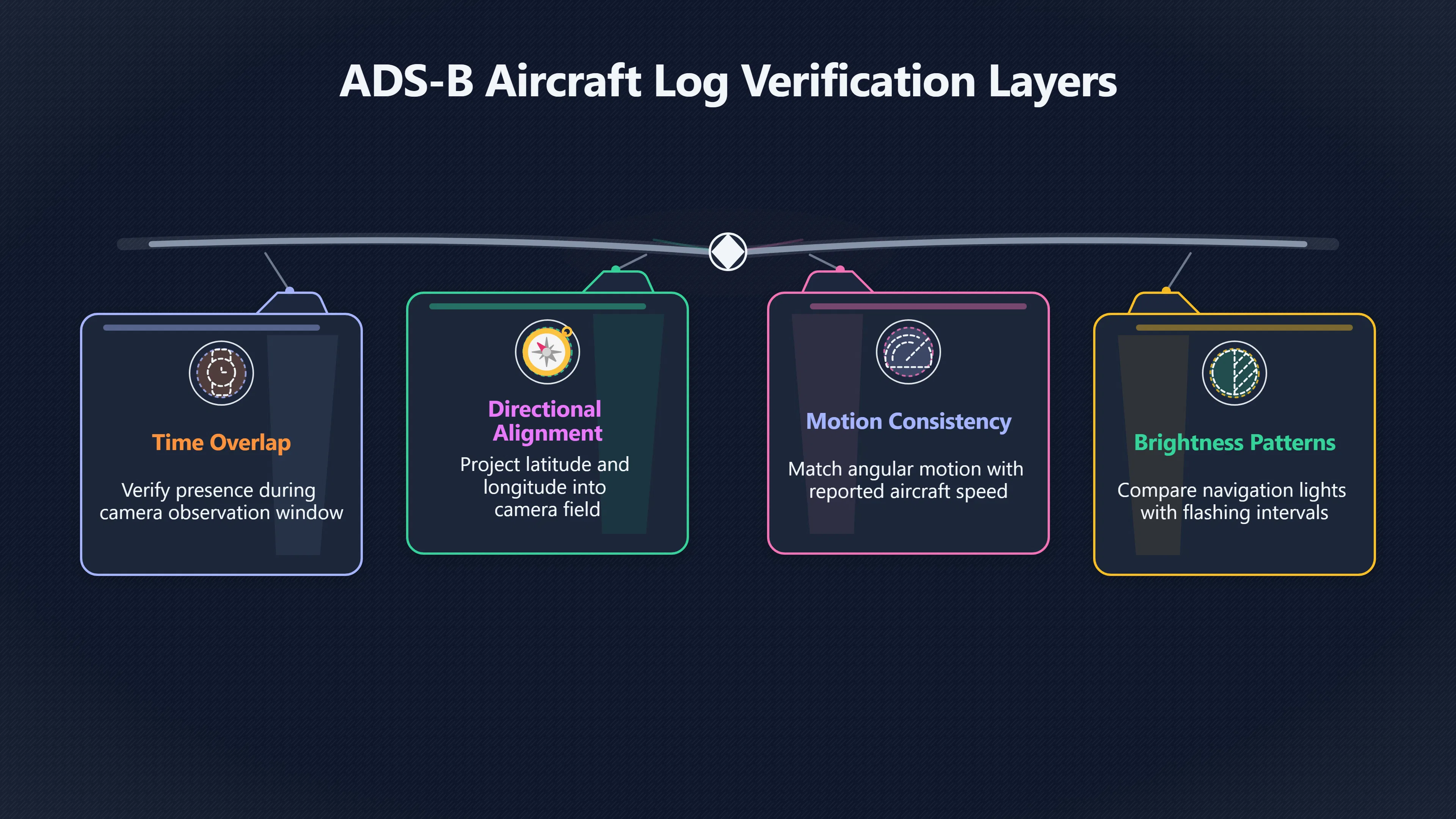
When matching video against ADS-B records, analysts typically compare several independent characteristics rather than a single timestamp.
Time overlap
The aircraft should be present during the camera observation after accounting for known timing uncertainty and transmission latency.
Direction
The reported latitude, longitude and altitude can be projected into the camera’s field of view using the calibrated camera position and orientation. If the calculated azimuth and elevation disagree substantially with the recorded object, the aircraft explanation weakens.
Motion
The apparent movement across successive video frames should be compatible with the aircraft’s reported speed and trajectory. A distant airliner generally moves smoothly across the field of view, whereas a nearby bird or insect often produces rapid angular motion inconsistent with ADS-B data.
Brightness behaviour
Aircraft navigation lights, anti-collision strobes and landing lights produce recognisable temporal patterns. Frame-by-frame brightness measurements can sometimes be compared with expected flashing intervals, particularly when high-frame-rate video is available.
Using several independent comparisons reduces the chance of accepting an incorrect match simply because two events happened at approximately the same time.
Environmental logs provide independent context
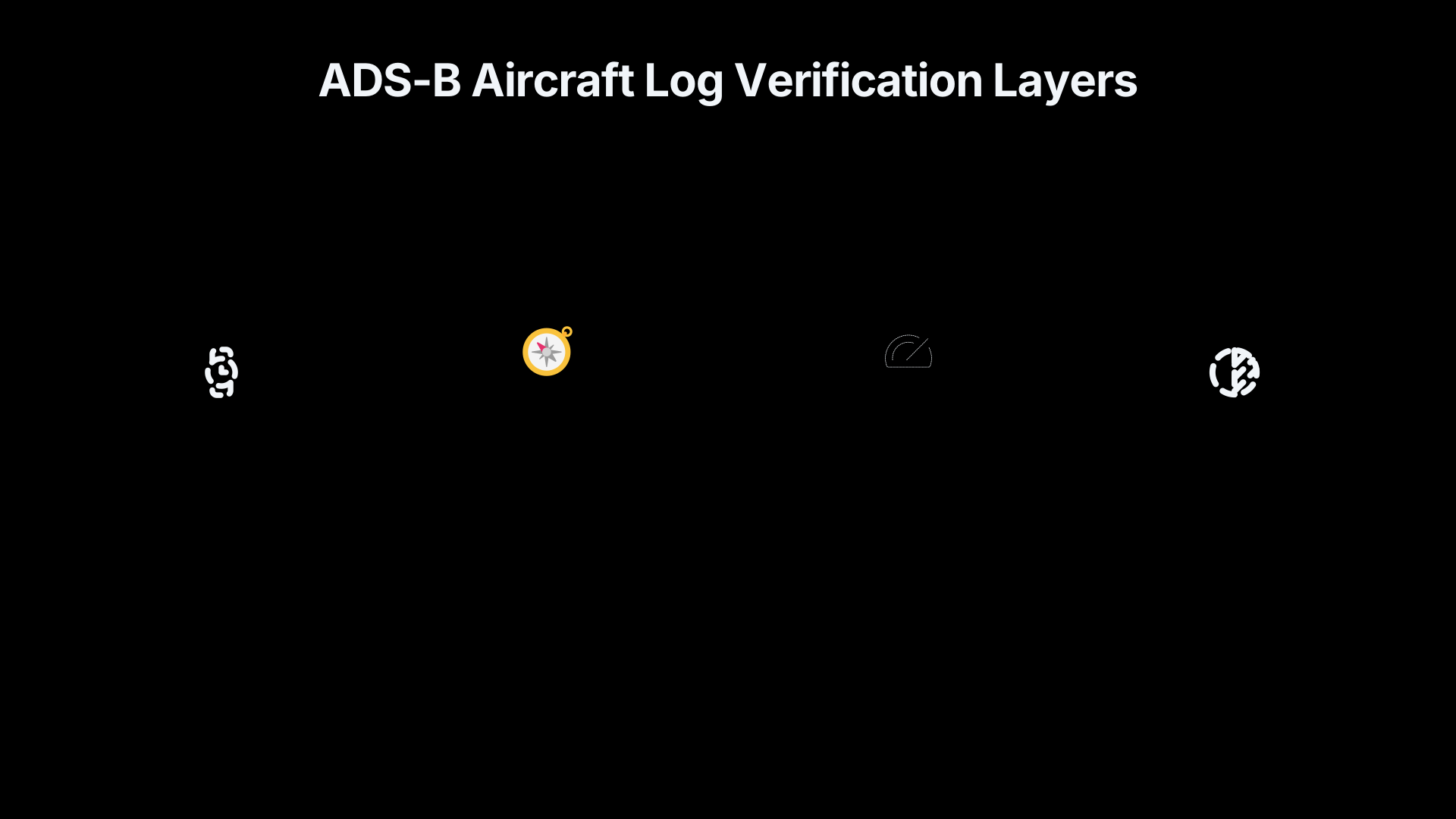
Aircraft records are only one part of the evidence chain. Environmental sensors often explain observations that initially appear anomalous.
Examples include:
- Wind measurements helping distinguish drifting balloons from powered flight.
- Cloud observations explaining intermittent disappearance of a light.
- Temperature and humidity measurements identifying conditions favourable for atmospheric optical effects.
- Lightning detection networks confirming distant electrical activity.
- Astronomical calculations identifying planets, bright stars or satellites occupying the same direction.
The value of these datasets lies in their independence. A camera cannot verify its own interpretation, but unrelated sensors can either reinforce or contradict it.
For instance, a camera may record a stationary bright object while weather sensors indicate heavy upper-level cloud movement. If astronomical software predicts a bright planet behind thin cloud at exactly that position and time, multiple datasets converge on an ordinary explanation.
Common mismatches caused by delay and buffering
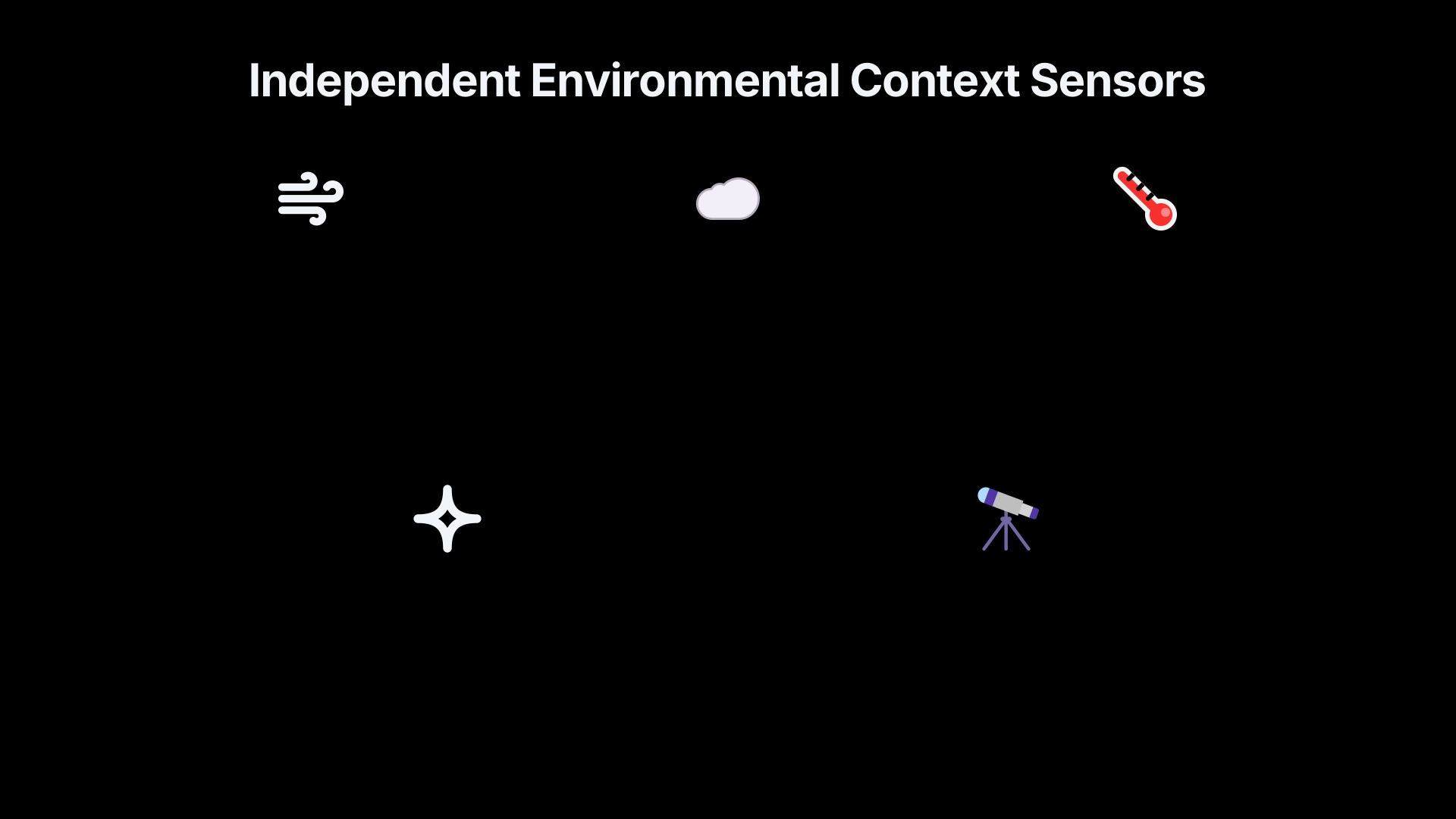
Perfect timestamps are uncommon in practical systems. Many apparent disagreements arise from technical delays rather than genuine contradictions.
Camera buffering
Many digital cameras buffer images before writing them to storage or transmitting them over a network. The timestamp attached to a saved frame may represent recording time, encoding time or file creation time rather than the exact exposure instant.
Compression pipelines can introduce additional latency that varies between frames, especially in network video systems.
ADS-B transmission and decoding latency
An ADS-B report is not an instantaneous measurement of an aircraft’s current position. Position information is measured onboard, encoded, transmitted, received, decoded and finally stored by a ground receiver. Studies of operational ADS-B systems have measured uncompensated latencies generally within the performance limits specified by aviation standards, but these delays are still significant when comparing rapidly moving objects frame by frame.[arXiv]arxiv.orgarXiv A study of uncompensated latency in ADS-B reportsarXiv A study of uncompensated latency in ADS-B reports
Network delays
If sensor computers synchronise over standard computer networks, packet delays and operating-system scheduling can introduce variable offsets between devices. Even when average clock accuracy is good, occasional network congestion may shift individual timestamps.
Logging intervals
Not every sensor samples continuously.
Examples include:
- Weather stations updating every few seconds.
- Environmental sensors recording once per minute.
- Aircraft broadcasts arriving irregularly because of radio reception.
- Cameras operating at different frame rates.
Interpolation is often necessary, but interpolation should never be mistaken for direct observation.
Matching is stronger than coincidence
A common analytical mistake is assuming that a nearby aircraft in ADS-B data automatically explains a visual observation. Good evidence matching requires agreement across multiple dimensions simultaneously.
A convincing correspondence typically includes:
- Compatible timestamps.
- Consistent viewing direction.
- Matching apparent motion.
- Plausible brightness behaviour.
- Reasonable positional uncertainty.
- No contradictory evidence from other sensors.
Likewise, the absence of a matching ADS-B track does not automatically imply an unidentified object. General aviation without ADS-B coverage, military aircraft, reception gaps, incomplete receiver networks, decoding failures or non-aircraft objects may all account for missing records. Receiver placement and network coverage materially affect what aircraft can be observed, and redundant receiver networks improve verification reliability.[arXiv]arxiv.orgarXiv Towards Security-Optimized Placement of ADS-B SensorsTowards Security-Optimized Placement of ADS-B SensorsApril 5, 2022…
Building a defensible evidence chain
For automated instrumented UFO detectors, the objective is not to accumulate dramatic videos but to produce observations that withstand independent scrutiny. Every successful frame-to-log match strengthens the chain of evidence by replacing subjective interpretation with measurable agreement.
The most reliable event records therefore preserve not only the original images but also the exact frame timestamps, camera calibration, ADS-B logs, environmental measurements and documented timing uncertainties. When these datasets tell the same story, analysts can confidently identify many ordinary objects. When they do not, investigators can focus attention on explaining the remaining discrepancies using evidence rather than appearance alone.
Amazon book picks
Further Reading
Books and field guides related to Do the Video and Logs Tell One Story?. Use these as the next step if you want deeper reading beyond the article.


Understanding GPS/GNSS
Explains accurate positioning and timing for correlated datasets.
Making Sense of Sensors
Explains integrating and interpreting multiple sensor measurements.
eBay marketplace picks
Marketplace Samples
Live-tested eBay searches with available results related to this page.




Endnotes
1.
Source: ntrs.nasa.gov
Title: Technical Reports Server JOHN F
Link:https://ntrs.nasa.gov/api/citations/19730024175/downloads/19730024175.pdf?attachment=true
Source snippet
KENNEDY SPACE CENTER4 Jul 1973 — CAMERA EXPERIMENTAL RIBBON FRAME. CZR. 1 HIGH SPEED METRIC CAMERA. D... 5 TRACKING CAMERA. 6 THERMAL CO...
2.
Source: researchgate.net
Link:https://www.researchgate.net/publication/321736587_ADS-B_vulnerabilities_and_a_security_solution_with_a_timestamp
Source snippet
ResearchGate(PDF) ADS-B vulnerabilities and a security solution with...November 1, 2017 — We developed a practical method that can rejec...
Published: November 1, 2017
3.
Source: arxiv.org
Title: arXiv A study of uncompensated latency in ADS-B reports
Link:https://arxiv.org/abs/2008.06352
4.
Source: arxiv.org
Title: arXiv Towards Security-Optimized Placement of ADS-B Sensors
Link:https://arxiv.org/abs/2204.01994
Source snippet
Towards Security-Optimized Placement of ADS-B SensorsApril 5, 2022...
Published: April 5, 2022
Additional References
5.
Source: elib.dlr.de
Title: Air Traffic Management Abbreviation Compendium V1.00
Link:https://elib.dlr.de/140788/1/Air%20Traffic%20Management%20Abbreviation%20Compendium%20V1.00.pdf
Source snippet
Traffic Management Abbreviation Compendiumby N Rieck · 2021 — As in all fields of work, an unmanageable number of abbreviations are used...
6.
Source: analytics.usa.gov
Title: all pages realtime.csv
Link:https://analytics.usa.gov/data/live/all-pages-realtime.csv
Source snippet
More... NASA Science 118,GSA eBuy! 116,"Case Search | National Labor Relations Board... Exchange To Regulate the Heterogeneous Ice Nucle...
7.
Source: archive.org
Title: NASA NTRS Archive 19720026320 djvu.txt
Link:https://archive.org/stream/NASA_NTRS_Archive_19720026320/NASA_NTRS_Archive_19720026320_djvu.txt
Source snippet
A selective list of acronyms and abbreviationsFull text of "NASA Technical Reports Server (NTRS) 19720026320: A selective list of acronym...
8.
Source: worksheets.codalab.org
Title: frequent classes
Link:https://worksheets.codalab.org/rest/bundles/0xd74f36104e7244e8ad99022123e78884/contents/blob/frequent-classes
Source snippet
codalab.org3... time 9686 ui 9634 not 9525 rss 9468 pagination 9449 textwidget 9440 popup 9427 11 9326 hero 9313 disabled 9302 b 9256 tag...
9.
Source: cs.princeton.edu
Title: words 333333.txt
Link:https://www.cs.princeton.edu/courses/archive/spring18/cos226/assignments/autocomplete/testing/words-333333.txt
Source snippet
b 419483948 work 417601616 last 416210411 most 414377632 products 414028837... study 152776595 application 152155277 cart 151553180 staf...
10.
Source: yumpu.com
Title: 1 Abk ¨urzungen
Link:https://www.yumpu.com/en/document/view/4059331/1-abk-urzungen-bscw-shared-workspace-server
Source snippet
BSCW Shared Workspace Server19 Nov 2012 — Transform your PDFs into Flipbooks and boost your revenue! Leverage SEO-optimized Flipbooks, po...
11.
Source: youtube.com
Title: UAPx: Correlating Sensor Logs and Optical Tracking Data
Link:https://www.youtube.com/watch?v=avCDzCxjPEM
Source snippet
Disc-shaped UAP caught on camera by the military in 2020...
12.
Source: youtube.com
Link:https://www.youtube.com/watch?v=lKYWrakDclw
Source snippet
Curios Pilot: UAP Investigation Example - YouTube...
13.
Source: youtube.com
Title: Curious Pilot: Aircraft Mode Tutorial
Link:https://www.youtube.com/watch?v=lb0rm_PCcKw
Source snippet
SkyScan: Tracking Aircraft with PTZ Cameras and ADS-B...
14.
Source: youtube.com
Title: Curios Pilot: UAP Investigation Example
Link:https://www.youtube.com/watch?v=CU1TRVk6yUc
Source snippet
Curious Pilot: Aircraft Mode Tutorial...
Topic Tree