Within Edge Computer
What one UAPx week says about data overload
The UAPx Catalina campaign shows how quickly serious field sensors can collect vast untriggered material around a small amount of triggered video.
On this page
- Triggered versus untriggered capture
- Why background data still matters
- What fixed stations can learn from field expeditions
Page outline Jump by section
Introduction
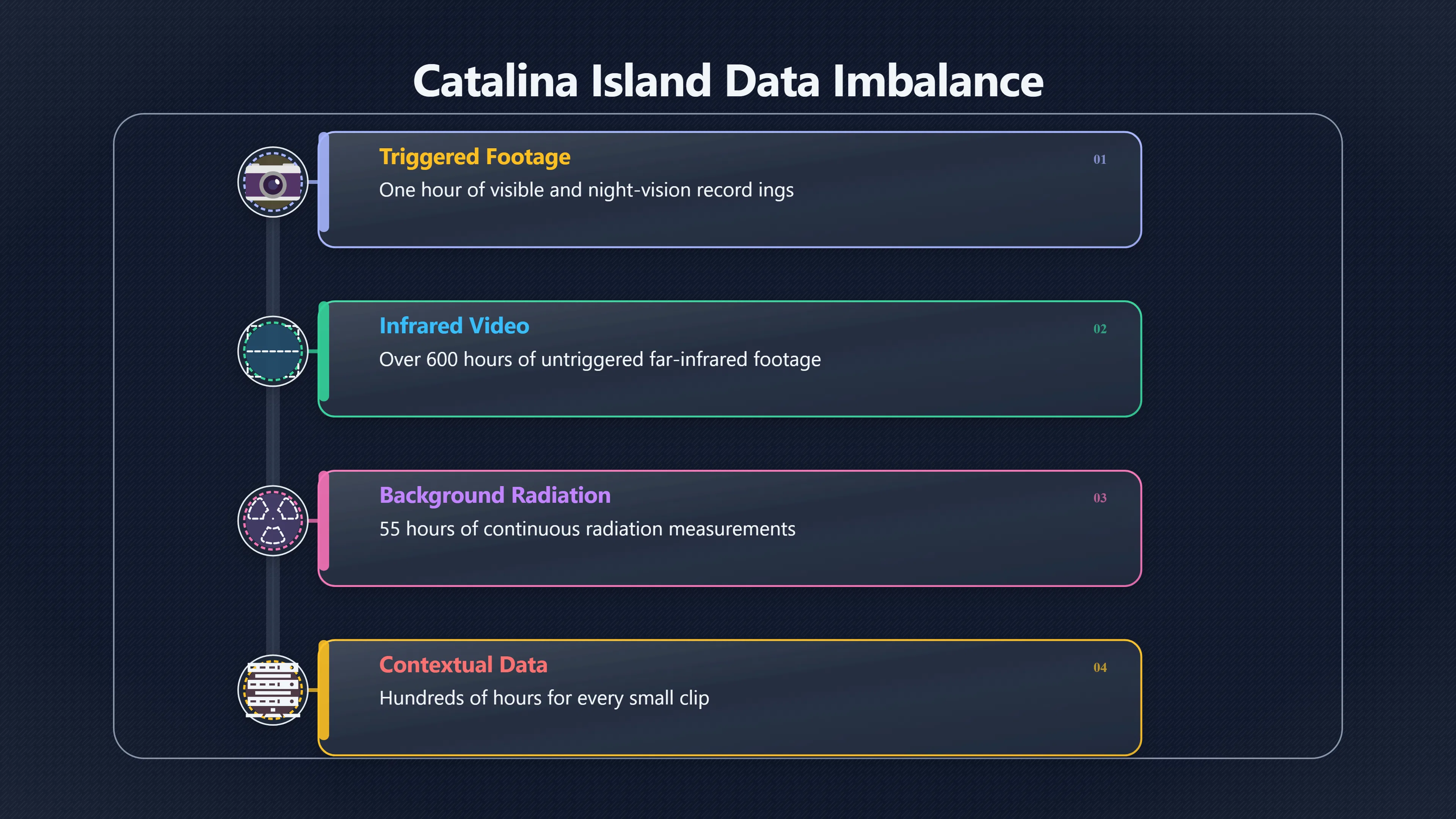
The 2021 UAPx field expedition to Catalina Island provides an unusually clear illustration of a problem that every permanent automated sky station eventually faces: almost all recorded data is uneventful, yet much of it still has scientific value. During roughly one week of observations, the team accumulated approximately one hour of triggered visible and night-vision video, but more than 600 hours of continuously recorded untriggered far-infrared (IR) video, alongside dozens of hours of other background measurements. The striking imbalance demonstrates that storage capacity, data management and intelligent event selection are not secondary engineering concerns—they are central design problems for any automated UAP observatory.[arXiv]arxiv.orgInitial Results From the First Field Expedition of UAPx to Study Unidentified Anomalous PhenomenaDecember 1, 2023…
 Rather than treating the excess footage as wasted effort, the UAPx researchers argued that continuous background recording provides the reference data needed to distinguish genuine anomalies from ordinary environmental activity. The Catalina campaign therefore offers a practical case study in why future fixed sky stations require edge computing, local filtering and carefully designed retention policies instead of attempting to archive everything indefinitely.[arXiv]arxiv.orgInitial Results From the First Field Expedition of UAPx to Study Unidentified Anomalous PhenomenaDecember 1, 2023…
Triggered versus untriggered capture
The Catalina deployment combined multiple optical and non-optical sensors with software intended to identify moving objects and trigger closer inspection. As in many automated surveillance systems, however, successful triggering did not eliminate the need for continuous recording.
The published UAPx results describe three very different categories of collected material:
- Around one hour of triggered visible and night-vision recordings associated with candidate events.
- More than 600 hours of continuously recorded far-infrared video that was not trigger-selected.
- Around 55 hours of background radiation measurements collected regardless of visible events.[arXiv]arxiv.orgInitial Results From the First Field Expedition of UAPx to Study Unidentified Anomalous PhenomenaDecember 1, 2023…
This ratio is revealing. Even when software identifies interesting moments, the overwhelming majority of sensor operating time still consists of normal skies, ordinary aircraft, atmospheric effects and empty frames. A week-long expedition therefore produces hundreds of hours of contextual data for every comparatively small collection of “interesting” clips.
For permanent observatories operating every night of the year, that imbalance scales rapidly. Simply multiplying the Catalina experience across months or a distributed network would create data volumes that become increasingly expensive to transfer, archive and manually review. The lesson is not that continuous recording is undesirable, but that it cannot remain unmanaged.
Why background data still matters
At first glance, untriggered footage appears to be little more than storage overhead. In practice, it performs several scientific functions that triggered clips alone cannot provide.
First, continuous recordings establish the normal operating behaviour of the instruments themselves. Researchers can measure sensor noise, changing thermal backgrounds, weather effects and calibration stability over long periods. Without these baselines it becomes difficult to determine whether an apparent anomaly reflects an external object or simply changing instrument behaviour.[arXiv]arxiv.orgInitial Results From the First Field Expedition of UAPx to Study Unidentified Anomalous PhenomenaDecember 1, 2023…
Second, background recordings allow investigators to revisit events after new information emerges. If another sensor detects something unusual, analysts may examine the corresponding period in archived infrared footage even if no optical trigger occurred at the time.
Third, extensive background datasets help improve automated detection algorithms. By exposing software to enormous numbers of ordinary observations—including aircraft, birds, insects, clouds and atmospheric turbulence—developers can reduce false positives and better characterise what “normal” actually looks like. The Catalina paper discusses applying relatively simple image-processing methods while also reflecting on lessons learned for future campaigns, illustrating that collecting ordinary data is part of improving the next generation of detection systems.[arXiv]arxiv.orgInitial Results From the First Field Expedition of UAPx to Study Unidentified Anomalous PhenomenaDecember 1, 2023…
This perspective also aligns with NASA’s broader recommendations for UAP research, which emphasise calibrated instruments, metadata, baseline observations and higher-quality datasets rather than relying solely on isolated dramatic recordings.[NASA Science]science.nasa.govNASA ScienceUAP9 Jun 2022 — The study will focus on identifying available data, how best to collect future data, and how NASA can use tha…
What fixed stations can learn from field expeditions
The Catalina expedition was temporary, yet it exposed engineering constraints that become far more demanding in permanent observatories.
Storage grows faster than noteworthy events
Most observing time does not produce candidate UAP events. Consequently, storage requirements are determined far more by operating hours than by the number of anomalies eventually investigated. Even a modest increase in camera resolution, frame rate or sensor count can multiply archive sizes while contributing relatively few additional triggered clips.
This changes how observatories should be designed. Storage planning cannot assume that only scientifically interesting events occupy disk space. Instead, systems must expect the background archive to dominate.
Edge decisions become essential
The Catalina experience supports the wider move toward edge computing in automated sky stations.
Rather than transmitting every frame to a central server, local systems can:
- identify candidate events in real time;
- preserve high-quality pre-trigger and post-trigger buffers;
- attach synchronised metadata from multiple sensors;
- retain lower-resolution summaries for routine periods;
- delete or compress uneventful recordings according to defined policies.
The goal is not to discard evidence recklessly but to preserve the highest-value information while keeping storage demands sustainable.
Retention policies become scientific decisions
A common misconception is that storage management is purely an information-technology problem. In reality, deciding what to keep is part of experimental design.
Researchers must balance several competing objectives:
- preserving enough background data to understand instrument behaviour;
- maintaining sufficient history for retrospective investigations;
- controlling hardware and archival costs;
- enabling practical review by human analysts.
The Catalina expedition demonstrates that these choices arise even during a short campaign. A continuously operating network of automated UAP stations would have to formalise them from the outset.

What the Catalina case ultimately demonstrates
The most valuable lesson from the UAPx Catalina campaign is not the small number of unresolved observations discussed in the paper, but the overwhelming volume of ordinary data generated while searching for them. Approximately one week of fieldwork produced hundreds of hours of continuous infrared recordings compared with roughly one hour of triggered visible footage, making storage management an unavoidable scientific and engineering challenge rather than an administrative afterthought.[arXiv]arxiv.orgInitial Results From the First Field Expedition of UAPx to Study Unidentified Anomalous PhenomenaDecember 1, 2023…
For designers of automated instrumented UFO or UAP detectors, this reinforces a broader principle: successful observatories are built not only to detect rare events, but also to manage the immense quantity of normal observations required to recognise those events with confidence. Continuous background recording remains scientifically valuable, but only when paired with intelligent local processing, disciplined metadata collection and storage strategies that prevent the archive itself from becoming the limiting factor.
Amazon book picks
Further Reading
Books and field guides related to What one UAPx week says about data overload. Use these as the next step if you want deeper reading beyond the article.
Designing Data-Intensive Applications
Best fit for large-scale sensor storage and processing.



eBay marketplace picks
Marketplace Samples
Live-tested eBay searches with available results related to this page.



Endnotes
1.
Source: arxiv.org
Link:https://arxiv.org/abs/2312.00558
Source snippet
Initial Results From the First Field Expedition of UAPx to Study Unidentified Anomalous PhenomenaDecember 1, 2023...
Published: December 1, 2023
2.
Source: arxiv.org
Link:https://arxiv.org/html/2312.00558v3
Source snippet
Initial Results From the First Field Expedition of UAPx to...16 Oct 2024 — This paper reviews both the hardware and software techniques...
3.
Source: science.nasa.gov
Link:https://science.nasa.gov/uap/
Source snippet
NASA ScienceUAP9 Jun 2022 — The study will focus on identifying available data, how best to collect future data, and how NASA can use tha...
4.
Source: ui.adsabs.harvard.edu
Link:https://ui.adsabs.harvard.edu/abs/arXiv%3A2208.11215
Source snippet
Observations of eventsUnidentified Aerial Phenomena (UAP), observations of events that cannot scientifically be identified as known natur...
Additional References
5.
Source: researchgate.net
Link:https://www.researchgate.net/publication/391817538_Initial_results_from_the_first_field_expedition_of_UAPx_to_study_unidentified_anomalous_phenomena
Source snippet
Initial results from the first field expedition of UAPx to study...23 Jan 2026 — Unidentified anomalous phenomena (UAP) continue to pres...
6.
Source: gblabs.com
Link:https://www.gblabs.com/news
Source snippet
NewsFastNAS Generation 3, is now available with even greater capacities to meet the demands of today's media workflows. With options avai...
7.
Source: oscars.org
Link:https://www.oscars.org/sites/oscars/files/long-term_management_and_storage_of_digital_motion_picture_materials.pdf?VersionId=KQxVNB7q.sl5jQbUMtxFxMOD1d3iW3SK
Source snippet
TERM MANAGEMENT AND STORAGE OF DIGITAL...This report discusses the Council's experiences in applying best preservation practices to an a...
8.
Source: reddit.com
Link:https://www.reddit.com/r/UFOs/comments/rqjb60/what_did_uapx_discover/
Source snippet
What did UAPx discover?: r/UFOsUAPx made some big claims in their end of year statement announcing "significant discoveries in understan...
9.
Source: whitecase.com
Title: personal devices whatsapp and signal within reach eu general court upholds broad
Link:https://www.whitecase.com/insight-alert/personal-devices-whatsapp-and-signal-within-reach-eu-general-court-upholds-broad
Source snippet
Personal devices, WhatsApp and Signal within reach: EU...10 Jun 2026 — The EU General Court has handed down two significant judgments cl...
10.
Source: youtube.com
Link:https://www.youtube.com/watch?v=BS0kScJ3Qqw
Source snippet
This is what 46 Terabytes of backup storage looks likeGo to channel Ask Leo! What's the Best Long Term Storage Media? Tips to Avoid Losin...
11.
Source: inspirehep.net
Link:https://inspirehep.net/literature/2729355
Source snippet
n approximately one hour in total of triggered visible/night-vision-mode video and over 600 hours...Read more...
12.
Source: youtube.com
Link:https://www.youtube.com/watch?v=cdZ577fiGzw
Source snippet
"UAPx" "Catalina" data video The Proof Is Out There: Catalina UAPx | Exclusive (Season 2) | History HISTORY...
13.
Source: unit42.paloaltonetworks.com
Title: cloaked ursa online storage services campaigns
Link:https://unit42.paloaltonetworks.com/cloaked-ursa-online-storage-services-campaigns/
Source snippet
APT29 Hackers Use Online Storage Services...19 Jul 2022 — Cloaked Ursa (aka APT29, Nobelium or Cozy Bear) has recently used trusted onli...
14.
Source: backblaze.com
Title: three hidden costs in ai video storage
Link:https://www.backblaze.com/blog/three-hidden-costs-in-ai-video-storage/
Source snippet
23 Oct 2025 — Hidden cost #1: Storage tiers and complexity. AI video data doesn't behave neatly. Training sets might sit untouched for lo...
Topic Tree