Within Radar
When passive radar sees the wrong thing
Passive radar can reduce mystery, but reflections from buildings, terrain and strong transmitters can also create misleading tracks.
On this page
- How direct signals swamp weak echoes
- Why buildings and terrain create multipath
- Checks that separate clutter from objects
Page outline Jump by section
Introduction
Passive radar is often presented as an attractive companion to optical cameras in automated instrumented UFO detectors because it can provide independent measurements without transmitting radio energy. However, passive radar has a major weakness of its own: it can generate convincing but entirely false tracks through clutter and multipath. Before any unusual radar detection can be treated as evidence of an unknown object, it must first survive a series of tests designed to eliminate these well-understood failure modes.
 For UAP investigations, this matters because a second sensing channel is only valuable if its own errors are understood. Buildings, hills, aircraft hangars, wind turbines, moving vehicles and even the transmitter itself can all create misleading detections. Modern passive radar research therefore devotes as much effort to cancelling unwanted signals as to detecting genuine targets.[ResearchGate+2IET Research Journal]researchgate.netTutorial: Passive radar tutorial | Request PDFThis work focuses on target location algorithms based on bistatic-range measure…
How direct signals swamp weak echoes
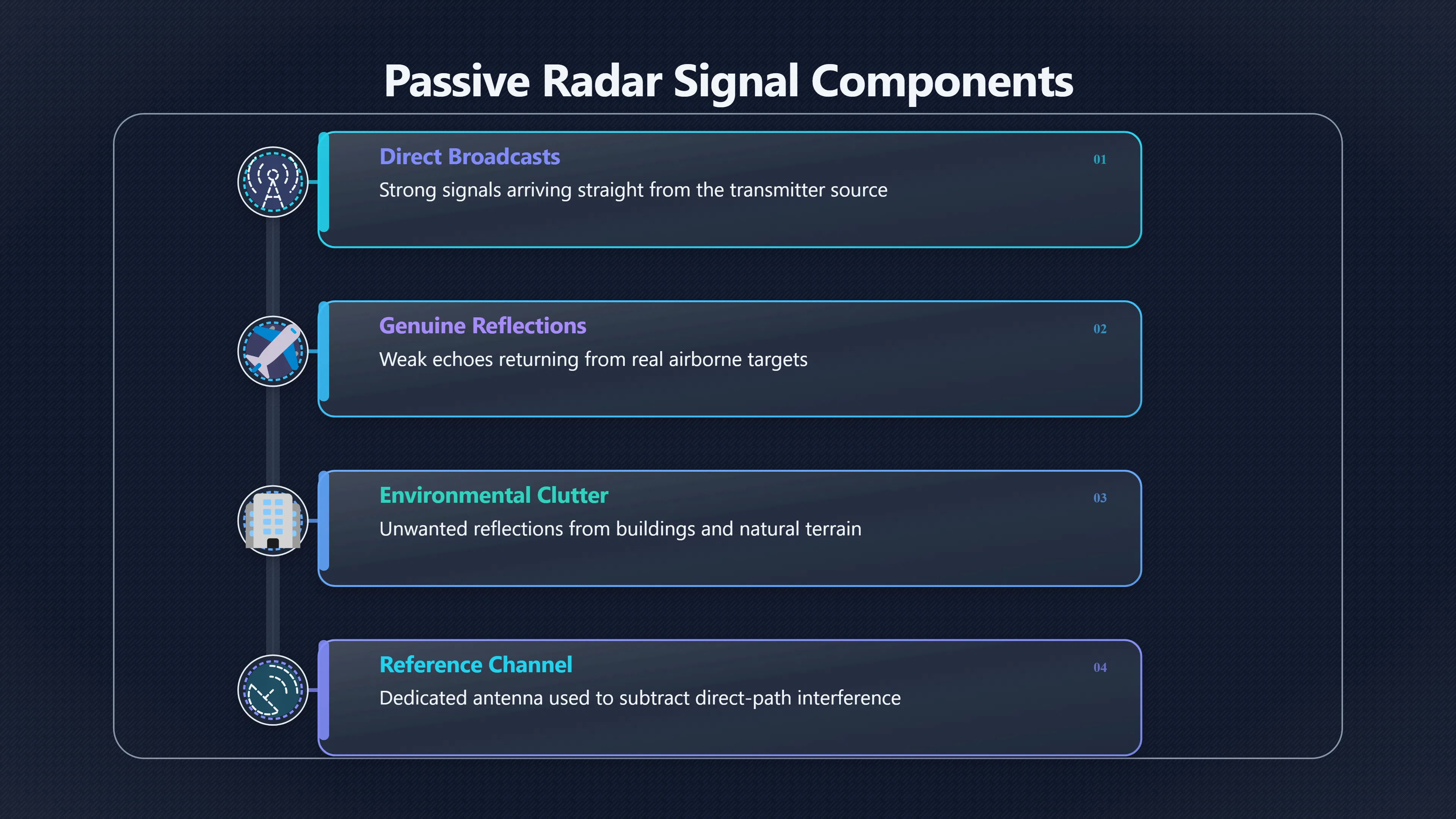
Unlike conventional radar, passive radar does not control its transmitter. Instead, it exploits existing broadcasts such as FM radio, digital television or other “illuminators of opportunity”. The receiver simultaneously collects:
- a strong direct signal arriving straight from the transmitter;
- much weaker reflections from real objects;
- numerous unwanted reflections from the surrounding environment.
The direct transmission is typically many orders of magnitude stronger than any target reflection. Even a large aircraft may return a signal that is tiny compared with the original broadcast, while a small drone or balloon may be weaker still. If the direct-path signal is not removed extremely effectively, it masks genuine echoes and creates artefacts in delay-Doppler processing that resemble targets.[ResearchGate+2IET Research Journal]researchgate.net308842709 Direct signal suppression schemes for passive radarResearchGate(PDF) Direct signal suppression schemes for passive radar10 Feb 2017 — Passive radar systems must detect the presence of a ta…
This is why passive radar systems almost always include a dedicated reference antenna aimed directly at the transmitter. The reference channel allows the receiver to estimate what the original broadcast looked like so that it can be subtracted from the surveillance channel. In practice, that subtraction is never perfect, particularly when reflections distort the reference signal itself.[MDPI+2MDPI]mdpi.comA Target Detection Method of Distributed Passive Radar…by H Zhu · 2023 · Cited by 9 — The cross-correlation detection method is ba…
For an automated UAP station, any event appearing only while the receiver is struggling with strong direct-path interference deserves particular scepticism.
Why buildings and terrain create multipath
Multipath occurs whenever radio waves reach the receiver by more than one route.
Instead of travelling directly from transmitter to receiver, signals may also reflect from:
- office buildings;
- hillsides and cliffs;
- water surfaces;
- large metal roofs;
- bridges;
- wind turbines;
- moving road traffic;
- parked aircraft;
- industrial structures.
Each reflected path has a slightly different travel distance and arrival time. Rather than seeing one clean signal, the receiver observes several delayed copies of the same transmission.
Passive radar processing estimates target position by measuring delay and Doppler shift. Unfortunately, multipath reflections also possess delays and, if the reflecting surface is moving or vibrating, apparent Doppler shifts. The result is that clutter may occupy the same delay-Doppler space where genuine aerial targets are expected.[MDPI+2Springer Nature Link]mdpi.comIn passive radar, targetBeamforming Techniques for Passive Radar: An Overviewby JM Núñez-Ortuño · 2023 · Cited by 21 — Cross ambiguity function is one key in…
In dense urban environments, one physical object may even generate several apparent targets because its reflection reaches the receiver along multiple routes. Likewise, a stationary building can produce echoes whose geometry changes as aircraft, vehicles or atmospheric conditions alter the propagation paths.
This explains why passive radar images can look considerably more complicated than the true physical scene.

Why clutter can look surprisingly convincing
One misconception is that false returns appear as random noise. In reality, clutter often produces stable, repeatable tracks.
Examples include:
- reflections repeatedly appearing near particular buildings;
- apparent objects that always emerge over the same ridge line;
- echoes following railway lines or motorways because moving vehicles continually generate similar reflections;
- strong stationary returns that resemble hovering objects.
Because passive radar relies on external transmitters, changing transmitter power, modulation or reception quality can also alter the apparent target picture without anything changing in the sky.
Research into passive bistatic radar consistently identifies direct-path interference, stationary clutter and multipath as the dominant limitations on detection performance. Considerable computational effort is devoted to cancelling these unwanted signals before attempting target detection.[IET Research Journal+2IET Research Journal]ietresearch.onlinelibrary.wiley.comiet spr.2019.0338IET Research JournalTwo‐stage clutter and interference cancellation method in…by C Gang · 2020 · Cited by 20 — Target echoes are inevi…
Checks that separate clutter from real objects
The most useful protection against false detections is not a single algorithm but several independent consistency checks.
A robust automated UAP observatory should ask whether the apparent target behaves like a physical object rather than merely exceeding a detection threshold.
Useful checks include:
- Persistence across different geometries. A real airborne object should continue producing consistent measurements as the observing geometry changes. Multipath ghosts often disappear or shift unpredictably when transmitter or receiver geometry changes.
- Agreement between sensors. A passive radar detection that has no corresponding optical observation, thermal signature or independent radio evidence deserves cautious interpretation. Likewise, a camera event unsupported by radar should not automatically be considered anomalous.
- Consistency over multiple receivers. Distributed passive radar networks can compare detections from several sites. Multipath artefacts are frequently local to one receiver, whereas genuine airborne targets should produce geometrically consistent measurements across multiple stations.[arXiv]arxiv.orgarXiv Statistical Properties of Target Localization Using Passive Radar SystemsStatistical Properties of Target Localization Using Passive Radar SystemsJanuary 28, 2026…
- Physical motion tests. Real objects obey continuous trajectories. Clutter artefacts may jump between locations, appear suddenly without feasible motion, or remain locked to terrain features.
- Environmental correlation. Repeated detections occurring only during heavy rain, strong temperature inversions, high winds affecting turbines, or when certain transmitters dominate reception are more consistent with propagation effects than unusual objects.
These checks reduce false alarms without assuming that every unexplained detection is either ordinary or extraordinary.
Why cancellation algorithms matter
Modern passive radar is not simply a receiver attached to an antenna. Much of the system’s sophistication lies in signal processing that suppresses unwanted returns before searching for targets.
Common approaches include adaptive filtering, beamforming, direct-signal suppression and variants of the Extensive Cancellation Algorithm (ECA). These methods estimate the unwanted direct-path and clutter components and subtract them from the surveillance channel. Current research continues to improve cancellation performance because imperfect suppression remains one of the principal limits on passive radar sensitivity.[MDPI+3MathWorks+3Springer Nature Link]mathworks.comDirect Signal Interference (DSI) Suppression In Passive…This example investigates the performance of direct signal interferen…
The need for increasingly sophisticated cancellation techniques is itself evidence that clutter is not a minor inconvenience but one of the defining engineering problems of passive radar.
What this means for automated UAP detection
Within an automated instrumented UFO detector, passive radar should be viewed as a corroborating sensor rather than an independent arbiter of unusual events.
A radar return gains credibility when it:
- persists after direct-path cancellation;[ietresearch.onlinelibrary.wiley.com]ietresearch.onlinelibrary.wiley.comiet spr.2019.0338IET Research JournalTwo‐stage clutter and interference cancellation method in…by C Gang · 2020 · Cited by 20 — Target echoes are inevi…
- is reproducible across independent receivers;
- follows a physically plausible trajectory;
- coincides with calibrated optical observations;
- remains consistent despite changes in geometry and environmental conditions.
Conversely, detections that remain tied to buildings, terrain, transmitter geometry or known clutter hotspots are more parsimoniously explained as multipath or environmental reflections than as unknown airborne objects.
Understanding these clutter mechanisms does not diminish the value of passive radar. Instead, it establishes the standard of evidence required before an apparent radar target can reasonably be regarded as something that merits further investigation rather than another example of radio propagation creating the illusion of an object.
Amazon book picks
Further Reading
Books and field guides related to When passive radar sees the wrong thing. Use these as the next step if you want deeper reading beyond the article.
Introduction to Radar Systems
Explains radar fundamentals, clutter, multipath, detection limits, and signal processing relevant to passive radar false tracks.

Bistatic Radar
Covers geometry, clutter, multipath, and detection issues closely related to passive radar operation.

Adaptive filter theory
Adaptive filtering techniques are central to cancelling strong direct-path signals and reducing clutter in passive radar receivers.
Principles of Modern Radar
Discusses detection theory, propagation, clutter, and practical radar performance that underpin passive radar interpretation.
eBay marketplace picks
Marketplace Samples
Example marketplace items related to this page. Use the search link to explore similar finds on eBay.




Endnotes
1.
Source: researchgate.net
Link:https://www.researchgate.net/publication/331723832_Tutorial_Passive_radar_tutorial
Source snippet
Tutorial: Passive radar tutorial | Request PDFThis work focuses on target location algorithms based on bistatic-range measure...
2.
Source: researchgate.net
Title: 308842709 Direct signal suppression schemes for passive radar
Link:https://www.researchgate.net/publication/308842709_Direct_signal_suppression_schemes_for_passive_radar
Source snippet
ResearchGate(PDF) Direct signal suppression schemes for passive radar10 Feb 2017 — Passive radar systems must detect the presence of a ta...
3.
Source: mdpi.com
Link:https://www.mdpi.com/2079-9292/12/2/433
Source snippet
A Target Detection Method of Distributed Passive Radar...by H Zhu · 2023 · Cited by 9 — The cross-correlation detection method is ba...
4.
Source: mdpi.com
Link:https://www.mdpi.com/2072-4292/15/15/3876
Source snippet
Target Detection of Passive Bistatic Radar under the...by Y Wu · 2023 · Cited by 6 — This paper addresses the issue of the reference sig...
5.
Source: mathworks.com
Link:https://www.mathworks.com/help/phased/ug/direct-signal-interference-dsi-suppression-in-passive-radar.html
Source snippet
Direct Signal Interference (DSI) Suppression In Passive...This example investigates the performance of direct signal interferen...
6.
Source: mdpi.com
Title: In passive radar, target
Link:https://www.mdpi.com/1424-8220/23/7/3435
Source snippet
Beamforming Techniques for Passive Radar: An Overviewby JM Núñez-Ortuño · 2023 · Cited by 21 — Cross ambiguity function is one key in...
7.
Source: link.springer.com
Link:https://link.springer.com/article/10.1186/s13634
Source snippet
Some important recent algorithms such as the ECA...Read more...
8.
Source: researchgate.net
Link:https://www.researchgate.net/publication/4256080_Comparison_of_Clutter_and_Multipath_Cancellation_Techniques_for_Passive_Radar
Source snippet
Different adaptive techniques are considered based on both well...Read more...
9.
Source: arxiv.org
Title: arXiv Statistical Properties of Target Localization Using Passive Radar Systems
Link:https://arxiv.org/abs/2601.20817
Source snippet
Statistical Properties of Target Localization Using Passive Radar SystemsJanuary 28, 2026...
Published: January 28, 2026
10.
Source: mdpi.com
Link:https://www.mdpi.com/1424-8220/25/21/6748
Source snippet
An Improved Extensive Cancellation Method for Clutter...by G Chen · 2025 — Passive bistatic radar experiences serious clutter echo inter...
11.
Source: mdpi.com
Link:https://www.mdpi.com/2072-4292/17/6/961
12.
Source: researchgate.net
Link:https://www.researchgate.net/publication/261267322_Direct_path_wave_purification_for_passive_radar_with_normalized_least_mean_square_algorithm
Source snippet
This algorithm can attenuate the...
13.
Source: researchgate.net
Link:https://www.researchgate.net/publication/390360778_Passive_Radar_Detection_Approach_for_Multiple_and_Small_Targets_Based_on_Multi-carrier_and_Sparse_Reconstruction
Source snippet
Conventional detection methods, which...Read more...
14.
Source: ietresearch.onlinelibrary.wiley.com
Title: iet spr.2019.0338
Link:https://ietresearch.onlinelibrary.wiley.com/doi/full/10.1049/iet-spr.2019.0338
Source snippet
IET Research JournalTwo‐stage clutter and interference cancellation method in...by C Gang · 2020 · Cited by 20 — Target echoes are inevi...
15.
Source: ietresearch.onlinelibrary.wiley.com
Title: iet rsn.2013.0185
Link:https://ietresearch.onlinelibrary.wiley.com/doi/10.1049/iet-rsn.2013.0185
Source snippet
IET Research JournalAnalysis of detection range of FM‐based passive radar1 Feb 2014 — This study presents an analysis of the detection ra...
16.
Source: ietresearch.onlinelibrary.wiley.com
Link:https://ietresearch.onlinelibrary.wiley.com/doi/10.1049/iet-rsn.2017.0106
Source snippet
IET Research JournalParallel processing algorithm for multipath clutter cancellation...by Y Fu · 2018 · Cited by 28 — In this study, an...
17.
Source: ietresearch.onlinelibrary.wiley.com
Title: iet spr.2019.0338
Link:https://ietresearch.onlinelibrary.wiley.com/doi/10.1049/iet-spr.2019.0338
Source snippet
wiley.comTwo‐stage clutter and interference cancellation method in...by C Gang · 2020 · Cited by 20 — Target echoes are inevitably conta...
18.
Source: dictionary.cambridge.org
Link:https://dictionary.cambridge.org/dictionary/english-chinese-traditional/passive
Source snippet
in Traditional Chinese - Cambridge Dictionarynot acting to influence or change a situation; allowing other people to be in control 被動的,消極...
19.
Source: dictionary.cambridge.org
Link:https://dictionary.cambridge.org/dictionary/english/passive
Source snippet
not reacting to what happens, or not acting or taking part: They attack people who are too weak or too passive to resist.Read more...
20.
Source: ui.adsabs.harvard.edu
Link:https://ui.adsabs.harvard.edu/abs/arXiv%3A1805.01533
Source snippet
Time delay and Doppler shift estimation is an...Read more...
21.
Source: frontiersin.org
Link:https://www.frontiersin.org/journals/signal-processing/articles/10.3389/frsip.2025.1688944/full
Source snippet
A novel approach which incorporates both signal and...
Additional References
22.
Source: dictionary.com
Link:https://www.dictionary.com/browse/passive
Source snippet
PASSIVE Definition & Meaninginfluenced, acted upon, or affected by some external force, cause, or agency; being the object of action rath...
23.
Source: test-english.com
Link:https://test-english.com/grammar-points/b1/passive-verb-forms/
Source snippet
Passive verb formsMaster passive verb forms in this B1 Intermediate grammar lesson. Clear grammar [rules]({{ 'rules/' | relative_url }}), charts and exercises. Practise now...
24.
Source: publica.fraunhofer.de
Link:https://publica.fraunhofer.de/entities/publication/ec0895dd-6324-4e3f-9e23-16afdeacda68
Source snippet
multipath clutter cancellation in OFDM-based...We present an advanced algorithm to suppress multipath clutter in passive radar systems u...
25.
Source: publications.sto.nato.int
Link:https://publications.sto.nato.int/publications/STO%20Educational%20Notes/STO-EN-SET-216/EN-SET-216-06.pdf
Source snippet
Radar Signal Processingby A De Maio · Cited by 10 — To mitigate the deleterious effects of clutter and jammer, modern radars have employe...
26.
Source: advice.writing.utoronto.ca
Link:https://advice.writing.utoronto.ca/revising/passive-voice/
Source snippet
Voice: When to Use It and When to Avoid ItIn a passive sentence, the person or thing acted on comes first, and the actor is added at the...
27.
Source: youtube.com
Link:http://www.youtube.com/watch?v=z9tjjzv1kig
Source snippet
Passive radar clutter multipath delay doppler cross ambiguity Radar Systems Engineering Course by Dr. Robert M. O'Donnell. Chapter 10: Ra...
28.
Source: doaj.org
Link:https://doaj.org/article/cf9d6d0c150c4e9baff70c272461f0e4
Source snippet
try provides a novel scheme to the detection of target in sea clutter environment...Read more...
29.
Source: intechopen.com
Title: These transmissions are inherently not designed for radar
Link:https://www.intechopen.com/chapters/57342
Source snippet
Adaptive Clutter Cancellation Techniques for Passive Radarsby T Pető · 2017 · Cited by 9 — In radar systems, the ambiguity func...
30.
Source: merriam-webster.com
Title: PASSIV E Definition & Meaning3 days ago — 1
Link:https://www.merriam-webster.com/dictionary/passive
Source snippet
a (1): acted upon by an external agency (2): receptive to outside impressions or influences b (1): asserting that the grammatical subj...
31.
Source: radars.ac.cn
Link:https://radars.ac.cn/en/article/doi/10.12000/JR25155
Source snippet
Multipath Effects and Suppression in Reference Channels...by W Xuesong · 2025 — For Linear Frequency Modulated (LFM) signals, a dechirp...
Topic Tree