Within Sky Detectors
How Do You Trust a UAP Event File?
A strange event record is more valuable when every processing step and sensor state can be traced afterward.
On this page
- Sensor state and event history
- Raw data versus processed clips
- Audit trails for later review
Page outline Jump by section
Introduction
A UAP event file is only as trustworthy as the trail behind it. For automated instrumented UFO detectors, the key question is not simply “did the camera record something strange?” but “can another reviewer reconstruct exactly how that record was made, handled, processed, and interpreted?” Data provenance is the record of origin and transformation; chain of custody is the record of control, access, transfer, and preservation. Together, they turn a clip into evidence that can be checked rather than merely watched.
This matters because the strongest official and scientific critiques of UAP material are not usually that every sighting is fake. They are that many cases lack calibrated sensors, multiple measurements, sensor metadata, baseline context, or timely actionable data. NASA’s independent UAP study said current analysis is hampered by poor calibration, missing metadata and lack of baseline data, while AARO’s 2024 annual report said many cases remain unresolved because sufficient actionable data is missing.[NASA Science]science.nasa.govNASA Science…
The Event File Is More Than the Video
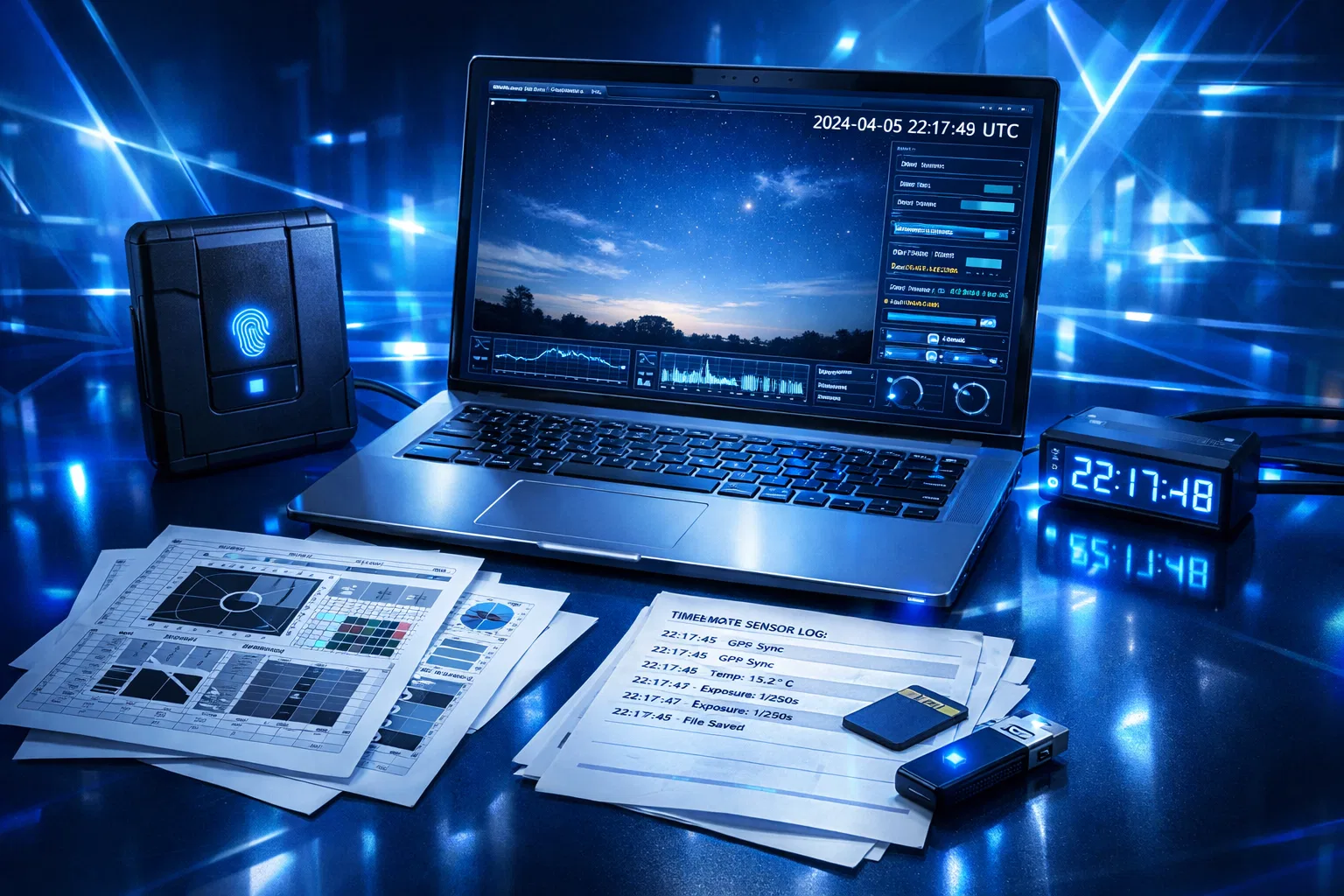
A useful UAP event file should behave less like a viral upload and more like a small scientific dataset. The video or image is only the visible centre of the record. Around it should sit a packet of contextual facts: sensor identity, sensor settings, timing source, location, pointing direction, calibration state, software version, trigger logic, environmental readings, nearby aircraft and satellite context, and every processing step applied after capture.
AARO’s 2025 workshop paper put this plainly: effective UAP analysis requires rich contextual metadata, ideally including time, date, precise location, event-specific details, sensor positions, witness background where relevant, and technical parameters for structured data. It also defined provenance as the chain of custody and source of the data, essential for interpretability and trust.[AARO]aaro.mil2025 UAP Workshop Paper2025 UAP Workshop: Narrative Data, Infrastructures, and Analysis…
For an automated sky detector, that means the event file should answer at least four questions:
- What generated the record? The camera, radar receiver, microphone, magnetometer, weather station, software module, and clock source should be identified.
- What was the instrument doing? Exposure, gain, focus, field of view, frame rate, pointing angle, calibration status and tracking mode should be preserved.
- What changed after capture? Cropping, compression, stabilisation, object tracking, denoising, false-colour rendering and machine-learning classification should be logged.
- Who or what handled the file? Human analysts, automated pipelines, cloud storage, public releases and derivative exports should each leave an audit trail.
This is where UAP provenance overlaps with ordinary scientific and forensic practice. The World Wide Web Consortium’s PROV model describes provenance in terms of entities, activities and agents: a dataset is an entity, processing is an activity, and a person, instrument or software service can be an agent responsible for a step in the chain.[w3.org]w3.orgprov dmprov dm
Sensor State and Event History
The most damaging gap in many aerial anomaly records is not absence of imagery; it is absence of instrument state. A blurry dot recorded by a phone, a cockpit sensor clip, or an automated sky camera may look intriguing, but without the sensor’s field of view, focal behaviour, exposure settings, position, timestamp accuracy and calibration history, basic physical estimates can be wildly wrong.
NASA’s report stressed that calibration and metadata are not decorative extras. Calibration is what makes measurements reliable and accurate, while missing sensor metadata makes later analysis much harder. The report also argued that UAP detection should use multiple well-calibrated sensors and that alert systems should share transient information quickly and uniformly.[NASA Science]science.nasa.govNASA Science…
For an automated detector, “sensor state” should be captured continuously or at least at event-trigger boundaries. A credible event history would include:
- the system clock status and whether it was synchronised to GPS, network time or another reference;
- the sensor’s physical location, orientation and uncertainty range;
- frame timing, dropped frames, compression settings and exposure changes;
- any automatic gain, autofocus, object-tracking or gimbal movement during the event;
- weather, seeing conditions, cloud cover, wind, temperature and local light conditions;
- contemporaneous non-UAP context, such as aircraft tracks, satellite passes, meteors, birds, drones and known astronomical objects.
The Galileo Project’s ground-based observatory concept is important here because it treats UAP study as a multi-sensor census problem rather than a single-camera problem. Its published design describes wide-field cameras, narrow-field optical instruments, passive radar-style receivers, radio spectrum analysers, microphones, environmental sensors, electric and magnetic field measurements, and energetic-particle sensors, with the explicit aim of making detections corroborated and verifiable.[arXiv]arxiv.orgOpen source on arxiv.org.
A later Galileo Project system architecture paper goes further by naming “data provenance management” as part of the edge computing subsystem at the observatory site. That is the correct placement: provenance capture should begin at the instrument, not be reconstructed later by an analyst trying to remember what happened.[arXiv]arxiv.orgarXiv Galileo Project Observatory Class System ArchitecturearXiv Galileo Project Observatory Class System Architecture
Raw Data Versus Processed Clips
A processed clip is easier to share, but it is usually weaker evidence than the raw or near-raw record behind it. Cropping can remove reference stars, aircraft lights or horizon cues. Stabilisation can create misleading apparent motion. Compression can introduce artefacts. False-colour infrared rendering can make ordinary temperature differences look more dramatic than they are. Object-tracking overlays can imply precision the underlying data does not support.
That does not mean processed clips are useless. They are often the right format for quick human review. The problem arises when the processed clip becomes the only surviving record. In a trustworthy UAP evidence pipeline, raw capture, working copies and interpreted outputs should be kept distinct.
Digital image forensic guidance from the US National Institute of Standards and Technology’s OSAC programme gives a useful model: original images should be retained in native format and protected; working images should be designated before processing; working copies should be verified against originals through hashing or another fixity check; and all processing steps should be documented.[NIST]nist.govosac 2024 n 0011 standard guide forensic digital image management version 10osac 2024 n 0011 standard guide forensic digital image management version 10
For automated UAP detectors, the same principle should apply even when the system is not part of a legal investigation. The raw record is the control sample. The processed clip is a view of that sample. The interpretation is a claim about what the sample may show. Mixing those layers makes it harder to separate genuine aerial motion from sensor artefact, software artefact or analyst preference.
The Galileo Project’s public FAQ describes a three-level observational archive: raw data, processed data with calibration, and interpreted results. That layered approach is well suited to UAP records because it allows different readers to ask different questions. A casual viewer may need the interpreted clip; a sceptical analyst may need the calibrated intermediate product; a specialist may need the raw frames and metadata.[The Galileo Project]galileo.hsites.harvard.eduOpen source on harvard.edu.
Chain of Custody Is a Defence Against Both Error and Hype
In UAP culture, chain of custody is often discussed as if it only matters for alleged exotic materials or leaked military clips. Automated detectors make it more routine and more important. Every file should carry a record of where it was generated, when it was copied, where it was stored, who accessed it, which software transformed it, and how later versions relate to the original.
The 2021 US intelligence community preliminary assessment defined a UAP report as documentation of a UAP event including verified chains of custody and basic information such as time, date, location and description. That definition is narrow but revealing: even at the reporting level, chain of custody was treated as part of what separates an event record from a loose anecdote.[Director of National Intelligence]dni.govOpen source on dni.gov.
A robust chain does not need to be theatrical. It needs to be boringly complete. A good automated detector should generate:
- a unique event identifier;
- cryptographic hashes for raw files and important derivatives;
- immutable or tamper-evident logs of file creation, access, export and deletion;
- version links between raw data, working copies, processed clips and published excerpts;
- analyst notes that separate observation from interpretation;
- retention rules for raw data, metadata and rejected triggers;
- access controls that protect privacy, sensitive locations and classified or restricted sources.
Hashing is not a magic proof that a video is authentic; it only proves that a particular file has not changed since the hash was recorded. But that is still valuable. If an analyst later disputes whether a released clip differs from the original, a hash-based fixity trail can settle the narrow question of file alteration and force the debate back to interpretation.
The value of custody records becomes clearer when public claims move faster than analysis. AARO’s public imagery pages repeatedly show a sober pattern: some objects can be assessed as balloons or aircraft with high confidence, while other cases remain unresolved not because they are demonstrably extraordinary, but because the available data is insufficient to identify a specific origin or type.[AARO]aaro.milOpen source on aaro.mil.
Audit Trails for Later Review
A UAP detector should be designed on the assumption that the most important reviewer may arrive months or years after the event. That reviewer may be a project scientist, an outside sceptic, a safety investigator, a journalist, a government analyst, or a future researcher comparing thousands of events. Audit trails make that later review possible.
A good audit trail records not just the final answer but the pathway to it. If a system first flags an object as anomalous, then reclassifies it as probable aircraft after ADS-B correlation, then reopens it because the aircraft track does not match the visual bearing, each step should be visible. The same applies when a human analyst overrides a machine classification, rejects a false trigger, masks a privacy-sensitive portion of the sky, or releases a cropped public version.
This matters especially because automated systems will increasingly use artificial intelligence for detection, classification and triage. NASA argued that AI and machine learning can help identify rare occurrences in large datasets, but only when those datasets are well characterised and collected to strong standards.[NASA Science]science.nasa.govNASA Science… AARO’s workshop paper likewise warned that fake data, disinformation and AI-generated photos or videos pose risks to public trust and analytic integrity.[AARO]aaro.mil2025 UAP Workshop Paper2025 UAP Workshop: Narrative Data, Infrastructures, and Analysis…
Audit trails also reduce the danger of “black box” anomaly claims. A model may assign a high anomaly score to an object because it really is unusual, because the training data lacks enough examples of a mundane object, or because the input data is degraded. Without logs of model version, training assumptions, thresholds, input files and post-processing steps, a machine-generated anomaly label can become a new kind of folklore.
What a Trustworthy UAP Dataset Would Contain
A well-formed automated UAP event package would not need to prove an exotic conclusion. Its first job would be to let reviewers test ordinary explanations properly. A strong package would include raw captures, calibrated derivatives, instrument state, event timeline, environmental context, cross-sensor correlations, exclusion checks and the full custody record.
The UAPx Catalina Island field expedition is a useful concrete example because its published work foregrounds both ambition and difficulty. The team deployed visible and infrared cameras and other sensors, recorded about an hour of triggered visible or night-vision video, more than 600 hours of untriggered far-infrared video, and 55 hours of radiation measurements. The paper describes several initially ambiguous observations that were later resolved, leaving one primary ambiguity for further discussion.[arXiv]arxiv.orgOpen source on arxiv.org.
The same UAPx paper explicitly says independent groups using data quality, chain of custody, data provenance and rigorous analysis are useful for cross-checking claims. That point is easy to miss: provenance is not only about trusting one team. It is about making a record structured enough that another team can disagree productively.[arXiv]arxiv.orgOpen source on arxiv.org.
Citizen and semi-commercial systems face the same issue at smaller scale. Sky360 describes itself as an open-source global sky-observation network using AI-powered stations to detect, track, identify and analyse aerial phenomena; its public repository describes a recorder intended to capture raw sensor data and situational awareness.[sky360.org]sky360.orgOpen source on sky360.org. UFODAP’s own presentation identifies questionable provenance of witness reports and photos or videos, plus missing coincident environmental measurements, as problems that automated real-time collection is meant to reduce.[handprint.com]handprint.comThe UFO Data Acquisition Project (UFODAPThe UFO Data Acquisition Project (UFODAP
The best future dataset is therefore not just a spectacular clip. It is a linked bundle:
- Raw layer: native files from each sensor, preserved without enhancement.
- Calibration layer: dark frames, flat fields, lens distortion models, timing checks, alignment data and sensor health.
- Context layer: weather, aircraft, satellite, astronomical, drone, fireball and local site data.
- Processing layer: software versions, scripts, model thresholds, manual edits and intermediate outputs.
- Interpretation layer: hypotheses tested, explanations rejected, confidence levels and unresolved questions.
- Custody layer: identifiers, hashes, access logs, transfers, exports and publication history.
The Trade-Off: Openness, Privacy and Sensitive Sensors
A fully open evidence archive sounds ideal, but UAP data often sits at the intersection of public interest, personal privacy, aviation safety, national security and proprietary sensor design. A detector may capture private property, faces, vehicle plates, sensitive infrastructure, aircraft operations or classified sensor capabilities. Provenance has to preserve trust without blindly exposing everything.
AARO’s 2025 workshop paper recognised this tension. Participants discussed linking UAP data to FAA and NASA aviation safety reporting, ADS-B flight tracks, weather radar, astronomical databases and fireball networks, while also giving reporters control over information such as geolocation and photo metadata. It recommended aggregated, de-identified releases to build trust without encouraging hoaxes.[AARO]aaro.mil2025 UAP Workshop Paper2025 UAP Workshop: Narrative Data, Infrastructures, and Analysis…
That trade-off argues for tiered access rather than either secrecy or total publication. Public users might see redacted clips, summary metadata and case conclusions. Accredited researchers might access richer calibrated data under privacy conditions. Government safety or defence analysts might access restricted sensor details where necessary. The key is that each redaction should itself be logged, so later reviewers can tell whether missing information is absent, withheld, destroyed or never collected.
Provenance does not require every sensitive fact to be public. The W3C PROV model explicitly allows provenance statements to use identifiers even when some resources have restricted access. That distinction is useful for UAP work: an event file can show that a restricted radar track was used in analysis without necessarily publishing the radar data itself.[w3.org]w3.orgprov dmprov dm
Why Provenance Changes the UAP Debate
Data provenance will not make every UAP case solvable. Some events will still be too brief, too distant, too poorly observed or too entangled with unavailable classified data. But strong provenance changes the shape of disagreement. Instead of arguing over whether a clip “looks real”, reviewers can ask narrower, better questions: was the timestamp accurate, did the camera move, was the object correlated with aircraft data, did processing create the apparent motion, and has the original file remained unchanged?
That shift is central to automated instrumented UFO detection. The goal is not to make extraordinary claims easier. It is to make weak claims easier to reject and strong anomalies harder to dismiss casually. When the raw data, sensor state, processing history and custody trail survive together, a UAP event becomes part of a cumulative evidence base rather than another disconnected mystery.
The practical standard is simple: a future reviewer should be able to replay the event’s life from instrument trigger to final interpretation. If that replay is impossible, the file may still be interesting. It may even point to something worth investigating. But as dataset evidence, it remains incomplete.

Amazon book picks
Further Reading
Books and field guides related to How Do You Trust a UAP Event File?. Use these as the next step if you want deeper reading beyond the article.

Windows Forensics And Incident Recovery Covers Windows Server...
Explains evidence integrity, provenance, audit trails and preservation.
Digital Evidence and Computer Crime
Covers handling, documentation and evaluation of digital evidence.
How to Lie with Statistics
Builds skepticism about weak evidence and unsupported conclusions.

The Art of Statistics
Helps readers think critically about evidence quality and uncertainty.
eBay marketplace picks
Marketplace Samples
Live-tested eBay searches with available results related to this page.


Endnotes
1.
Source: science.nasa.gov
Link:https://science.nasa.gov/wp-content/uploads/2023/09/uap-independent-study-team-final-report.pdf
Source snippet
NASA Science...
2.
Source: aaro.mil
Title: 2025 UAP Workshop Paper
Link:https://www.aaro.mil/Portals/136/PDFs/Information%20Papers/2025_UAP_Workshop_Paper.pdf
Source snippet
2025 UAP Workshop: Narrative Data, Infrastructures, and Analysis...
3.
Source: w3.org
Title: prov dm
Link:https://www.w3.org/TR/prov-dm/
4.
Source: w3.org
Title: prov o
Link:https://www.w3.org/TR/prov-o/
5.
Source: arxiv.org
Link:https://arxiv.org/abs/2305.18566
6.
Source: arxiv.org
Title: arXiv Galileo Project Observatory Class System Architecture
Link:https://arxiv.org/abs/2506.00125
7.
Source: nist.gov
Title: osac 2024 n 0011 standard guide forensic digital image management version 10
Link:https://www.nist.gov/document/osac-2024-n-0011-standard-guide-forensic-digital-image-management-version-10
8.
Source: aaro.mil
Link:https://www.aaro.mil/UAP-Cases/Official-UAP-Imagery/
9.
Source: arxiv.org
Link:https://arxiv.org/abs/2312.00558
10.
Source: arxiv.org
Link:https://arxiv.org/html/2312.00558v4
11.
Source: sky360.org
Link:https://www.sky360.org/
12.
Source: handprint.com
Title: The UFO Data Acquisition Project (UFODAP)
Link:https://www.handprint.com/UFO/UFODAP_Presentation.pdf
13.
Source: science.nasa.gov
Link:https://science.nasa.gov/uap/
14.
Source: nasa.gov
Title: update nasa shares uap independent study report names director
Link:https://www.nasa.gov/news-release/update-nasa-shares-uap-independent-study-report-names-director/
15.
Source: arxiv.org
Link:https://arxiv.org/html/2506.00125v1
16.
Source: arxiv.org
Link:https://arxiv.org/html/2312.00558v3
17.
Source: aaro.mil
Link:https://www.aaro.mil/
18.
Source: aaro.mil
Link:https://www.aaro.mil/Portals/136/PDFs/AARO_Mission_Brief_2025.pdf
19.
Source: aaro.mil
Title: UNCLASSIFIED FY23 Consolidated Annual Report on UAP Oct 25 2023 1236
Link:https://www.aaro.mil/Portals/136/PDFs/UNCLASSIFIED-FY23_Consolidated_Annual_Report_on_UAP-Oct_25_2023_1236.pdf
20.
Source: aaro.mil
Title: UAP Records
Link:https://www.aaro.mil/UAP-Records/
21.
Source: ufodap.com
Link:https://ufodap.com/faq
22.
Source: ufodap.com
Title: UFODA P
Link:https://ufodap.com/technology
23.
Source: w3.org
Title: prov n
Link:https://www.w3.org/TR/prov-n/
24.
Source: nvlpubs.nist.gov
Link:https://nvlpubs.nist.gov/nistpubs/ir/2022/NIST.IR.8387.pdf
25.
Source: galileo.hsites.harvard.edu
Link:https://galileo.hsites.harvard.edu/FAQ
26.
Source: dni.gov
Link:https://www.dni.gov/files/ODNI/documents/assessments/Prelimary-Assessment-UAP-20210625.pdf
27.
Source: github.com
Link:https://github.com/Sky360-Repository/sky360
28.
Source: drbriankeating.medium.com
Link:https://drbriankeating.medium.com/the-galileo-project-systematically-searching-for-evidence-of-extraterrestrial-technological-cb4535c6f351
29.
Source: galileo.hsites.harvard.edu
Title: scientific investigation unidentified aerial phenomena uap using multimodal
Link:https://galileo.hsites.harvard.edu/publications/scientific-investigation-unidentified-aerial-phenomena-uap-using-multimodal
30.
Source: galileo.hsites.harvard.edu
Link:https://galileo.hsites.harvard.edu/activities
31.
Source: ui.adsabs.harvard.edu
Link:https://ui.adsabs.harvard.edu/abs/2025PrAeS.15601099S/abstract
32.
Source: dni.gov
Title: 4020 uap 2024
Link:https://www.dni.gov/index.php/newsroom/reports-publications/reports-publications-2024/4020-uap-2024
33.
Source: reddit.com
Link:https://www.reddit.com/r/UFOs/comments/1go9ej4/the_galileo_project_under_my_leadership_avi_loeb/
34.
Source: youtube.com
Link:https://www.youtube.com/watch?v=uJtER5ahdPY
35.
Source: Wikipedia
Title: The Galileo Project
Link:https://en.wikipedia.org/wiki/The_Galileo_Project
Additional References
36.
Source: media.defense.gov
Title: FY24 CONSOLIDATED ANNUAL REPORT ON UAP 508
Link:https://media.defense.gov/2024/Nov/14/2003583603/-1/-1/0/FY24-CONSOLIDATED-ANNUAL-REPORT-ON-UAP-508.PDF
Source snippet
U.S. Department of WarFiscal Year 2024 Consolidated Annual Report on Unidentified Anomalous Phenomena...
37.
Source: youtube.com
Title: Unidentified Anomalous Phenomena Report from NASA
Link:https://www.youtube.com/watch?v=ixTICcLXueg
Source snippet
AARO UAP data standards scientific context Pentagon releases declassified UFO files detailing more than 400 incidents NBC News...
38.
Source: youtube.com
Title: Public Meeting on Unidentified Anomalous Phenomena (Official NASA Broadcast)
Link:https://www.youtube.com/watch?v=bQo08JRY0iM
Source snippet
What the new UFO files released by the Pentagon actually revealed...
39.
Source: youtube.com
Title: What the new UFO files released by the Pentagon actually revealed
Link:https://www.youtube.com/watch?v=UOMslb7oQo8
Source snippet
Pentagon releases declassified UFO files detailing more than 400 incidents...
40.
Source: youtube.com
Title: Unidentified Anomalous Phenomena Independent Study Report
Link:https://www.youtube.com/watch?v=TQcqOW39ksk
Source snippet
Public Meeting on Unidentified Anomalous Phenomena (Official NASA Broadcast)...
41.
Source: youtube.com
Title: Pentagon releases declassified UFO files detailing more than 400 incidents
Link:https://www.youtube.com/watch?v=bGYEQlBvJIc
Source snippet
Unidentified Anomalous Phenomena Report from NASA...
42.
Source: war.gov
Title: department of defense launches secure reporting mechanism on the all domain ano
Link:https://www.war.gov/News/Releases/Release/Article/3575027/department-of-defense-launches-secure-reporting-mechanism-on-the-all-domain-ano/
43.
Source: war.gov
Title: department of defense releases the annual report on unidentified anomalous phen
Link:https://www.war.gov/News/Releases/Release/Article/3964824/department-of-defense-releases-the-annual-report-on-unidentified-anomalous-phen/
44.
Source: war.gov
Title: the department of defense launches the all domain anomaly resolution office web
Link:https://www.war.gov/News/Releases/Release/Article/3513171/the-department-of-defense-launches-the-all-domain-anomaly-resolution-office-web/
45.
Source: researchgate.net
Link:https://www.researchgate.net/publication/343195293_Data_Provenance
Topic Tree
Follow this branch
Parent topic
Sky DetectorsRelated pages 29
- Audit Trail Can the file trail be trusted?
- Event Packet What belongs inside a UAP event file?
- In An Automated, Instrumented UAP Detection System, A Rejected Alert What false alerts can teach detectors
- Multi Sensor Why one camera is rarely enough
- Raw Files Why the raw file matters most
- +1 more in sidebar