Within Galileo
When Weather Becomes a UAP Problem
Rain, humidity, dust, visibility and treelines can turn routine sky monitoring into a noisy detector full of weak or broken tracks.
On this page
- Weather effects seen in Dalek commissioning
- Why weak tracks confuse object detection
- What observatories must record about conditions
Page outline Jump by section
Introduction
Automated UAP observatories face a basic problem that is often less dramatic than unidentified objects themselves: the atmosphere is constantly changing. A system such as the Galileo Project’s Dalek observatories can record hundreds of thousands of aerial detections, but rain, humidity, haze, dust, cloud edges and shifting visibility can alter how ordinary objects appear to sensors. The result is not necessarily a spectacular false UFO image. More often, weather creates weak, fragmented or ambiguous tracks that temporarily resist classification and risk being flagged for further analysis. The Galileo Project’s response has been to treat weather as a measurement variable rather than background scenery, incorporating environmental sensors and extensive calibration into the observatory design.[Medium+2arXiv]avi-loeb.medium.comCommissioning Data on Half a Million Objects in the Sky fromCommissioning Data on Half a Million Objects in the Sky from…November 12, 2024 — Reports on Unidentified Aerial Phenomena (UAP)…

When the Atmosphere Changes the Target
The central challenge is that a sky-monitoring system does not observe objects in isolation. It observes objects through a dynamic layer of air containing water vapour, aerosols, dust, temperature gradients and moving cloud structures.
In visible-light cameras, haze and moisture reduce contrast, making distant aircraft or birds appear dimmer and less distinct. In infrared systems such as Dalek, humidity and atmospheric absorption can change how thermal signatures propagate through the atmosphere. A target that is easily detectable under dry conditions may become faint, distorted or intermittent when atmospheric transmission deteriorates.[MDPI+2arXiv]mdpi.comCommissioning an All-Sky Infrared Camera Array for…by L Domine · 2025 · Cited by 11 — The custom Dalek enclosure protects the came…
This matters because automated detection software often relies on consistency. If an object repeatedly disappears and reappears, changes apparent brightness unexpectedly, or leaves only partial tracks, classification confidence declines. The event may not be truly anomalous, but it can temporarily resemble one.
Weather Effects Seen During Dalek Commissioning
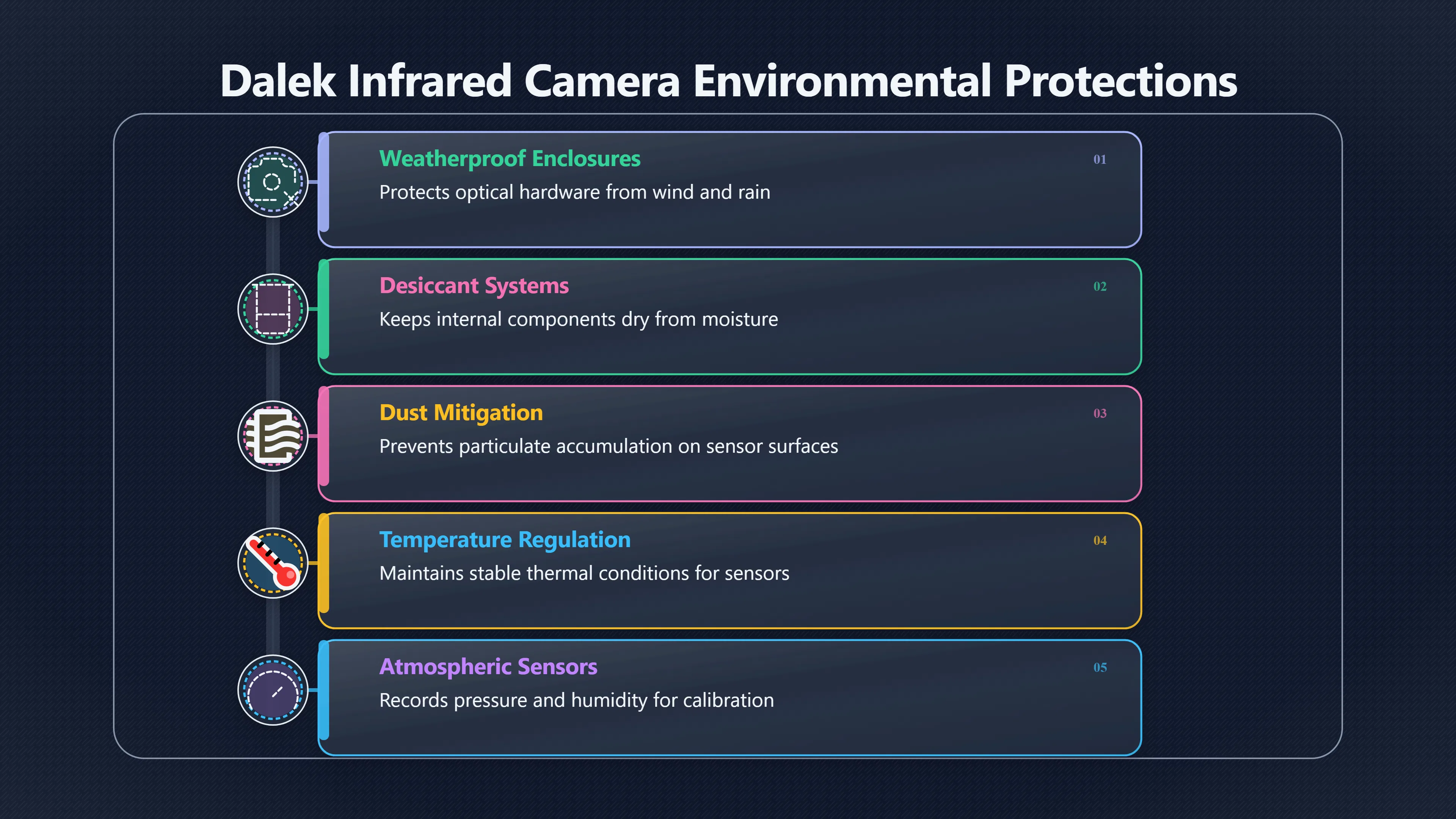
The Galileo Project’s commissioning work provides a useful illustration of the issue. Dalek was designed as an all-sky infrared camera array operating continuously in outdoor conditions. Its engineering documentation places significant emphasis on protection from wind, rain, snow, dust and moisture, including weather-resistant enclosures and desiccant systems intended to keep optical hardware dry.[MDPI]mdpi.comCommissioning an All-Sky Infrared Camera Array for…by L Domine · 2025 · Cited by 11 — The custom Dalek enclosure protects the came…
The attention devoted to environmental protection is itself revealing. A detector intended to identify unusual aerial events cannot assume that every unexpected signal originates in the sky. Moisture on optical surfaces, dust accumulation, temperature shifts within the enclosure and changing atmospheric transparency all have the potential to alter recorded imagery before any software analysis begins.[MDPI]mdpi.comCommissioning an All-Sky Infrared Camera Array for…by L Domine · 2025 · Cited by 11 — The custom Dalek enclosure protects the came…
Commissioning reports from the Galileo Project describe the collection of large numbers of ordinary aerial detections as part of a long-term census of the sky. Building that baseline is essential because weather-related effects become apparent only when large numbers of routine observations are compared across different environmental conditions.[Medium+2The Galileo Project]avi-loeb.medium.comCommissioning Data on Half a Million Objects in the Sky fromCommissioning Data on Half a Million Objects in the Sky from…November 12, 2024 — Reports on Unidentified Aerial Phenomena (UAP)…
Why Weak Tracks Confuse Object Detection
Most false alarms are not created by weather generating a convincing UFO-shaped object. Instead, weather degrades the information needed to identify ordinary objects.
Several mechanisms are especially important:
- Reduced visibility: Fog, mist and haze can hide parts of a flight path. Detection software may receive only fragments of an otherwise normal aircraft track.
- Variable infrared transmission: Water vapour absorbs infrared radiation unevenly, changing apparent brightness and making thermal targets fluctuate.
- Cloud-edge effects: Objects passing behind thin cloud layers can brighten, dim or disappear temporarily, creating unusual motion patterns in recorded data.
- Dust and aerosols: Particles scatter light and infrared energy, reducing image quality and increasing uncertainty in automated measurements.
- Rain and snow: Precipitation introduces moving features across the field of view while simultaneously degrading image contrast and tracking performance.[MDPI+2arXiv]mdpi.comCommissioning an All-Sky Infrared Camera Array for…by L Domine · 2025 · Cited by 11 — The custom Dalek enclosure protects the came…
These effects become particularly troublesome when combined with distance uncertainty. A nearby bird partially obscured by haze and a distant aircraft viewed through moisture-laden air may both generate incomplete tracks. If the detector lacks enough information to determine range, size or velocity confidently, classification algorithms may produce low-confidence outputs that require additional scrutiny.[arXiv]arxiv.orgOpen source on arxiv.org.
Treelines, Terrain and Local Weather Traps
False alarms do not arise solely from conditions overhead. The local environment around an observatory can interact with weather to create additional ambiguity.
Treelines are a useful example. When objects move near the horizon, branches and foliage can intermittently obscure them. Wind-driven motion in trees can also generate changing backgrounds that complicate tracking algorithms. During hazy conditions, the boundary between terrain and sky becomes less distinct, increasing the likelihood that a detector will lose and reacquire targets repeatedly. Each interruption can appear as a separate event rather than one continuous observation.
Similarly, heat rising from buildings, paved surfaces or nearby terrain can create local atmospheric distortions. These distortions affect apparent object position and brightness, especially close to the horizon where atmospheric path lengths are longest. Although such effects are familiar to astronomers, they become particularly important in systems attempting automated classification of every moving object in the sky.[arXiv]arxiv.orgOpen source on arxiv.org.
What Observatories Must Record About Conditions
The Galileo Project’s observatory concept addresses weather-related ambiguity by treating environmental measurements as part of the evidence record rather than auxiliary information. Its published instrument plans include sensors that monitor temperature, pressure, humidity and wind velocity alongside optical, infrared, radio and acoustic observations.[arXiv]arxiv.orgOpen source on arxiv.org.
This approach reflects a key lesson from automated UAP detection: a track cannot be evaluated properly without knowing the atmosphere through which it was observed.
Useful environmental metadata include:
- Air temperature and temperature trends.
- Relative humidity.
- Wind speed and direction.
- Atmospheric pressure.
- Precipitation status.
- Cloud coverage and visibility conditions.
- Local electric and magnetic field measurements.
- Instrument enclosure conditions such as moisture and temperature.[arXiv]arxiv.orgOpen source on arxiv.org.
When an unusual detection occurs, investigators can compare the event against the environmental record. A sudden loss of tracking during heavy humidity or a brightness fluctuation coinciding with cloud passage is less compelling as evidence of an anomalous object than the same behaviour observed under stable, clear conditions.
Weather Noise as a Scientific Risk
For automated UAP observatories, weather is not merely a source of inconvenience. It is a systematic source of uncertainty that can inflate the number of candidate anomalies if not measured carefully.
The Galileo Project’s emphasis on multimodal sensing, environmental monitoring and long-term sky censuses reflects recognition of this risk. A detector that records only images may struggle to distinguish between an unusual object and an unusual atmosphere. A detector that simultaneously records weather conditions, acoustic data, radio information and calibrated optical measurements is better positioned to determine whether an apparent anomaly belongs to the sky—or to the air through which the sky is being observed.[arXiv+2The Galileo Project]arxiv.orgOpen source on arxiv.org.
Amazon book picks
Further Reading
Books and field guides related to When Weather Becomes a UAP Problem. Use these as the next step if you want deeper reading beyond the article.

UFOs : Generals, Pilots, and Government Officials Go on the R...
Anchors the UAP observatory topic in credible aerial-anomaly reporting and investigation.
American Cosmic
Useful broader context for why UAP evidence, sensors and interpretation matter culturally.
The Signal and the Noise
Strong fit for false alarms, weak tracks, classification uncertainty and noisy sensor data.
The Weather Machine
Explains the measurement systems and atmospheric variables behind weather-aware observation.
eBay marketplace picks
Marketplace Samples
Example marketplace items related to this page. Use the search link to explore similar finds on eBay.
Endnotes
1.
Source: avi-loeb.medium.com
Title: Commissioning Data on Half a Million Objects in the Sky from
Link:https://avi-loeb.medium.com/commissioning-data-on-half-a-million-objects-in-the-sky-from-the-galileo-project-observatory-are-a23bd084233a
Source snippet
Commissioning Data on Half a Million Objects in the Sky from...November 12, 2024 — Reports on Unidentified Aerial Phenomena (UAP)...
Published: November 12, 2024
2.
Source: arxiv.org
Link:https://arxiv.org/abs/2305.18566
3.
Source: arxiv.org
Title: arXiv Galileo Project Observatory Class System Architecture
Link:https://arxiv.org/abs/2506.00125
4.
Source: mdpi.com
Link:https://www.mdpi.com/1424-8220/25/3/783
Source snippet
Commissioning an All-Sky Infrared Camera Array for...by L Domine · 2025 · Cited by 11 — The custom Dalek enclosure protects the came...
5.
Source: arxiv.org
Link:https://arxiv.org/abs/2411.07956
Source snippet
Commissioning An All-Sky Infrared Camera Array for...by L Dominé · 2024 · Cited by 11 — The Galileo Project is designing, building, and...
6.
Source: arxiv.org
Link:https://arxiv.org/html/2506.00125v1
Source snippet
1 Introduction30 May 2025 — A system designed for the comprehensive scientific study of aerial phenomena which integrates multiple sensor...
Published: May 2025
7.
Source: youtube.com
Title: The Galileo Project’s First Data on Half a Million Objects with Avi Loeb
Link:https://www.youtube.com/watch?v=uJtER5ahdPY
Source snippet
Using AI to detect strange events in the sky...
8.
Source: galileo.hsites.harvard.edu
Link:https://galileo.hsites.harvard.edu/publications/scientific-investigation-unidentified-aerial-phenomena-uap-using-multimodal
Source snippet
The Galileo ProjectThe Scientific Investigation of Unidentified Aerial Phenomena...A primary objective of the Galileo Project is to buil...
9.
Source: galileo.hsites.harvard.edu
Link:https://galileo.hsites.harvard.edu/publications
Source snippet
The Galileo ProjectThe Scientific Investigation of Unidentified Aerial Phenomena (UAP) Using Multimodal Ground-Based Observatories. Jou...
10.
Source: Wikipedia
Title: The Galileo Project
Link:https://en.wikipedia.org/wiki/The_Galileo_Project
Source snippet
The Galileo ProjectThe Galileo Project is an international scientific research project to search for extraterrestrial intelligence or...
Additional References
11.
Source: researchgate.net
Link:https://www.researchgate.net/publication/388466760_Commissioning_an_All-Sky_Infrared_Camera_Array_for_Detection_of_Airborne_Objects
Source snippet
(PDF) Commissioning an All-Sky Infrared Camera Array for...10 Jan 2025 — (Abridged) The Galileo Project aims to investigate Unidentified...
12.
Source: thedebrief.org
Link:https://thedebrief.org/galileo-project-releases-commissioning-data-on-half-a-million-aerial-objects-are-any-of-them-uap/
Source snippet
y of eight uncooled [infrared cameras]({{ 'infrared/' | relative_url }}) placed on half a sphere.Read more...
13.
Source: phys.org
Title: 2025 04 sky infrared camera dalek alien
Link:https://phys.org/news/2025-04-sky-infrared-camera-dalek-alien.html
Source snippet
An all-sky infrared camera named Dalek continues the...9 Apr 2025 — Galileo Project proposes an All-Sky Infrared Camera (Dalek) to searc...
14.
Source: universetoday.com
Title: an all sky infrared camera could search for alien spacecraft 1
Link:https://www.universetoday.com/articles/an-all-sky-infrared-camera-could-search-for-alien-spacecraft-1
Source snippet
An All-Sky Infrared Camera Named Dalek Continues...8 Apr 2025 — Galileo Project proposes an All-Sky Infrared Camera (Dalek) to search fo...
15.
Source: researchgate.net
Title: 392334596 Galileo Project Observatory Class System Architecture
Link:https://www.researchgate.net/publication/392334596_Galileo_Project_Observatory_Class_System_Architecture
Source snippet
The OCICP system consists of two subsystems. The first is the...Read more...
16.
Source: youtube.com
Link:https://www.youtube.com/watch?v=ZUBrIlxlNdI
Source snippet
Avi Loeb | The Crisis of Perception: UFOs, AI & Reality | TFP #103...
17.
Source: youtube.com
Title: Avi Loeb | The Crisis of Perception: UFOs, AI & Reality | TFP #103
Link:https://www.youtube.com/watch?v=1AvUp7cuo7E
Source snippet
Prof. Avi Loeb | The Crisis of Perception: UFOs, AI & Reality...
18.
Source: worldscientific.com
Link:https://www.worldscientific.com/doi/10.1142/S2251171723400068?srsltid=AfmBOooSmi7APx86ib8ngvQHCC0xXqfls9colGMF5iqqwJNNOL9N1G
Source snippet
The Scientific Investigation of Unidentified Aerial...by WA Watters · 2023 · Cited by 47 — A primary objective of the Galileo Project is...
19.
Source: worldscientific.com
Link:https://www.worldscientific.com/doi/10.1142/S2251171723400068?srsltid=AfmBOop-kdBugGPEeMbP5Y618NEdu6Qbxx07M9YAKjTUybhRVwb8sNL9
Source snippet
The Scientific Investigation of Unidentified Aerial...by WA Watters · 2023 · Cited by 47 — The primary science goal of the Galileo Proje...
20.
Source: youtube.com
Title: Using AI to detect strange events in the sky
Link:https://www.youtube.com/watch?v=nHMEfP68jqI
Source snippet
AI & Aliens: New Eyes on Ancient Questions // Richard Cloete // MLOps Podcast #288...
Topic Tree