Within Sky Detectors
What Did Hessdalen Teach UFO Detectors?
Hessdalen shows what decades of fixed monitoring can reveal and why recorded lights still may not settle an origin.
On this page
- Why Hessdalen became an instrumented hotspot
- What the station records and filters
- The limits of long term luminous phenomena monitoring
Page outline Jump by section
Introduction
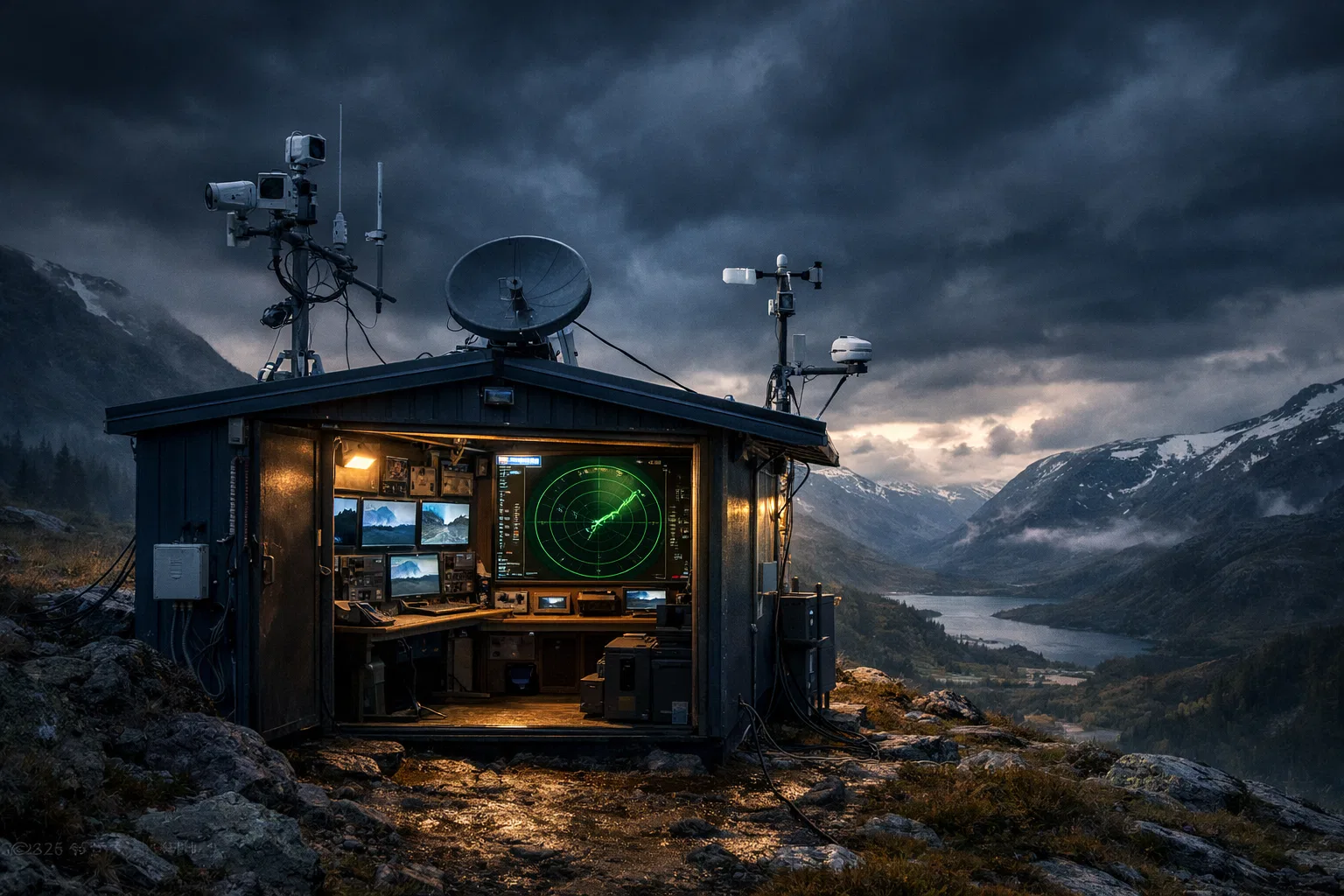
Hessdalen matters to automated UFO and UAP detection because it is one of the few places where repeated local reports led to a fixed, long-running measurement station rather than a one-off expedition. The Hessdalen Automatic Measurement Station, often called the AMS or “Blue Box”, began operating in August 1998 to watch a Norwegian valley associated with recurring luminous phenomena. Its importance is not that it solved the origin of the lights. It is that it showed what a persistent instrumented hotspot can do: gather time-stamped imagery, test ordinary explanations, build seasonal and hourly patterns, and expose the limits of single-site monitoring.[old.hessdalen.org]old.hessdalen.orgProject HessdalenProject Hessdalen
For modern automated UFO detectors, Hessdalen is a useful precedent and a cautionary tale. The station tried to replace anecdote with cameras, magnetometers, weather readings, radar experiments and later live-streamed video. Yet the central lesson is sober: long-term monitoring can improve the quality of the evidence without automatically producing a single accepted explanation. That makes Hessdalen a bridge between older UFO field investigations and today’s push for calibrated, multi-sensor UAP observatories. NASA’s 2023 UAP study made a similar point in broader terms: weak UAP analysis is often caused by poor calibration, missing metadata, too few simultaneous measurements and lack of baseline data.[NASA Science]science.nasa.govScience Independent Study Team ReportScience Independent Study Team Report
Why Hessdalen Became an Instrumented Hotspot
The Hessdalen valley in central Norway became famous because the reports were not isolated, one-night stories. Project Hessdalen’s own historical account says a field investigation in 1984 produced 53 light observations, while a winter 1985 investigation saw none during the period when instruments were present. The same account says observations later fell to roughly 20 per year, a lower rate than the early 1980s but still enough to justify a continuing monitoring effort.[old.hessdalen.org]old.hessdalen.orgProject HessdalenProject Hessdalen
That pattern created a problem familiar to anyone designing automated UAP detectors. If a phenomenon is intermittent, brief and hard to predict, sending people into the field for a few nights may miss it entirely. A fixed station is not glamorous, but it solves one important problem: it can watch when humans are absent. A teaching paper by Bjørn Gitle Hauge describes the reasoning behind the new Project Hessdalen clearly: instead of gathering many people to watch the sky and instruments, the project chose an automatic station that could record instruments and pictures continuously at lower cost. Student groups at Østfold College began the work in 1994, and the first version was ready for installation in 1998.[old.hessdalen.org]old.hessdalen.orgMicrosoft WordMicrosoft Word
This makes Hessdalen different from many better-known UFO cases. It was not only a collection of witness statements; it became a local measurement problem. The “hotspot” label matters because the valley offered a repeatable observing environment. Researchers could point cameras at known mountains, mask out roads and houses, compare events against local weather, and accumulate a baseline of ordinary sky activity. That is precisely the kind of discipline later UAP instrumentation projects have tried to formalise.
The institutional story also matters. Project Hessdalen describes itself today as a non-profit volunteer citizen-science organisation studying the Hessdalen Lights, while the older station pages show links to Østfold University College and a long history of student-built instrumentation. This was neither a fully state-funded observatory nor a purely private UFO club. It sat in an awkward but productive middle ground: volunteer-driven, technically ambitious, academically connected and chronically dependent on practical engineering compromises.[Project Hessdalen]hessdalen.orgOpen source on hessdalen.org.

What the Station Actually Recorded and Filtered
The first AMS was installed on 7 August 1998 in a blue container on the mountainside of Rognefjell, looking west towards Finnsåhøgda. A Project Hessdalen technical history says system 1 used two computers, a black-and-white CCD camera, a video recorder and a magnetometer. The computer analysed the camera image every second; if a light appeared and met the trigger criteria, the system saved an alarm picture, started the video recorder and sent the image to the internet.[old.hessdalen.org]old.hessdalen.orgProject HessdalenProject Hessdalen
That trigger logic is central to understanding Hessdalen as an automated detector. The system was not simply “filming UFOs”. It was deciding what counted as a candidate event. The light had to be large enough, strong enough and moving fast enough to trigger an alarm. This gave the station a practical way to avoid being overwhelmed, but it also meant the system could miss faint, slow, very brief or badly placed events. In later UAP language, the detector had a selection function: it saw the sky through its own thresholds.[old.hessdalen.org]old.hessdalen.orgProject HessdalenProject Hessdalen
The station evolved because the first system had an obvious weakness: with one camera, it could not calculate distance. System 2, installed from the end of July 2001 and expanded in 2002 and 2003, added two colour cameras 171 metres apart so that an object appearing in both could in principle be triangulated. It also added a zoom camera on a pan-tilt unit, a camera aimed at a radar screen, a weather station, low-frequency electromagnetic monitoring and improved magnetometer handling.[old.hessdalen.org]old.hessdalen.orgProject HessdalenProject Hessdalen
The details are revealing because they show how quickly “just put up a camera” becomes a measurement-engineering problem. The radar component, for example, did not simply deliver clean confirmation. Project Hessdalen’s own station page says the radar screen had so much noise that the team did not trust the signal and did not publish those pictures online. That is a valuable negative result. Instrumentation can add credibility, but only when its failure modes are understood and disclosed.[old.hessdalen.org]old.hessdalen.orgProject HessdalenProject Hessdalen
Later station descriptions show a more mature camera system. The AMS page describes three CCD cameras transmitting live video around the clock, with two cameras at the Blue Box and another at an upper station 171 metres away. It says the analogue video is digitised and streamed through Østfold University College, while a separate alarm system saves an image and short video sequence when something suddenly appears.[old.hessdalen.org]old.hessdalen.orgProject HessdalenProject Hessdalen
The station also used filtering by geography. One technical page explains that parts of the image containing houses and roads were masked out so the software did not analyse them. That choice is mundane but important: many UAP false alarms come from lights on roads, buildings, aircraft paths, insects near the camera, lens artefacts or known celestial objects. Hessdalen’s mask is a simple example of local knowledge being built into automated detection.[old.hessdalen.org]old.hessdalen.orgProject HessdalenProject Hessdalen
What Long Monitoring Revealed
The strongest result from Hessdalen is not a single spectacular image. It is the accumulation of patterns. Massimo Teodorani’s long-term survey, using AMS data from 1998 to 2001, reported that recorded luminous events tended to occur more often in winter and between about 10 pm and 1 am. The same paper notes that daylight records were extremely rare, and that the lights appeared low in the sky and close to the ground without following a preferred trajectory.[Project Hessdalen]hessdalen.orgProject Hessdalenscex-18-02-15 217..251Project Hessdalenscex-18-02-15 217..251
Those patterns matter because they move the discussion away from isolated stories. A witness report might say “a light appeared”; a station can ask when such lights tend to appear, where in the field of view they occur, whether they correlate with the Moon, whether artificial lights were eliminated, and whether there is a seasonal or weather-related pattern. The survey states that artificial lights were removed after identification, and that some large plotted lights in the AMS data were due to the Moon in different phases and periods. That is exactly the kind of filtering automated UFO detectors must do before treating an event as unusual.[Project Hessdalen]hessdalen.orgProject Hessdalenscex-18-02-15 217..251Project Hessdalenscex-18-02-15 217..251
Hessdalen also showed that a fixed camera can generate useful relative statistics without measuring the true number of events in the valley. The EMBLA 2000 report warned that the observatory’s field of view was only a little over 100 degrees, that faint or very short lights could be missed, and that events far away, hidden by hills or occurring on the opposite side of the station could not be recorded. The authors concluded that the station’s statistics were useful for relative time distributions, but not a complete census of all lights.[Project Hessdalen]hessdalen.orgProject Hessdalen Microsoft WordProject Hessdalen Microsoft Word
That distinction is easy to miss. A permanent detector may feel objective, but it still sees only what its location, optics, sensitivity, software and maintenance allow it to see. Hessdalen therefore teaches a crucial design principle: long duration is not the same as full coverage. A decade of one-site data can still be geometrically narrow.
The long-term survey also tested a tempting environmental hypothesis. Earlier analysis had suggested possible links between solar activity and some measured parameters from the 1984 campaign, especially magnetic perturbations. But when AMS data from 1998 to 2001 were compared with monthly and yearly sunspot number, the survey reported no correlation on those time-scales, while noting that other solar measures such as X-rays and radio flux still deserved study.[Project Hessdalen]hessdalen.orgProject Hessdalenscex-18-02-15 217..251Project Hessdalenscex-18-02-15 217..251
That is a good example of how monitoring can make a mystery less vague even when it does not solve it. It can rule down some simple correlations, expose gaps in earlier explanations and force more specific hypotheses. Hessdalen did not become “explained” by being measured, but it became harder to discuss responsibly without mentioning instrument limits, event filters, seasonal distributions and environmental checks.
The EMBLA Add-On: Turning a Sky Camera into a Physical Survey
The EMBLA missions are important because they show the next step beyond optical alarms. In 2000, Italian researchers working with Norwegian colleagues added radio and electromagnetic instruments to the Hessdalen effort. The EMBLA 2000 report describes a joint initiative involving the Italian Institute of Radioastronomy and Østfold College, with instruments operating in Hessdalen for 25 days. Its aim was to examine the radio spectrum of recurrent luminous phenomena in the UHF, VLF and ELF ranges.[Project Hessdalen]hessdalen.orgProject Hessdalen Microsoft WordProject Hessdalen Microsoft Word
The report framed EMBLA as an improvement over the 1984 measurements because it offered a wider frequency range, higher sensitivity and automated acquisition. It also said earlier work had indicated that the phenomenon was measurable: able to reflect radar waves, produce local magnetic perturbations and generate unexplained spike-like radio signals in the HF-VHF range. These claims should be read as research findings from the project literature, not as proof of an exotic origin. Their value for automated detector design is that they show why multiple sensor channels are attractive.[Project Hessdalen]hessdalen.orgProject Hessdalen Microsoft WordProject Hessdalen Microsoft Word
The 2004 long-term survey lists specific EMBLA 2000 instruments, including a VLF-ELF correlation receiver and spectrometer connected to loop antennas, sensitive to magnetic fields in the 1 kHz to 14 kHz range, and a VLF receiver connected to a dipole antenna, sensitive to electric fields from 1 kHz to 100 kHz. The former produced results the authors considered interesting; the latter produced no relevant results.[Project Hessdalen]hessdalen.orgProject Hessdalenscex-18-02-15 217..251Project Hessdalenscex-18-02-15 217..251
For readers interested in automated UFO detectors, that mixed outcome is more useful than a clean mystery story. Multi-sensor systems do not guarantee multi-sensor confirmation. Some channels may be noisy, irrelevant, under-characterised or hard to interpret. Others may produce candidate correlations that need replication. Hessdalen’s EMBLA phase shows both the promise and the burden of instrumenting a hotspot: once the detector records more than imagery, the analysis must also explain what each sensor can and cannot mean.
Why the Origin Remained Unsettled
Hessdalen is often presented in popular accounts as either a solved natural plasma case or a stubborn UFO mystery. The measured record supports a more careful reading. The station collected recurring light records, but the origin of all reported or recorded events remained unresolved. Teodorani’s survey states that AMS statistics helped establish that the phenomenon was not caused by known artificial sources in the analysed set, but did not lead to an understanding of the origin or physical nature of the lights.[Project Hessdalen]hessdalen.orgProject Hessdalenscex-18-02-15 217..251Project Hessdalenscex-18-02-15 217..251
Several natural models have been proposed. One published model suggests dusty plasma formed by ionisation of air and dust, with radon decay contributing alpha particles; another line of discussion has considered quartz-related piezoelectricity, while later work argued that piezoelectricity alone could not explain assumed internal geometric structures in some Hessdalen-like lights. These are attempts to explain luminous atmospheric phenomena within physics, not evidence that the station identified a craft or an intelligent source.[ResearchGate]researchgate.netResearch Gate A hypothetical dusty plasma mechanism of Hessdalen lightsResearch Gate A hypothetical dusty plasma mechanism of Hessdalen lights
There has also been dispute about prosaic explanations. Some Hessdalen-like sightings have been attributed in broader accounts to astronomical bodies, aircraft, car headlights or mirages, and there has been explicit back-and-forth in the literature over whether parts of the EMBLA optical survey were vulnerable to a car-headlight interpretation. The existence of such criticism is not a failure of instrumentation; it is a reminder that the hardest cases are often not “light versus no light” but distance, identity, geometry and context.[Wikipedia]WikipediaHessdalen lightsHessdalen lights
The station’s own design shows why this remained difficult. A single camera cannot measure distance. Two cameras can help, but only if the same event is captured clearly by both, synchronised accurately and interpreted with reliable geometry. Radar could help, but the project’s own radar-screen experiment was undermined by noise. Magnetometers and radio receivers can add context, but a coincident fluctuation does not automatically identify the cause.[old.hessdalen.org]old.hessdalen.orgProject HessdalenProject Hessdalen
That is why Hessdalen’s long experiment is so relevant to UAP research. Better instruments do not remove ambiguity by themselves; they relocate the argument into calibration, synchronisation, sensor coverage, false-alarm handling and repeatability. A poor phone video leaves people arguing about impressions. A station like Hessdalen leaves them arguing about thresholds, baselines, geometry and signal interpretation. That is progress, but not closure.
What Hessdalen Teaches Modern UAP Detectors
The first lesson is that location matters. Hessdalen was attractive because reports were geographically concentrated and recurring. For automated UAP detection, that means a hotspot can be a rational first deployment site: not because it is guaranteed to contain something extraordinary, but because recurrence improves the odds of collecting comparable data.
The second lesson is that automation must be paired with transparent filtering. Hessdalen’s alarm system saved events only above particular size, brightness and motion thresholds, and its later software masked out roads and houses. Those choices are sensible, but they shape the evidence. A detector that does not document its thresholds is not much better than an eyewitness whose viewing conditions are unknown.[old.hessdalen.org]old.hessdalen.orgProject HessdalenProject Hessdalen
The third lesson is that multi-sensor data are essential but messy. Hessdalen’s cameras, magnetometers, weather station, radio experiments and radar attempts show the right instinct: collect independent context around an event. But the radar noise problem and the mixed EMBLA radio results show that adding sensors also adds failure modes. More instruments mean more ways to be misled unless calibration and baseline behaviour are documented.[old.hessdalen.org]old.hessdalen.orgProject HessdalenProject Hessdalen
The fourth lesson is that long monitoring can answer statistical questions before it answers origin questions. Hessdalen produced useful observations about winter prevalence, night-time timing, rarity of daylight events and lack of simple sunspot correlation in one analysed data set. Those are meaningful findings even without a final explanation.[Project Hessdalen]hessdalen.orgProject Hessdalenscex-18-02-15 217..251Project Hessdalenscex-18-02-15 217..251
The final lesson is humility. Hessdalen is one of the most interesting precedents for instrumented UFO detection precisely because it did not deliver a simple ending. It made the phenomenon more measurable, not automatically more explainable. For modern UAP observatories, that may be the realistic benchmark: collect better data, reduce false positives, preserve context, publish limitations, and accept that a durable record can narrow the mystery without making it disappear.
Amazon book picks
Further Reading
Books and field guides related to What Did Hessdalen Teach UFO Detectors?. Use these as the next step if you want deeper reading beyond the article.
In Plain Sight: an Investigation Into UFOs and Impossible Sci...
Explores contemporary UAP investigations, sensor evidence, and the limits of available data.
The Hynek UFO Report
Discusses investigation methods, observational data, and the difficulties of reaching firm conclusions from sightings.

UFOs : Generals, Pilots, and Government Officials Go on the R...
Focuses on evidence quality, multiple witnesses, radar data, and the challenge of investigating anomalous aerial reports.
The UFO Experience
Examines systematic observation, classification, and evidence assessment relevant to automated monitoring efforts.
eBay marketplace picks
Marketplace Samples
Live-tested eBay searches with available results related to this page.

Endnotes
1.
Source: old.hessdalen.org
Title: Project Hessdalen
Link:https://old.hessdalen.org/reports/ProjectHessdalen-story-April2002-letter.pdf
2.
Source: hessdalen.org
Title: Project Hessdalenscex-18-02-15 217..251
Link:https://hessdalen.org/reports/scex1802217251.pdf
3.
Source: science.nasa.gov
Title: Science Independent Study Team Report
Link:https://science.nasa.gov/wp-content/uploads/2023/09/uap-independent-study-team-final-report.pdf
4.
Source: nasa.gov
Title: update nasa shares uap independent study report names director
Link:https://www.nasa.gov/news-release/update-nasa-shares-uap-independent-study-report-names-director/
5.
Source: old.hessdalen.org
Title: Project Hessdalen
Link:https://old.hessdalen.org/index_e.shtml
6.
Source: old.hessdalen.org
Title: Microsoft Word
Link:https://old.hessdalen.org/reports/E522BD.pdf
7.
Source: hessdalen.org
Link:https://www.hessdalen.org/
8.
Source: old.hessdalen.org
Title: Project Hessdalen
Link:https://old.hessdalen.org/station/
9.
Source: hessdalen.org
Title: Project Hessdalen Microsoft Word
Link:https://hessdalen.org/reports/EMBLA-2000.pdf
10.
Source: old.hessdalen.org
Title: Project Hessdalen
Link:https://old.hessdalen.org/station/second.shtml
11.
Source: old.hessdalen.org
Title: Project Hessdalen
Link:https://old.hessdalen.org/station/third.shtml
12.
Source: researchgate.net
Title: Research Gate A hypothetical dusty plasma mechanism of Hessdalen lights
Link:https://www.researchgate.net/publication/222751827_A_hypothetical_dusty_plasma_mechanism_of_Hessdalen_lights
13.
Source: Wikipedia
Title: Hessdalen lights
Link:https://en.wikipedia.org/wiki/Hessdalen_lights
14.
Source: Wikipedia
Title: Hessdalen AMS
Link:https://en.wikipedia.org/wiki/Hessdalen_AMS
15.
Source: Wikipedia
Title: Hessdalen AMS
Link:https://de.wikipedia.org/wiki/Hessdalen_AMS
16.
Source: Wikipedia
Link:https://en.wikipedia.org/wiki/Hessdalen
17.
Source: old.hessdalen.org
Title: Hessdal article2000.shtml
Link:https://old.hessdalen.org/reports/Hessdal-article2000.shtml
18.
Source: old.hessdalen.org
Link:https://old.hessdalen.org/station/1999/
19.
Source: old.hessdalen.org
Title: Hessdalen Database English Nov2017
Link:https://old.hessdalen.org/reports/Hessdalen_Database_English_Nov2017.pdf
20.
Source: hessdalen.org
Link:https://hessdalen.org/rapporter/PH-artikkel032002.pdf
21.
Source: old.hessdalen.org
Link:https://old.hessdalen.org/sse/program/
22.
Source: old.hessdalen.org
Title: 2025 2502.06794v2
Link:https://old.hessdalen.org/reports/2025-2502.06794v2.pdf
23.
Source: old.hessdalen.org
Title: ufo it 1995
Link:https://old.hessdalen.org/press/journals/ufo-it-1995.pdf
24.
Source: old.hessdalen.org
Link:https://old.hessdalen.org/pictures/
25.
Source: hessdalen.org
Link:https://www.hessdalen.org/theories
26.
Source: researchgate.net
Link:https://www.researchgate.net/publication/228609015_A_long-term_scientific_survey_of_the_Hessdalen_phenomenon
27.
Source: researchgate.net
Title: 228559449 The EMBLA 2000 Mission in Hessdalen
Link:https://www.researchgate.net/publication/228559449_The_EMBLA_2000_Mission_in_Hessdalen
28.
Source: researchgate.net
Link:https://www.researchgate.net/figure/Flow-chart-of-the-Automatic-Measurement-Station-in-Hessdalen-System-2_fig1_241540573
29.
Source: researchgate.net
Link:https://www.researchgate.net/figure/Flow-chart-of-the-Automatic-Measurement-Station-in-Hessdalen-System-2_fig1_241556861
30.
Source: researchgate.net
Title: 252836793 EMBLA 2002 an Optical and Ground Survey in Hessdalen
Link:https://www.researchgate.net/publication/252836793_EMBLA_2002_an_Optical_and_Ground_Survey_in_Hessdalen
31.
Source: researchgate.net
Link:https://www.researchgate.net/publication/239920959_Hessdalen_Light_Phenomena_and_the_Inconsistency_of_the_Car-Headlight_Interpretation
32.
Source: science.nasa.gov
Link:https://science.nasa.gov/uap/
33.
Source: en.hessdalen.de
Link:https://www.en.hessdalen.de/measurement-stations.html
34.
Source: facebook.com
Link:https://www.facebook.com/groups/388012498516204/posts/1169604847023628/
35.
Source: societyforuapstudies.org
Title: project hessdalen
Link:https://www.societyforuapstudies.org/project-hessdalen
36.
Source: veriarch.com
Title: The Hessdalen Lights
Link:https://veriarch.com/the-hessdalen-lights
37.
Source: fundamentaljournals.com
Link:https://www.fundamentaljournals.com/index.php/ijfps/article/view/100
Additional References
38.
Source: youtube.com
Link:https://www.youtube.com/watch?v=KaFWf5wYkaM
Source snippet
THE HESSDALEN PHENOMENON - English trailer (2023)...
39.
Source: youtube.com
Title: The Hessdalen Lights Have Stumped Scientists for 40 Years
Link:https://www.youtube.com/watch?v=YihXXHJ8VKc
Source snippet
Mysterious Hessdalen Lights Baffle Scientists | The Proof Is Out There | The UnXplained Zone...
40.
Source: facebook.com
Link:https://www.facebook.com/groups/625436697499583/posts/7266561173387069/
41.
Source: journalofscientificexploration.org
Link:https://journalofscientificexploration.org/index.php/jse/article/view/234/219
42.
Source: medium.com
Link:https://medium.com/%40krindiri/six-minds-one-valley-one-big-mistery-remote-viewing-the-famous-hessdalen-lights-bca46c64c9a8
43.
Source: instagram.com
Link:https://www.instagram.com/reel/DX9pIrat530/
44.
Source: instagram.com
Link:https://www.instagram.com/reel/DX9pIrat530/?hl=en
45.
Source: medium.com
Link:https://medium.com/%40kyeq1/the-valley-that-wouldnt-explain-itself-9a34db28be4a
46.
Source: visithessdalen.no
Link:https://visithessdalen.no/en
47.
Source: research-collection.ethz.ch
Link:https://www.research-collection.ethz.ch/server/api/core/bitstreams/67dcdf4d-15f9-4538-95c7-201fad80ca03/content
Topic Tree