Within Timing
Why UAP Stations Need a Real Clock
Satellite timing can give a detector station a stable reference point when local computers, networks and sensors introduce delays.
On this page
- How satellite timing anchors station records
- Pulse per second timing in practical detector builds
- Limits and failure modes to document
Page outline Jump by section
Introduction
For an automated UAP detector, the station clock is part of the measuring instrument, not merely a way to name files. If the clock cannot be trusted, it becomes difficult to determine whether a camera frame, radio signal, environmental sensor reading or observation from another station truly describes the same event. A GPS-disciplined clock, more accurately described today as a GNSS-disciplined oscillator (GNSSDO), provides an independent reference to Coordinated Universal Time (UTC) that is far more stable than relying on an ordinary computer clock or an internet connection alone. Studies from the US National Institute of Standards and Technology (NIST) show that properly implemented GPS-disciplined oscillators can provide timing referenced to UTC with uncertainties well below a microsecond after calibration, making them suitable for demanding scientific instrumentation rather than simple computer timekeeping.[NIST+2NIST]tf.boulder.nist.govCharacterizing the Performance of GPS Disciplined Oscillators…by MA Lombardi · Cited by 51 — can provide time accurate to within 1…
 Within an automated instrumented UAP station, a GPS-disciplined clock therefore serves as the common time reference that allows independent sensors to be compared objectively. It does not prove that an unusual object exists, but it greatly improves confidence that all recorded measurements describe the same physical event.
How satellite timing anchors station records
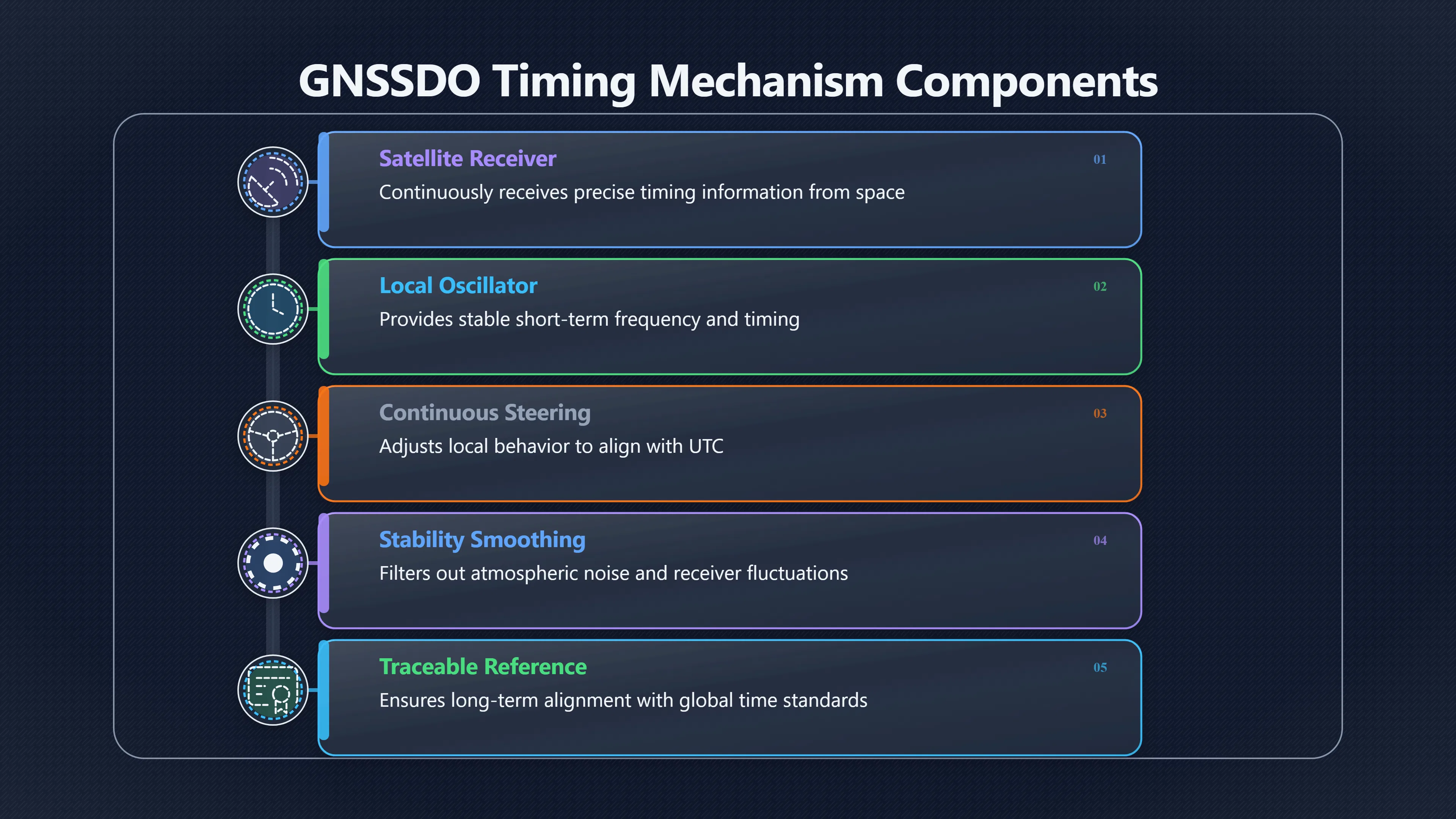
A GPS-disciplined oscillator combines two complementary elements: a satellite navigation receiver that continuously receives precise timing information, and a high-quality local oscillator—typically an oven-controlled crystal oscillator (OCXO) or, in higher-end systems, a rubidium standard. Rather than simply reading GPS time, the system continuously adjusts, or “disciplines”, the local oscillator so that its long-term behaviour remains aligned with UTC while preserving excellent short-term stability.[NIST+2NIST]nist.govIt discusses how GPSDOs work, how measurement traceability can be established with a GPSDO,Read more…
This distinction matters because satellite signals alone are not perfectly stable over very short intervals. Atmospheric effects, receiver noise and antenna conditions introduce small fluctuations. Conversely, a quality local oscillator is exceptionally stable over seconds or minutes but gradually drifts over hours or days. A disciplined oscillator combines the strengths of both:
- GPS provides long-term traceability to UTC.
- The local oscillator smooths short-term variations.
- Continuous steering prevents long-term drift.
- The resulting clock remains stable even between successive satellite updates.[NIST+2NIST]nist.govIt discusses how GPSDOs work, how measurement traceability can be established with a GPSDO,Read more…
For a UAP station, this means every sensor can timestamp observations against the same physical time reference instead of relying on separate software clocks that may drift independently.
Pulse-per-second timing in practical detector builds
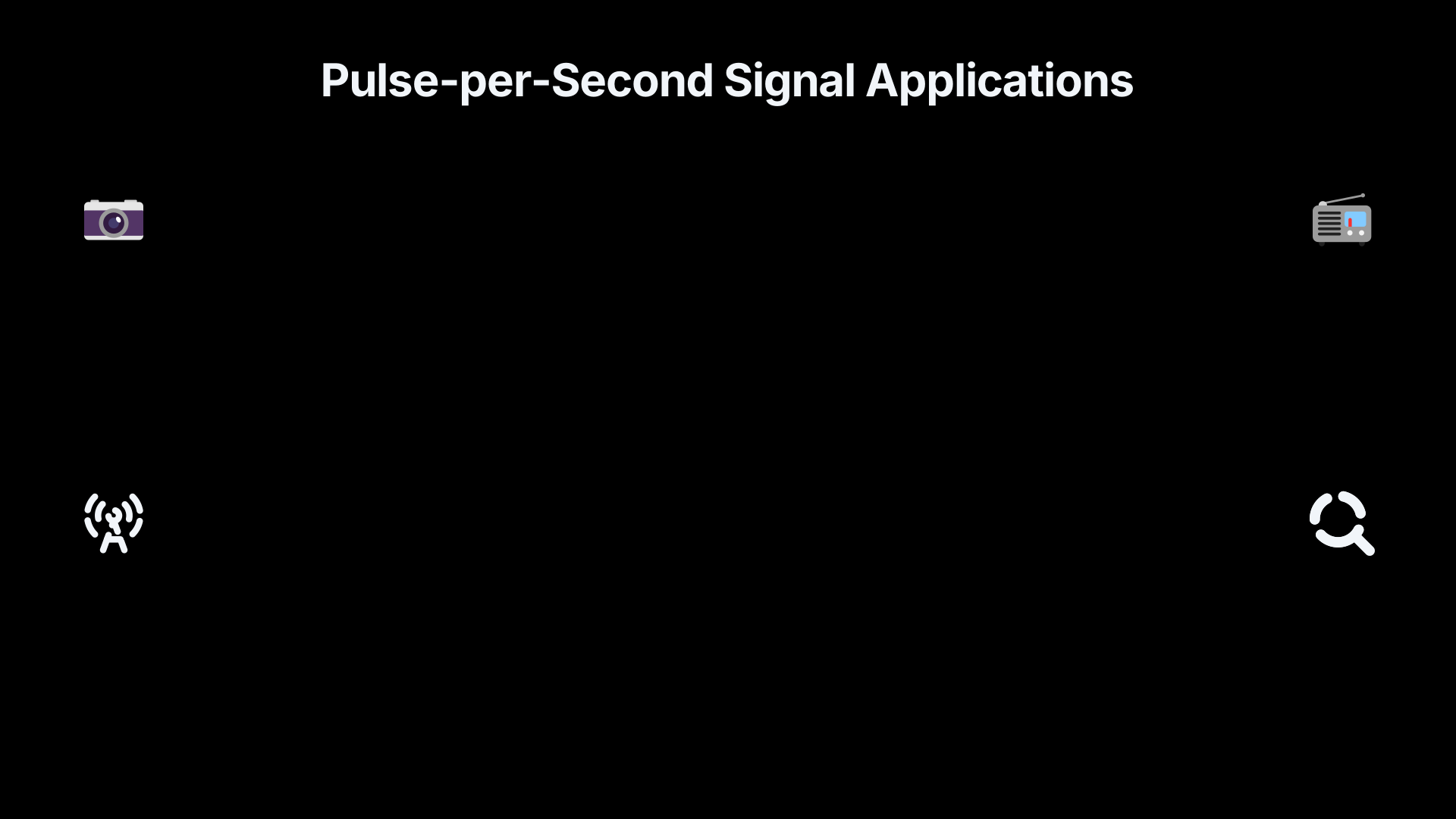
The most useful output from a GPS-disciplined clock is usually not the displayed time but its one pulse per second (1 PPS) signal. This electrical pulse marks the start of every UTC second with extremely low uncertainty and can be distributed directly to cameras, data acquisition hardware, embedded computers and other instruments. Many systems also provide a stable 10 MHz reference for equipment requiring precise frequency synchronisation.[gps.gov+2Safran - Navigation & Timing]gps.govAn Evaluation of Dependencies of Critical Infrastructure…by MA Lombardi · 2021 · Cited by 34 — The LO provides disciplined output sign…
In a practical automated UAP observatory, the PPS signal can be used in several ways:
- Camera synchronisation. Frame counters can be locked or periodically aligned to PPS so that video timestamps remain consistent over long observing sessions.
- Sensor correlation. Radio receivers, microphones, weather instruments and optical sensors can all record against the same second boundaries.
- Distributed stations. Independent observatories separated by kilometres can compare observations without relying on internet latency or manually synchronised clocks.
- Event reconstruction. Analysts can determine whether measurements from different sensors overlap closely enough to describe one physical object rather than unrelated events.[gps.gov+2NIST]gps.govAn Evaluation of Dependencies of Critical Infrastructure…by MA Lombardi · 2021 · Cited by 34 — The LO provides disciplined output sign…
The important point is that PPS establishes a hardware timing reference. Software timestamps generated only after an operating system processes data packets may include unpredictable scheduling delays, whereas hardware timestamping tied to PPS substantially reduces this uncertainty.
Why a GPS clock is better than relying on computer time
A computer’s internal clock is influenced by oscillator quality, processor scheduling, operating-system delays and power-management behaviour. Even when synchronised over the internet using Network Time Protocol (NTP), accuracy depends on network latency and asymmetry.
A GPS-disciplined clock avoids these variables by generating its own local timing reference directly from satellite time. The detector does not need a continuously functioning internet connection to maintain accurate timing, and all connected instruments share the same physical clock rather than attempting to synchronise independently. NIST notes that GPS-disciplined oscillators can serve as primary frequency standards when correctly implemented and verified, although performance varies considerably between designs.[NIST]nist.govIt discusses how GPSDOs work, how measurement traceability can be established with a GPSDO,Read more…
For scientific event reconstruction, this independence is valuable because timing errors become measurable characteristics of the station itself instead of unknown properties of an external network.
Limits and failure modes to document
Although GPS-disciplined clocks provide excellent timing, they are not infallible. Good instrument design requires documenting when the timing reference is degraded rather than assuming perfect operation.
Loss of satellite reception
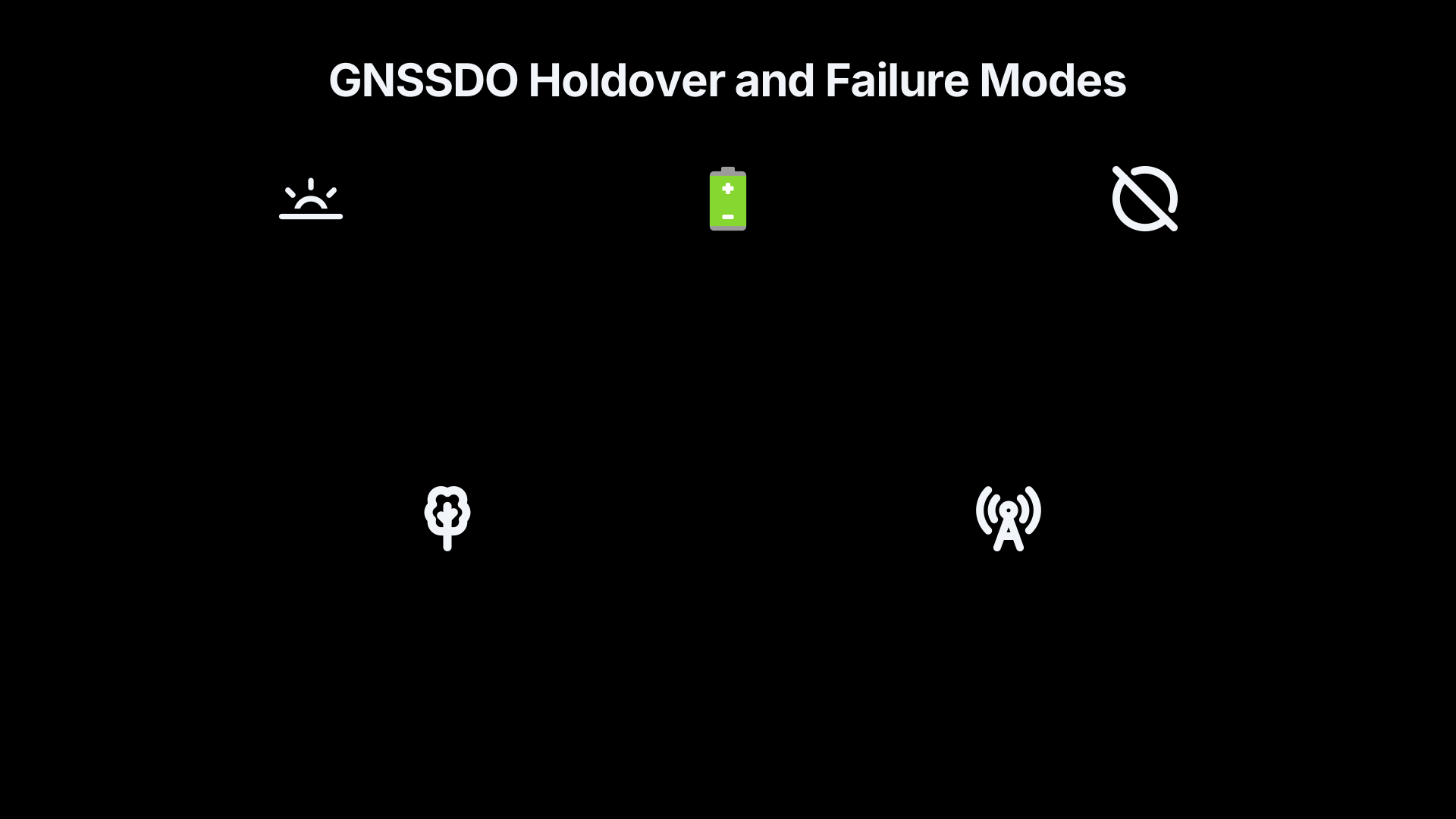
If the antenna loses satellite visibility because of weather, foliage, nearby buildings or antenna faults, the receiver enters holdover mode. During holdover, the internal oscillator continues running using its previously learned behaviour.
Holdover performance depends almost entirely on oscillator quality:
- inexpensive crystal oscillators may drift noticeably within minutes or hours;
- high-grade OCXOs maintain useful accuracy much longer;
- rubidium-based systems offer still longer holdover periods.[iqdfrequencyproducts.com+2Wikipedia]iqdfrequencyproducts.com8hrs, then there is no need to specify the clock module with its full holdover…Read more…
A UAP station should therefore log when holdover begins and ends so analysts know whether timestamps were referenced directly to satellites or to a free-running oscillator.
Antenna and installation effects
GPS timing accuracy depends on more than the receiver itself. Antenna placement, cable length, multipath reflections from nearby structures and calibration of cable delays all influence final timing accuracy. NIST measurements show that cable-delay calibration is important when seeking sub-microsecond performance.[NIST]tf.boulder.nist.govCharacterizing the Performance of GPS Disciplined Oscillators…by MA Lombardi · Cited by 51 — can provide time accurate to within 1…
For permanent detector stations, installation records should include:
- antenna model and location;
- cable type and measured delay;
- date of calibration;
- firmware version of the timing receiver;
- estimated timing uncertainty after installation.
These details become part of the station’s measurement provenance.
Jamming, spoofing and interference
GNSS signals arriving at Earth are extremely weak. They can be disrupted accidentally by local radio-frequency interference or, more rarely, intentionally through jamming or spoofing. Timing systems designed for critical infrastructure therefore often monitor satellite lock quality, receiver alarms and holdover status rather than accepting every timing update uncritically.[Wikipedia]WikipediaHoldover in synchronization applicationsHoldover in synchronization applications
For UAP instrumentation, logging these receiver health indicators alongside every observation provides later analysts with evidence that the timing reference remained trustworthy throughout the recording.
What should be recorded with every event
A trustworthy timestamp is more than a UTC value. The metadata accompanying each observation should include enough information for another investigator to assess timing quality independently.
Useful timing metadata includes:
- UTC timestamp with stated precision.
- Whether the timestamp originated from hardware PPS or software time.
- GPS lock status at the moment of recording.
- Holdover status, if applicable.
- Estimated timing uncertainty.
- Receiver model and firmware.
- Antenna configuration and calibration date where known.
Recording this information transforms timing from an assumption into a documented measurement characteristic.
The practical value for automated UAP detection
Most reported UAP events ultimately require comparison with independent data such as astronomical catalogues, aircraft transponders, meteor observations, weather records or observations from another detector station. Those comparisons depend on trustworthy timing at least as much as they depend on image quality.
A GPS-disciplined clock cannot determine whether an observed object is ordinary or anomalous. Its contribution is more fundamental: it establishes a common, traceable timeline across every sensor in the observing system. When multiple stations independently record the same event against a documented UTC reference with known uncertainty, analysts gain a much firmer basis for triangulation, sensor fusion and later verification than would ever be possible with loosely synchronised computer clocks alone.[NIST+2NIST]nist.govIt discusses how GPSDOs work, how measurement traceability can be established with a GPSDO,Read more…
Amazon book picks
Further Reading
Books and field guides related to Why UAP Stations Need a Real Clock. Use these as the next step if you want deeper reading beyond the article.

Measurement Systems Application and Design
First published 1966. Subjects: Measuring instruments, Physical measurements, Meetinstrumenten, Capteurs (technologie), Messgerät.
eBay marketplace picks
Marketplace Samples
Live-tested eBay searches with available results related to this page.




Endnotes
1.
Source: tf.boulder.nist.gov
Link:https://tf.boulder.nist.gov/general/pdf/2086.pdf
Source snippet
Characterizing the Performance of GPS Disciplined Oscillators...by MA Lombardi · Cited by 51 — can provide time accurate to within 1...
2.
Source: nist.gov
Link:https://www.nist.gov/publications/use-gps-disciplined-oscillators-primary-frequency-standards-calibration-and-metrology
Source snippet
It discusses how GPSDOs work, how measurement traceability can be established with a GPSDO,Read more...
3.
Source: tf.nist.gov
Link:https://tf.nist.gov/general/pdf/1424.pdf
Source snippet
GPS, well known as a versatile, global tool for positioning, has also become the primary system for distributing time and frequency.Read...
4.
Source: tf.nist.gov
Link:https://tf.nist.gov/general/pdf/2294.pdf
Source snippet
GPSDO designer is to transfer the inherent accuracy and stability of the satellite signals to the signals generated by the local oscillat...
5.
Source: Wikipedia
Title: GPS disciplined oscillator
Link:https://en.wikipedia.org/wiki/GPS_disciplined_oscillator
Source snippet
GPS disciplined oscillatorThese signals are accurate to nanoseconds and provide a good reference for timing applications. A GPS discip...
6.
Source: gps.gov
Link:https://www.gps.gov/sites/default/files/2025-07/NIST.TN_.2189.pdf
Source snippet
An Evaluation of Dependencies of Critical Infrastructure...by MA Lombardi · 2021 · Cited by 34 — The LO provides disciplined output sign...
7.
Source: safran-navigation-timing.com
Link:https://safran-navigation-timing.com/solution/gps-disciplined-oscillators-gpsdo/
Source snippet
Navigation & TimingGPS Disciplined Oscillators (GPSDO)A multi-GNSS disciplined oscillator (GNSSDO) takes in signals from a GNSS, and spit...
8.
Source: iqdfrequencyproducts.com
Link:https://www.iqdfrequencyproducts.com/en/app-note/disciplined-ocxo-specification
Source snippet
8hrs, then there is no need to specify the clock module with its full holdover...Read more...
9.
Source: Wikipedia
Title: Holdover in synchronization applications
Link:https://en.wikipedia.org/wiki/Holdover_in_synchronization_applications
10.
Source: tf.nist.gov
Link:https://tf.nist.gov/general/pdf/2297.pdf
Source snippet
Use of GPS Disciplined Oscillators as Primary Frequency...by MA Lombardi · Cited by 172 — The goal of the GPSDO designer is to transfer...
Additional References
11.
Source: microchip.com
Link:https://www.microchip.com/en-us/products/clock-and-timing/components/gnss-gps-disciplined
12.
Source: kb.veexinc.com
Link:https://kb.veexinc.com/en/knowledge/gps-disciplining-holdover-for-field-testing
Source snippet
hat is continuously being corrected using the coordinated universal timing signal (...Read more...
13.
Source: blog.bliley.com
Title: what are gps disciplined oscillators gpsdo applications
Link:https://blog.bliley.com/what-are-gps-disciplined-oscillators-gpsdo-applications
Source snippet
Are GPS Disciplined Oscillators (GPSDO)?Apr 27, 2023 — GPSDO timing signals are accurate up to nanoseconds and are capable of generating...
14.
Source: gssc.esa.int
Title: int GP S Time and Frequency Transfer Techniques
Link:https://gssc.esa.int/navipedia/index.php/GPS_Time_and_Frequency_Transfer_Techniques
Source snippet
Time and Frequency Transfer Techniques - NavipediaJun 21, 2012 — The GPS Carrier phase is one of the most powerful techniques for time tr...
15.
Source: researchgate.net
Title: 269520225 A NIST Disciplined Oscillator
Link:https://www.researchgate.net/publication/269520225_A_NIST_Disciplined_Oscillator
Source snippet
(PDF) A NIST Disciplined OscillatorDec 15, 2014 — This paper discusses the theory of operation of the NISTDO, and demonstrates the accura...
16.
Source: rntfnd.org
Title: UTC (USNO) via an external reference, currently GPS.Read more
Link:https://rntfnd.org/wp-content/uploads/NIST-Paper-on-Modernized-Loran-.pdf
Source snippet
ptti capabilities of the modernized loran systemby K Montgomery · Cited by 10 — The TFE uses the oscillators to compute its own local tim...
17.
Source: youtube.com
Title: BG7TBL GPSDO (GPS Disciplined Oscillator) and 10 MHz Distribution Amplifier
Link:https://www.youtube.com/watch?v=EgF6-JbGUXA
Source snippet
How to Calibrate Oscillators with GPS module...
18.
Source: insidegnss.com
Link:https://insidegnss.com/nist-confirms-stl-as-accurate-time-source-independent-of-gnss-and-indoors/
Source snippet
NIST Confirms STL as Accurate Time Source Independent...Apr 22, 2021 — The evaluation by NIST confirms that users of PNT-reliant applica...
19.
Source: youtube.com
Title: Stanford Research Systems FS752 GNSSDO teardown, [review]({{ ‘review/’ | relative_url }}), and experiments
Link:https://www.youtube.com/watch?v=mbS7AiLWte8
Source snippet
Developing a GPSDO from scratch - part 1...
20.
Source: youtube.com
Title: Developing a GPSDO from scratch
Link:https://www.youtube.com/watch?v=pWjpdjZx554
Source snippet
BG7TBL GPSDO (GPS Disciplined Oscillator) and 10 MHz Distribution Amplifier...
Topic Tree