Within Hotspots
Hotspot Stations or Citizen Sky Networks?
A full hotspot instrument suite can chase repeat events, while citizen networks trade depth at one site for comparable coverage across many skies.
On this page
- Why dense equipment fits high yield locations
- Why cheaper stations help broad comparison
- How a staged strategy can use both approaches
Page outline Jump by section
Introduction
Designing an automated instrumented UFO or UAP detector network is as much a deployment problem as an engineering one. A limited budget can either fund a heavily instrumented station at a location with a history of repeated reports, or a larger number of simpler stations spread across many regions. Neither strategy is inherently superior because they answer different scientific questions. Dense hotspot stations maximise the chance of collecting detailed measurements if unusual events genuinely recur at a specific location. Citizen sky networks sacrifice per-site sophistication in exchange for geographic reach, making them better suited to measuring how often unusual detections occur against the ordinary background of aircraft, satellites, meteors, weather and wildlife. Modern projects increasingly view these approaches as complementary rather than competing.[MDPI+2Sky360]mdpi.comCommissioning an All-Sky Infrared Camera Array for…by L Domine · 2025 · Cited by 11 — Galileo Project is designing, building, and…

Why dense equipment fits high-yield locations
The strongest argument for concentrating expensive equipment is efficiency. Multi-sensor observatories combining optical, infrared, radio, acoustic and environmental instruments are costly to build, calibrate and maintain. Deploying them where reports have historically clustered increases the probability that every operating hour captures useful data rather than empty sky.
A hotspot observatory can also pursue questions that are impossible with isolated sightings. Because the instruments remain fixed for months or years, researchers can compare detections against local weather, terrain, magnetic conditions, aircraft traffic, seasonal variation and viewing geometry. Even if every event ultimately receives a conventional explanation, the station produces a detailed environmental baseline that improves later analysis.
Recent observatory designs illustrate this philosophy. The Galileo Project’s commissioning work combines infrared cameras, visible-light sensors, radio receivers and other instruments into a continuously operating platform. Rather than merely recording unusual objects, the system is intended to establish the statistical background of normal aerial activity so that genuine anomalies, if present, can be identified through comparison with millions of routine detections. Calibration against aircraft broadcasting Automatic Dependent Surveillance–Broadcast (ADS-B) signals demonstrates the importance of accurately characterising known traffic before investigating unknowns.[MDPI+2arXiv]mdpi.comCommissioning an All-Sky Infrared Camera Array for…by L Domine · 2025 · Cited by 11 — Galileo Project is designing, building, and…
This concentration of resources also allows improvements that would be prohibitively expensive across hundreds of sites, including:
- higher-resolution imaging and spectroscopy;
- multiple sensor modalities operating simultaneously;
- precise timing and calibration between instruments;
- continuous maintenance and quality control;
- rapid upgrades when weaknesses are discovered.
The disadvantage is equally clear: conclusions drawn from one valley, coastline or military training area may not generalise elsewhere. A hotspot may represent a genuinely unusual environment—or simply reflect local reporting culture, observer expectations or unique atmospheric conditions.
Why cheaper stations help broad comparison
Citizen sky networks invert these priorities. Instead of asking whether one location repeatedly produces unusual events, they ask whether the same types of detections appear across many independent observers using comparable equipment.
This wider coverage has several scientific advantages.
First, it reduces geographic bias. If apparently anomalous detections occur only at famous locations, that pattern may suggest local environmental factors or social influences. If comparable events appear across diverse regions under standardised observation methods, the phenomenon becomes more difficult to dismiss as a purely local effect.
Second, distributed stations generate much larger background datasets. Machine-learning systems require enormous numbers of examples of aircraft, satellites, birds, insects, clouds and weather phenomena before they can reliably recognise unusual cases. Hundreds of modest stations can contribute this training data far faster than one elite observatory.[Sky360]sky360.orgObservational Citizen Science of Earth's AtmosphereSky360 is an open-source global sky observation network using AI-powered tracking stat…
Third, citizen networks provide independent replication. An isolated detection at one station is difficult to interpret, but simultaneous observations from multiple locations can constrain direction, altitude and trajectory while reducing the likelihood that an instrument fault explains the event.
Projects such as Sky360 explicitly embrace this model. Rather than building a few specialised observatories, the project promotes affordable, open-source stations that volunteers can assemble themselves. Wide-angle cameras continuously monitor the sky, while software detects moving objects and can trigger higher-resolution follow-up sensors. Hardware and software are openly developed so that identical methods can be reproduced by many participants instead of remaining confined to one research institution.[Sky360]sky360.orgObservational Citizen Science of Earth's AtmosphereSky360 is an open-source global sky observation network using AI-powered tracking stat…
Citizen-science research in other areas of astronomy and atmospheric science demonstrates the same principle. Large volunteer networks have successfully contributed to meteor recovery, aurora classification and transient astronomical surveys because broad participation creates spatial coverage that professional observatories alone cannot achieve.[European Citizen Science Platform+2arXiv]citizenscience.euEuropean Citizen Science PlatformTaivaanvahti/Skywarden/Himlakollen11 Jun 2024 — Taivaanvahti/Skywarden/Himlakollen · Skywarden observati…

The trade-off between depth and breadth
The central design choice is therefore not simply “better sensors” versus “more sensors”, but competing forms of evidence.
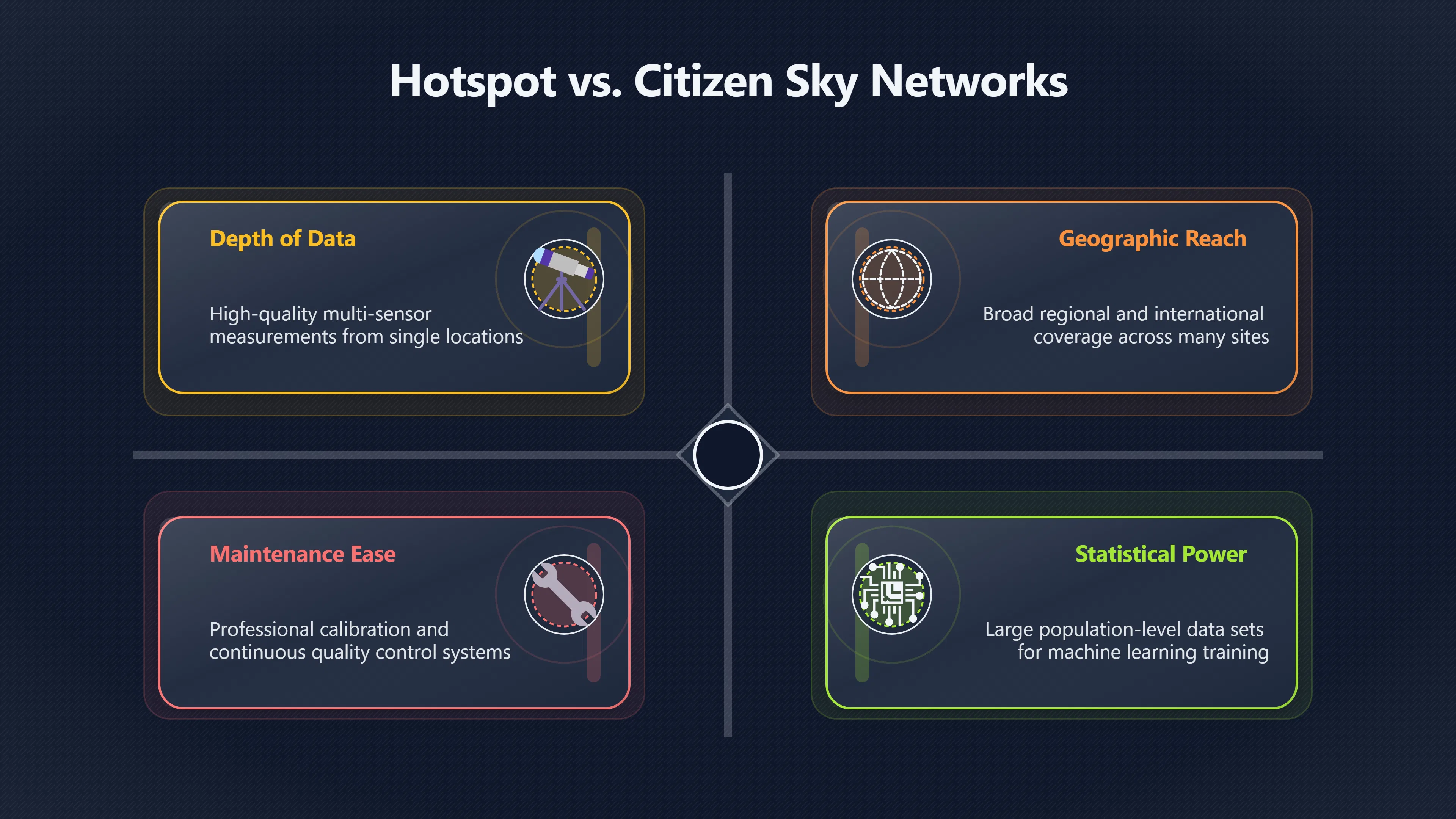
Hotspot stationsCitizen sky networksHigh-quality measurements from one locationModerate-quality measurements from many locationsOptimised for repeat local eventsOptimised for statistical comparisonEasier to maintain calibrationHarder to standardise across volunteersRich multi-sensor datasetsLarge population-level datasetsHigher cost per stationLower cost per observing siteLimited geographic representativenessBroad regional and international coverage
These differences affect the kinds of scientific claims each approach can support.
A hotspot station is well suited to investigating whether a recurring luminous phenomenon exhibits consistent physical properties. A distributed network is better suited to estimating detection rates, identifying regional differences and determining whether apparent anomalies remain unusual once ordinary aerial traffic is systematically catalogued.
Neither approach alone fully resolves the fundamental challenge of UAP research: distinguishing genuinely unexplained observations from the enormous number of conventional objects appearing in the sky every day.
How a staged strategy can use both approaches
Many recent proposals increasingly converge on a hybrid deployment strategy.
The first stage concentrates sophisticated instrumentation where repeat observations or operational considerations make data collection most likely. During this phase, researchers refine calibration procedures, improve automatic classification algorithms and understand common false positives.
The second stage distributes simplified versions of the proven design across a wider network. Because each station follows comparable hardware and software standards, observations become directly comparable rather than being isolated case studies.
The third stage links both layers together. If a distributed station detects an unusual event, nearby hotspot observatories—or neighbouring citizen stations—can provide additional viewpoints. Multi-station observations improve estimates of altitude, speed and trajectory while reducing ambiguity caused by single-camera recordings.
This staged model also makes financial sense. Expensive instruments remain concentrated where they deliver the greatest scientific return, while inexpensive citizen stations expand coverage without requiring every volunteer location to host a research-grade observatory.

Choosing between the two approaches
For automated instrumented UAP detection, the decision depends on the question being asked rather than on any universal hierarchy of methods.
If the objective is to investigate a location with persistent reports using the richest possible measurements, a hotspot station provides greater scientific depth. If the objective is to determine how frequently unusual aerial events occur across ordinary skies and to establish reliable background statistics, a citizen network offers stronger comparative power.
The most robust long-term strategy combines both. High-performance observatories develop and validate sophisticated detection methods, while geographically distributed citizen stations test whether those methods continue to identify the same patterns under diverse observing conditions. Together they offer a practical balance between intensive local investigation and broad, reproducible sky surveillance.[MDPI+2Sky360]mdpi.comCommissioning an All-Sky Infrared Camera Array for…by L Domine · 2025 · Cited by 11 — Galileo Project is designing, building, and…
Amazon book picks
Further Reading
Books and field guides related to Hotspot Stations or Citizen Sky Networks?. Use these as the next step if you want deeper reading beyond the article.
The Backyard Astronomer's Guide
Excellent for planning observing stations and networks.

UFOs : Generals, Pilots, and Government Officials Go on the R...
Broad context for citizen observation efforts.
UFOs
NEW YORK TIMES BESTSELLER • Impeccably researched, this riveting journalistic investigation separates fact from fiction, and documents th...
eBay marketplace picks
Marketplace Samples
Example marketplace items related to this page. Use the search link to explore similar finds on eBay.



Endnotes
1.
Source: mdpi.com
Link:https://www.mdpi.com/1424-8220/25/3/783
Source snippet
Commissioning an All-Sky Infrared Camera Array for...by L Domine · 2025 · Cited by 11 — Galileo Project is designing, building, and...
2.
Source: sky360.org
Link:https://www.sky360.org/
Source snippet
Observational Citizen Science of Earth's AtmosphereSky360 is an open-source global sky observation network using AI-powered tracking stat...
3.
Source: arxiv.org
Link:https://arxiv.org/abs/2305.18566
4.
Source: arxiv.org
Link:https://arxiv.org/abs/2411.07956
Source snippet
Commissioning An All-Sky Infrared Camera Array for...by L Dominé · 2024 · Cited by 11 — Galileo Project is designing, building, and comm...
5.
Source: arxiv.org
Link:https://arxiv.org/abs/2103.02005
6.
Source: citizenscience.eu
Link:https://citizenscience.eu/project/524
Source snippet
European Citizen Science PlatformTaivaanvahti/Skywarden/Himlakollen11 Jun 2024 — Taivaanvahti/Skywarden/Himlakollen · Skywarden observati...
Additional References
7.
Source: gfz.de
Link:https://www.gfz.de/en/transfer-and-innovation/knowledge-transfer/focus-areas/citizen-science
Source snippet
Citizen ScienceCitizen science refers to the active participation of individuals who are not institutionally involved in this field in sc...
8.
Source: researchgate.net
Link:https://www.researchgate.net/publication/275829635_Project_for_a_network_of_automatic_stations_for_UFO_monitoring
Source snippet
Project for a network of automatic stations for UFO monitoringThe proposed idea is intended to be a basis of discussion concerning the im...
9.
Source: avi-loeb.medium.com
Link:https://avi-loeb.medium.com/commissioning-data-on-half-a-million-objects-in-the-sky-from-the-galileo-project-observatory-are-a23bd084233a
Source snippet
Data on Half a Million Objects in the Sky from...Commissioning Data on Half a Million Objects in the Sky from the Galileo Project Observ...
10.
Source: vice.com
Title: ufo hunters built an open source ai system to scan the skies
Link:https://www.vice.com/en/article/ufo-hunters-built-an-open-source-ai-system-to-scan-the-skies/
Source snippet
UFO Hunters Built an Open-Source AI System To Scan The...9 May 2023 — The Sky360 stations consist of an AllSkyCam with a wide angle fish...
Published: May 2023
11.
Source: youtube.com
Title: Harvard Launches Galileo Project to Find Aliens | WION Podcast
Link:https://www.youtube.com/watch?v=T4lZh1j9t1Y
Source snippet
AI & Aliens: New Eyes on Ancient Questions // Richard Cloete // MLOps Podcast #288 AI & Aliens: New Eyes on Ancient Questions // Richard...
12.
Source: universetoday.com
Title: an all sky infrared camera could search for alien spacecraft 1
Link:https://www.universetoday.com/articles/an-all-sky-infrared-camera-could-search-for-alien-spacecraft-1
Source snippet
An All-Sky Infrared Camera Named Dalek Continues...8 Apr 2025 — Galileo Project proposes an All-Sky Infrared Camera (Dalek) to search fo...
13.
Source: youtube.com
Title: AI & Aliens: New Eyes on Ancient Questions // Richard Cloete
Link:https://www.youtube.com/watch?v=ZUBrIlxlNdI
Source snippet
Harvard Launches Galileo Project to Find Aliens | WION Podcast...
14.
Source: youtube.com
Title: Inside the AI Alien Hunting Project at Harvard
Link:https://www.youtube.com/watch?v=oDAY0_wRjxA
Source snippet
The Galileo Project's First Data on Half a Million Objects with Avi Loeb...
15.
Source: youtube.com
Title: The Galileo Project’s First Data on Half a Million Objects with Avi Loeb
Link:https://www.youtube.com/watch?v=uJtER5ahdPY
Source snippet
Open Source Astronomy - Sky360...
16.
Source: youtube.com
Title: Open Source Astronomy
Link:https://www.youtube.com/watch?v=rf1cyFFtYLs
Source snippet
New Space Economy...
Topic Tree