Within Parallax
Can a Dot Prove Impossible Acceleration?
Acceleration claims can collapse when small errors in distance, pointing, timing, or target association are amplified across frames.
On this page
- Why acceleration is harder than speed to prove
- How tracking and stabilization errors create jumps
- What data is needed before claiming high g motion
Page outline Jump by section
Introduction
A dot moving across a video frame cannot, by itself, prove extraordinary acceleration. In most optical UFO or UAP recordings, acceleration is not measured directly; it is inferred from changes in apparent position over time. That inference depends critically on assumptions about range. If the object’s distance is uncertain, even small errors in estimated range, camera pointing, timing, image stabilisation or target association can multiply into dramatically inflated acceleration estimates. For automated instrumented UFO detectors, this is a central engineering problem rather than a philosophical one: before claiming that an object performed an impossible high-g manoeuvre, the system must first demonstrate that its three-dimensional position is known with sufficient accuracy.[AARO]aaro.milEffect of Forced Perspective and Parallax View on UAP…This paper provides a basic overview of these phenomena and their impact on…
Why acceleration is harder than speed to prove
Speed is already difficult to estimate from a single optical sensor because angular motion must be converted into linear motion using distance. Acceleration is harder still because it is the rate of change of velocity. Any uncertainty present in one velocity estimate is carried into the next, and then amplified when the two are compared.
This means that an apparently sharp turn or sudden burst of speed may reflect uncertainty rather than genuine motion. If the assumed range changes from one frame to another, or if the tracking algorithm momentarily locks onto a different point on the target, the reconstructed trajectory can appear to contain abrupt changes that never occurred in reality.
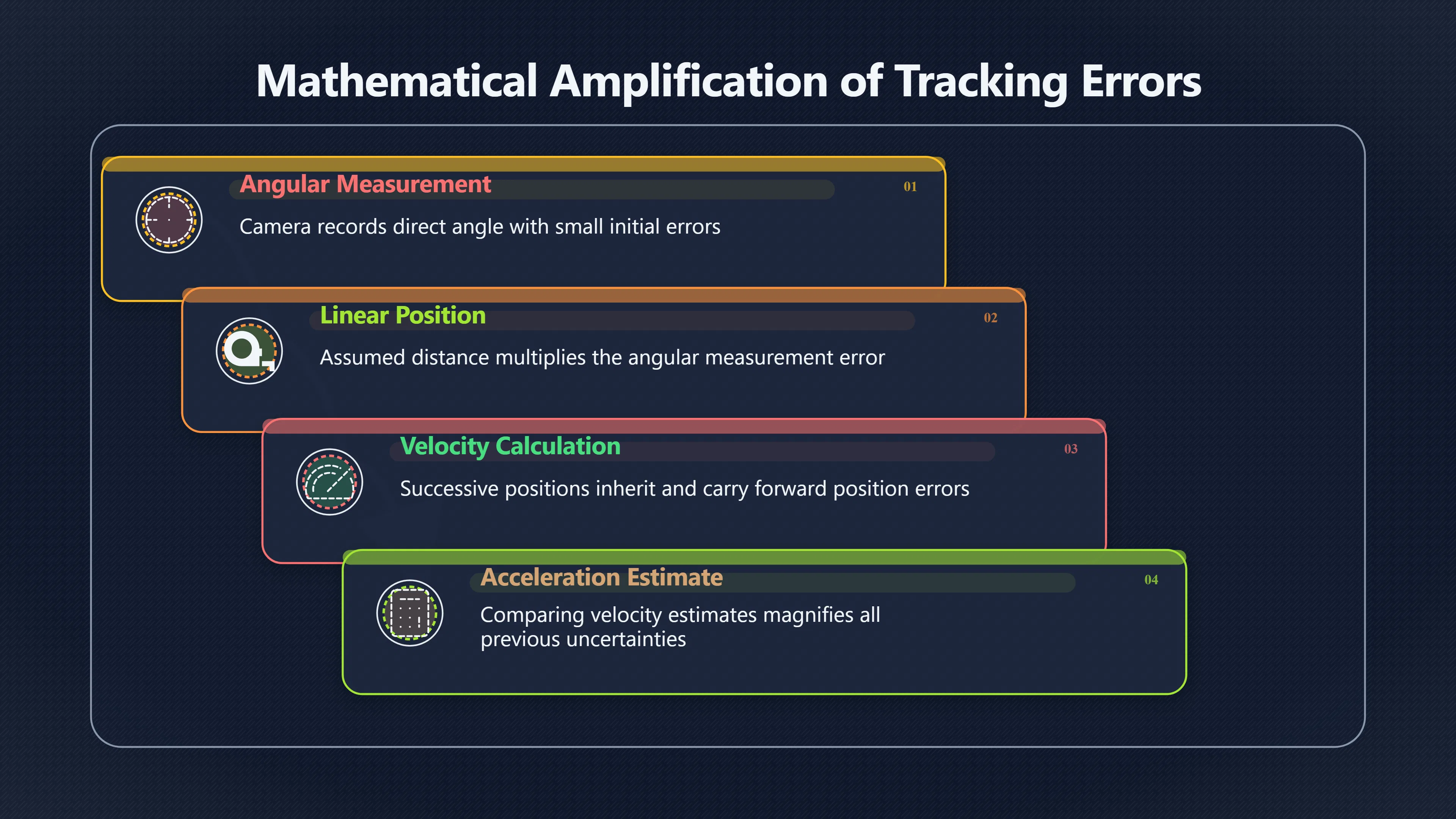
The mathematics illustrates the problem. Angular position is measured directly by the camera. Linear position is obtained by multiplying that angle by an assumed distance. Therefore:
- a small angular measurement error produces a larger position error at greater assumed distances;
- velocity is calculated from successive positions, so it inherits both position errors;
- acceleration compares successive velocity estimates, effectively magnifying those uncertainties again.
As a result, acceleration estimates are typically much less robust than speed estimates unless range has been independently measured.
How tracking and stabilisation errors create apparent jumps
Modern imaging systems rarely record raw sensor motion. Military targeting pods, astronomical trackers and automated surveillance cameras continuously stabilise images, compensate for platform motion and adjust pointing to keep a target centred.
Each processing step introduces opportunities for small discontinuities.
Target lock changes
If the tracker briefly shifts from the centre of a target to its edge, or temporarily locks onto a nearby bright feature before recovering, the recorded track can show an instantaneous positional jump. On a magnified display this may resemble a violent change in direction even though the physical object continued smoothly.
The problem becomes more severe when the object occupies only a few pixels. In that case, one-pixel shifts correspond to substantial angular changes, making acceleration estimates highly sensitive to image-processing decisions rather than object dynamics.
Platform motion compensation
Aircraft-mounted sensors must continually subtract the aircraft’s own movement. Small errors in aircraft attitude, roll, heading or inertial navigation propagate directly into the reconstructed target path.
If compensation briefly under- or over-corrects, the target’s apparent trajectory may kink or zigzag. Unless these corrections are accounted for, an analyst may incorrectly attribute the resulting motion to the object itself rather than to the observing platform. NASA’s independent UAP study identified incomplete metadata and insufficient sensor calibration as major obstacles to reliable interpretation of such events.[NASA Science]science.nasa.govNASA ScienceIndependent Study Team ReportThe study of Unidentified Anomalous Phenomena (UAP) presents a unique scientific opportunity tha…
Why uncertain range creates impossible-g illusions
Many dramatic acceleration claims assume that the object remained at a particular distance throughout the observation. That assumption is often hidden inside the calculation.
Suppose two equally plausible distance estimates differ by only a factor of two. The reconstructed path length also doubles. Velocity doubles because the elapsed time is unchanged. The inferred acceleration during any apparent turn likewise doubles.
If the true uncertainty spans several kilometres—as is common for isolated optical observations over open sky or sea—the range of possible accelerations can vary by orders of magnitude.
This is particularly important when observers report:
- instantaneous ninety-degree turns;
- abrupt stops;
- rapid reversals;
- extreme climb rates.
Without independently measured distance, these may simply represent different geometric interpretations of the same angular measurements rather than evidence for extraordinary flight performance.
The Go Fast example illustrates the geometry
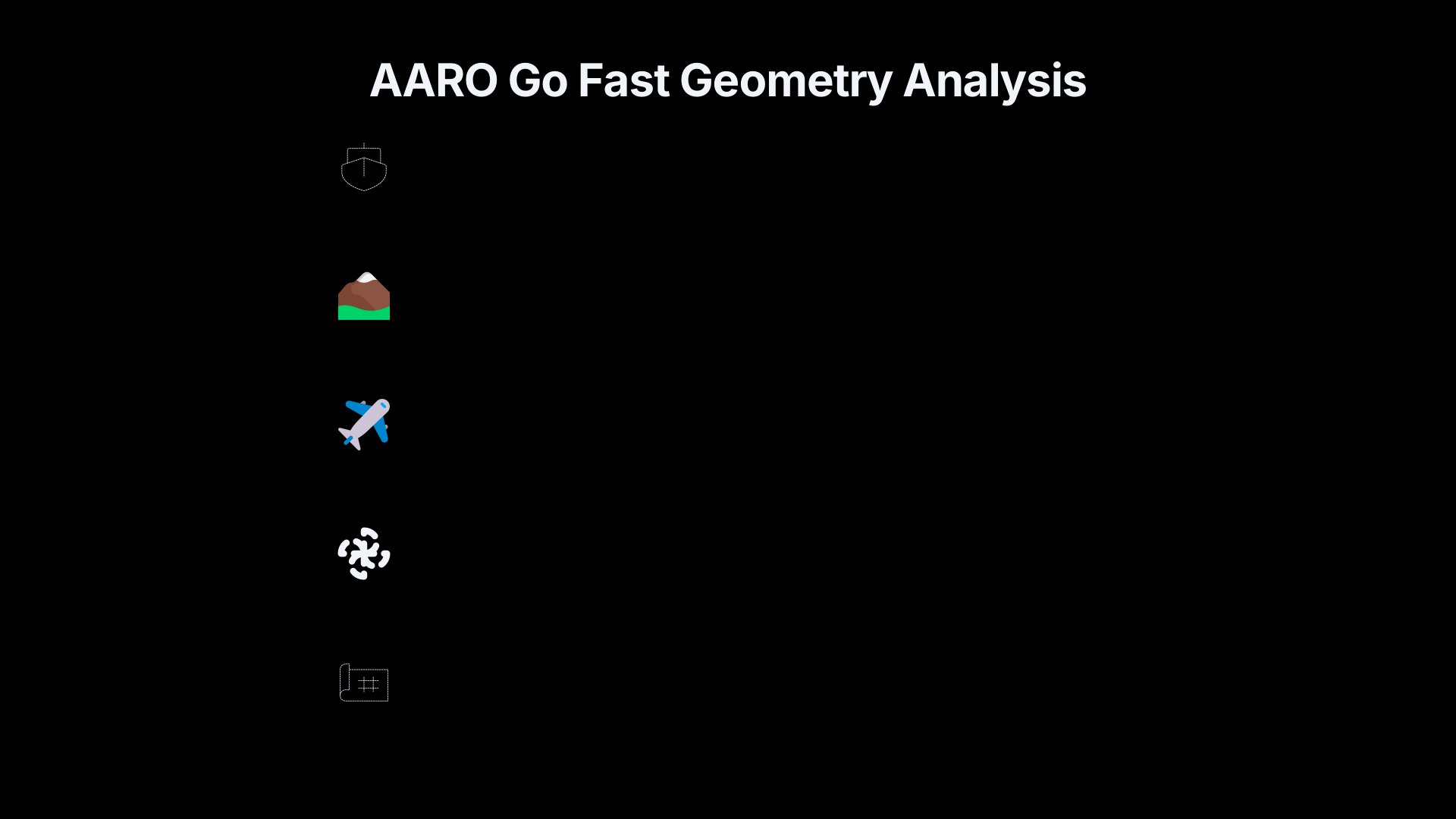
The widely discussed “Go Fast” video demonstrates how range assumptions affect not only speed but also implied acceleration.
Early interpretations often assumed the object was skimming close to the ocean surface. Under that assumption, its apparent movement across the display implied remarkable performance.
Subsequent geospatial reconstruction by the All-domain Anomaly Resolution Office concluded instead that the object was approximately 13,000 feet above the ocean. Once the geometry, aircraft motion and environmental conditions were incorporated, the object’s motion became consistent with ordinary wind-driven drift rather than extreme manoeuvring. The apparent rapid movement relative to the sea resulted largely from motion parallax generated by the observing aircraft.[AARO+2PBS]aaro.milEffect of Forced Perspective and Parallax View on UAP…This paper provides a basic overview of these phenomena and their impact on…
An important lesson is that acceleration claims can disappear even when the observed image itself is unchanged. What changes is the geometric reconstruction.
What data is needed before claiming high-g motion
An automated instrumented UFO detection system should treat extraordinary acceleration as a hypothesis requiring multiple independent measurements rather than as a direct output of video tracking.
Strong evidence would normally include:
- independently measured range, such as radar, lidar or stereo optical triangulation;
- precisely synchronised timestamps with verified frame timing;
- calibrated camera orientation throughout the observation;
- complete platform navigation and attitude data;
- documented image stabilisation and tracking behaviour;
- quantified uncertainty estimates for every stage of the reconstruction.
Ideally, the object’s position should be reconstructed in three dimensions with uncertainty bounds before velocity or acceleration are reported. Rather than quoting a single value, a scientifically robust system should produce confidence intervals showing how sensitive the result is to range uncertainty.

Why automated detectors should report uncertainty first
Automation improves consistency, but it cannot remove geometric ambiguity when the underlying measurements are incomplete.
A detector that automatically labels a track as exhibiting “1000 g acceleration” without simultaneously reporting uncertainty in distance risks presenting a speculative reconstruction as a measured fact. A more reliable design estimates both the motion and the confidence in that estimate.
In practice, the most valuable output is often not a headline acceleration value but an explicit statement that the available data cannot distinguish between an ordinary object at one range and an apparently extraordinary object at another. That approach aligns with current scientific recommendations for UAP analysis, which emphasise calibrated sensors, multiple independent observations and complete metadata before drawing conclusions about anomalous flight behaviour.[NASA Science]science.nasa.govNASA ScienceIndependent Study Team ReportThe study of Unidentified Anomalous Phenomena (UAP) presents a unique scientific opportunity tha…
Amazon book picks
Further Reading
Books and field guides related to Can a Dot Prove Impossible Acceleration?. Use these as the next step if you want deeper reading beyond the article.

Multiple view geometry in computer vision
Directly addresses 3D reconstruction and uncertainty from camera imagery.
Fundamentals of Astrodynamics and Applications
Explains trajectory reconstruction, measurement uncertainty, and motion estimation principles.

An introduction to error analysis
Shows how measurement errors propagate into derived quantities such as acceleration.

Computer Vision
Covers feature tracking, camera geometry, and sources of tracking error.
eBay marketplace picks
Marketplace Samples
Example marketplace items related to this page. Use the search link to explore similar finds on eBay.


Endnotes
1.
Source: aaro.mil
Link:https://www.aaro.mil/Portals/136/PDFs/Information%20Papers/AARO_Effect_of_Forced_Perspective_and_Parallax_View_on_UAP_Observations_2024.pdf
Source snippet
Effect of Forced Perspective and Parallax View on UAP...This paper provides a basic overview of these phenomena and their impact on...
2.
Source: science.nasa.gov
Link:https://science.nasa.gov/wp-content/uploads/2023/09/uap-independent-study-team-final-report.pdf
Source snippet
NASA ScienceIndependent Study Team ReportThe study of Unidentified Anomalous Phenomena (UAP) presents a unique scientific opportunity tha...
3.
Source: science.nasa.gov
Link:https://science.nasa.gov/uap/
Source snippet
NASA ScienceUAP9 Jun 2022 — The study will focus on identifying available data, how best to collect future data, and how NASA can use tha...
4.
Source: pbs.org
Link:https://www.pbs.org/newshour/science/3-ways-scientists-use-math-to-help-debunk-ufo-videos
Source snippet
3 ways scientists use math to help debunk UFO videos24 Apr 2025 — Semeter helped analyze one particular video called "GO FAST," where...
5.
Source: aaro.mil
Title: AARO Historical Record Report Vol 1 2024
Link:https://www.aaro.mil/Portals/136/PDFs/AARO_Historical_Record_Report_Vol_1_2024.pdf
Source snippet
AARO_Historical_Record_Repor...6 Mar 2024 — SECTION I: Introduction. This report represents Volume I of the All-domain Anomaly Resolution...
6.
Source: aaro.mil
Link:https://www.aaro.mil/UAP-Cases/UAP-Case-Resolution-Reports/
Source snippet
UAP Case Resolution ReportsEglin Case Resolution. A military pilot reported the object due to its potential as a flight safety hazard and...
Additional References
7.
Source: reddit.com
Link:https://www.reddit.com/r/UFOs/comments/16iix64/nasas_gofast_analysis_says_object_going_40mph/
Source snippet
NASA's GoFast Analysis says object going 40mph: r/UFOsUsing the calculated true air speed (TAS) and a bit more trigonometry, we find the...
8.
Source: nypost.com
Title: pentagon claims to debunk famous gofast ufo radar video
Link:https://nypost.com/2024/11/20/us-news/pentagon-claims-to-debunk-famous-gofast-ufo-radar-video/
Source snippet
Pentagon claims to debunk famous 'GOFAST' UFO radar...20 Nov 2024 — The Pentagon announced they solved one of the most famous UFO videos...
9.
Source: defensescoop.com
Title: uap aaro findings go fast puerto rico mt etna objects
Link:https://defensescoop.com/2024/11/19/uap-aaro-findings-go-fast-puerto-rico-mt-etna-objects/
Source snippet
Pentagon's UAP office reviews findings on Go Fast, Puerto...19 Nov 2024 — “AARO and its partners disproved the obiect flew through the a...
10.
Source: facebook.com
Link:https://www.facebook.com/knopnews2/posts/a-number-of-sources-familiar-with-the-report-say-the-military-will-not-confirm-o/4333311970013933/
Source snippet
ted safety of flight issues and potential operational security issues...
11.
Source: aui.edu
Link:https://aui.edu/aaro-releases-report-on-unidentified-anomalous-phenomena-uap/
Source snippet
The meeting gathered 40 participants from government...Read more...
12.
Source: facebook.com
Link:https://www.facebook.com/colbertlateshow/posts/it-turns-out-john-oliver-is-an-expert-on-ufos-and-high-velocity-surveillance-bal/3139288369549226/
Source snippet
e suddenly found explanations for over 200 UAP incidents since May...
13.
Source: armed-services.senate.gov
Title: aaro case slides 112024
Link:https://www.armed-services.senate.gov/download/aaro-case-slides-112024
Source snippet
Proposed AARO Branding GuideThe estimated distance between the UAP and the UAV is based on [weather]({{ 'weather/' | relative_url }}) analysis of the cloud deck and wind sp...
14.
Source: medium.com
Link:https://medium.com/%40samirvarma/you-cant-quietly-park-at-0-1c-what-the-physics-actually-says-about-the-alien-probe-hypothesis-d67f8c6af4a9
Source snippet
en Probe Hypothesis People have been arguing about whether UAP...
15.
Source: reddit.com
Link:https://www.reddit.com/r/ufo/comments/1iooz44/pentagon_releases_aaro_report_on_go_fast_video/
Source snippet
ct that induces an observer to perceive that a stationary...
16.
Source: Wikipedia
Title: All domain Anomaly Resolution Office
Link:https://en.wikipedia.org/wiki/All-domain_Anomaly_Resolution_Office
Source snippet
All-domain Anomaly Resolution OfficeIn March 2024, AARO released a report titled "Report on the Historical Record of U.S. Government I...
Published: March 2024
Topic Tree