Within Weather
Why ground wind is not enough
Ground wind can mislead UAP analysis when balloons, debris or high-altitude objects are moving in a different air layer.
On this page
- Why surface wind misses the object's air layer
- Using radiosonde and model winds in event review
- Drift patterns that separate balloons from anomalies
Page outline Jump by section
Introduction
Ground-level wind is one of the easiest environmental measurements to collect during a suspected UAP event, but it is often one of the least informative for identifying drifting aerial objects. A balloon, lightweight debris, or other passive object may be travelling in an air mass thousands of metres above the observer, where the wind can differ dramatically in speed and direction from conditions at the surface. For automated instrumented UAP detectors, this distinction is crucial: comparing an object’s apparent motion only with surface weather observations can lead to incorrect conclusions about whether it was manoeuvring or simply drifting with upper-level winds.
 The practical solution is to reconstruct the atmosphere vertically rather than treating it as a single layer. Radiosonde observations, numerical weather prediction models, and aviation wind profiles provide the evidence needed to compare an object’s movement with the winds at its probable altitude. This allows investigators to distinguish many drifting candidates from events that remain inconsistent with known atmospheric transport.
Why surface wind misses the object’s air layer
Surface weather stations typically measure wind around 10 metres above ground level. That information is highly valuable for local weather, but it says little about the atmosphere several kilometres overhead.
The atmosphere is layered. Wind speed and direction often change substantially with altitude because of pressure gradients, terrain effects, temperature structure, and jet streams. A calm evening at ground level may coincide with strong winds a few kilometres above, while brisk surface winds may weaken or even reverse aloft. This phenomenon, known as vertical wind shear, is routine in meteorology rather than exceptional.[NOAA]noaa.govRadiosondes | National Oceanic and Atmospheric…16 Sept 2025 — The radiosonde is a small instrument package that is suspended below…
For UAP investigations, this means an apparently puzzling motion may simply reflect the wind in the object’s own air layer rather than the conditions experienced by the observer. Examples include:
- weather balloons ascending through multiple wind layers;
- research balloons drifting at nearly constant altitude;
- lightweight airborne debris;
- smoke or ash transported above the boundary layer;
- reflective materials carried by high-altitude airflow.
An automated detector that records only ground wind therefore lacks one of the key variables needed to test a passive-drift explanation.
Using radiosonde and model winds in event review
Radiosondes provide the missing vertical profile
The most direct way to reconstruct upper-air conditions is through radiosonde observations. A radiosonde is carried beneath a weather balloon and transmits pressure, temperature, humidity and GPS-derived position throughout its ascent. By tracking the balloon, meteorologists derive wind speed and direction continuously through the atmosphere. These observations have been a foundation of operational forecasting for decades.[National Weather Service+2National Weather Service]weather.govNational Weather ServiceRadiosonde ObservationThe radiosonde is a small, expendable instrument package (weighs 60 to 80 grams) that is su…
For an automated UAP review, investigators can compare:
- the event time;
- the detector location;
- the estimated object altitude;
- the observed motion;
- the nearest upper-air wind profile.
Agreement between object motion and winds at the corresponding altitude strengthens the hypothesis that the object was drifting rather than self-propelled.
Numerical weather models fill spatial gaps
Routine radiosondes are normally launched only twice daily from distributed stations rather than continuously at every location. To bridge these gaps, investigators often use numerical weather prediction analyses or atmospheric reanalysis products that assimilate radiosonde, satellite, aircraft and surface observations into three-dimensional wind fields.[US EPA]epa.govUS EPAAir Quality Modeling - Surface and Upper Air Databases27 Feb 2026 — This site provides two types of meteorological data: (1) surfac…
These models cannot identify an individual balloon, but they can estimate the expected wind vector at specific altitudes and times. When combined with camera geometry and line-of-sight measurements, they provide a much stronger environmental context than surface observations alone.
Matching altitude matters more than matching location
A common analytical mistake is comparing an observed object’s track with the nearest weather station’s wind direction.
A more reliable workflow is:[aoml.noaa.gov]aoml.noaa.govupper air observationsAir Observations: How Weather Balloons Improve…1 Sept 2017 — Weather balloons, also known as radiosondes, provide detailed and reliabl…
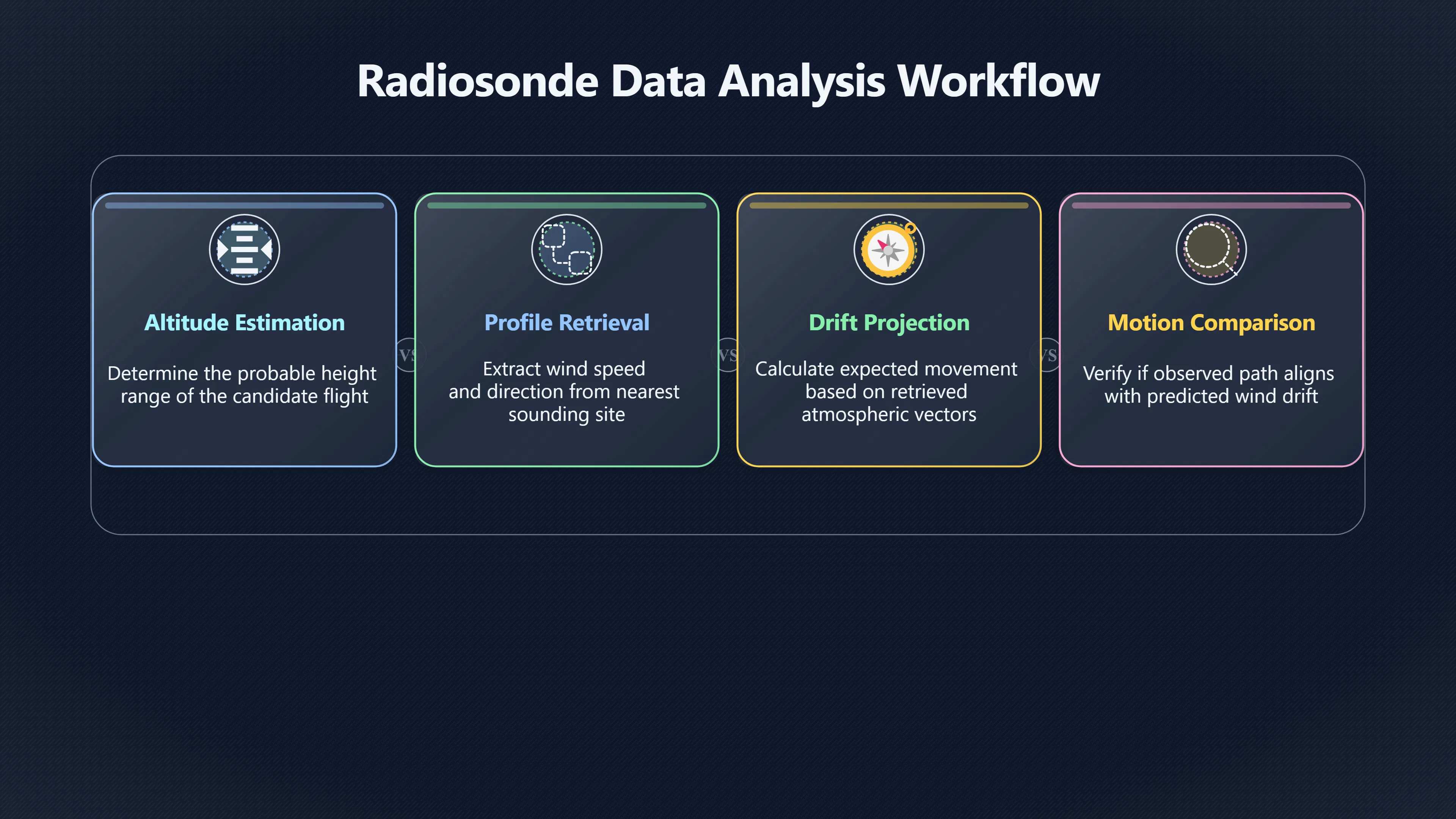
- estimate the object’s probable altitude range;
- retrieve winds across that altitude interval;
- project the expected drift over the observation period;
- compare the predicted and observed motion while accounting for viewing geometry.
If an object’s apparent path aligns only with winds at, for example, 8 km altitude rather than those measured at the surface, the upper-air comparison is the meaningful one.
Drift patterns that separate balloons from anomalies
Passive airborne objects leave recognisable signatures when analysed against upper-air winds.
One indicator is sustained agreement between the object’s velocity vector and the wind field over time. Weather balloons naturally accelerate, decelerate or change heading as they ascend through different atmospheric layers. Their tracks therefore often contain smooth directional transitions that correspond closely with measured wind profiles.[National Weather Service]weather.govNational Weather ServiceRadiosonde ObservationThe radiosonde is a small, expendable instrument package (weighs 60 to 80 grams) that is su…
Another useful indicator is altitude-dependent behaviour. An object may appear nearly stationary while crossing the observer’s line of sight if it is moving largely towards or away from the camera. Later, as geometry changes, the same object may appear to accelerate dramatically without any real increase in airspeed. Comparing its motion against upper-air winds helps distinguish perspective effects from genuine manoeuvres.
Investigators also examine whether an object’s heading changes at altitudes where radiosonde profiles show wind shifts. Consistent correspondence across multiple altitude layers is difficult to explain by coincidence if the object is simply drifting.
By contrast, events become more interesting when careful reconstruction shows that the observed trajectory remains incompatible with measured winds over all plausible altitude ranges. Such cases do not automatically demonstrate anomalous flight, because altitude estimates, sensor calibration, tracking accuracy and perspective effects may still be uncertain. However, eliminating passive drift strengthens the case for examining alternative explanations.
Practical integration into automated UAP detector networks
An instrumented detection system gains significant analytical value when upper-air information is incorporated automatically into each event record.
Useful environmental metadata include:
- nearest radiosonde launch profile before and after the event;
- interpolated winds from operational weather models;[docdb.cept.org]docdb.cept.organd operational characteristics of weather…Radiosondes are mainly used for upper air measurements from the surface up to altitudes of…
- altitude-dependent wind vectors at regular intervals;
- estimated uncertainty resulting from distance from the sounding site;
- predicted drift trajectories for passive objects released at different heights.
Rather than merely storing wind speed at the ground, the system records the atmospheric conditions through which a candidate object was likely travelling.
This approach also supports reproducibility. Independent investigators can retrieve the same meteorological datasets and verify whether the reported comparison between object motion and upper-air flow is robust.

What upper-air winds can and cannot prove
Upper-air wind analysis is a powerful filtering tool but not a standalone identification method.
Agreement between an object’s movement and upper-level winds does not prove it was a balloon or other passive object. Several unrelated objects may drift similarly, and uncertainty in range estimation can complicate comparisons. Conversely, disagreement with upper-air winds does not automatically indicate extraordinary performance, because active aircraft, drones, birds and sensor artefacts can also depart from passive drift.
The greatest value of upper-air wind analysis is therefore evidential rather than conclusive. It allows investigators to test a specific physical mechanism using independently measured atmospheric data. For automated instrumented UAP detectors, incorporating vertical wind profiles moves event analysis beyond simple comparisons with surface weather and towards a more rigorous assessment of whether a candidate behaved like an object carried by the atmosphere or something requiring further investigation.
Amazon book picks
Further Reading
Books and field guides related to Why ground wind is not enough. Use these as the next step if you want deeper reading beyond the article.
Weather For Dummies
Introduces wind layers and atmospheric behavior in an approachable way.
The AMS Weather Book
Provides practical explanations of weather systems influencing winds at different altitudes.
The UFO Experience
Supports evidence-based analysis where atmospheric explanations are evaluated before anomalies.

Meteorology today
Explains vertical atmospheric structure, winds aloft, jet streams, and upper-air observations.
eBay marketplace picks
Marketplace Samples
Example marketplace items related to this page. Use the search link to explore similar finds on eBay.
Endnotes
1.
Source: noaa.gov
Link:https://www.noaa.gov/jetstream/upperair/radiosondes
Source snippet
Radiosondes | National Oceanic and Atmospheric...16 Sept 2025 — The radiosonde is a small instrument package that is suspended below...
2.
Source: epa.gov
Link:https://www.epa.gov/scram/air-quality-modeling-surface-and-upper-air-databases
Source snippet
US EPAAir Quality Modeling - Surface and Upper Air Databases27 Feb 2026 — This site provides two types of meteorological data: (1) surfac...
3.
Source: weather.gov
Link:https://www.weather.gov/upperair/factsheet
Source snippet
National Weather ServiceRadiosonde ObservationThe radiosonde is a small, expendable instrument package (weighs 60 to 80 grams) that is su...
4.
Source: weather.gov
Link:https://www.weather.gov/epz/upperair
Source snippet
National Weather ServiceUpper Air10 Dec 2024 — The observation system consists of an instrument (radiosonde), and a gas-filled balloon. T...
5.
Source: ncei.noaa.gov
Link:https://www.ncei.noaa.gov/products/weather-balloon/integrated-global-radiosonde-archive
Source snippet
Global Radiosonde Archive (IGRA)The Integrated Global Radiosonde Archive (IGRA) consists of radiosonde and pilot balloon observations fro...
6.
Source: weather.gov
Link:https://www.weather.gov/gjt/education_corner_balloon
Source snippet
Education Corner weather balloonDuring that that time, the weather balloon can reach over 100,000 feet in altitude and may drift over 100...
7.
Source: weather.gov
Link:https://www.weather.gov/chs/upperair
Source snippet
Weather Balloon / Upper Air ObservationsWeather balloons carry an instrument called a radiosonde which is tracked by specialized ground e...
8.
Source: weather.gov
Link:https://www.weather.gov/rah/virtualtourballoon
Source snippet
onde can ascend to over 115,000 feet (35,000 meters) and drift more than...Read more...
9.
Source: aoml.noaa.gov
Title: upper air observations
Link:https://www.aoml.noaa.gov/upper-air-observations/
Source snippet
Air Observations: How Weather Balloons Improve...1 Sept 2017 — Weather balloons, also known as radiosondes, provide detailed and reliabl...
10.
Source: ncei.noaa.gov
Title: weather balloon
Link:https://www.ncei.noaa.gov/products/weather-balloon
Source snippet
BalloonThese data are obtained from radiosondes, which are instrument packages tethered to balloons that are launched from the ground, as...
11.
Source: met.ie
Title: Upper Air
Link:https://www.met.ie/climate/what-we-measure/upper-air
Source snippet
The Irish Meteorological ServiceUpper air measurements have been taken at Valential Observatory since 1943 by means of a radiosonde, this...
12.
Source: Wikipedia
Link:https://en.wikipedia.org/wiki/Radiosonde
Source snippet
RadiosondeA radiosonde is a battery-powered telemetry instrument carried into the atmosphere usually by a weather balloon that measure...
13.
Source: Wikipedia
Title: Weather balloon
Link:https://en.wikipedia.org/wiki/Weather_balloon
Source snippet
Weather balloonBalloons meant to stay at a constant altitude for long periods are known as transosondes. Weather balloons that do not...
Additional References
14.
Source: hurricanescience.org
Link:https://hurricanescience.org/science/observation/landbased/radiosonde/index.html
Source snippet
Upper-Air Observations: The RadiosondeAs the radiosonde rises at about 300 m/min (about 1,000 ft/min), its sensors make in-situ measureme...
15.
Source: community.wmo.int
Link:https://community.wmo.int/observation-components-of-global-observing-system
Source snippet
World Meteorological OrganizationObservation components of the Global Observing SystemFrom a global network of about 1,300 upper-air stat...
16.
Source: docdb.cept.org
Link:https://docdb.cept.org/download/2081
Source snippet
and operational characteristics of weather...Radiosondes are mainly used for upper air measurements from the surface up to altitudes of...
17.
Source: agupubs.onlinelibrary.wiley.com
Title: AGU Publications Global radiosonde balloon drift statistics
Link:https://agupubs.onlinelibrary.wiley.com/doi/full/10.1029/2010JD014891
Source snippet
AGU PublicationsGlobal radiosonde balloon drift statistics - AGU Journals - Wileyby DJ Seidel · 2011 · Cited by 106 — This study presents...
18.
Source: wildcardweather.com
Title: radiosondes weather balloons and their role in forecasting
Link:https://wildcardweather.com/2012/08/10/radiosondes-weather-balloons-and-their-role-in-forecasting/
Source snippet
Radiosondes (Weather balloons) and their role in forecasting10 Aug 2012 — The radiosonde measures pressure, temperature, and relative hum...
19.
Source: journals.ametsoc.org
Title: Errors in the wind and humidity data are also examined. 1
Link:https://journals.ametsoc.org/view/journals/clim/19/14/jcli3804.1.pdf
Source snippet
of Balloon Drift Errors in Radiosonde Data on...by R McGrath · 2006 · Cited by 40 — However, the impact of the drift errors on global cl...
20.
Source: cds.climate.copernicus.eu
Link:https://cds.climate.copernicus.eu/datasets/insitu-comprehensive-upper-air-observation-network?tab=overview
Source snippet
Upper-air Observation Network from 1901 to...18 Mar 2025 — The observation platforms include pilot balloons, radiosondes, and ozonesondes...
21.
Source: gmd.copernicus.org
Title: Weather Prediction (NWP), but also for air
Link:https://gmd.copernicus.org/preprints/gmd-2023-215/gmd-2023-215.pdf
Source snippet
drift estimation and improved position...by U Voggenberger · 2023 · Cited by 3 — Radiosonde measurements are used in a variety of applic...
22.
Source: data.ucar.edu
Title: noaa nws high resolution radiosonde data
Link:https://data.ucar.edu/dataset/noaa-nws-high-resolution-radiosonde-data
Source snippet
ucar.eduNOAA/NWS High Resolution Radiosonde Data - DatasetThis data set contains rawinsonde profiles from 63 National Weather Service (NW...
23.
Source: rmets.onlinelibrary.wiley.com
Link:https://rmets.onlinelibrary.wiley.com/doi/10.1002/met.2128
Source snippet
observations from hot‐air balloons and the application in...3 Jul 2023 — In this paper, we report on a wind observation method based on...
Topic Tree