Within Timing
Two Cameras Help Only If Their Clocks Agree
Two observing stations can strengthen a case only when their clocks are aligned closely enough to compare the same moving object.
On this page
- Why synchronized stations are needed for 3 D tracks
- How timing errors create false position and speed
- What a defensible multi station record should include
Page outline Jump by section
Introduction
Two observing stations only strengthen an unusual sky observation if they can prove they recorded the same object at the same time. In automated instrumented UFO (or UAP) detector networks, triangulation is not simply a matter of placing cameras far apart. It depends on combining accurate geometry with closely synchronised clocks so that each observation can be matched frame-by-frame or exposure-by-exposure. If the clocks disagree, analysts may accidentally pair different objects, calculate impossible speeds, or reconstruct a false flight path.
 This requirement is well established in other branches of observational astronomy. Meteor camera networks, which routinely reconstruct three-dimensional atmospheric trajectories, rely on precise timing alongside calibrated camera geometry. Their experience provides a practical model for automated UAP detector networks because both problems involve transient objects observed from separated locations.[arXiv+2globalmeteornetwork.org]arxiv.orgarXiv A Multi-station Meteor Monitoring (M3) SystemI. Design…The camera has a built-in GPS module for accurately timing the meteoroid entry into the atmosphere (accurate to 1 µs), which…
Why synchronised stations are needed for 3D tracks
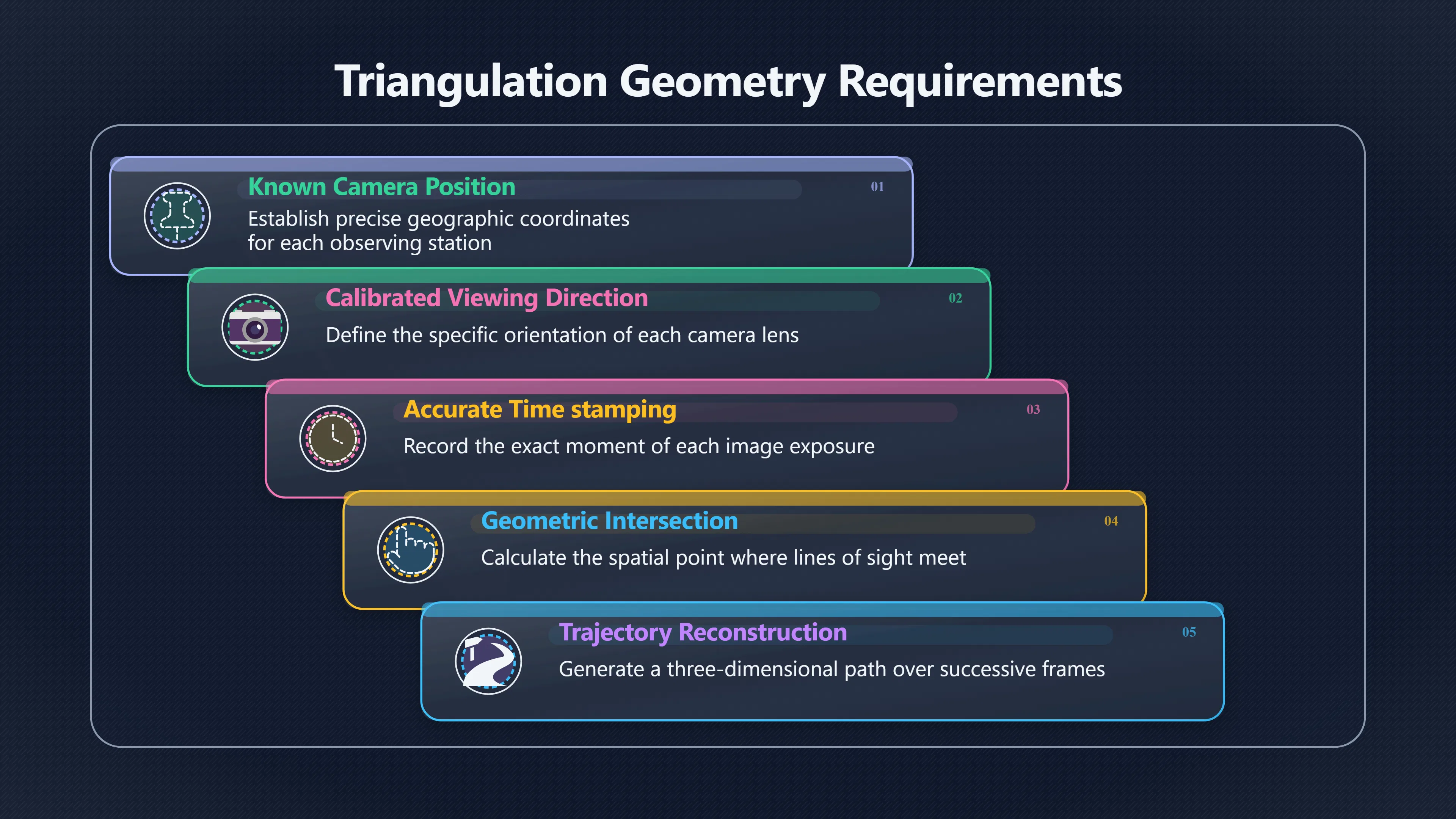
Triangulation works by finding where two or more lines of sight intersect in space. Each observing station contributes:
- a precisely known camera position;[onlinelibrary.wiley.com]onlinelibrary.wiley.comj.1945 5100.2012.01402.xnew method of meteor trajectory determination applied to…by PS GURAL · 2012 · Cited by 62 — The camera systems possess a number of kno…
- a calibrated viewing direction for each image;
- an accurately timestamped observation.
The geometric intersection identifies where the object was at a particular instant. Repeating that process over successive frames produces a three-dimensional trajectory and allows estimates of altitude, velocity and direction of travel.
Timing is inseparable from this geometry because the object is moving. Even if both cameras are perfectly calibrated, the intersection becomes meaningless if one station records the object several frames earlier or later than the other. The reconstruction software must know which observations correspond to the same physical moment before it can calculate a valid position.[PMC]pmc.ncbi.nlm.nih.govLong Baseline Stereovision for Automatic Detection and…by R Danescu · 2012 · Cited by 25 — This paper presents a generic, low cost…
Meteor observation networks illustrate this principle well. The Global Meteor Network automatically searches for meteors detected by multiple stations before triangulating their paths in three dimensions. Successful pairing depends on matching observations that occur within the correct time window rather than merely detecting similar streaks in different images.[globalmeteornetwork.org]globalmeteornetwork.orgthe Global Meteor Network wiki page!10 Mar 2026 — The server finds meteors that were observed from more than one station, which allows th…
How timing errors create false position and speed
Small clock errors do not simply add uncertainty; they can fundamentally alter the reconstructed event.
If Station A records an object at 22:14:15.100 and Station B’s clock is actually 150 milliseconds slow, software may incorrectly compare images that represent different points along the object’s path. The resulting triangulation may place the object in a location where it never existed.
Several types of error can follow:
- Incorrect altitude. The intersecting sight lines are calculated from mismatched positions, shifting the apparent distance from both cameras.
- False velocity. Speed estimates become artificially high or low because displacement is divided by an incorrect time interval.
- Artificial acceleration. Variable clock offsets between stations can make a steadily moving object appear to accelerate or manoeuvre.
- False rejection or false association. Genuine multi-station detections may fail matching tests, while unrelated aircraft lights, satellites or birds may be paired accidentally.
These effects become increasingly important for fast-moving targets. An offset that is insignificant for slowly drifting clouds may completely invalidate reconstruction of a meteor, nearby bird, drone or rapidly crossing luminous object.[Diva Portal+2arXiv]diva-portal.orgDiva PortalOptimization of Meteor Triangulations Using Timed…by V Niklasson · 2021 — But it turns out that the timestamps between the…
A practical lesson comes from meteor trajectory research, where investigators have found that unsynchronised camera timestamps required explicit estimation of inter-station time offsets before realistic meteor velocities could be recovered. The geometry alone was insufficient.[Diva Portal]diva-portal.orgDiva PortalOptimization of Meteor Triangulations Using Timed…by V Niklasson · 2021 — But it turns out that the timestamps between the…
Clock accuracy must match the scientific question
No single timing requirement applies to every observing network.
The acceptable timing uncertainty depends on factors including:
- camera frame rate;
- angular field of view;
- station separation;
- expected object speed;
- required positional accuracy.
Networks interested only in determining whether two stations observed the same slow-moving aircraft may tolerate millisecond-level uncertainty. Systems intended to measure precise atmospheric trajectories or distinguish nearby objects from distant ones benefit from much tighter synchronisation.
Modern meteor systems often address this by incorporating GPS-disciplined cameras that timestamp exposures directly against satellite time. One published multi-station design uses cameras capable of recording exposure timing with approximately one-microsecond precision specifically because accurate timing improves trajectory reconstruction and meteorite fall predictions from geographically separated observations.[arXiv]arxiv.orgarXiv A Multi-station Meteor Monitoring (M3) SystemI. Design…The camera has a built-in GPS module for accurately timing the meteoroid entry into the atmosphere (accurate to 1 µs), which…
Likewise, long-baseline stereoscopic sky surveillance research has demonstrated GPS-controlled synchronisation between widely separated cameras to support automatic three-dimensional target localisation.[PMC]pmc.ncbi.nlm.nih.govLong Baseline Stereovision for Automatic Detection and…by R Danescu · 2012 · Cited by 25 — This paper presents a generic, low cost…
Synchronisation is more than setting the clock once
A common misconception is that synchronising computers before deployment is sufficient.
In practice, clocks drift continuously because of oscillator imperfections, temperature changes and operating-system scheduling. Reliable observing stations therefore require ongoing clock discipline rather than a single initial adjustment.
Typical approaches include:
- GNSS (GPS or other satellite navigation) timing, where each station maintains an independent reference to Coordinated Universal Time (UTC).
- Precision Time Protocol (PTP) on controlled local networks, allowing sub-microsecond synchronisation when supported by suitable hardware.
- Continuous monitoring of measured clock offsets so analysts know the uncertainty associated with every observation.
If GPS reception is temporarily lost or a timing source changes, the event record should preserve that information. Knowing that a station’s clock uncertainty increased during an observation is often as valuable as the timestamp itself because it defines the confidence that can be placed in later triangulation.[Pure Manchester+2ResearchGate]pure.manchester.ac.ukIEEE Trans on Power Delivery Hao Guo 27 03 2016 v3 FinalPure ManchesterDesign of a Time Synchronization System based on GPS and…Yesterday — A substation now requires two or three 1588 master…

What a defensible multi-station record should include
A convincing triangulated observation requires considerably more than two videos showing similar lights.
At minimum, a defensible record should preserve:
- precise UTC timestamps for every frame or exposure;
- documented synchronisation method (for example GNSS or PTP);
- measured or estimated clock uncertainty;
- calibrated station coordinates;
- camera orientation and optical calibration;
- exposure duration and frame rate;
- any dropped frames, timing interruptions or synchronisation faults;
- the matching method used to associate observations across stations.
This metadata allows independent investigators to reproduce the trajectory solution and determine whether alternative pairings produce different results. Without it, a claimed three-dimensional reconstruction is difficult to verify scientifically.[arXiv+2globalmeteornetwork.org]arxiv.orgarXiv A Multi-station Meteor Monitoring (M3) SystemI. Design…The camera has a built-in GPS module for accurately timing the meteoroid entry into the atmosphere (accurate to 1 µs), which…
The strongest evidence comes from agreement in both time and space
Two separated cameras are often viewed as inherently stronger evidence than a single recording, but separation alone is not enough. Independent stations become scientifically valuable only when their observations can be shown to coincide within a well-characterised timing uncertainty.
In automated UAP detector networks, synchronised clocks transform simultaneous images into measurable geometry. Rather than simply confirming that “something was seen”, they allow investigators to determine where the object was, how it moved through three-dimensional space, and whether the reconstructed motion remains physically consistent across every observing station. That combination of spatial agreement and verified timing is what makes multi-station triangulation substantially more reliable than isolated observations.
Amazon book picks
Further Reading
Books and field guides related to Two Cameras Help Only If Their Clocks Agree. Use these as the next step if you want deeper reading beyond the article.

Multiple view geometry in computer vision
Combines multi-camera geometry with synchronized observations.
Introduction to Modern Photogrammetry
Details triangulation from separated observing stations.

eBay marketplace picks
Marketplace Samples
Example marketplace items related to this page. Use the search link to explore similar finds on eBay.




Endnotes
1.
Source: arxiv.org
Title: arXiv A Multi-station Meteor Monitoring (M3) System
Link:https://arxiv.org/html/2409.19503v1
Source snippet
I. Design...The camera has a built-in GPS module for accurately timing the meteoroid entry into the atmosphere (accurate to 1 µs), which...
2.
Source: globalmeteornetwork.org
Link:https://globalmeteornetwork.org/wiki/
Source snippet
the Global Meteor Network wiki page!10 Mar 2026 — The server finds meteors that were observed from more than one station, which allows th...
3.
Source: pmc.ncbi.nlm.nih.gov
Link:https://pmc.ncbi.nlm.nih.gov/articles/PMC3545550/
Source snippet
Long Baseline Stereovision for Automatic Detection and...by R Danescu · 2012 · Cited by 25 — This paper presents a generic, low cost...
4.
Source: diva-portal.org
Link:https://www.diva-portal.org/smash/get/diva2%3A1622264/FULLTEXT01.pdf
Source snippet
Diva PortalOptimization of Meteor Triangulations Using Timed...by V Niklasson · 2021 — But it turns out that the timestamps between the...
5.
Source: researchgate.net
Link:https://www.researchgate.net/publication/242777797_Measurement_of_synchrophasors_with_GPS_and_IEEE_1588
Source snippet
Measurement of synchrophasors with GPS and IEEE 1588When highly accurate time synchronization is needed, satellite systems, l...
6.
Source: researchgate.net
Link:https://www.researchgate.net/publication/388713619_High-Precision_Time_Synchronization_Based_on_Timestamp_Mapping_in_Datacenter_Networks
Source snippet
High-Precision Time Synchronization Based on Timestamp...1 Feb 2025 — We have proposed a time synchronization method based on timestamp...
7.
Source: arxiv.org
Link:https://arxiv.org/html/2605.29124v1
Source snippet
Optical and [Radar]({{ 'radar/' | relative_url }}) Observations of the February 2025...27 May 2026 — The AllSky7 meteor camera network measurements were triangulated usi...
Published: February 2025
8.
Source: pure.manchester.ac.uk
Title: IEEE Trans on Power Delivery Hao Guo 27 03 2016 v3 Final
Link:https://pure.manchester.ac.uk/ws/files/51486209/IEEE_Trans_on_Power_Delivery_Hao_Guo_27_03_2016_v3_Final.pdf
Source snippet
Pure ManchesterDesign of a Time Synchronization System based on GPS and...Yesterday — A substation now requires two or three 1588 master...
9.
Source: pmc.ncbi.nlm.nih.gov
Link:https://pmc.ncbi.nlm.nih.gov/articles/PMC11154300/
Source snippet
by S Li · 2024 · Cited by 1 — This paper proposes a precise and high-stability space-based time system established under the autonomou...
Additional References
10.
Source: disco.ethz.ch
Link:https://disco.ethz.ch/courses/hs19/distsys/lnotes/chapter20.pdf
Source snippet
ethz.chTime, Clocks & GPSThe Precision Time Protocol (PTP) is a clock synchronization protocol similar to NTP, but which uses medium acce...
11.
Source: popastro.com
Link:https://www.popastro.com/meteor/observing-meteors-with-a-video-camera/
Source snippet
Observing meteors with a video cameraBy collaborating with other observers it is possible to analyse video of the same meteor obtained fr...
12.
Source: pointonenav.com
Title: time synchronization in gnss ins the 1 thing engineers get wrong
Link:https://pointonenav.com/insights/time-synchronization-in-gnss-ins-the-1-thing-engineers-get-wrong/
Source snippet
Time Synchronization in GNSS/INS Positioning Systems23 Mar 2026 — Building a positioning system? Time synchronization across GNSS/INS sen...
13.
Source: avi-loeb.medium.com
Title: a new calculation on the fly to the nasa uap study 2dacaf860cac
Link:https://avi-loeb.medium.com/a-new-calculation-on-the-fly-to-the-nasa-uap-study-2dacaf860cac
Source snippet
New Calculation on the Fly to the NASA UAP Study - Avi LoebRubin Observatory in Chile will survey the entire southern sky every four days...
14.
Source: web.stanford.edu
Title: NarinsLo IONGNSS 2012 APNTIONPaperFinal
Link:https://web.stanford.edu/group/scpnt/gpslab/pubs/papers/NarinsLo_IONGNSS_2012_APNTIONPaperFinal.pdf
Source snippet
Need for a Robust Precise Time and Frequency...by M Narins · Cited by 21 — The Federal Aviation Administration (FAA) has initiated an Al...
15.
Source: imo.net
Link:https://www.imo.net/observations/methods/radio-observation/practical/
Source snippet
ifferences go up to a few tenths of a second...Read more...
16.
Source: masibus.com
Title: GPS Time Synchronization
Link:https://www.masibus.com/wp-content/uploads/2023/11/GPS-Time-Synchronization.pdf
Source snippet
21 Nov 2023 — For time synchronization, the GNSS signal is received, processed by a local master clock / time server or primary reference...
17.
Source: onlinelibrary.wiley.com
Title: j.1945 5100.2012.01402.x
Link:https://onlinelibrary.wiley.com/doi/full/10.1111/j.1945-5100.2012.01402.x
Source snippet
new method of meteor trajectory determination applied to...by PS GURAL · 2012 · Cited by 62 — The camera systems possess a number of kno...
18.
Source: support.sbg-systems.com
Title: time synchronization and event management
Link:https://support.sbg-systems.com/sc/kb/latest/inertial-sensors-operation/time-synchronization-and-event-management
Source snippet
To begin, we will provide an in-depth understanding of the different calculation delays...Read more...
19.
Source: astronomy.me.uk
Link:https://www.astronomy.me.uk/dedicated-software-options-for-amateur-ham-radio-meteor-scatter
Source snippet
Dedicated software options for amateur ham radio meteor...7 Oct 2025 — Integration with timing / synchronization: Meteor scatter communi...
Topic Tree