Within Baselines
Why the Horizon Creates So Many False Mysteries
Low-elevation lights are where aircraft, glare, distance, and light pollution most often turn ordinary traffic into puzzling tracks.
On this page
- Why low angles make range and speed harder to judge
- How light pollution and distance degrade detection
- Baseline checks that separate traffic from anomalies
Page outline Jump by section
Introduction
Automated sky cameras and instrumented UFO or UAP detectors are most likely to generate misleading tracks near the horizon. This is not because the horizon is inherently mysterious, but because it is where perspective, atmospheric effects, distant traffic and artificial lighting combine to make ordinary objects appear unusual. For systems that rely on optical tracking, infrared sensors or automated image analysis, low-elevation targets are often the most difficult to classify correctly. That is why modern pattern-of-life collection places special emphasis on learning what “normal” looks like close to the horizon before treating any track as anomalous. NASA’s independent UAP study similarly argues that reliable conclusions depend on calibrated sensors, multiple measurements, complete metadata and strong baseline data rather than isolated observations.[NASA Science]science.nasa.govNASA ScienceIndependent Study Team ReportThe study of Unidentified Anomalous Phenomena (UAP) presents a unique scientific opportunity tha…

Why low angles make range and speed harder to judge
The horizon compresses three-dimensional space into a narrow viewing angle. Objects separated by many kilometres can appear close together, while aircraft at vastly different altitudes may project onto nearly identical positions in a camera image. A detector observing only angular motion cannot directly determine distance, so estimating true speed becomes extremely difficult.
This creates several common failure modes:
- A distant jet flying almost directly towards the camera may appear nearly stationary for an extended period before suddenly seeming to accelerate sideways as its viewing angle changes.
- Two unrelated aircraft at different distances can appear to converge or intersect.
- Objects moving at ordinary cruising speeds can seem unusually slow because their apparent angular motion is small at long range.
- Conversely, nearby birds or insects crossing the field of view can appear extraordinarily fast.
Wide-angle cameras worsen the problem. Many all-sky systems intentionally sacrifice geometric accuracy to maximise sky coverage, meaning image scale changes substantially from the zenith towards the edge of the frame. Unless corrected through calibration, apparent trajectories near the horizon can become distorted.
These geometric ambiguities are well known in computer vision. Research on vision-based aircraft detection below the horizon identifies cluttered backgrounds, low apparent target size and weak relative motion as major challenges even for systems designed specifically to detect aircraft rather than unknown objects.[arXiv]arxiv.orgWe address some of the challenges faced by existing vision-…Read more…
How light pollution and distance degrade detection
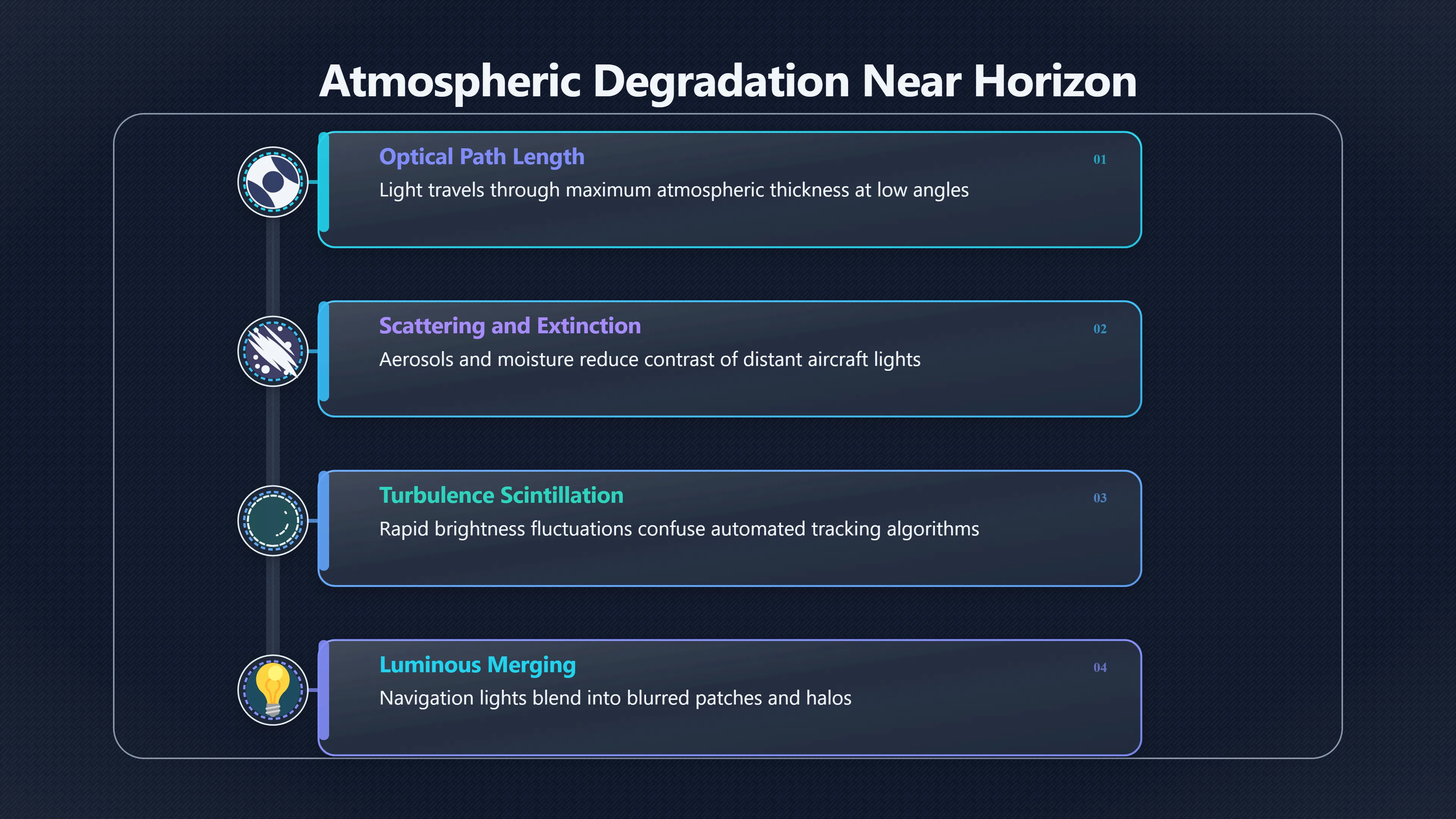
Near the horizon, detectors observe through the greatest thickness of Earth’s atmosphere. This longer optical path introduces several effects that rarely occur overhead with the same severity.
Atmospheric scattering and extinction
Light from distant aircraft must travel through much more atmosphere than light arriving from high elevation angles. Aerosols, moisture and dust scatter and absorb part of that light, reducing contrast while simultaneously spreading bright sources into larger halos.
The result is that navigation lights, landing lights and illuminated clouds can merge into blurred luminous patches that are harder for automated classifiers to identify consistently. Atmospheric transmission, turbulence and refraction all become increasingly dependent on viewing angle as observations approach the horizon.[DLR Electronic Library+2Optica Publishing Group]elib.dlr.deDLR Electronic LibraryarXiv:1901.07452v2 [quant-ph] 9 Jun 2019October 19, 2021 — by D Vasylyev · 2019 · Cited by 133 — We show that the s…
Turbulence and scintillation
Atmospheric turbulence causes rapid fluctuations in brightness and apparent position, commonly recognised by astronomers as scintillation or “twinkling.” While stars show this effect most clearly, distant point-like aircraft lights can also fluctuate enough to confuse algorithms attempting to maintain continuous tracks.
Tracking software may interpret these brightness variations as changes in object behaviour rather than changes in the intervening atmosphere. Studies of astronomical photometry consistently identify atmospheric turbulence as a dominant noise source for precise ground-based optical measurements.[Astrophysics Data System+2ESA Proceedings Database]adsabs.harvard.eduAstrophysics Data System Atmospheric Intensity Scintillation of Stars, ID Dravins · 1997 · Cited by 148 — Quantitative determinations for stellar scintillation at a low-altitude site were mad…
Artificial lighting
Urban environments introduce another source of confusion. Sky glow, illuminated buildings, advertising displays, vehicle headlights, cranes and industrial lighting all contribute bright structures close to the horizon.
Automatic detection algorithms often work by identifying moving bright regions against darker backgrounds. Unfortunately, the horizon usually contains the brightest and most cluttered part of the image. Lens flare, reflections inside optics and changing exposure settings can therefore create transient shapes that resemble genuine moving targets.
Why ordinary aircraft become convincing false anomalies
Commercial aviation is concentrated close to the horizon for many ground observers because most flights spend relatively little time directly overhead compared with long periods approaching or departing in the distance.
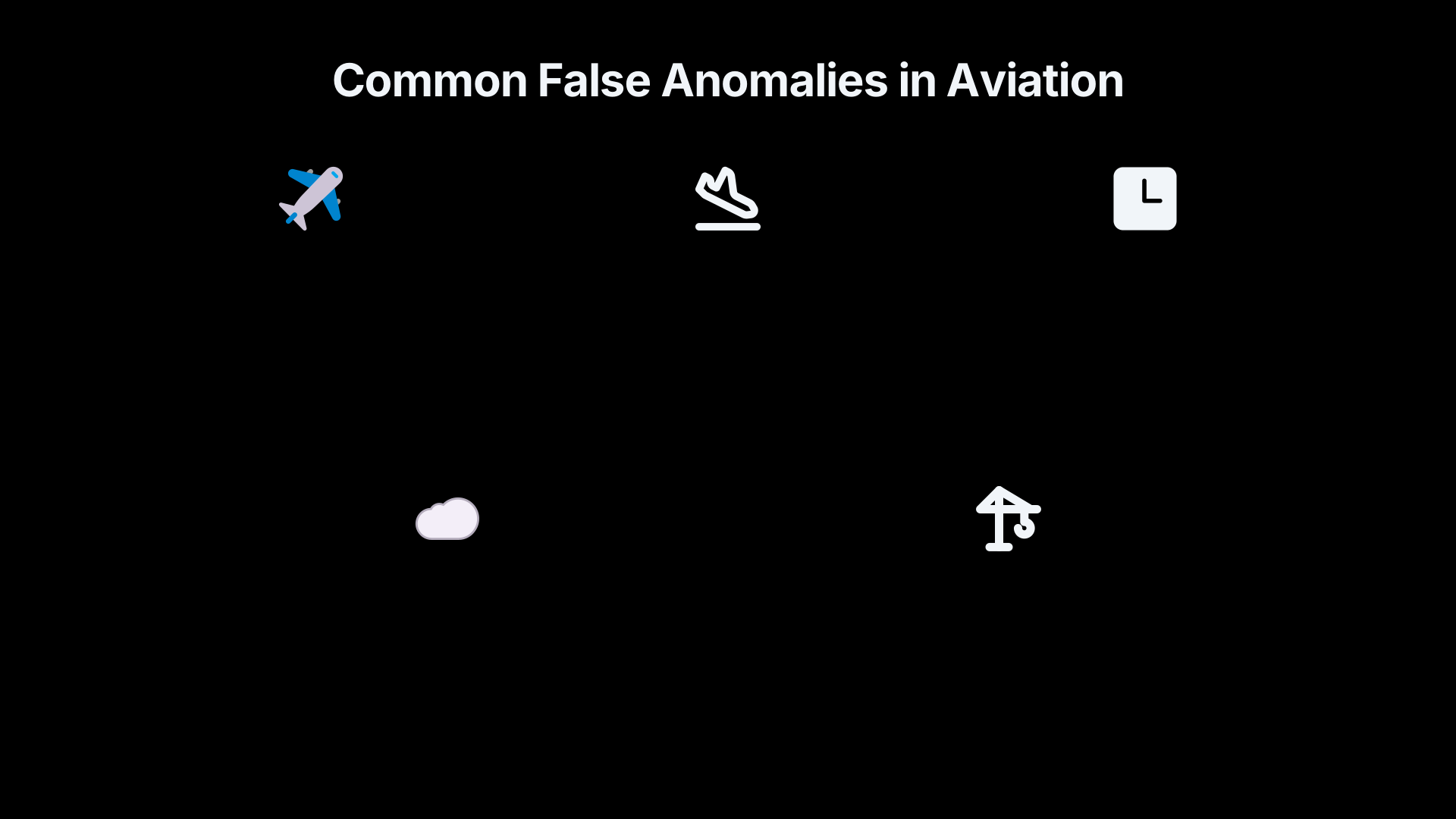
Several familiar situations repeatedly generate puzzling tracks:
Head-on approaches. Aircraft flying nearly towards the observer produce little sideways motion, appearing to hover for several minutes while steadily brightening.
Landing lights. Powerful forward-facing landing lights can dominate the visual appearance long before navigation lights become visible, making an aircraft resemble a single brilliant object.
Turning aircraft. During banking turns, different lights become visible or hidden, creating sudden changes in brightness or colour that may resemble unusual manoeuvres.
Layered weather. Thin cloud, haze and inversion layers can intermittently obscure or reveal lights, producing apparently discontinuous motion.
Without independent information such as ADS-B broadcasts, radar, stereo imaging or multiple synchronised cameras, these situations can be surprisingly difficult for automated systems to classify reliably.
This is one reason why many modern multimodal UAP observatories emphasise combining optical data with additional sensors instead of relying on video alone.[ResearchGate+2World Scientific]researchgate.netResearchGate(PDF) The Scientific Investigation of Unidentified Aerial…May 29, 2023 — This study aims to highlight outlier events withi…
Why machine vision struggles near the horizon
Computer vision systems generally assume that targets possess distinguishable features and maintain reasonably consistent appearance between successive frames. Horizon observations violate many of those assumptions simultaneously.
Backgrounds become highly structured, containing trees, hills, buildings and clouds. Objects occupy very few pixels because they are distant. Contrast changes continuously as haze thickens or lighting changes. Atmospheric turbulence introduces apparent motion that is unrelated to the target itself.
These conditions increase both false positives and fragmented tracks, where a detector repeatedly loses and reacquires the same object. Research on automated aircraft detection below the horizon specifically addresses these problems because conventional tracking methods perform significantly worse against low-elevation backgrounds than against open sky.[arXiv]arxiv.orgWe address some of the challenges faced by existing vision-…Read more…

Baseline checks that separate traffic from anomalies
Pattern-of-life collection becomes especially valuable close to the horizon because repeated observations establish which unusual-looking behaviours occur every day.
Effective baseline analysis typically includes:
- Recording weeks or months of continuous observations from the same camera geometry.
- Cross-checking optical tracks against ADS-B aircraft broadcasts whenever available.
- Logging local weather, humidity, visibility and cloud conditions.
- Mapping persistent sources of artificial lighting.
- Measuring the detector’s false-positive rate at different elevation angles.
- Comparing simultaneous observations from multiple cameras viewing the same target from different positions.
Repeated measurements often reveal that specific “mysterious” trajectories recur under similar weather, lighting or air traffic conditions. Once recognised, these become part of the site’s normal behaviour rather than unexplained events.
NASA’s independent UAP study emphasises exactly this approach: high-quality metadata, calibrated sensors, multiple independent observations and comprehensive baseline datasets are prerequisites for distinguishing genuine anomalies from ordinary but poorly characterised observations.[NASA Science]science.nasa.govNASA ScienceIndependent Study Team ReportThe study of Unidentified Anomalous Phenomena (UAP) presents a unique scientific opportunity tha…
What this means for automated UFO detectors
A detector that treats every unusual-looking low-horizon track as equally significant will generate a large number of false alerts. The better design strategy is to recognise that the horizon is a statistically different observing environment from the rest of the sky.
Rather than lowering detection thresholds, robust systems characterise horizon behaviour separately. Elevation-dependent confidence scoring, continuous pattern-of-life collection, integration with external air traffic information, atmospheric monitoring and multi-sensor confirmation all reduce the likelihood that distant aircraft, lighting effects or atmospheric distortions are promoted into candidate anomalies.
In practice, the horizon is not where the sky becomes most mysterious. It is where ordinary physics, ordinary aviation and ordinary environmental conditions combine to make automated interpretation most difficult. Understanding those effects is therefore an essential part of building credible instrumented UAP detection systems rather than an obstacle to them.
Amazon book picks
Further Reading
Books and field guides related to Why the Horizon Creates So Many False Mysteries. Use these as the next step if you want deeper reading beyond the article.
The Demon-Haunted World
Useful for avoiding false mystery narratives when perception and evidence are weak.
NightWatch
Helps readers recognise ordinary low-horizon sky objects and observing distortions.
Turn Left at Orion
Encourages repeated comparison of objects at different elevations and viewing conditions.

UFOs : Generals, Pilots, and Government Officials Go on the R...
Provides context for why better sensor evidence is needed before treating sightings as extraordinary.
eBay marketplace picks
Marketplace Samples
Example marketplace items related to this page. Use the search link to explore similar finds on eBay.

Endnotes
1.
Source: science.nasa.gov
Link:https://science.nasa.gov/wp-content/uploads/2023/09/uap-independent-study-team-final-report.pdf
Source snippet
NASA ScienceIndependent Study Team ReportThe study of Unidentified Anomalous Phenomena (UAP) presents a unique scientific opportunity tha...
2.
Source: space.com
Title: nasa ufo uap study team first results revealed
Link:https://www.space.com/nasa-ufo-uap-study-team-first-results-revealed
Source snippet
NASA UFO report finds no evidence of 'extraterrestrial...14 Sept 2023 — "At present, analysis of UAP data is hampered by poor sensor cal...
3.
Source: arxiv.org
Link:https://arxiv.org/abs/1903.03275
Source snippet
We address some of the challenges faced by existing vision-...Read more...
4.
Source: elib.dlr.de
Link:https://elib.dlr.de/135611/1/1901.07452n.pdf
Source snippet
DLR Electronic LibraryarXiv:1901.07452v2 [quant-ph] 9 Jun 2019October 19, 2021 — by D Vasylyev · 2019 · Cited by 133 — We show that the s...
Published: October 19, 2021
5.
Source: opg.optica.org
Link:https://opg.optica.org/ao/abstract.cfm?URI=ao-59-21-F11
Source snippet
Optica Publishing GroupBelow the horizon—the physics of extreme visual rangesby M Vollmer · 2020 · Cited by 15 — Extreme visual ranges re...
6.
Source: conference.sdo.esoc.esa.int
Link:https://conference.sdo.esoc.esa.int/proceedings/sdc9/paper/344/SDC9-paper344.pdf
Source snippet
ESA Proceedings DatabaseATMOSPHERIC SCINTILLATION IN RESIDENT...by M Kuhn — We conclude that atmospheric scintillation noise should be k...
7.
Source: arxiv.org
Title: arXiv Atmospheric Scintillation Noise in Ground-Based Exoplanet Photometry
Link:https://arxiv.org/abs/1909.02004
8.
Source: researchgate.net
Link:https://www.researchgate.net/publication/371163445_The_Scientific_Investigation_of_Unidentified_Aerial_Phenomena_UAP_Using_Multimodal_Ground-Based_Observatories
Source snippet
ResearchGate(PDF) The Scientific Investigation of Unidentified Aerial...May 29, 2023 — This study aims to highlight outlier events withi...
Published: May 29, 2023
9.
Source: science.nasa.gov
Link:https://science.nasa.gov/uap/
Source snippet
nasa.govUAP9 Jun 2022 — A study team to examine unidentified anomalous phenomena (UAPs) – that is, observations of events in the sky that...
10.
Source: nasa.gov
Title: update nasa shares uap independent study report names director
Link:https://www.nasa.gov/news-release/update-nasa-shares-uap-independent-study-report-names-director/
Source snippet
UPDATE: NASA Shares UAP Independent Study Report14 Sept 2023 — The report contains the external study team's findings and recommendations...
11.
Source: nasa.gov
Title: to release discuss unidentified anomalous phenomena report
Link:https://www.nasa.gov/news-release/nasa-to-release-discuss-unidentified-anomalous-phenomena-report/
Source snippet
NASA to Release, Discuss Unidentified Anomalous...12 Sept 2023 — NASA defines UAP as observations of events in the sky that cannot be id...
12.
Source: arxiv.org
Link:https://arxiv.org/pdf/2305.18566
Source snippet
The Scienti¯c Investigation of Unidenti¯ed Aerial...by WA Watters · 2023 · Cited by 47 — (2) UAPx is a group of scientists, technicians...
13.
Source: researchgate.net
Link:https://www.researchgate.net/publication/380745221_An_Optical_Daytime_Astronomy_Pathfinder_for_the_Huntsman_Telescope
Source snippet
ime astronomy facility, by conducting an exploratory survey using a pathfinder...Read more...
14.
Source: researchgate.net
Link:https://www.researchgate.net/publication/325659005_UAT_ADS-B_Data_Anomalies_and_the_Effect_of_Flight_Parameters_on_Dropout_Occurrences
Source snippet
s including dropout, missing payload, data jump, low confidence data, and altitude...Read more...
15.
Source: adsabs.harvard.edu
Title: Astrophysics Data System Atmospheric Intensity Scintillation of Stars, I
Link:https://adsabs.harvard.edu/full/1997PASP..109..173D
Source snippet
D Dravins · 1997 · Cited by 148 — Quantitative determinations for stellar scintillation at a low-altitude site were mad...
16.
Source: worldscientific.com
Link:https://www.worldscientific.com/doi/10.1142/S2251171723400068?srsltid=AfmBOor7G4xLRljML3XexExWlR-xDcAVYRlCgVg-HP6j8iactcWHcJp0
Source snippet
A primary objective of the...
Additional References
17.
Source: nature.com
Link:https://www.nature.com/articles/s41599-024-04182-z
Source snippet
Looking up the sky: unidentified aerial phenomena and...by N Goldstein · 2024 · Cited by 1 — UAP sightings measure is highly correlated...
18.
Source: mitre.org
Link:https://www.mitre.org/sites/default/files/2021-08/16-4497-AIAA-2017-ADS-B.pdf
Source snippet
ADS-B Surveillance System Performance with Small UAS...This analysis intends to highlight the impact on the Universal Access Transceiver...
19.
Source: facebook.com
Link:https://www.facebook.com/groups/348704483442978/posts/1131448681835217/
Source snippet
Tracking unidentified flying objectsThe limited amount of high-quality reporting on unidentified aerial phenomena (UAP) hampers our abili...
20.
Source: rev.com
Title: unidentified anomalous phenomena independent study report from nasa transcript
Link:https://www.rev.com/transcripts/unidentified-anomalous-phenomena-independent-study-report-from-nasa-transcript
Source snippet
UAP Independent Study Report from NASA18 Sept 2023 — The Unidentified Anomalous Phenomena from NASA released a report to the public. Read...
21.
Source: astrodennis.com
Link:https://astrodennis.com/FalsePositiveDetection.pdf
Source snippet
, amateur astronomers have conducted time- series analysis of exoplanet transits with enough precision...Read more...
22.
Source: youtube.com
Link:https://www.youtube.com/watch?v=TQcqOW39ksk
Source snippet
Unidentified Anomalous Phenomena Independent Study ReportNASA commissioned an independent study team to examine unidentified anomalous ph...
23.
Source: avi-loeb.medium.com
Title: a new calculation on the fly to the nasa uap study 2dacaf860cac
Link:https://avi-loeb.medium.com/a-new-calculation-on-the-fly-to-the-nasa-uap-study-2dacaf860cac
Source snippet
New Calculation on the Fly to the NASA UAP Study - Avi LoebThe NASA Study will examine unclassified data on UAP in an attempt to separate...
24.
Source: Wikipedia
Title: NASA Unidentified Anomalous Phenomena Independent Study Team
Link:https://en.wikipedia.org/wiki/NASA_Unidentified_Anomalous_Phenomena_Independent_Study_Team
Source snippet
NASA Unidentified Anomalous Phenomena Independent...UAPs are defined as phenomena or observations of events in the air, sea, space, a...
25.
Source: scirp.org
Link:https://www.scirp.org/journal/paperinformation?paperid=135539
Source snippet
nimal air traffic after midnight, isolation from the rest of Long Island, and...Read more...
26.
Source: flyingmag.com
Title: nasa releases ufo study appoints director of uap research
Link:https://www.flyingmag.com/nasa-releases-ufo-study-appoints-director-of-uap-research/
Source snippet
NASA Releases UFO Study, Appoints Director of UAP...14 Sept 2023 — A NASA-commissioned independent study team urged the agency to use ev...
Topic Tree