Within NASA Gap
From Strange Image to Usable Measurement
Calibration lets reviewers test whether a recorded shape, brightness or motion came from the sky or from the instrument itself.
On this page
- What calibration changes in a UAP review
- How sensor faults can imitate structure or motion
- Why shared calibration standards make stations comparable
Page outline Jump by section
Introduction
For an automated instrumented UAP detector, calibration is the step that transforms an intriguing image into evidence that can be measured, checked and compared. A photograph alone records what a sensor produced; a calibrated observation records how faithfully that sensor represented the scene. This distinction sits at the heart of NASA’s 2023 Independent Study Team report, which argues that poor calibration is one of the main reasons existing UAP material often cannot support reliable scientific analysis. Without calibration, analysts cannot confidently determine whether an unusual shape, brightness or apparent motion belongs to the sky or to the instrument that captured it.[NASA Science]science.nasa.govScience Independent Study Team ReportNASA ScienceIndependent Study Team ReportSeptember 13, 2023 — At present, analysis of UAP data is hampered by poor sensor calibration, th…
 Calibration therefore is not an optional engineering refinement. It is the mechanism that allows later reviewers to quantify uncertainty, reproduce measurements and compare observations made by different stations. Rather than asking whether an image “looks unusual”, calibration asks whether every measurable property of that image can be traced back to a known physical quantity.
What calibration changes in a UAP review
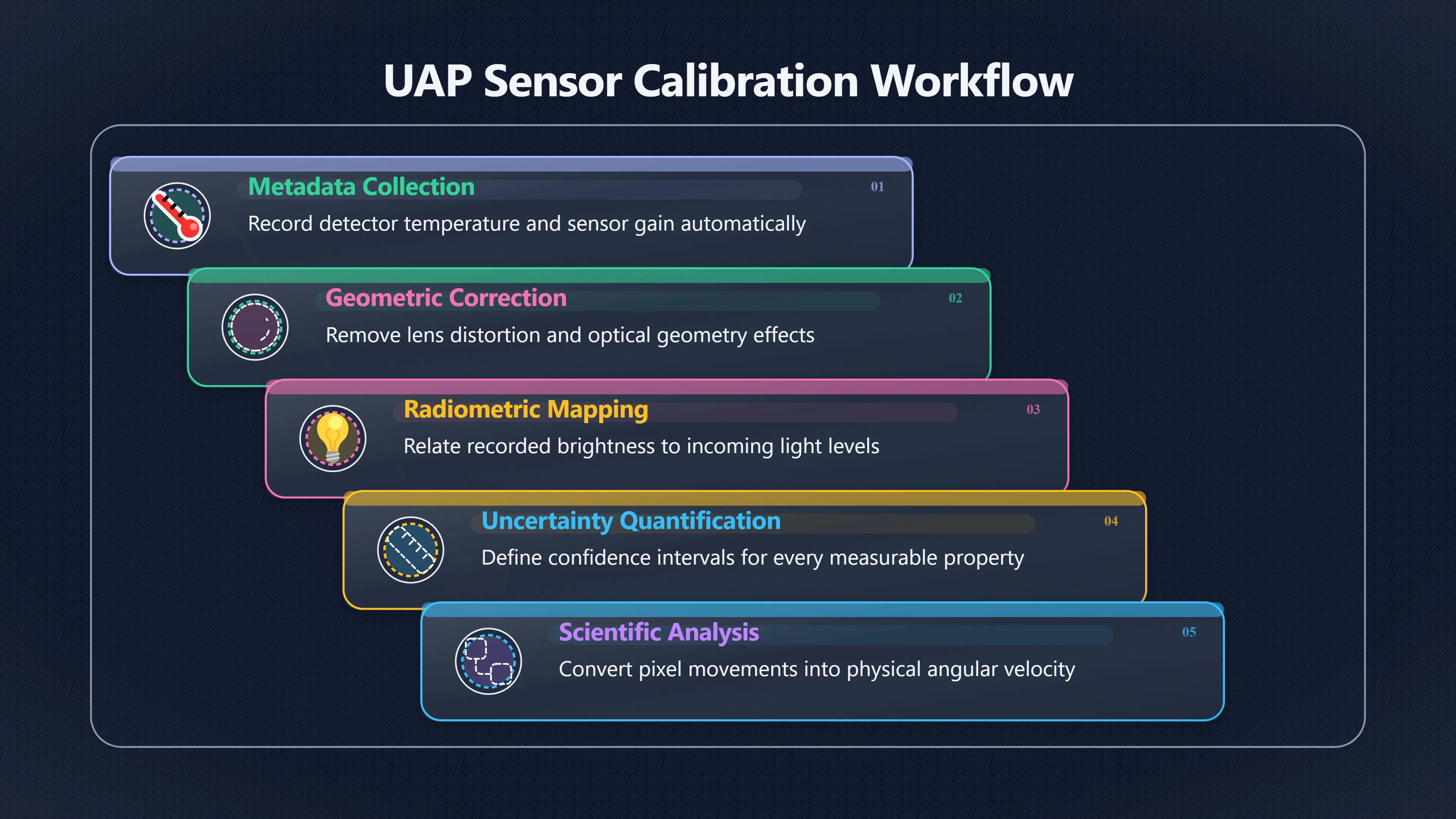
The most important effect of calibration is that every observable quantity acquires a defined meaning.
A calibrated imaging system establishes relationships such as:
- how image pixels correspond to angular position in the sky;
- how recorded brightness relates to incoming light;
- how accurately timestamps represent the moment of exposure;
- how lens geometry alters apparent object position;
- how sensor noise changes with temperature, gain or exposure.
Once these relationships are known, analysts can replace subjective impressions with measurable quantities.
For example, an object appearing to cross twenty pixels between frames says very little on its own. If the camera’s focal length, pixel scale, exposure interval and pointing direction are calibrated, those twenty pixels can instead become an angular velocity. Combined with independent range information, that angular velocity can later be converted into a physical speed with known uncertainty rather than speculation. This is the transition from a sighting to a measurement.[NASA Science+2Optical Metrology Centre]science.nasa.govScience Independent Study Team ReportNASA ScienceIndependent Study Team ReportSeptember 13, 2023 — At present, analysis of UAP data is hampered by poor sensor calibration, th…
Calibration also preserves confidence intervals. Scientific measurements are valuable not because they eliminate uncertainty, but because they quantify it. Knowing that an object’s position is accurate to within 0.05° is far more informative than simply knowing where it appeared in an image.
How sensor faults can imitate structure or motion
Many apparently unusual features originate inside imaging systems rather than outside them. Calibration exists precisely because cameras are imperfect measuring instruments.
Lens distortion
Most lenses bend light unevenly across the image. Straight paths through the sky may appear curved, while objects near the edge of the field can seem displaced from their true positions.
Modern photogrammetry routinely measures these distortions so software can remove them before positional measurements are made. Without that correction, apparent manoeuvres may simply reflect optical geometry rather than object motion.[Optical Metrology Centre+2PMC]optical-metrology-centre.comOptical Metrology CentreTHE DEVELOPMENT OF CAMERA CALIBRATION METHODS…by TA CLARKE · Cited by 609 — Correction for image distortion in…
Rolling shutter effects
Many CMOS cameras expose each image line sequentially rather than simultaneously. If either the camera or the target moves during capture, objects become skewed, stretched or tilted.
In everyday photography this may produce leaning buildings or distorted propellers. In sky observations it can also create misleading trajectories or apparent shape changes. Aerospace researchers studying star trackers devote significant effort to modelling and correcting rolling-shutter distortion because even small timing offsets reduce measurement accuracy.[MDPI]mdpi.comAnalysis and Correction of the Rolling Shutter Effect for a…by Z Fu · 2022 · Cited by 3 — The rolling shutter effect decreases the…
For automated UAP detectors, recording shutter mode and exposure timing is therefore part of calibration rather than an implementation detail.
Brightness artefacts
Brightness can also deceive.
Sensor saturation, blooming, hot pixels, automatic gain control and internal image processing may create halos, apparent glowing edges or changes in intensity unrelated to the object itself.
Radiometric calibration measures how detector output corresponds to incoming light and identifies the limits where the sensor no longer behaves linearly. NASA has long treated radiometric calibration as essential because inaccurate brightness measurements can lead to incorrect scientific conclusions and prevent meaningful comparison between instruments.[NASA Technical Reports Server+2ResearchGate]ntrs.nasa.govNASA Technical Reports ServerRadiometric Calibration Assessment of Commercial High…by K Holekamp · 2006 — Inaccurate radiometric calib…
Why calibration matters before an event occurs
A frequent misconception is that calibration can be reconstructed after an unusual recording has already been made.
In reality, much calibration information only exists while the observation is taking place.
Examples include:
- detector temperature;
- focus position;
- sensor gain;
- exposure duration;
- software version;
- image processing pipeline;
- pointing accuracy;
- timing synchronisation.
If these values are not recorded automatically, they cannot always be recovered later.
This explains NASA’s emphasis on collecting metadata alongside observations. A visually impressive recording without instrument state information often leaves analysts unable to distinguish genuine external behaviour from changes introduced by the camera itself.[NASA Science]science.nasa.govScience Independent Study Team ReportNASA ScienceIndependent Study Team ReportSeptember 13, 2023 — At present, analysis of UAP data is hampered by poor sensor calibration, th…
Why shared calibration standards make stations comparable
A network of automated detectors only becomes scientifically useful when different stations measure the sky in compatible ways.
Suppose two cameras observe the same bright object from different locations.
If each uses different timing references, different geometric corrections and different brightness scales, comparing the recordings becomes difficult. Apparent disagreements may result from instrumentation rather than from the object.
Shared calibration standards reduce this problem by ensuring that each station:
- uses consistent geometric corrections;
- maintains synchronised clocks;
- measures brightness on comparable scales;
- records identical metadata fields;
- documents calibration uncertainty.
Once those standards exist, observations from multiple sites can be combined into triangulation, trajectory reconstruction and independent verification.
This mirrors established practice in astronomy, Earth observation and remote sensing, where common calibration procedures allow measurements from different observatories and satellites to be compared over long periods despite using different hardware. NASA Technical Reports Server+2NASA Technical Reports Server[ntrs.nasa.gov]ntrs.nasa.govNASA Technical Reports ServerRadiometric Calibration of the Earth Observing System's…by PN Slater · 1997 — The work on the grant invol…
Calibration supports explanation as much as discovery
Calibration is sometimes viewed as a way to strengthen extraordinary claims. In practice, its first benefit is usually the opposite.
A calibrated system is better at identifying ordinary explanations.
Known optical distortion can explain apparent curvature.
Measured rolling-shutter timing can explain apparent acceleration.
Documented sensor noise can explain isolated bright pixels.
Verified pointing information can identify satellites, aircraft or planets occupying the recorded direction.
Removing these false positives is scientifically valuable because it leaves fewer genuinely unexplained events requiring detailed investigation. NASA’s report explicitly notes that some apparent UAP have proved to be sensor artefacts once calibration and metadata were examined carefully.[NASA Science]science.nasa.govScience Independent Study Team ReportNASA ScienceIndependent Study Team ReportSeptember 13, 2023 — At present, analysis of UAP data is hampered by poor sensor calibration, th…
The result is a higher-quality evidence pipeline. Instead of treating every unusual image as equally mysterious, calibrated systems progressively separate instrumental effects from physical observations. Only after that filtering process does an observation become suitable for meaningful scientific analysis.
Amazon book picks
Further Reading
Books and field guides related to From Strange Image to Usable Measurement. Use these as the next step if you want deeper reading beyond the article.

Data Reduction and Error Analysis for the Physical Sciences
Directly addresses measurement uncertainty and calibration.

An introduction to error analysis
Covers propagation of measurement error and precision.
eBay marketplace picks
Marketplace Samples
Example marketplace items related to this page. Use the search link to explore similar finds on eBay.
Endnotes
1.
Source: science.nasa.gov
Title: Science Independent Study Team Report
Link:https://science.nasa.gov/wp-content/uploads/2023/09/uap-independent-study-team-final-report.pdf
Source snippet
NASA ScienceIndependent Study Team ReportSeptember 13, 2023 — At present, analysis of UAP data is hampered by poor sensor calibration, th...
Published: September 13, 2023
2.
Source: optical-metrology-centre.com
Link:https://www.optical-metrology-centre.com/Downloads/Papers/Photogrammetric%20Record%201998%20Camera%20calibration.pdf
Source snippet
Optical Metrology CentreTHE DEVELOPMENT OF CAMERA CALIBRATION METHODS...by TA CLARKE · Cited by 609 — Correction for image distortion in...
3.
Source: pmc.ncbi.nlm.nih.gov
Link:https://pmc.ncbi.nlm.nih.gov/articles/PMC4208234/
Source snippet
Calibration of Action Cameras for Photogrammetric Purposesby C Balletti · 2014 · Cited by 112 — In order to be able to use the sensor...
4.
Source: mdpi.com
Link:https://www.mdpi.com/2072-4292/14/22/5772
Source snippet
Analysis and Correction of the Rolling Shutter Effect for a...by Z Fu · 2022 · Cited by 3 — The rolling shutter effect decreases the...
5.
Source: researchgate.net
Link:https://www.researchgate.net/publication/326515831_Calibration_and_Noise_Identification_of_a_Rolling_Shutter_Camera_and_a_Low-Cost_Inertial_Measurement_Unit
Source snippet
(PDF) Calibration and Noise Identification of a Rolling...10 Jul 2018 — This paper proposes a new calibration method that jointly estima...
6.
Source: ntrs.nasa.gov
Link:https://ntrs.nasa.gov/citations/20060010387
Source snippet
NASA Technical Reports ServerRadiometric Calibration Assessment of Commercial High...by K Holekamp · 2006 — Inaccurate radiometric calib...
7.
Source: researchgate.net
Link:https://www.researchgate.net/publication/7513531_Radiometric_validation_of_NASA%27s_Ames_Research_Center%27s_Sensor_Calibration_Laboratory
Source snippet
Radiometric validation of NASA's Ames Research Center's...The comparison was one of a series of validation activities overseen by the EO...
8.
Source: ntrs.nasa.gov
Link:https://ntrs.nasa.gov/citations/19970011087
Source snippet
NASA Technical Reports ServerRadiometric Calibration of the Earth Observing System's...by PN Slater · 1997 — The work on the grant invol...
9.
Source: researchgate.net
Link:https://www.researchgate.net/publication/403808219_A_NIST-Traceable_Lab-to-Sky_Spectral_and_Radiometric_Calibration_for_NASA%27s_High-Altitude_Airborne_Hyperspectral_Pushbroom_Imager_for_Cloud_and_Aerosol_Research_and_Development_PICARD
Source snippet
A NIST-Traceable Lab-to-Sky Spectral and Radiometric...11 Jun 2026 — A NIST-Traceable Lab-to-Sky Spectral and Radiometric Calibration fo...
10.
Source: ntrs.nasa.gov
Link:https://ntrs.nasa.gov/citations/19860034742
Source snippet
importance and attainment of accurate absolute...by PN Slater · 1984 · Cited by 36 — The importance of accurate absolute radiometric cal...
11.
Source: ntrs.nasa.gov
Link:https://ntrs.nasa.gov/api/citations/20170002654/downloads/20170002654.pdf
Source snippet
Propulsion Lab and Rochester...Read more...
12.
Source: ntrs.nasa.gov
Link:https://ntrs.nasa.gov/citations/19850041613
Source snippet
[review]({{ 'review/' | relative_url }}) of some radiometric calibration problems...by PN Slater · 1984 · Cited by 13 — A review of some radiometric calibration problems...
Additional References
13.
Source: isprs.org
Link:https://www.isprs.org/proceedings/xxxi/congress/part5/534_XXXI-part5.pdf
Source snippet
ction with the collinearity equations is sufficient.Read more...
14.
Source: youtube.com
Title: Unidentified Anomalous Phenomena Report from NASA
Link:https://www.youtube.com/watch?v=ixTICcLXueg
Source snippet
This NASA UAP Report Presentation details why establishing strict sensor calibration baselines is crucial for transforming raw, ambiguous...
15.
Source: youtube.com
Title: UAP Independent Study Event Post-Meeting Media Teleconference (
Link:https://www.youtube.com/watch?v=C3uXUfgSadU
Source snippet
The [Galileo]({{ 'galileo/' | relative_url }}) Project's First Data on Half a Million Objects with Avi Loeb...
Published: May 31, 2023
16.
Source: arxiv.org
Link:https://arxiv.org/html/2411.02401v1
Source snippet
A Civilian Astronomer's Guide to UAP Research5 Nov 2024 — We compare the investigation of UAP to the process of calibration and interpret...
17.
Source: youtube.com
Title: Replay! NASA’s Release of the Unidentified Anomalous Phenomena Report
Link:https://www.youtube.com/watch?v=nuBMnluJfs0
Source snippet
UAP Independent Study Event Post-Meeting Media Teleconference (May 31, 2023)...
Published: May 31, 2023
18.
Source: arxiv.org
Link:https://arxiv.org/abs/0910.2233
Source snippet
Blind astrometric calibration of arbitrary astronomical imagesby D Lang · 2009 · Cited by 1552 — We have built a reliable and robust syst...
19.
Source: cs.auckland.ac.nz
Title: auckland.ac.nz Camera calibration with distortion models and accuracy
Link:https://www.cs.auckland.ac.nz/courses/compsci773s1c/lectures/camera%20distortion.pdf
Source snippet
Using these parameters, the 3-D...Read more...
20.
Source: youtube.com
Title: The Galileo Project’s First Data on Half a Million Objects with Avi Loeb
Link:https://www.youtube.com/watch?v=uJtER5ahdPY
Source snippet
Unidentified Anomalous Phenomena Report from NASA...
21.
Source: youtube.com
Title: Unidentified Anomalous Phenomena Independent Study Report
Link:https://www.youtube.com/watch?v=TQcqOW39ksk
Source snippet
Replay! NASA's Release of the Unidentified Anomalous Phenomena Report...
22.
Source: sciopen.com
Link:https://www.sciopen.com/local/article_pdf/10.1007/s42064-023-0168-2.pdf
Source snippet
Astrometric calibration and source characterisation of the...by NO Ralph · 2023 · Cited by 36 — In these experiments, the EB space imagi...
Topic Tree