Within Edge Computer
Is the sky event real or the station misbehaving?
A station should test weather, clock, camera motion and sensor status before treating a strange recording as an unexplained event.
On this page
- Clock, weather and vibration checks
- Camera settings that can invalidate a clip
- How health metadata protects later review
Page outline Jump by section
Introduction
An automated UAP detector is only as trustworthy as the condition of the instruments that produced its data. Before a sky station classifies an unusual recording as an unexplained event, it should first ask a more mundane question: is the sky behaving strangely, or is the station itself? This distinction is critical because camera faults, incorrect clocks, vibration, weather effects and misconfigured settings can all produce convincing-looking anomalies. NASA’s independent UAP study identified poor calibration and missing metadata as major barriers to reliable analysis, noting that several apparent UAP have ultimately proved to be sensor artefacts once calibration and metadata were examined.[NASA Science]science.nasa.govScience Independent Study Team ReportNASA ScienceIndependent Study Team ReportSeptember 13, 2023 — In short, calibration ensures that future data gathered are reliable and ac…
 Within an edge-computing architecture, these health checks should happen automatically before an event is promoted to a high-priority alert. Rather than simply detecting an unusual object, the station should continuously assess whether its own measurements remain scientifically valid.
Why every alert should begin with a self-test
Many false UAP alerts originate from the observing system rather than the sky. A detector that only searches for unusual motion cannot distinguish between a genuinely unusual target and a camera shaken by wind, a lens covered with moisture or a computer that has drifted several seconds away from the correct time.
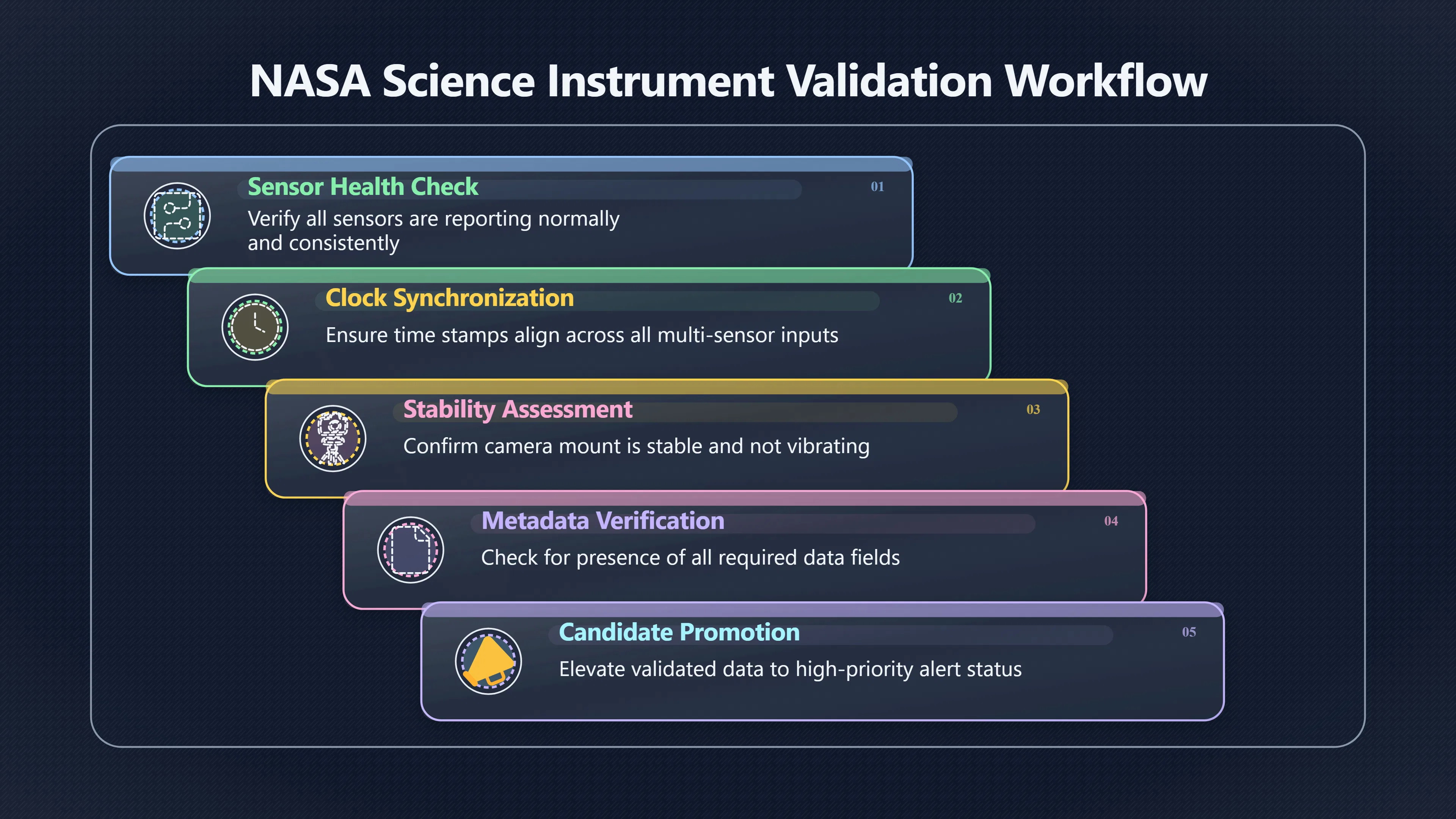
The first stage of event processing therefore becomes instrument validation. Instead of asking only, “Did something unusual appear?”, the software asks a sequence of questions such as:
- Are all sensors reporting normally?
- Are timestamps still synchronised?
- Is the camera stable?
- Are weather conditions compatible with reliable observation?
- Has any configuration changed since calibration?
- Are all required metadata fields present?
Only after these checks pass should an event be treated as a candidate for further analysis. This philosophy closely matches the emphasis in NASA’s report on calibration, metadata and systematic elimination of sensor artefacts before interpreting unusual observations.[NASA Science]science.nasa.govScience Independent Study Team ReportNASA ScienceIndependent Study Team ReportSeptember 13, 2023 — In short, calibration ensures that future data gathered are reliable and ac…
Clock, weather and vibration checks
Clock synchronisation is a scientific measurement
Modern sky stations combine optical cameras, infrared sensors, radio receivers, microphones and aircraft databases. Their usefulness depends on accurate timing.
A clock that drifts by even a fraction of a second can make unrelated observations appear simultaneous or prevent genuine multi-sensor agreement from being recognised. An optical flash and an infrared detection that should align may instead appear to describe different events.
Health monitoring should therefore include continuous verification of:
- GPS or network time lock
- clock drift relative to a reference
- timestamp consistency across sensors
- detection of sudden time resets after reboot
If timing integrity fails, the event should either be downgraded or marked as unsuitable for precise trajectory reconstruction. NASA similarly stresses that accurate timing metadata is essential for meaningful UAP analysis.[NASA Science]science.nasa.govScience Independent Study Team ReportNASA ScienceIndependent Study Team ReportSeptember 13, 2023 — In short, calibration ensures that future data gathered are reliable and ac…
Weather can create convincing false anomalies
Environmental monitoring is not an optional accessory but part of the observing instrument.
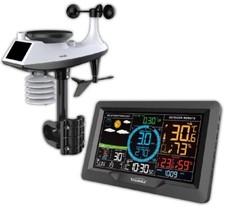
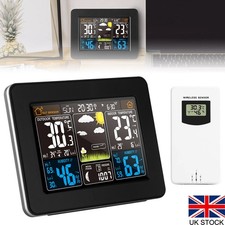
Health software should continuously record conditions including:
- cloud cover
- rain intensity
- humidity
- fog probability
- wind speed
- temperature
- atmospheric pressure
These measurements provide context for later interpretation.
Examples include:
- Strong wind increasing mast vibration and producing apparent moving stars.
- High humidity causing halos around bright lights.
- Thin cloud producing distorted aircraft lights.
- Rain droplets or insects crossing close to the lens.
Rather than suppressing every observation made in poor weather, the station should attach a confidence penalty that later reviewers can evaluate alongside the imagery.

Detecting station movement
One of the simplest ways to eliminate false alerts is to measure whether the camera itself moved.
A small accelerometer or inertial measurement unit mounted beside the camera can detect:
- wind-induced oscillation
- vibration from nearby traffic
- accidental impacts
- mount loosening
- maintenance activity
If the entire field of view shifts by exactly the same amount while vibration sensors simultaneously record movement, the system has strong evidence that the apparent motion originated in the station rather than the sky.
Camera settings that can invalidate a clip
Not every recorded image has equal scientific value. Camera configuration changes can fundamentally alter how objects appear.
Health monitoring should continuously verify operational settings such as:
- exposure time
- gain or ISO
- frame rate
- focus position
- zoom level
- white balance mode
- compression settings
- firmware version
Unexpected changes should be logged automatically.
For example, a very long exposure can stretch moving aircraft lights into unusual shapes. Automatic exposure adjustments may suddenly brighten faint clouds, while autofocus hunting can briefly distort bright objects. None of these effects necessarily indicate an unusual aerial phenomenon.
Similarly, maintenance operations deserve explicit recording. Cleaning the lens, replacing a camera, updating firmware or adjusting mounting angles changes the observing system. Any events recorded immediately afterwards should carry metadata identifying that recent intervention.
Health metadata protects later review
Health information becomes most valuable after the event, when investigators attempt to reconstruct what happened.
Instead of storing only video, a scientifically useful record should preserve the complete observing context, including:
- calibration status
- software version
- sensor temperatures
- GPS lock status
- timing accuracy
- weather conditions
- vibration measurements
- camera configuration
- storage integrity
- processor load
- any active fault warnings
NASA argues that metadata describing the observing instrument—including sensor characteristics, operating mode and environmental context—is essential because it allows investigators to distinguish genuine observations from instrument artefacts.[NASA Science]science.nasa.govScience Independent Study Team ReportNASA ScienceIndependent Study Team ReportSeptember 13, 2023 — In short, calibration ensures that future data gathered are reliable and ac…
The Galileo Project’s observatory architecture follows the same general principle by treating sensor optimisation, calibration, provenance management and system monitoring as integral parts of the edge-computing subsystem rather than afterthoughts added during later analysis.[arXiv]arxiv.orgarXiv Galileo Project Observatory Class System ArchitecturearXiv Galileo Project Observatory Class System Architecture
Designing alerts that recognise unhealthy sensors
A robust detector should distinguish between an unusual sky event and an unhealthy observing system.
Instead of issuing a single “UAP detected” notification, an edge station can classify outcomes such as:
Station statusSuggested actionAll health checks passPreserve full-resolution data and raise a candidate event.Minor health issuePreserve data but attach reduced confidence.Significant timing or calibration failureArchive recording but prevent automatic UAP classification.Sensor malfunctionGenerate a maintenance alert instead of an observational alert.
This separation prevents technical failures from being mistaken for unexplained phenomena while ensuring potentially valuable recordings are not discarded.
Comparable health-monitoring approaches are common in safety-critical sensing systems, where watchdogs monitor missing camera frames, corrupted images, processor health and communication failures before trusting any automated decision.[ROSA P]rosap.ntl.bts.govFor example, ifROSA PAudible Alert and TMA Lighting - ROSA PJuly 24, 2025 — by Y Adu-Gyamfi · 2025 — • Sensor Health Monitoring: The system will periodi…
The goal is fewer mysteries, not fewer detections
A well-designed automated UAP detector should be conservative about declaring anomalies but aggressive about documenting its own condition. Every unexplained observation should arrive with evidence that the station itself was operating correctly.
That approach does not eliminate genuine unknowns. Instead, it removes a large class of preventable false positives caused by drifting clocks, unstable mounts, changing weather, misconfigured cameras and failing hardware. As a result, the remaining candidate events are supported not only by images but also by a documented record showing that the instruments producing those images were functioning as intended.
Amazon book picks
Further Reading
Books and field guides related to Is the sky event real or the station misbehaving?. Use these as the next step if you want deeper reading beyond the article.
Designing Data-Intensive Applications
Useful for metadata integrity and system architecture.

Building Secure and Reliable Systems
Focuses on system health, monitoring and dependable operation.


eBay marketplace picks
Marketplace Samples
Example marketplace items related to this page. Use the search link to explore similar finds on eBay.
Endnotes
1.
Source: science.nasa.gov
Title: Science Independent Study Team Report
Link:https://science.nasa.gov/wp-content/uploads/2023/09/uap-independent-study-team-final-report.pdf
Source snippet
NASA ScienceIndependent Study Team ReportSeptember 13, 2023 — In short, calibration ensures that future data gathered are reliable and ac...
Published: September 13, 2023
2.
Source: arxiv.org
Title: arXiv Galileo Project Observatory Class System Architecture
Link:https://arxiv.org/abs/2506.00125
3.
Source: arxiv.org
Link:https://arxiv.org/abs/2305.18566
4.
Source: rosap.ntl.bts.gov
Title: For example, if
Link:https://rosap.ntl.bts.gov/view/dot/85413/dot_85413_DS1.pdf
Source snippet
ROSA PAudible Alert and TMA Lighting - ROSA PJuly 24, 2025 — by Y Adu-Gyamfi · 2025 — • Sensor Health Monitoring: The system will periodi...
Published: July 24, 2025
Additional References
5.
Source: prophesee.ai
Link:https://www.prophesee.ai/event-based-vision-industrial/
Source snippet
Event-based Vision for Industrial ApplicationsWith Metavision® event-based systems, see what traditional cameras can't for drastically im...
6.
Source: avi-loeb.medium.com
Link:https://avi-loeb.medium.com/commissioning-data-on-half-a-million-objects-in-the-sky-from-the-galileo-project-observatory-are-a23bd084233a
Source snippet
Data on Half a Million Objects in the Sky from...A collection of sensors in the Galileo Project Observatory at Harvard University monito...
7.
Source: galileo.hsites.harvard.edu
Title: scientific investigation unidentified aerial phenomena uap using multimodal
Link:https://galileo.hsites.harvard.edu/publications/scientific-investigation-unidentified-aerial-phenomena-uap-using-multimodal
Source snippet
Scientific Investigation of Unidentified Aerial Phenomena...A primary objective of the Galileo Project is to build an integrated softwar...
8.
Source: youtube.com
Link:https://www.youtube.com/watch?v=cZyQQulUrgM
9.
Source: albany.edu
Title: 2025 ualbany physicists test scientific approach uap research
Link:https://www.albany.edu/news-center/news/2025-ualbany-physicists-test-scientific-approach-uap-research
Source snippet
UAlbany Physicists Test Scientific Approach to UAP...2 Jun 2025 — A team of physicists from UAlbany has proposed scientifically rigorous...
10.
Source: researchgate.net
Link:https://www.researchgate.net/publication/371163445_The_Scientific_Investigation_of_Unidentified_Aerial_Phenomena_UAP_Using_Multimodal_Ground-Based_Observatories
Source snippet
mena (UAP) using an integrated software and instrumentation system for...Read more...
11.
Source: oxmaint.com
Title: ai vision cameras facility monitoring real time
Link:https://oxmaint.com/industries/facility-management/ai-vision-cameras-facility-monitoring-real-time
Source snippet
AI Vision Cameras for Real-Time Facility Monitoring12 May 2026 — How are false alerts managed in AI facility monitoring systems? Edge AI...
Published: May 2026
12.
Source: instagram.com
Link:https://www.instagram.com/reel/DXY40UDmU7Z/
Source snippet
acy (±0.5°C), covering temps from -200°C to 800°C. Features fast...
13.
Source: pubmed.ncbi.nlm.nih.gov
Link:https://pubmed.ncbi.nlm.nih.gov/20519129/
Source snippet
biomedical sensor system for real-time monitoring of...by DY Fei · 2010 · Cited by 39 — Results: The sensor integration, data collection...
14.
Source: safetyscope.eu
Title: reduce [false alarms]({{ ‘false-alarms/’ | relative_url }}) ai security cameras
Link:https://safetyscope.eu/learn/reduce-false-alarms-ai-security-cameras
Source snippet
How to reduce false alarms in AI security cameras1 Dec 2025 — The five most common causes are environmental triggers (wind, rain, shadows...
Topic Tree