Within Sky Detectors
What Happens After a Detector Triggers?
Automation can find candidates, but expert review still decides whether an alert is ordinary, unclear, or worth deeper study.
On this page
- Sorting obvious false alarms
- When human expertise is needed
- Building transparent review categories
Page outline Jump by section
Introduction
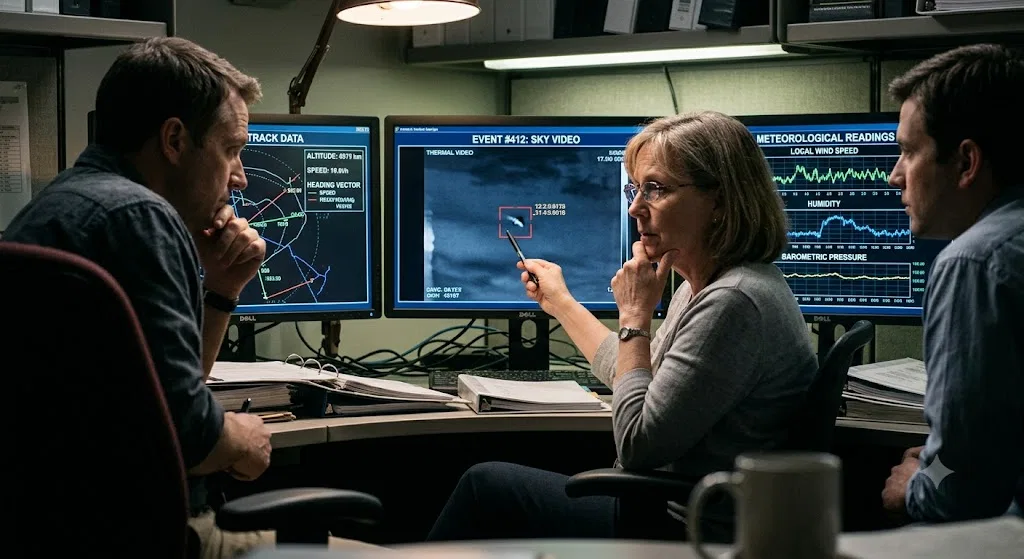
When an automated instrumented UFO detector triggers, the alert is not the answer. It is the start of a review chain. The system may have recorded something unusual enough to preserve: a light, track, infrared source, radar return or multi-sensor coincidence. Human reviewers then decide whether the event is an obvious false alarm, an ordinary object with enough evidence to identify it, a low-information case that should stay unresolved, or a genuinely interesting candidate for deeper study. This matters because automated detection can improve the record, but it cannot remove judgement. NASA’s UAP study stressed that useful progress depends on calibrated sensors, metadata, baseline data and rigorous analysis, not simply more sightings or more cameras.[NASA Science]science.nasa.govScience Independent Study Team ReportNASA ScienceIndependent Study Team ReportSeptember 13, 2023 — The study of Unidentified Anomalous Phenomena (UAP) presents a unique scien…
For automated sky-watch projects, the most important triage principle is therefore modest: treat every alert first as a measurement problem. The question is not “what extraordinary thing was seen?” but “what ordinary explanations can be tested with the data in hand, and what remains after those tests?”
The Alert Is Only a Candidate
Automated detectors are designed to notice patterns faster and more consistently than a person staring at the sky. A wide-field camera may flag motion; an infrared array may detect a warm moving source; software may compare a track with aircraft data; a narrow-field camera may be cued to zoom in. Projects such as Sky360 describe this ambition as continuous observation that can detect, track, identify and analyse aerial phenomena, while the Galileo Project frames its observatories as a multi-modal census of aerial objects and anomalies rather than a machine that declares “UAP” by itself.[Sky360]sky360.orgObservational Citizen Science of Earth's AtmosphereSky360 is an open-source global sky observation network using AI-powered tracking stat…
That difference is crucial. A detector threshold is usually tuned to catch more than it needs, because missing a rare event is worse than saving too many clips. The result is a queue of candidates, not a queue of discoveries. Reviewers must ask whether the alert is a bird close to the lens, a satellite flare, a distant aircraft, a drone, a balloon, a meteor, a cloud edge, a sensor artefact, a software tracking error or an event that really deserves escalation.
The best systems make this review easier by saving the context around the alert: time stamps, pointing direction, sensor settings, weather, aircraft and satellite context, raw frames before and after the trigger, and data provenance showing how the record was produced. The Galileo Project’s observatory-class architecture explicitly separates real-time edge acquisition from later post-processing workflows, including commissioning, census operations, science operations and system-effectiveness monitoring. That structure recognises that the first machine decision is only one stage in a longer review pipeline.[arXiv]arxiv.orgarXiv Galileo Project Observatory Class System ArchitectureGalileo Project Observatory Class System ArchitectureMay 30, 2025…
Sorting Obvious False Alarms
The first human review pass is usually not glamorous. It is the deliberate removal of routine sky traffic and sensor mistakes. This is where most alerts should go, because the sky is busy: aircraft cross fields of view, birds and insects pass close to cameras, satellites brighten unexpectedly, balloons drift, drones hover, clouds change shape, and optics create glints or ghosts.
A useful triage workflow starts with mundane checks before any exotic interpretation:
- Aircraft and drones: compare the time, bearing and motion with ADS-B aircraft data where available, local airport patterns, drone-prone sites and known military or emergency activity.
- Satellites and space objects: check satellite catalogues, recent launches, orbital predictions and reflection geometry, especially for trains of low-Earth-orbit satellites.
- Weather and atmosphere: inspect cloud layers, wind, temperature, humidity, precipitation, lightning, sprites, mirages and other atmospheric effects.
- Biological sources: review frame-by-frame morphology and parallax for birds, bats and insects, especially when the apparent speed is caused by closeness to the camera.
- Instrument effects: look for lens flare, hot pixels, compression artefacts, focus errors, rolling-shutter distortions, automatic exposure changes and tracking-software jumps.
Government and research experience shows why this first pass matters. AARO’s 2024 annual report said it resolved 118 cases during the reporting period as prosaic objects such as balloons, birds and unmanned aerial systems, and another group of cases was recommended for closure pending peer review.[U.S. Department of War]media.defense.govFY24 CONSOLIDATED ANNUAL REPORT ON UAP 508Department of WarFiscal Year 2024 Consolidated Annual Report on…November 14, 2024 — 14 Nov 2024 — AARO resolved 118 cases during the r… AARO’s public case material also shows how full-motion video can look puzzling until it is combined with commercial flight data; in one “Western U.S. Objects” case, AARO assessed that the objects were three distant commercial aircraft aligned with radar tracks.[AARO]aaro.milOpen source on aaro.mil.
The Starlink problem is a good example of why automated detectors need expert review rather than simple visual surprise. A 2024 case study reconstructed reports from commercial pilots over the Pacific and showed how recently launched Starlink satellites, orbital data and aircraft position data could explain a sighting that looked anomalous to trained observers at the time. The paper’s broader recommendation was not to mock witnesses, but to improve advance space-situational-awareness data so unusual satellite illumination can be recognised faster.[arXiv]arxiv.orgOpen source on arxiv.org.
When Human Expertise Is Needed
Automated filters can discard many weak candidates, but expert review becomes essential when the event sits near the boundary between ordinary and unclear. These are cases where the data may be good enough to test hypotheses, but not simple enough for a rule-based classifier.
Expert triage often needs several kinds of knowledge at once. An astronomer may recognise a meteor, satellite flare or planet near the horizon. An aviation specialist may see a landing pattern or navigation-light geometry. A meteorologist may identify cloud illumination or a rare atmospheric phenomenon. A computer-vision specialist may spot a tracking artefact. A sensor engineer may know when an infrared camera, radar receiver or lens system produces misleading output. No single reviewer can reliably cover all of these failure modes.
NASA’s 2023 study made a related point at the institutional level: UAP analysis has been hampered by poor calibration, missing metadata, lack of multiple measurements and lack of baseline data. Those are not just collection problems; they are review problems. Without calibration and metadata, a reviewer cannot confidently convert pixels into angles, angles into motion, or brightness into physical properties.[NASA Science]science.nasa.govScience Independent Study Team ReportNASA ScienceIndependent Study Team ReportSeptember 13, 2023 — The study of Unidentified Anomalous Phenomena (UAP) presents a unique scien…
The Galileo Project’s ground-based observatory concept tries to reduce this ambiguity by combining optical, infrared, radio, acoustic, environmental and other sensor channels. Its authors argue that multiple modalities help recognise artefacts and make true detections more corroborated and verifiable.[arXiv]arxiv.orgOpen source on arxiv.org. But even there, human review remains central: experts still have to decide whether an event is a sensor artefact, a known object with unusual presentation, or an outlier worth formal analysis.
A practical example comes from UAPx’s Catalina Island expedition. The published account emphasises both hardware and software methods, but also discusses successes and failures from a field campaign. That kind of post-event review is important because it shows that “instrumented” does not mean “self-interpreting”. Field data can reveal calibration gaps, confusing environmental conditions, operational mistakes and false positives that only become obvious during later analysis.[arXiv]arxiv.orgOpen source on arxiv.org.
The Triage Categories That Make Review Transparent
A mature review system should not force every alert into a binary choice between “explained” and “extraordinary”. Most cases need intermediate categories that make uncertainty visible. One useful precedent is GEIPAN, the French UAP office within CNES, which collects, analyses and archives reports and publishes classifications. CNES describes GEIPAN’s role as collecting, analysing, archiving and informing the public about unidentified aerospace phenomena.[CNES]cnes.frOpen source on cnes.fr.
GEIPAN-style categories are valuable because they separate different kinds of uncertainty. In one published analysis of GEIPAN data, cases were described as explained unambiguously, probably identified, non-identifiable because of lack of data, or non-identified after investigation.[cnes-geipan.fr]cnes-geipan.frSpatial Point Pattern Analysis of the Unidentified AerialSpatial Point Pattern Analysis of the Unidentified Aerial That distinction is especially important for automated detector networks. A poor-quality alert should not be promoted simply because it remains unidentified; it may only be “unidentifiable” because the system lacked enough information.
For automated instrumented UFO detectors, transparent categories might look like this:
- False trigger: no real external object is evident; the alert came from software, sensor noise, camera shake, lens effects or other instrument behaviour.
- Identified ordinary object: the event matches an aircraft, satellite, drone, balloon, bird, meteor, weather effect or other known source with strong supporting evidence.
- Probable ordinary object: the best explanation is mundane, but the available data are incomplete or not decisive.
- Insufficient data: the record cannot support a reliable explanation, even if it looks interesting.
- Anomalous candidate: the event has enough calibrated, contextual data to justify deeper expert study after ordinary explanations have been seriously tested.
- Escalated scientific case: the event has multi-sensor support, preserved raw data, independent checks and clearly stated reasons why standard explanations are inadequate.
These labels protect both scepticism and curiosity. They stop weak cases from being over-sold, while preserving genuinely interesting records for deeper analysis. They also make later audits possible: reviewers can ask whether too many cases are being left as “insufficient data”, whether the detector is oversensitive to birds or satellites, or whether particular sites produce recurring false alarms.
Peer Review, Second Opinions and Closure
The most credible review chains include a second stage before closure or escalation. AARO’s 2024 reporting language is instructive because some cases were not merely “solved” by one analyst; additional cases were recommended for closure pending peer review.[U.S. Department of War]media.defense.govFY24 CONSOLIDATED ANNUAL REPORT ON UAP 508Department of WarFiscal Year 2024 Consolidated Annual Report on…November 14, 2024 — 14 Nov 2024 — AARO resolved 118 cases during the r… In a public-facing scientific detector network, the equivalent would be independent review by people who were not involved in the first classification.
Second review helps with three recurring problems. First, it catches confirmation bias: a reviewer who wants a case to be interesting may underweight mundane explanations, while a reviewer who expects false alarms may dismiss a genuine outlier too quickly. Second, it improves specialist coverage: a satellite expert, meteorologist or sensor engineer may notice something the first reviewer missed. Third, it makes public communication more trustworthy, because the project can show that closure was not arbitrary.
For cases worth deeper study, triage should preserve the chain of evidence rather than only publishing a polished clip. The original frames, calibration files, software version, time source, sensor orientation, local weather, aircraft and satellite checks, and reviewer notes all matter. Without that provenance, outside experts cannot reproduce the analysis or challenge it fairly. This is one reason NASA’s UAP work repeatedly emphasised data quality, standardisation and transparency rather than dramatic conclusions.[NASA Science]science.nasa.govOpen source on nasa.gov.
There is also a public-safety dimension. AARO has said that only a small percentage of reports are potentially anomalous, but those cases require significant time, resources and focused scientific inquiry; it has also highlighted commonplace categories such as balloons, birds, drones, satellites and aircraft.[U.S. Department of War]war.govdod examining unidentified anomalous phenomenadod examining unidentified anomalous phenomena For detector networks near airports, military ranges or sensitive infrastructure, “ordinary” does not always mean “unimportant”. A drone or balloon may be mundane as a UAP explanation but still relevant to aviation safety or security.

Why Better Automation Can Increase the Need for Review
It may seem counterintuitive, but better automated detectors can create more human review work, not less. A sensitive all-sky system will catch events that human witnesses never noticed: tiny satellite glints, high-altitude aircraft, faint meteors, distant drones, birds at odd angles and sensor artefacts at the edge of detection. The more comprehensive the census, the larger the queue of ordinary but initially ambiguous objects.
This is not a failure. It is how scientific filtering works. The Galileo Project’s emphasis on long-term census operations means building a baseline of ordinary sky behaviour so that rare outliers can be recognised against a known background.[arXiv]arxiv.orgarXiv Galileo Project Observatory Class System ArchitectureGalileo Project Observatory Class System ArchitectureMay 30, 2025… A detector that only saves spectacular-looking clips may be more exciting, but a detector that also records the ordinary sky is more useful for review.
The challenge is to keep automation and human judgement in the right relationship. Software is good at watching continuously, preserving pre-trigger data, comparing motion patterns and running repeatable checks against databases. Humans are better at noticing when the software is asking the wrong question, when a database is incomplete, when a camera artefact mimics motion, or when a case needs a different specialist.
The strongest review cultures therefore avoid two opposite mistakes. They do not treat every alert as mysterious merely because a machine selected it. They also do not erase ambiguity by forcing every case into the nearest mundane box. The goal is a disciplined middle path: identify the ordinary quickly, label low-information cases honestly, and reserve scarce expert attention for records with enough data to make deeper analysis meaningful.
What a Good Post-Alert Workflow Looks Like
A practical review workflow for automated instrumented UFO detectors can be simple without being simplistic. It should be designed so that a later reader can see not only the conclusion, but how the conclusion was reached.
First, the system should preserve the raw event package: sensor data, pre- and post-trigger frames, exact time, pointing geometry, software logs and environmental context. Second, an initial reviewer should run the standard exclusion checks for aircraft, satellites, drones, weather, biological sources and instrument effects. Third, the case should be assigned a transparent category rather than left as a vague “unknown”. Fourth, cases above a defined threshold should go to specialist review. Fifth, any public release should include the level of confidence, the strongest ordinary explanation considered, and the remaining uncertainty.
This structure changes the meaning of an automated alert. It becomes not a claim, but an evidence packet. That is the real promise of instrumented detection: not to remove human judgement, but to give human judgement better material to work with.
Amazon book picks
Further Reading
Books and field guides related to What Happens After a Detector Triggers?. Use these as the next step if you want deeper reading beyond the article.
Digital Evidence and Computer Crime
Shows structured workflows for evaluating evidence.

eBay marketplace picks
Marketplace Samples
Live-tested eBay searches with available results related to this page.



Endnotes
1.
Source: science.nasa.gov
Title: Science Independent Study Team Report
Link:https://science.nasa.gov/wp-content/uploads/2023/09/uap-independent-study-team-final-report.pdf
Source snippet
NASA ScienceIndependent Study Team ReportSeptember 13, 2023 — The study of Unidentified Anomalous Phenomena (UAP) presents a unique scien...
Published: September 13, 2023
2.
Source: science.nasa.gov
Link:https://science.nasa.gov/uap/faqs/
Source snippet
NASA ScienceUAP FAQs8 May 2026 — In 2023, NASA commissioned the UAP Independent Study Team to examine unidentified anomalous phenomena fr...
Published: May 2026
3.
Source: sky360.org
Link:https://www.sky360.org/
Source snippet
Observational Citizen Science of Earth's AtmosphereSky360 is an [open-source]({{ 'open-source/' | relative_url }}) global sky observation network using AI-powered tracking stat...
4.
Source: arxiv.org
Link:https://arxiv.org/abs/2305.18566
5.
Source: arxiv.org
Title: arXiv Galileo Project Observatory Class System Architecture
Link:https://arxiv.org/abs/2506.00125
Source snippet
Galileo Project Observatory Class System ArchitectureMay 30, 2025...
Published: May 30, 2025
6.
Source: media.defense.gov
Title: FY24 CONSOLIDATED ANNUAL REPORT ON UAP 508
Link:https://media.defense.gov/2024/Nov/14/2003583603/-1/-1/0/FY24-CONSOLIDATED-ANNUAL-REPORT-ON-UAP-508.PDF
Source snippet
Department of WarFiscal Year 2024 Consolidated Annual Report on...November 14, 2024 — 14 Nov 2024 — AARO resolved 118 cases during the r...
Published: November 14, 2024
7.
Source: aaro.mil
Link:https://www.aaro.mil/UAP-Cases/Official-UAP-Imagery/
8.
Source: arxiv.org
Link:https://arxiv.org/abs/2403.08155
9.
Source: arxiv.org
Link:https://arxiv.org/abs/2312.00558
10.
Source: cnes.fr
Link:https://cnes.fr/en/projects/geipan
11.
Source: cnes-geipan.fr
Title: Spatial Point Pattern Analysis of the Unidentified Aerial
Link:https://www.cnes-geipan.fr/sites/default/files/2015-09-01_Spatial_Point_Pattern_Analysis_of_the_Unidentified.pdf
12.
Source: science.nasa.gov
Link:https://science.nasa.gov/uap/
13.
Source: war.gov
Title: dod examining unidentified anomalous phenomena
Link:https://www.war.gov/News/News-Stories/Article/Article/3965403/dod-examining-unidentified-anomalous-phenomena/
14.
Source: arxiv.org
Link:https://arxiv.org/abs/2411.07956
15.
Source: arxiv.org
Link:https://arxiv.org/html/2506.00125v1
16.
Source: arxiv.org
Link:https://arxiv.org/pdf/2305.18566
17.
Source: arxiv.org
Link:https://arxiv.org/html/2312.00558v3
18.
Source: arxiv.org
Link:https://arxiv.org/html/2411.02401v1
19.
Source: Wikipedia
Title: The Galileo Project
Link:https://en.wikipedia.org/wiki/The_Galileo_Project
20.
Source: youtube.com
Link:https://www.youtube.com/watch?v=lTGJt7Gho0w&vl=en
Additional References
21.
Source: youtube.com
Title: Avi Loeb: The White House Gave Me Access to UFO Evidence. Here’s What I Found
Link:https://www.youtube.com/watch?v=BIuyuYOymv4
Source snippet
NASA UAP Independent Study Team briefing analysis No evidence that 'UAP are extraterrestrial in origin,' NASA independent study team says...
22.
Source: youtube.com
Link:https://www.youtube.com/watch?v=iAVQOL8g6iQ
Source snippet
Public Meeting on Unidentified Anomalous Phenomena (Official NASA Broadcast)...
23.
Source: youtube.com
Link:https://www.youtube.com/watch?v=YvCK7vk21_8
Source snippet
Avi Loeb: The White House Gave Me Access to UFO Evidence. Here's What I Found...
24.
Source: youtube.com
Title: Public Meeting on Unidentified Anomalous Phenomena (Official NASA Broadcast)
Link:https://www.youtube.com/watch?v=bQo08JRY0iM
Source snippet
VISITORS: Mitch Randall (Skywatch, Ascendant AI)...
25.
Source: youtube.com
Title: VISITORS: Mitch Randall (Skywatch, Ascendant AI)
Link:https://www.youtube.com/watch?v=g6gA1RJ1oKg
Source snippet
Harvard's Avi Loeb Confirms New Government UAP Science Council | Good Trouble Show...
26.
Source: researchgate.net
Link:https://www.researchgate.net/publication/371163445_The_Scientific_Investigation_of_Unidentified_Aerial_Phenomena_UAP_Using_Multimodal_Ground-Based_Observatories
27.
Source: reddit.com
Link:https://www.reddit.com/r/UFOs/comments/1hvg988/247_aipowered_uap_research_station_live_sky/
28.
Source: researchgate.net
Link:https://www.researchgate.net/publication/391817538_Initial_results_from_the_first_field_expedition_of_UAPx_to_study_unidentified_anomalous_phenomena
29.
Source: facebook.com
Link:https://www.facebook.com/FOX7Austin/posts/a-diamond-shaped-uap-moving-at-approximately-434-knots-the-observer-also-reporte/1462526139246970/
30.
Source: reddit.com
Link:https://www.reddit.com/r/UFOs/comments/1h9jv3p/building_an_aipowered_247_ufo_detection_system/
Topic Tree