Within Review
When a UFO Alert Is Just Noise
Most automated alerts deserve a careful first pass that removes birds, aircraft, satellites, weather, and sensor mistakes before mystery is assumed.
On this page
- Why detectors over collect candidates
- The mundane checks reviewers run first
- How false alarms should be recorded
Page outline Jump by section
Introduction
Automated instrumented UFO detectors are deliberately designed to preserve more events than they are expected to explain. Missing a genuinely unusual event is considered a greater failure than storing hundreds of ordinary ones, so alert thresholds are typically set to favour sensitivity over selectivity. The result is that most alerts require a human first pass before they become useful evidence. That review is not an attempt to identify exotic objects. Instead, it asks whether the recorded event can be explained by ordinary sky traffic, atmospheric conditions or instrument behaviour using the available data. NASA’s independent UAP study likewise argues that progress depends on calibrated measurements, complete metadata and rigorous analysis rather than treating every anomaly as intrinsically mysterious.[NASA Science]nasa.govScience Independent Study Team ReportNASA ScienceIndependent Study Team ReportSeptember 13, 2023 — The study of Unidentified Anomalous Phenomena (UAP) presents a unique scien…
Why detectors deliberately over-collect candidates
An automated detector cannot understand context in the way an experienced reviewer can. Motion, brightness changes, unusual trajectories or infrared signatures may all satisfy a detection rule without representing anything unusual.
Designers therefore accept a high false-positive rate for several practical reasons:
- Rare events cannot be recovered if they are never recorded.
- Environmental conditions change constantly, making fixed thresholds unreliable.
- Machine-learning systems require large numbers of both positive and negative examples for improvement.
- Multi-sensor observatories benefit from retaining borderline cases for later comparison with other instruments.
Modern observatory designs therefore separate real-time detection from later scientific assessment. The automated system captures the event together with timestamps, sensor settings and provenance information, while post-processing workflows determine whether the event survives review or is rejected.[arXiv]arxiv.orgarXiv Galileo Project Observatory Class System ArchitectureGalileo Project Observatory Class System ArchitectureMay 30, 2025…
The mundane checks reviewers run first
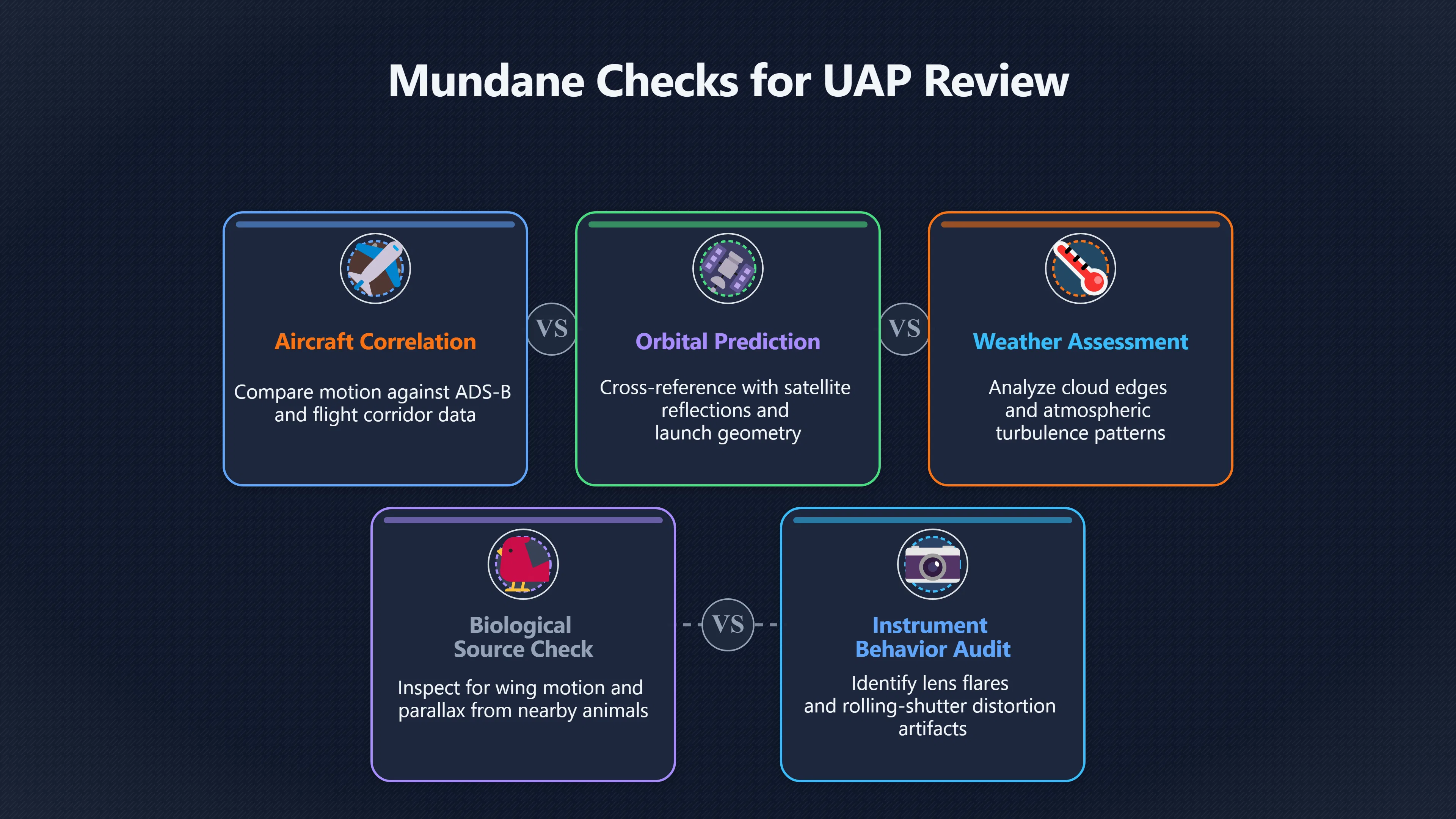
The first review pass is intentionally conservative. Rather than asking what an object might be, reviewers try to eliminate every common explanation that fits the recorded evidence.
A typical sequence includes:
-
Aircraft correlation. Time, direction and apparent motion are compared with aircraft surveillance data such as ADS-B, airport traffic patterns and known flight corridors. Many research observatories also use aircraft tracks during instrument calibration because they provide known moving targets. arXiv
- Satellite and space-object checks. Reviewers compare the event with orbital predictions, recent launches and expected satellite reflection geometry. Satellite flares and large constellations can produce striking but predictable appearances.
-
Weather assessment. Cloud edges, atmospheric turbulence, lightning-related phenomena, haze and changing illumination are examined before considering more unusual interpretations. Environmental sensors become especially valuable here because they provide objective context instead of relying solely on images. NASA Science
- Biological sources. Birds, bats and insects often appear to move much faster than they really are because they pass close to a wide-angle camera. Frame-by-frame inspection frequently reveals wing motion, changing focus or strong parallax that distinguishes nearby animals from distant aerial objects.
- Instrument behaviour. Lens flare, hot pixels, rolling-shutter distortion, automatic exposure changes, compression artefacts and tracking glitches are examined before the event is considered unexplained. Modern observatory concepts explicitly use multiple sensor types so that artefacts affecting one instrument are less likely to fool the entire system. arXiv
The important point is that these checks are cumulative. A single clue rarely resolves an alert, but several independent indicators often reduce confidence that the event represents anything unusual.
What reviewers look for before escalating a case
An alert generally moves beyond the first-pass review only if it survives several independent tests.
Reviewers place greater weight on events that show characteristics such as:
- agreement across multiple independent sensors;
- accurate timing and complete metadata;
- consistent behaviour over consecutive frames rather than isolated image artefacts;
- trajectories that remain unusual after accounting for camera geometry and perspective;
- failure to match aircraft, satellites or known environmental conditions.
Conversely, missing metadata often prevents escalation. An unusual-looking clip without reliable timestamps, calibration information or environmental context is usually treated as an unresolved low-information observation rather than persuasive evidence of an anomalous object. NASA’s UAP study repeatedly identifies data quality as the limiting factor in scientific investigation. NASA Science
A useful example: ambiguous does not mean extraordinary
Commissioning work for the Galileo Project illustrates how conservative review can be. During the analysis of roughly 500,000 reconstructed aerial trajectories collected over several months, automated outlier searches initially identified many unusual tracks. Manual inspection removed the overwhelming majority. Only 144 trajectories remained ambiguous, and even those were considered likely to represent ordinary objects that could not yet be fully explained because of limitations such as missing distance estimates or insufficient sensor coverage—not evidence of extraordinary phenomena. arXiv
This example demonstrates an important distinction in expert triage. “Ambiguous” is not treated as equivalent to “unknown technology”. It usually means that the available measurements are insufficient to support a confident identification in either direction.
How false alarms should be recorded
Rejecting an alert should not mean deleting it. High-quality review systems preserve rejected events because they improve both detector performance and reviewer consistency.
Good practice includes:
- recording the specific reason for rejection rather than simply marking the alert as false;
- preserving the original sensor data alongside the review decision;
- linking the alert to corroborating evidence such as aircraft tracks or weather records where available;
- using confirmed false alarms as labelled examples to refine future detection algorithms;
- periodically auditing reviewer decisions to ensure that changing software or procedures do not introduce systematic bias.
This creates a continuously improving reference library. Over time, reviewers spend less effort on recurring classes of false alarms, while developers gain realistic training data that better distinguish genuine outliers from ordinary sky activity. The objective is not to eliminate every false alert—which is unrealistic—but to make each rejected event strengthen the overall detection system. mdpi.com+2arXiv
Amazon book picks
Further Reading
Books and field guides related to When a UFO Alert Is Just Noise. Use these as the next step if you want deeper reading beyond the article.



Digital Image Processing, Global Edition
First published 2018. Subjects: Image processing, digital techniques.
eBay marketplace picks
Marketplace Samples
Live-tested eBay searches with available results related to this page.


Endnotes
2.
Source: science.nasa.gov
Link:https://science.nasa.gov/uap/
Source snippet
NASA ScienceUAP9 Jun 2022 — The study will focus on identifying available data, how best to collect future data, and how NASA can use tha...
3.
Source: arxiv.org
Title: arXiv Galileo Project Observatory Class System Architecture
Link:https://arxiv.org/abs/2506.00125
Source snippet
Galileo Project Observatory Class System ArchitectureMay 30, 2025...
Published: May 30, 2025
4.
Source: arxiv.org
Link:https://arxiv.org/html/2506.00125v1
Source snippet
1 Introduction30 May 2025 — A system designed for the comprehensive scientific study of aerial phenomena which integrates multiple sensor...
Published: May 2025
7.
Source: mdpi.com
Link:https://www.mdpi.com/1424-8220/25/3/783
Source snippet
Detection errors: True positive all reconstructed object tracks were associated with...
8.
Source: arxiv.org
Link:https://arxiv.org/html/2411.02401v1
Source snippet
A Civilian Astronomer's Guide to UAP Research5 Nov 2024 — The goal of this paper is to present solid strategies for civilian astronomers...
9.
Source: ilrs.gsfc.nasa.gov
Title: session5 Wilkinson presentation
Link:https://ilrs.gsfc.nasa.gov/2019_Technical_Workshop/docs/2019/presentations/Session5/session5_Wilkinson_presentation.pdf
Source snippet
DETECTING AIRCRAFT FOR IN- SKY...An ADS-B system called 'listen2planes' Variable sky conditions complicate the detection and can lead to...
Additional References
10.
Source: researchgate.net
Link:https://www.researchgate.net/publication/371163445_The_Scientific_Investigation_of_Unidentified_Aerial_Phenomena_UAP_Using_Multimodal_Ground-Based_Observatories
Source snippet
(PDF) The Scientific Investigation of Unidentified Aerial...PDF | (Abridged) The Galileo Project aims to investigate Unidentified Aerial...
11.
Source: avi-loeb.medium.com
Link:https://avi-loeb.medium.com/commissioning-data-on-half-a-million-objects-in-the-sky-from-the-galileo-project-observatory-are-a23bd084233a
Source snippet
Data on Half a Million Objects in the Sky from...The GP Observatories offer an array of multi-modal, multi-spectral sensors that continu...
12.
Source: Wikipedia
Link:https://en.wikipedia.org/wiki/Automatic_Dependent_Surveillance%E2%80%93Broadcast
Source snippet
Automatic Dependent Surveillance–BroadcastADS-B is an aviation surveillance technology and form of electronic conspicuity in which an...
13.
Source: abdn.elsevierpure.com
Title: the scientific investigation of unidentified aerial phenomena uap
Link:https://abdn.elsevierpure.com/en/publications/the-scientific-investigation-of-unidentified-aerial-phenomena-uap
Source snippet
Scientific Investigation of Unidentified Aerial...13 May 2023 — A primary objective of the Galileo Project is to build an integrated sof...
Published: May 2023
14.
Source: researchgate.net
Title: 392334596 Galileo Project Observatory Class System Architecture
Link:https://www.researchgate.net/publication/392334596_Galileo_Project_Observatory_Class_System_Architecture
Source snippet
(PDF) Galileo Project Observatory Class System Architecture30 May 2025 — This subsystem supports data analysis workflows, including commi...
Published: May 2025
15.
Source: researchgate.net
Link:https://www.researchgate.net/publication/380882646_Detection_of_aircraft_traces_in_nighttime_all-sky_camera_images_using_deep_learning_A_new_way_to_improve_aerial_safety_in_Satellite_Laser_Ranging_operations
Source snippet
networks to analyse nighttime images from an all-sky camera, and propose that such...Read more...
16.
Source: metabunk.org
Title: is there a “uap phenomenon” worth studying.14943
Link:https://www.metabunk.org/threads/is-there-a-%E2%80%9Cuap-phenomenon%E2%80%9D-worth-studying.14943/
Source snippet
Is there a “UAP phenomenon” worth studying?10 Jun 2026 — To address this deficiency, the Galileo Project is designing, building, and comm...
17.
Source: worldscientific.com
Link:https://www.worldscientific.com/doi/full/10.1142/S2251171723400081?srsltid=AfmBOooat5EBW3WpZwqdXZdM62YM0xvlG8IcYKlj4TGvKpTKUBCVhF15
Source snippet
Integrated Computing Platform for Detection and Tracking...by R Cloete · 2023 · Cited by 9 — The Alcor OMEA 9C is an all-sky optical cam...
18.
Source: galileo.hsites.harvard.edu
Link:https://galileo.hsites.harvard.edu/publications/scientific-investigation-unidentified-aerial-phenomena-uap-using-multimodal
Source snippet
We describe an approach for highlighting outlier...Read more...
19.
Source: facebook.com
Link:https://www.facebook.com/groups/172438633343696/posts/574643459789876/
Source snippet
How to identify satellites, meteors or other streaks in allsky...Aircraft appear as fast moving bright dots and satellites are generally...
Topic Tree