Within Acoustics
What Makes Sky Audio Trustworthy?
A useful sky-station microphone setup needs calibration, time stamps, weather context and enough recording before and after each event.
On this page
- Microphones, clocks and calibration basics
- Recording before and after the visual trigger
- Metadata that keeps audio evidence reviewable
Page outline Jump by section
Introduction
A sky-station microphone is only useful as evidence if reviewers can determine exactly what was recorded, when it was recorded, how the recording system was calibrated, and whether the sound is genuinely associated with the visual event. Within an automated instrumented UFO detector, the audio channel should therefore be treated as a scientific measurement system rather than as a simple sound recorder. Good design makes it possible to compare recordings across stations, distinguish genuine aerial sounds from local noise, and independently audit conclusions months or years later. Conversely, poorly documented audio may add confusion instead of evidence.
 For automated sky-observing networks, the goal is not to prove that an unusual event occurred from sound alone. Instead, audio should provide an independently verifiable measurement that complements optical, environmental and timing data. This approach aligns with broader recommendations for calibrated, multi-sensor observations rather than relying on unverified witness impressions or isolated recordings.[arXiv]arxiv.orgarXiv Multi-Band Acoustic Monitoring of Aerial SignaturesMulti-Band Acoustic Monitoring of Aerial SignaturesMay 29, 2023…
What makes an audio channel scientifically trustworthy?
A trustworthy audio channel is designed so that another investigator can reproduce its measurements and understand its limitations. Three principles are particularly important:
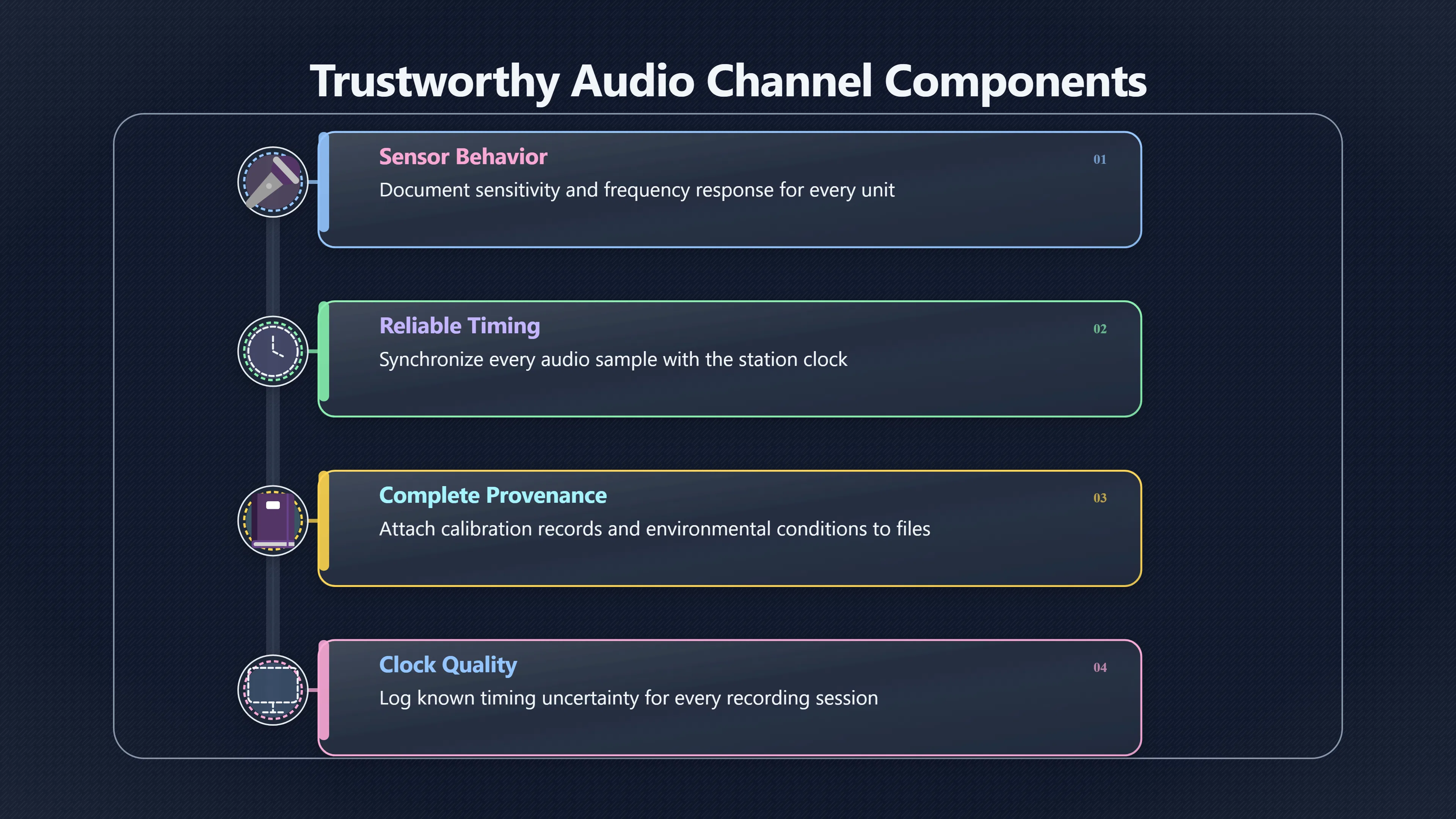
- Known sensor behaviour. The microphone’s sensitivity, frequency response and noise floor should be documented rather than assumed.
- Reliable timing. Every audio sample should be synchronised with the station clock so that sound can be compared precisely with camera frames and other sensors.
- Complete provenance. Calibration records, environmental conditions and equipment settings should accompany every recording.
Without these elements, a recording may still be interesting, but it cannot easily be compared with observations from other stations or subjected to rigorous review.
Microphones, clocks and calibration basics
Selecting an appropriate microphone depends on the intended measurement. Many sky stations use a low-noise omnidirectional microphone because it records the surrounding sound field without favouring one direction. More advanced installations may include several microphones arranged as an array, allowing approximate direction-of-arrival estimates through differences in arrival time between sensors. Multi-band systems can extend beyond the normal human hearing range by combining infrasonic, audible and ultrasonic sensors, each covering different classes of aerial sound.[arXiv]arxiv.orgarXiv Multi-Band Acoustic Monitoring of Aerial SignaturesMulti-Band Acoustic Monitoring of Aerial SignaturesMay 29, 2023…
Calibration should be treated as routine maintenance rather than a one-time installation task. Useful practices include:
- Measuring microphone sensitivity with a calibrated acoustic reference source before deployment and at regular intervals.
- Recording the microphone model, serial number and calibration date.
- Documenting any replacement windscreens, cables or preamplifiers that could alter frequency response.
- Monitoring background self-noise so gradual equipment degradation can be detected.
Time synchronisation is equally important. Audio files should use a common reference clock shared with cameras and other instruments, ideally disciplined by Global Navigation Satellite System (GNSS) timing or another traceable reference. Accurate timestamps allow investigators to measure expected sound delays, compare simultaneous recordings between stations and determine whether an acoustic event could plausibly correspond to an observed object.
Clock quality should also be logged. A recording with known timing uncertainty is more valuable than one whose accuracy is unknown.
Recording before and after the visual trigger
Many unusual sky events are brief, but their acoustic context often begins earlier or continues afterwards. A trigger-based recorder that saves only the instant of detection may discard the information needed for interpretation.
A more robust design uses a continuously running circular buffer. When an optical trigger occurs, the system permanently saves:
- A configurable interval before the trigger.
- The trigger period itself.
- An extended recording after the trigger.
Pre-trigger recording helps determine whether an aircraft, drone or vehicle was already audible before appearing in the camera. Post-trigger recording allows delayed sound arrivals to be measured. Because sound travels much more slowly than light, an object several kilometres away may be seen well before any associated acoustic signal reaches the station.
Longer recordings also provide valuable baseline information. Reviewers can compare the event with the ambient environment immediately before and afterwards, reducing the chance that isolated sounds are incorrectly linked to the visual observation.
Metadata that keeps audio evidence reviewable
An audio file without accompanying metadata is difficult to evaluate. Every recording should therefore be accompanied by structured information describing both the event and the recording conditions.
Useful metadata includes:
- Coordinated Universal Time (UTC) timestamp with known timing uncertainty.
- Station coordinates and altitude.
- Microphone model, orientation and calibration status.
- Sampling rate, bit depth and recording format.
- Trigger source (camera, manual review or automated classifier).
- Weather observations, including wind speed, rainfall, humidity and temperature.
- Estimated ambient noise level before the event.
- Software and firmware versions used during recording.
Weather deserves particular attention because wind, precipitation and atmospheric conditions strongly influence acoustic measurements. High winds can create microphone turbulence that resembles low-frequency signals, while rain, insects and nearby vegetation can dominate the audible spectrum. Recording local weather alongside the audio allows later reviewers to assess whether an apparent anomaly may instead reflect environmental contamination.
Designing for independent verification
A reviewable audio channel should assume that every important event may eventually be examined by someone outside the original project. That means preserving the original recording rather than only compressed excerpts or processed spectrograms.
Good governance practices include:
- Storing uncompressed or losslessly compressed master recordings.
- Keeping calibration histories alongside event records.
- Preserving immutable timestamps.
- Recording all software processing steps used to generate derived products such as spectrograms or noise-reduced versions.
- Ensuring derived files never overwrite the original recording.
If machine-learning classifiers identify aircraft, drones or other known sources, those classifications should remain clearly separated from the raw evidence. Future reviewers may wish to apply different algorithms or reassess earlier conclusions using improved methods.
Common design mistakes
Several recurring problems reduce the evidential value of otherwise useful recordings.
Recording only after a trigger may eliminate the contextual information needed to identify ordinary aircraft or local disturbances.
Using consumer voice-processing features such as automatic gain control, aggressive noise suppression or speech enhancement can distort signal amplitudes and alter spectral content, making later analysis unreliable.
Failing to document calibration leaves reviewers unable to determine whether differences between stations reflect genuine acoustic variation or differences between microphones.
Finally, relying on audio alone can encourage over-interpretation. Even sophisticated acoustic systems cannot identify every aerial source, particularly in noisy environments or when the object is distant. Current multi-band systems, including the Galileo Project’s Acoustic Monitoring Omni-directional System (AMOS), are intended as one component of a broader multi-sensor observatory rather than as a standalone identification method. Their developers emphasise combining calibrated acoustic measurements with optical observations, environmental sensors and future automated classification methods.[arXiv]arxiv.orgarXiv Multi-Band Acoustic Monitoring of Aerial SignaturesMulti-Band Acoustic Monitoring of Aerial SignaturesMay 29, 2023…
Amazon book picks
Further Reading
Books and field guides related to What Makes Sky Audio Trustworthy?. Use these as the next step if you want deeper reading beyond the article.

eBay marketplace picks
Marketplace Samples
Live-tested eBay searches with available results related to this page.




Endnotes
1.
Source: arxiv.org
Title: arXiv Multi-Band Acoustic Monitoring of Aerial Signatures
Link:https://arxiv.org/abs/2305.18551
Source snippet
Multi-Band Acoustic Monitoring of Aerial SignaturesMay 29, 2023...
Published: May 29, 2023
Additional References
2.
Source: amostech.com
Link:https://amostech.com/TechnicalPapers/2021/Non-Resolved-Object-Characterization/Simon.pdf
Source snippet
Space Object Identification, Discrimination, and Tracking...PRFR uses RF signals normally transmitted by a satellite to determine its po...
3.
Source: youtube.com
Title: ELDÆON: A New Multi-Sensor Approach to UAP Detection | David Dominguez Hooper
Link:http://www.youtube.com/watch?v=TUXQdhRY6GM
Source snippet
Skywatcher: Function, Purpose, and Scientific Framework | Garry Nolan...
4.
Source: youtube.com
Title: Sky360: A Global UAP Tracking Network for Science | Richard Hopf
Link:http://www.youtube.com/watch?v=M528GR8DgYU
Source snippet
ELDÆON: A New Multi-Sensor Approach to UAP Detection | David Dominguez Hooper...
5.
Source: youtube.com
Title: [UFODAP]({{ ‘ufodap/’ | relative_url }}) Engineer Ron Olch Explains the Gear
Link:http://www.youtube.com/watch?v=P0789_mAsRI
Source snippet
ELDÆON: A New Multi-Sensor Approach to UAP Detection | David Dominguez Hooper UAP Summit · 4.3K views...
6.
Source: youtube.com
Title: Skywatcher: Function, Purpose, and Scientific Framework | Garry Nolan
Link:http://www.youtube.com/watch?v=kPodKWDFrp4
Source snippet
We Can Finally See Them: New UAP Tech Revealed...
7.
Source: ui.adsabs.harvard.edu
Link:https://ui.adsabs.harvard.edu/abs/2023amos.conf..114H/abstract
Source snippet
Sensor Calibration Procedure - ADSby CP Hernández · 2023 · Cited by 5 — Depending on the operational regime of the sensor, the observed o...
8.
Source: youtube.com
Title: We Can Finally See Them: New UAP Tech Revealed
Link:http://www.youtube.com/watch?v=bKWnLFSEH0U
Source snippet
UFODAP Engineer Ron Olch Explains the Gear...
9.
Source: thedebrief.org
Link:https://thedebrief.org/did-microphones-recently-capture-the-mystery-sound-of-unidentified-anomalous-phenomena/
Source snippet
The DebriefDid Microphones Recently Capture the 'Mystery Sound' of...10 Nov 2023 — The AMOS system spans infrasonic frequencies down to...
Topic Tree