Within Sky Detectors
What Data Gap Must UFO Detectors Close?
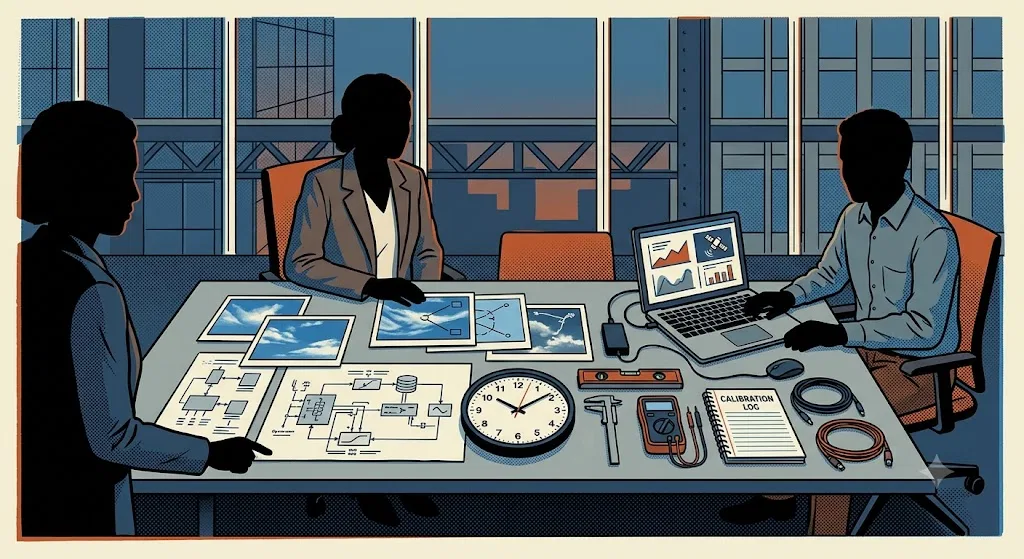
NASA's study framed the core problem clearly: UAP research needs calibrated, time-stamped, multi-measurement data.
On this page
- Poor calibration and missing metadata
- Why multiple measurements matter
- How future detectors address the gap
Page outline Jump by section
Introduction
NASA’s UAP study made a narrow but important point: the main obstacle in UAP research is not a shortage of stories, but a shortage of usable measurements. The report says present analysis is weakened by poor sensor calibration, missing sensor metadata, lack of multiple measurements and lack of baseline data. That is the strongest governance case for automated instrumented UFO detectors: they are less about assuming an extraordinary explanation and more about fixing the evidential weaknesses that keep ordinary, unusual and genuinely unresolved events tangled together.[NASA Science]science.nasa.govScience Independent Study Team ReportNASA ScienceIndependent Study Team ReportSeptember 13, 2023 — At present, analysis of UAP data is hampered by poor sensor calibration, th…
For detectors, the job is therefore not simply to capture sharper video. A useful system must record when and where the event occurred, what the instrument was doing, how the sensor was calibrated, what ordinary traffic or weather was nearby, and whether another independent sensor saw the same thing. NASA’s framing turns “UFO detection” into a data-quality problem: build systems that make a later scientific or intelligence assessment possible, even when the answer turns out to be aircraft, drones, balloons, birds, satellites, atmospheric effects or sensor artefacts.
The gap NASA actually identified
NASA’s 2023 Independent Study Team was careful not to present UAP as evidence of extraterrestrial technology. Its central contribution was more procedural: it described what a credible future evidence base would need. The executive summary says NASA can contribute through new data-acquisition methods, advanced analysis, systematic reporting and reduced reporting stigma, but it repeatedly returns to the same bottleneck: most available UAP material was not collected as scientific data.[NASA Science]science.nasa.govScience Independent Study Team ReportNASA ScienceIndependent Study Team ReportSeptember 13, 2023 — At present, analysis of UAP data is hampered by poor sensor calibration, th…
That distinction matters. A video may be compelling to a viewer but weak as evidence if the analyst does not know the camera model, focal length, exposure settings, pointing direction, clock accuracy, range to target, weather, aircraft traffic or processing history. Without those details, apparent speed, size or manoeuvring can be misread. A small nearby object can look like a fast distant object; a thermal contrast can look like a body; a compression artefact can look like structure.
NASA’s report names four linked failures:
- Poor calibration: the instrument’s measurements cannot be trusted without knowing how the sensor behaves.
- Missing metadata: analysts lack contextual information such as time, location, sensor type, observing mode and noise characteristics.
- Lack of multiple measurements: one camera or one witness leaves too many possible explanations open.
- Lack of baseline data: without knowing what ordinary sky activity looks like from the same site and sensor, it is hard to identify a true outlier.[NASA Science]science.nasa.govScience Independent Study Team ReportNASA ScienceIndependent Study Team ReportSeptember 13, 2023 — At present, analysis of UAP data is hampered by poor sensor calibration, th…
This is why automated instrumented detectors are a policy intervention as much as a technical hobby. They standardise what is collected before anyone knows whether an event will be interesting. That is the opposite of the usual UAP record, where investigators often receive a clip, a memory or a partial sensor extract after the fact.

Poor calibration and missing metadata
Calibration is the difference between an image and a measurement. NASA’s report says calibration ensures that future data are reliable and accurate, while metadata makes the context of a recorded event knowable. It also notes that some apparent UAP have been shown to be sensor artefacts once calibration and metadata scrutiny were applied.[NASA Science]science.nasa.govScience Independent Study Team ReportNASA ScienceIndependent Study Team ReportSeptember 13, 2023 — At present, analysis of UAP data is hampered by poor sensor calibration, th…
For an automated detector, this means the system must preserve more than the visible event. It should record the instrument state at the moment of detection: lens settings, field of view, detector temperature where relevant, clock source, orientation, gain, exposure, image-processing steps, software version and any known sensor faults. A later analyst should be able to reconstruct not only what appeared in the frame, but how the instrument produced that frame.
This is especially important because UAP reports often come from sensors built for other purposes. Military targeting pods, security cameras, phone cameras, aircraft displays and astronomical instruments all have different design assumptions. A sensor optimised for navigation, targeting or surveillance may not be optimised for scientific classification of a small ambiguous object. NASA explicitly warns that, because UAP data often originate from instruments not designed for that purpose, proper calibration becomes even more crucial.[NASA Science]science.nasa.govScience Independent Study Team ReportNASA ScienceIndependent Study Team ReportSeptember 13, 2023 — At present, analysis of UAP data is hampered by poor sensor calibration, th…
A detector designed around NASA’s gap would therefore treat metadata as evidence, not administrative clutter. A useful event package would include:
- precise timestamp and clock synchronisation;
- observing location, pointing direction and field of view;
- raw or minimally processed sensor data where possible;
- calibration files and sensor-health information;
- environmental data such as cloud, visibility, wind, temperature and humidity;
- known aircraft, satellite, balloon or drone context;
- a clear record of any automated filtering or classification.
The governance lesson is simple: if agencies, researchers or citizen networks want UAP data to be taken seriously, they need shared minimum evidence standards. Otherwise, each case becomes a bespoke argument over whether the record is good enough to interpret.
Why multiple measurements matter
NASA’s report says the importance of detecting UAP with multiple, well-calibrated sensors is “paramount”. The reason is not that more sensors make an event mysterious; it is that they make ordinary explanations testable. Optical video alone may show motion across a frame, but without range it may not show real speed. Infrared may show a thermal contrast, but not necessarily whether the contrast is an object, reflection or artefact. Radar may provide range and velocity, but can have clutter, multipath or classification problems.[NASA Science]science.nasa.govScience Independent Study Team ReportNASA ScienceIndependent Study Team ReportSeptember 13, 2023 — At present, analysis of UAP data is hampered by poor sensor calibration, th…
AARO’s public case material illustrates the same problem. In one unresolved Middle East 2023 case, AARO says an infrared recording showed an apparent thermal contrast that might be a physical object, but the absence of corroborating telemetry or multi-modal sensor data prevented it from determining whether the signature was a sensor artefact, thermal emission or reflection.[AARO]aaro.milUAP ImageryHowever, due to the absence of corroborating telemetry or multi-modal sensor data, AARO cannot determine whether the obser…
That example is useful because it does not require any dramatic assumption. The point is exactly NASA’s: a single ambiguous sensor record can remain unresolved because it lacks the surrounding measurements needed to decide between mundane possibilities. Better detectors should not merely collect “more footage”; they should collect independent channels that can contradict or corroborate one another.
The Galileo Project’s proposed ground-based observatory model shows what this looks like in practice. Its instrument package includes wide-field cameras in multiple bands, narrow-field instruments for morphology and spectra, passive radar-style receivers, radio spectrum analysers, microphones, environmental sensors and measurements of electric, magnetic and energetic-particle conditions. The stated aim is to make artefacts easier to recognise and genuine detections more verifiable.[Galileo Project]galileo.hsites.harvard.eduOpen source on harvard.edu.
Multi-measurement detection also changes what counts as an anomaly. A light in the sky is weak evidence by itself. A time-synchronised event observed by optical, infrared and radio sensors, from known positions, with aircraft and satellite traffic excluded, is a different kind of record. It may still be ordinary, but the analysis can proceed from measurements rather than impressions.

Baseline data is the unglamorous missing piece
The easiest mistake in UAP analysis is to focus only on the rare event. NASA’s mention of baseline data points in the other direction: detectors must learn what normal looks like. A sky station that records only suspected anomalies is far less useful than one that also records routine aircraft, birds, satellites, meteors, balloons, insects, clouds, reflections and sensor glitches from the same location under the same operating conditions.[NASA Science]science.nasa.govScience Independent Study Team ReportNASA ScienceIndependent Study Team ReportSeptember 13, 2023 — At present, analysis of UAP data is hampered by poor sensor calibration, th…
Baseline data lets analysts ask better questions. How often does this camera produce false tracks near the horizon? What does a distant aircraft look like in this infrared band at different humidity levels? How do insects near the lens appear at night? What satellite passes are commonly misclassified? How often do compression artefacts, autofocus shifts or sensor blooming produce apparent shapes?
This is where automated detectors have a major advantage over eyewitness-centred reporting. A fixed detector can run through boring nights and ordinary days, collecting the comparison set that makes rare events interpretable. NASA’s report also notes that large-sky surveys and other federal ground-based assets can generate vast quantities of data useful for searching for anomalous objects beyond Earth’s atmosphere, but it stresses clear evidence thresholds to avoid errors, especially with automated methods.[NASA Science]science.nasa.govScience Independent Study Team ReportNASA ScienceIndependent Study Team ReportSeptember 13, 2023 — At present, analysis of UAP data is hampered by poor sensor calibration, th…
For governance, baseline data also reduces selection bias. If a system is deployed only at sites where people expect UAP, or records only clips that look strange, its archive will be distorted from the start. A serious detector network needs routine collection, clear retention rules and transparent criteria for what gets flagged, discarded, escalated or published.
What future detectors must fix
A detector that answers NASA’s critique needs to be designed backwards from the later investigation. The goal is not “capture something weird”; it is “produce a record that can survive independent review”. Several design requirements follow.
First, sensors need shared calibration standards. Each station should know its own geometry, timing and instrument response. The Galileo Project’s all-sky infrared camera work is a concrete example: its calibration includes intrinsic and thermal calibration, plus an extrinsic method using synchronously collected ADS-B aircraft positions to help calibrate where the cameras are looking.[MDPI]mdpi.comOpen source on mdpi.com.
Second, event data should be time-synchronised across sensors. If an optical camera, infrared camera, radio receiver and acoustic sensor all record on different clocks, cross-checking becomes fragile. Millisecond-scale timing matters for fast transient events, and NASA specifically says purpose-built future sensors should be able to adjust on millisecond timescales, with alert systems that share transient information quickly and uniformly.[NASA Science]science.nasa.govScience Independent Study Team ReportNASA ScienceIndependent Study Team ReportSeptember 13, 2023 — At present, analysis of UAP data is hampered by poor sensor calibration, th…
Third, detectors should preserve provenance. Provenance means the record of where the data came from and how it was handled. The Galileo Project’s Observatory Class Integrated Computing Platform is explicitly framed as a response to fragmented, uncalibrated UAP data with missing metadata; it combines real-time data acquisition, sensor optimisation and data-provenance management with later post-processing workflows.[arXiv]arxiv.orgOpen source on arxiv.org.
Fourth, detectors should collect ordinary context automatically. ADS-B aircraft data, satellite ephemerides, weather, local light conditions, radar context where available and environmental readings should be part of the event package, not an afterthought. Many UAP cases are not solved by staring harder at the object; they are solved by discovering what else was in the sky, what the sensor was doing, or what environmental condition shaped the observation.
Fifth, automated classification must be auditable. NASA highlights artificial intelligence and machine learning as useful for finding rare events in large datasets, but it warns that these methods work only on well-characterised data gathered to strong standards. AI cannot rescue chaotic records; it can scale pattern recognition once calibration, metadata and baselines are already in place.[NASA Science]science.nasa.govScience Independent Study Team ReportNASA ScienceIndependent Study Team ReportSeptember 13, 2023 — At present, analysis of UAP data is hampered by poor sensor calibration, th…
AARO’s experience shows why the gap persists
The US All-domain Anomaly Resolution Office has reached a similar operational conclusion from the defence side. Its fiscal year 2024 annual report says the majority of its case holdings remain unresolved because of a lack of data needed for further analysis, and that without sufficient actionable data, cases cannot be researched or analysed. It also says AARO has begun using GREMLIN, a prototype sensor system for detecting, tracking and characterising UAP, with a planned 90-day “pattern of life” collection at a national-security site.[U.S. Department of War]media.defense.govU.S. Department of War(https://media.defense.gov/2024/Nov/14/2003583603/-1/-1/0/FY24-CONSOLIDATED-ANNUAL-REPORT-ON-UAP-508.PDF)
The phrase “pattern of life” is important. It means collecting the normal activity around a site so that unusual events can be judged against a local baseline. That is almost exactly the problem NASA identified in scientific terms. Whether the setting is a defence range or a civilian sky-observation network, the question is the same: can the system distinguish the rare from the routine without relying on a witness’s surprise?
AARO has also said many civilian reports lack enough data for conclusive analysis, including cases described only as “lights” without morphology, geospatial location or anomalous behaviours. It notes that cases lacking sufficient verifiable data cannot be resolved, and that high-quality empirical data are needed for scientific method, modelling, simulation and peer review.[AARO]aaro.milThe US Defense Department & The UAP MissionThe US Defense Department & The UAP Mission
This is not a dismissal of witnesses. It is a recognition that witnesses and instruments answer different questions. A witness can report that something looked strange. A detector must record enough information to test what it could have been.
The practical standard for automated UFO detectors
NASA’s data gap suggests a practical standard for any automated instrumented UFO detector: it should make the least interesting explanation easier to test first. That may sound deflating, but it is how a credible system earns trust. The detector should be built to identify aircraft, satellites, meteors, birds, insects, drones, balloons, clouds, lens effects and sensor artefacts before treating an event as anomalous.
Field research shows how hard this can be. UAPx’s Catalina expedition used visible and infrared cameras plus other sensors, recording more than 600 hours of untriggered far-infrared video and background radiation measurements. The authors report that several initially ambiguous observations were resolved through later analysis, while one primary ambiguity remained. That is a useful model of the right attitude: reduce ambiguity where the data allow it, and keep unresolved cases bounded by what the instruments actually recorded.[arXiv]arxiv.orgOpen source on arxiv.org.
For public-facing detector networks, this standard has governance consequences. Systems should publish enough method detail for outside scrutiny, including calibration approach, detection thresholds, known failure modes and data-retention rules. They should separate raw observations from interpretation. They should avoid presenting every unexplained track as evidence of something extraordinary. And they should make negative and ordinary detections part of the archive, because those records define the baseline.
The best near-term detector is therefore not the one with the most dramatic promotional footage. It is the one that can answer dull but decisive questions: Was the clock accurate? Was the camera calibrated? Was the object seen by more than one sensor? Was aircraft traffic checked? Was the weather recorded? Are the raw data preserved? Can another analyst reproduce the classification?
What the NASA gap changes
NASA’s UAP report shifted the discussion from belief to measurement quality. It did not say that automated detectors will solve every UAP case, and it did not claim that better data will make extraordinary explanations more likely. It said the current record is too weak for firm scientific conclusions and that future work needs calibrated, contextual, multi-measurement data.[NASA Science]science.nasa.govOpen source on nasa.gov.
That framing is valuable because it gives automated instrumented UFO detectors a clear test. They should not be judged by whether they produce viral clips. They should be judged by whether they close the evidential gaps NASA named: calibration, metadata, multiple measurements and baselines. If they do that, most detections may become less mysterious, not more. But the smaller remainder would be far more meaningful, because it would rest on a record designed for analysis rather than argument.
Amazon book picks
Further Reading
Books and field guides related to What Data Gap Must UFO Detectors Close?. Use these as the next step if you want deeper reading beyond the article.

UFOs : Generals, Pilots, and Government Officials Go on the R...
Frames the evidence problem that better instrumented data aims to solve.

Data Reduction and Error Analysis for the Physical Sciences
Covers uncertainty, calibration, and reliable scientific measurements.

Handbook of CCD astronomy
Explains scientific image acquisition and detector performance.
eBay marketplace picks
Marketplace Samples
Live-tested eBay searches with available results related to this page.



Endnotes
1.
Source: science.nasa.gov
Title: Science Independent Study Team Report
Link:https://science.nasa.gov/wp-content/uploads/2023/09/uap-independent-study-team-final-report.pdf
Source snippet
NASA ScienceIndependent Study Team ReportSeptember 13, 2023 — At present, analysis of UAP data is hampered by poor sensor calibration, th...
Published: September 13, 2023
2.
Source: nasa.gov
Title: update nasa shares uap independent study report names director
Link:https://www.nasa.gov/news-release/update-nasa-shares-uap-independent-study-report-names-director/
Source snippet
UPDATE: NASA Shares UAP Independent Study Report14 Sept 2023 — NASA can help the whole-of-government UAP effort through systematic da...
3.
Source: aaro.mil
Link:https://www.aaro.mil/UAP-Cases/Official-UAP-Imagery/
Source snippet
UAP ImageryHowever, due to the absence of corroborating telemetry or multi-modal sensor data, AARO cannot determine whether the obser...
4.
Source: arxiv.org
Link:https://arxiv.org/abs/2305.18566
5.
Source: mdpi.com
Link:https://www.mdpi.com/1424-8220/25/3/783
6.
Source: arxiv.org
Link:https://arxiv.org/abs/2411.07956
7.
Source: arxiv.org
Link:https://arxiv.org/html/2506.00125v1
8.
Source: arxiv.org
Title: arXiv Galileo Project Observatory Class System Architecture
Link:https://arxiv.org/abs/2506.00125
9.
Source: media.defense.gov
Title: U.S. Department of War
Link:https://media.defense.gov/2024/Nov/14/2003583603/-1/-1/0/FY24-CONSOLIDATED-ANNUAL-REPORT-ON-UAP-508.PDF
10.
Source: aaro.mil
Title: The US Defense Department & The UAP Mission
Link:https://www.aaro.mil/Portals/136/PDFs/AARO_Mission_Brief_2025.pdf
11.
Source: arxiv.org
Link:https://arxiv.org/html/2312.00558v3
12.
Source: arxiv.org
Link:https://arxiv.org/abs/2312.00558
13.
Source: science.nasa.gov
Link:https://science.nasa.gov/uap/
14.
Source: war.gov
Title: department of defense releases the annual report on unidentified anomalous phen
Link:https://www.war.gov/News/Releases/Release/Article/3964824/department-of-defense-releases-the-annual-report-on-unidentified-anomalous-phen/
15.
Source: nasa.gov
Title: to release discuss unidentified anomalous phenomena report
Link:https://www.nasa.gov/news-release/nasa-to-release-discuss-unidentified-anomalous-phenomena-report/
16.
Source: galileo.hsites.harvard.edu
Link:https://galileo.hsites.harvard.edu/publications/scientific-investigation-unidentified-aerial-phenomena-uap-using-multimodal
17.
Source: media.defense.gov
Title: DOPSR 2024 0263 AARO HISTORICAL RECORD REPORT VOLUME 1 2024
Link:https://media.defense.gov/2024/Mar/08/2003409233/-1/-1/0/DOPSR-2024-0263-AARO-HISTORICAL-RECORD-REPORT-VOLUME-1-2024.PDF
18.
Source: ui.adsabs.harvard.edu
Link:https://ui.adsabs.harvard.edu/abs/2025PrAeS.15601099S/abstract
Additional References
19.
Source: youtube.com
Title: How Science is Revolutionising UAP Research: Data Triumphs Over Stigma
Link:https://www.youtube.com/watch?v=t75k2dAHwaU
Source snippet
NASA UAP Independent Study Team final report press conference NASA UFO Press Conference # ufo #uap #ufo #aliens #nasa #space #spacenews Q...
20.
Source: en.wikisource.org
Title: Page:UAP Independent Study Team
Link:https://en.wikisource.org/wiki/Page%3AUAP_Independent_Study_Team_-_Final_Report.pdf/15
Source snippet
Page:UAP Independent Study Team - Final Report.pdf/1512 Nov 2023 — Indeed, several apparent UAP have been demonstrated to be se...
21.
Source: youtube.com
Link:https://www.youtube.com/watch?v=mvsU4p0Gsas
Source snippet
How Science is Revolutionising UAP Research: Data Triumphs Over Stigma...
22.
Source: youtube.com
Title: Capture The BEST UFO/UAP Imagery | w/ Ezra Kelderman, Galileo Project
Link:https://www.youtube.com/watch?v=M4RoE8Cy3kc
Source snippet
Breaking Down UAP Footage with the Head of The Pentagon’s UAP Taskforce, Dr. Jon Kosloski...
23.
Source: youtube.com
Title: NASA UAP Independent Study Report — Press Conference (
Link:https://www.youtube.com/watch?v=uDbo7fq7Rq0
Source snippet
Public Meeting on Unidentified Anomalous Phenomena (Official NASA Broadcast)...
Published: September 14, 2023
24.
Source: youtube.com
Title: Public Meeting on Unidentified Anomalous Phenomena (Official NASA Broadcast)
Link:https://www.youtube.com/watch?v=bQo08JRY0iM
Source snippet
Capture The BEST UFO/UAP Imagery | w/ Ezra Kelderman, Galileo Project...
25.
Source: en.wikisource.org
Link:https://en.wikisource.org/wiki/NASA_Unidentified_Anomalous_Phenomena%3A_Independent_Study_Team_Report/Responses_to_Statement_of_Task
Source snippet
NASA Unidentified Anomalous Phenomena: Independent...14 Oct 2023 — The panel notes that, at present, gathering data on UAP is...
26.
Source: facebook.com
Link:https://www.facebook.com/thesocialctv/posts/nasa-has-released-a-report-detailing-how-it-tracks-unidentified-anomalous-phenom/850192826467495/
27.
Source: researchgate.net
Link:https://www.researchgate.net/publication/388466760_Commissioning_an_All-Sky_Infrared_Camera_Array_for_Detection_of_Airborne_Objects
28.
Source: researchgate.net
Link:https://www.researchgate.net/publication/391817538_Initial_results_from_the_first_field_expedition_of_UAPx_to_study_unidentified_anomalous_phenomena
Topic Tree