Within Sky Detectors
What Would an Academic UAP Observatory Measure?
The Galileo Project is the clearest example of treating UAP as an observatory problem rather than a witness-report problem.
On this page
- The Galileo multimodal instrument concept
- Edge computing and data provenance
- How observatory style work changes the evidence standard
Page outline Jump by section
Introduction
The Galileo Project matters because it treats unidentified anomalous phenomena, or UAP, as an observatory problem: not “Who saw something?”, but “What did calibrated instruments record, under what conditions, and can another team inspect the chain of evidence?” Within the wider field of automated instrumented UFO detectors, it is the most explicit academic attempt to build a repeatable measurement system around the sky itself. Its published plan is not a single UFO camera; it is a multimodal ground-based observatory designed to census ordinary aerial objects, identify outliers, and preserve enough metadata to test whether an event is mundane, instrumental, or genuinely unexplained.[The Galileo Project]galileo.hsites.harvard.eduOpen source on harvard.edu.
That distinction is important because the strongest recent official reviews point to the same weakness in legacy UAP evidence: poor calibration, missing metadata, too few simultaneous measurements, and little baseline data about normal sky traffic. NASA’s 2023 independent study said future UAP work needs multiple well-calibrated sensors, multispectral data and rigorous acquisition standards; AARO’s 2024 report likewise tied many unresolved cases to insufficient actionable sensor data.[NASA Science]science.nasa.govNASA Science…
Why Galileo turns UAP into an observatory problem
Most UFO evidence begins after the event: a witness report, a short video, a memory of motion, or a military sensor clip whose full context may be classified. The Galileo Project reverses that order. It aims to collect new data continuously, from known instruments, with known fields of view, clocks, calibrations, environmental context and processing records. Its public description says the work is based on transparent analysis of open scientific data collected using optimised instruments, rather than on classified government holdings or anecdotal sightings.[The Galileo Project]galileo.hsites.harvard.eduThe Galileo Project Activities | The Galileo ProjectThe Galileo Project Activities | The Galileo Project
This is a different evidential lane from “disclosure” debates. Galileo’s UAP branch says it will use artificial intelligence to filter observations into known classes, then examine remaining observations for anomalous characteristics. Its FAQ is unusually clear about the boundary: popular anecdotes are not part of the research data, and the project is not accepting outside photos or videos because it wants information that is high-quality, reliable, consistent, calibrated and comparable.[The Galileo Project]galileo.hsites.harvard.eduThe Galileo Project Frequently Asked Questions | The Galileo ProjectThe Galileo Project Frequently Asked Questions | The Galileo Project
The observatory model also changes what counts as a useful negative result. If a site records thousands of birds, aircraft, insects, clouds, satellites and weather artefacts, that is not wasted effort. It builds the ordinary-sky baseline against which unusual events can be measured. In a field where many dramatic claims collapse because distance, size, speed or camera state is unknown, a well-documented census of ordinary aerial phenomena is part of the measurement system, not a distraction from it.

The Galileo multimodal instrument concept
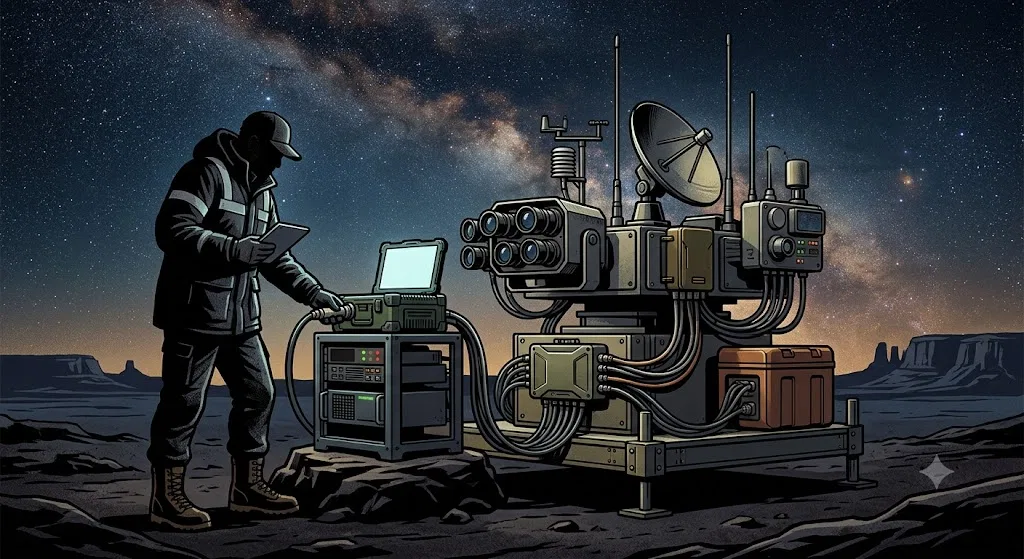
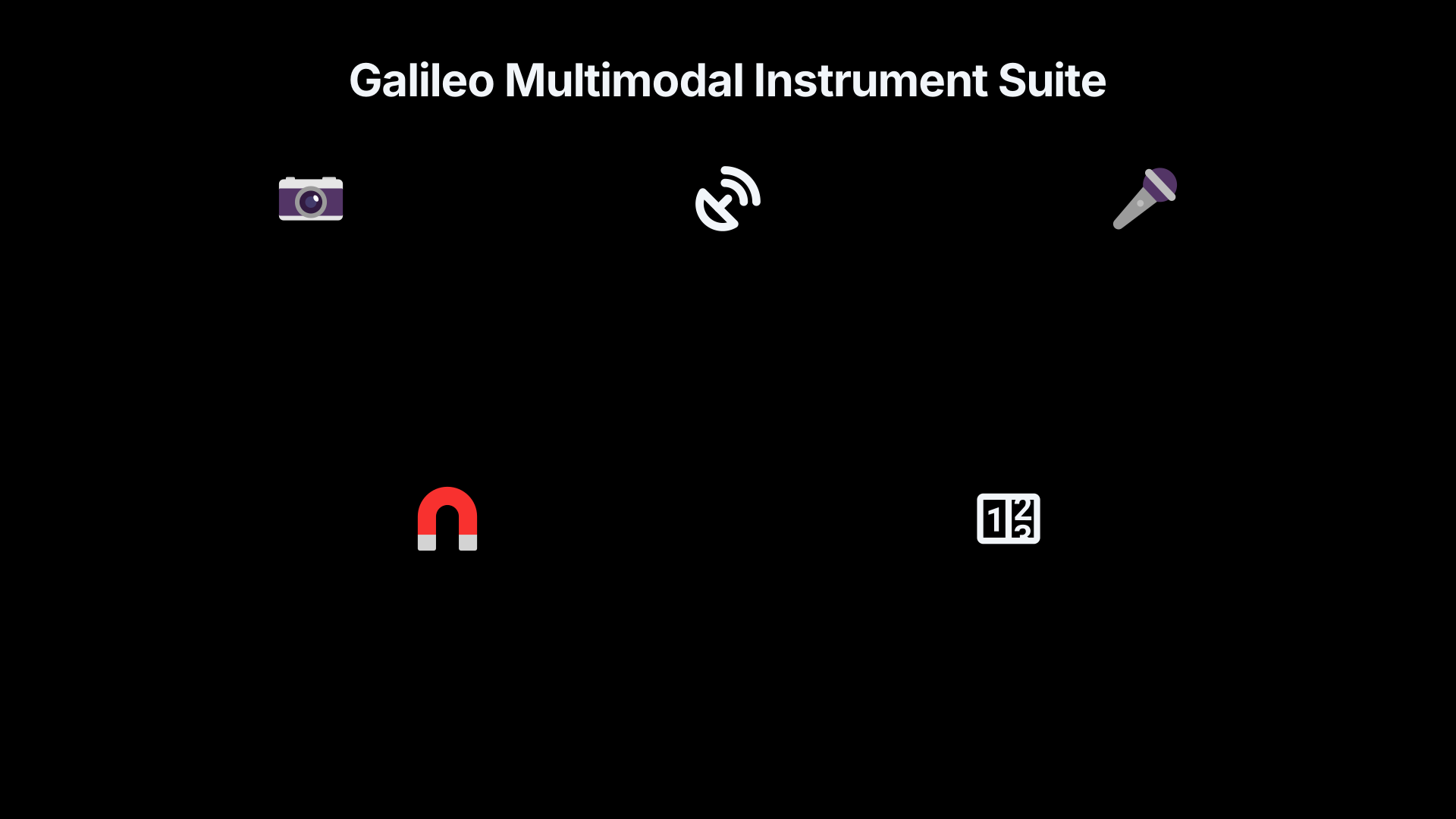
The core design is multimodal and multispectral. In the Galileo Project’s 2023 Journal of Astronomical Instrumentation paper, the proposed package includes wide-field cameras in multiple bands for detection and tracking, narrow-field instruments for morphology and spectra, passive multistatic antenna arrays for radar-derived range and kinematics, radio spectrum analysers, microphones, environmental sensors, electric and magnetic field measurements and energetic-particle sensors. The stated purpose is not to assume exotic explanations, but to make artefacts recognisable and detections corroborated and verifiable.[The Galileo Project]galileo.hsites.harvard.eduOpen source on harvard.edu.
That sensor mix answers a basic problem in skywatching: one camera can show angular motion, but it often cannot prove range, true size or true speed. A nearby insect, a distant aircraft and a balloon can all make surprising tracks in a single image. The Galileo concept therefore tries to connect physical questions to observables: direction, brightness, spectrum, sound, radio context, magnetic context, weather and, where possible, triangulated position. The point is to make an event hard to explain only after ordinary explanations have been given a fair chance.
Galileo’s first detailed instrument result came from an all-sky infrared camera array nicknamed Dalek. The array uses eight uncooled long-wave infrared FLIR Boson 640 cameras, arranged to observe the sky around the site. The project’s Sensors paper describes intrinsic, thermal and extrinsic calibration, including a notable method that uses aircraft positions from Automatic Dependent Surveillance–Broadcast, or ADS-B, as calibration references. In plain terms, ordinary aircraft become moving calibration targets because their reported positions can be compared with where the cameras see them.[MDPI]mdpi.comCommissioning an All-Sky Infrared Camera Array for Detection of Airborne ObjectsCommissioning an All-Sky Infrared Camera Array for Detection of Airborne Objects…
This is exactly the kind of unglamorous work that academic UAP measurement requires. Before a detector can claim something unusual, it has to show what it misses, what it detects, how weather affects it, how aircraft appear at different ranges, and how often its algorithms create false or fragmented tracks. Galileo’s commissioning work is therefore less like a UFO stakeout and more like the early validation of an astronomical or atmospheric instrument.
Edge computing and data provenance
A modern UAP observatory has to make fast decisions without losing the evidential trail. The Galileo Project’s Observatory Class Integrated Computing Platform, or OCICP, is designed around two main subsystems: an edge computing subsystem at the observatory site and a post-processing subsystem away from the site. The edge subsystem directly interfaces with sensors, performs real-time data acquisition, supports sensor optimisation and manages data provenance; the post-processing subsystem supports commissioning, census operations, science operations and system-effectiveness monitoring.[arXiv]arxiv.orgar Xiv11 Introduction…
The edge-computing emphasis matters because aerial events are transient. A system may need to detect a moving object, decide whether it is worth higher-resolution follow-up, preserve the raw and processed data, and keep enough metadata to reconstruct what happened later. Galileo’s architecture describes event-driven processing, multi-sensor acquisition, object detection and tracking, data fusion, sensor control, data persistence and egress, and data inspection. It also notes that clocks are synchronised with GPS time and monitored for drift, a small but crucial detail when trying to match observations across instruments.[arXiv]arxiv.orgar Xiv11 Introduction…
Data provenance is not just a database nicety here. In UAP analysis, provenance is often the difference between a measurement and a mystery story. The OCICP paper describes provenance goals as supporting the immutability, integrity and traceability of sensor data, system configuration and calibration data for repeatable science operations. It also describes a raw data lake whose records are intended to preserve traceability of sensor data and relevant calibration data.[arXiv]arxiv.orgar Xiv11 Introduction…
The practical implication is simple: a future Galileo candidate event should not be judged only by a clip. A serious event record would include what each sensor was doing, whether the instrument was calibrated, what software processed it, what environmental conditions applied, whether ADS-B or other contextual sources explained it, and how the classification changed from raw observation to interpreted result.
What the first commissioning data actually showed
The most valuable Galileo result so far is not a claimed breakthrough UAP; it is a working example of how difficult, measurable and error-prone sky census work really is. The Dalek commissioning study covered five months of field operation and reconstructed about 500,000 trajectories of various aerial objects. Its pipeline used a YOLO machine-learning object detector and the SORT tracking algorithm, then tested performance against ADS-B-derived aircraft data, synthetic trajectories and manually labelled real-world data.[MDPI]mdpi.comCommissioning an All-Sky Infrared Camera Array for Detection of Airborne ObjectsCommissioning an All-Sky Infrared Camera Array for Detection of Airborne Objects…
The numbers are sobering. For ADS-B-equipped aircraft, the study found a 41% acceptance rate for aircraft passing through the effective field of view of at least one camera and a mean frame-by-frame detection efficiency of 36% for recorded aircraft. Detection efficiency depended on weather, range and aircraft size. The paper also notes that precipitation, reduced visibility, high relative humidity, dust, raindrops and treeline effects reduced performance.[MDPI]mdpi.comCommissioning an All-Sky Infrared Camera Array for Detection of Airborne ObjectsCommissioning an All-Sky Infrared Camera Array for Detection of Airborne Objects…
The outlier exercise is especially instructive. Out of 502,015 reconstructed trajectories, 81,873 were flagged by a deliberately simple “toy” outlier search based on high apparent two-dimensional trajectory sinuosity. After manual inspection, 144 trajectories remained ambiguous, but the authors described them as likely mundane objects that could not be further resolved at that stage without distance, kinematics or other sensor modalities.[MDPI]mdpi.comCommissioning an All-Sky Infrared Camera Array for Detection of Airborne ObjectsCommissioning an All-Sky Infrared Camera Array for Detection of Airborne Objects…
That result is easy to misread. It does not prove that 144 objects were extraordinary, and it does not prove that no extraordinary object was present. It shows how a scientific system can move from a large pile of detections to a smaller set of ambiguous cases while preserving uncertainty. The authors then used a likelihood-based method to place an upper limit on the number of outliers for that five-month interval, and argued that the method can be generalised to future outlier searches using other metrics and other sensor channels.[MDPI]mdpi.comCommissioning an All-Sky Infrared Camera Array for Detection of Airborne ObjectsCommissioning an All-Sky Infrared Camera Array for Detection of Airborne Objects…
How observatory-style work changes the evidence standard
Galileo’s biggest contribution may be cultural as much as technical: it makes UAP claims compete against a quantified background. In older UFO discussions, a puzzling video often becomes the centre of gravity. In an observatory approach, a puzzling event is only one row in a larger dataset that includes known aircraft, birds, weather, satellites, camera limitations and algorithmic failures.
That shift raises the standard in several ways:
- From image to measurement. A picture is not enough unless the system can connect pixels to time, pointing, calibration, range constraints and environmental conditions.
- From witness confidence to sensor performance. The question becomes how often the detector misses aircraft, fragments trajectories, misclassifies birds or fails in rain.
- From isolated anomaly to statistical outlier. An event is more meaningful if it stands out against months or years of ordinary-sky data collected by the same system.
- From secrecy to reproducibility. Galileo’s stated deliverables include peer-reviewed articles and an open-access observational data archive with raw, calibrated and interpreted data products.[The Galileo Project]galileo.hsites.harvard.eduThe Galileo Project Frequently Asked Questions | The Galileo ProjectThe Galileo Project Frequently Asked Questions | The Galileo Project
This does not make the project immune to criticism. It still has to show that its instruments can run reliably, scale beyond development sites, estimate distance and kinematics well enough, combine modalities effectively, and release data in a form other researchers can scrutinise. The OCICP paper says the platform has been deployed at three observatory sites and is supporting long-term multimodal data collection, but also notes that some features are not yet operational, that real-time classification is not currently implemented, and that autonomous sensor response and expanded real-time decision-making remain future work.[arXiv]arxiv.orgar Xiv11 Introduction…
That caution is healthy. Academic UAP measurement should not be judged by whether it rapidly produces spectacular claims. It should be judged by whether it reduces ambiguity in a disciplined way, quantifies what its instruments can and cannot see, and allows other researchers to inspect the route from raw sky data to candidate anomaly.

Where Galileo sits among instrumented UFO detectors
In the automated instrumented UFO detector landscape, Galileo occupies the academic-observatory lane. It is more formal and publication-driven than citizen-science skywatching networks, more open-science oriented than military sensor programmes, and more system-engineered than ad hoc UFO camera projects. NASA’s report and AARO’s GREMLIN sensor work show that the broader field is converging on a similar diagnosis: UAP cases cannot be resolved reliably without better sensors, calibration, metadata and repeated baseline collection.[NASA Science]science.nasa.govNASA Science…
The Galileo Project’s distinct value is that it makes those requirements explicit and testable in public research papers. Its first infrared commissioning study did not deliver a clean catalogue of exotic objects; it delivered calibration methods, failure modes, performance baselines, ambiguity counts and a statistical framework for future outlier searches. That is less dramatic than a viral video, but it is more useful for science.
If the project succeeds, its most important output may not be a single famous case. It may be a standard for what a UAP observation should contain before anyone argues about what it means: calibrated multimodal data, known sensor behaviour, ordinary-sky baselines, transparent processing, documented uncertainty and a candidate event that remains interesting after all of that has been applied.
Amazon book picks
Further Reading
Books and field guides related to What Would an Academic UAP Observatory Measure?. Use these as the next step if you want deeper reading beyond the article.

UFOs : Generals, Pilots, and Government Officials Go on the R...
Focuses on evidence, official investigations, sensor data, and the challenge of establishing credible standards for anomalous observations.
The UFO Experience
Examines classification, observation quality, and the need for systematic investigation of unexplained aerial events.
The Demon-Haunted World
Directly addresses how to assess extraordinary claims using rigorous standards, a core theme of observatory-based UAP research.
Astrophysics for People in a Hurry
Rating: 4.5/5 from 7 Google Books ratings
Provides accessible background in observational astronomy and the physical context relevant to interpreting unusual sky observations.
eBay marketplace picks
Marketplace Samples
Live-tested eBay searches with available results related to this page.

Endnotes
1.
Source: science.nasa.gov
Link:https://science.nasa.gov/wp-content/uploads/2023/09/uap-independent-study-team-final-report.pdf
Source snippet
NASA Science...
2.
Source: mdpi.com
Title: Commissioning an All-Sky Infrared Camera Array for Detection of Airborne Objects
Link:https://www.mdpi.com/1424-8220/25/3/783
Source snippet
Commissioning an All-Sky Infrared Camera Array for Detection of Airborne Objects...
3.
Source: arxiv.org
Title: ar Xiv1
Link:https://arxiv.org/html/2506.00125v1
Source snippet
1 Introduction...
4.
Source: arxiv.org
Link:https://arxiv.org/abs/2305.18566
Source snippet
The Scientific Investigation of Unidentified Aerial...by WA Watters · 2023 · Cited by 44 — A primary objective of the Galileo Project is...
5.
Source: arxiv.org
Link:https://arxiv.org/abs/2506.00125
Source snippet
Galileo Project Observatory Class System Architectureby P Bridgham · 2025 — This design and implementation paper describes the system lif...
6.
Source: science.nasa.gov
Link:https://science.nasa.gov/uap/
7.
Source: aaro.mil
Title: AARO Historical Record Report Vol 1 2024
Link:https://www.aaro.mil/Portals/136/PDFs/AARO_Historical_Record_Report_Vol_1_2024.pdf
8.
Source: aaro.mil
Title: Next UAP Report Documents
Link:https://www.aaro.mil/Next-AARO-Home-redesign/Next-Parent/Next-UAP-Report-Documents/
9.
Source: aaro.mil
Title: Official UAP Imagery
Link:https://www.aaro.mil/UAP-Cases/Official-UAP-Imagery/
10.
Source: youtube.com
Title: The Galileo Project’s Search for UAP
Link:https://www.youtube.com/watch?v=87POecVP-s4
Source snippet
3 The Galileo Project public announcement...
11.
Source: youtube.com
Title: The Galileo Project public announcement
Link:https://www.youtube.com/watch?v=Q3NqRak2tjc
Source snippet
4 The Galileo Project's First Data on Half a Million Objects with Avi Loeb...
12.
Source: youtube.com
Title: The Galileo Project’s First Data on Half a Million Objects with Avi Loeb
Link:https://www.youtube.com/watch?v=uJtER5ahdPY
Source snippet
5 Could There Be Alien Artifacts Orbiting Us? With Dr. Avi Loeb...
13.
Source: galileo.hsites.harvard.edu
Link:https://galileo.hsites.harvard.edu/publications/scientific-investigation-unidentified-aerial-phenomena-uap-using-multimodal
14.
Source: galileo.hsites.harvard.edu
Title: The Galileo Project Frequently Asked Questions | The Galileo Project
Link:https://galileo.hsites.harvard.edu/FAQ
15.
Source: galileo.hsites.harvard.edu
Title: The Galileo Project Activities | The Galileo Project
Link:https://galileo.hsites.harvard.edu/activities
16.
Source: galileo.hsites.harvard.edu
Link:https://galileo.hsites.harvard.edu/search
17.
Source: galileo.hsites.harvard.edu
Link:https://galileo.hsites.harvard.edu/
18.
Source: galileo.hsites.harvard.edu
Link:https://galileo.hsites.harvard.edu/publications
19.
Source: galileo.hsites.harvard.edu
Title: integrated computing platform detection and tracking unidentified aerial
Link:https://galileo.hsites.harvard.edu/publications/integrated-computing-platform-detection-and-tracking-unidentified-aerial
20.
Source: galileo.hsites.harvard.edu
Title: public announcement
Link:https://galileo.hsites.harvard.edu/public-announcement
21.
Source: Wikipedia
Title: The Galileo Project
Link:https://en.wikipedia.org/wiki/The_Galileo_Project
22.
Source: drbriankeating.medium.com
Link:https://drbriankeating.medium.com/the-galileo-project-systematically-searching-for-evidence-of-extraterrestrial-technological-cb4535c6f351
23.
Source: reddit.com
Link:https://www.reddit.com/r/UFOs/comments/1go9ej4/the_galileo_project_under_my_leadership_avi_loeb/
24.
Source: thecrimson.com
Title: galileo project
Link:https://www.thecrimson.com/article/2021/8/11/galileo-project/
Additional References
25.
Source: youtube.com
Title: Could There Be Alien Artifacts Orbiting Us? With Dr. Avi Loeb
Link:https://www.youtube.com/watch?v=tNCh6iQGbuk
Source snippet
Inside the AI Alien Hunting Project at Harvard - YouTube Inside the AI Alien Hunting Project at Harvard - YouTube Bloomberg Originals...
26.
Source: media.defense.gov
Title: FY24 CONSOLIDATED ANNUAL REPORT ON UAP 508
Link:https://media.defense.gov/2024/Nov/14/2003583603/-1/-1/0/FY24-CONSOLIDATED-ANNUAL-REPORT-ON-UAP-508.PDF
Source snippet
U.S. Department of WarFiscal Year 2024 Consolidated Annual Report on Unidentified Anomalous Phenomena...
27.
Source: youtu.be
Title: Will the Galileo Project Solve the Fermi Paradox?
Link:https://youtu.be/WSAOTXYeUlw
Source snippet
Extraterrestrial: The First Sign of Intelligent Life Beyond Earth [https://amzn.to/2LiIxoo](https://amzn.to/2LiIxoo) affiliate link...
28.
Source: youtube.com
Title: Inside the AI Alien Hunting Project at Harvard
Link:https://www.youtube.com/watch?v=oDAY0_wRjxA
Source snippet
2 The Galileo Project's Search for UAP - with Andy Mead | Merged EP0115...
29.
Source: reddit.com
Link:https://www.reddit.com/r/UFOs/comments/1f46ned/galileo_project_distances_itself_from_published/
30.
Source: facebook.com
Link:https://www.facebook.com/groups/930540941927100/posts/1026209159026944/
31.
Source: reddit.com
Link:https://www.reddit.com/r/space/comments/qrubd9/opinion_and_discussion_on_the_galileo_project/
32.
Source: reddit.com
Link:https://www.reddit.com/r/UFOs/comments/16ik6x5/summary_of_nasa_unidentified_anomalous_phenomena/
33.
Source: researchgate.net
Link:https://www.researchgate.net/figure/Stacked-area-plot-showing-the-evolution-over-time-of-the-sum-of-all-cameras-recording_fig4_388466760
34.
Source: disclosurearchives.com
Link:https://disclosurearchives.com/research
Topic Tree