Within Sky Detectors
What Rules Apply to Sky Monitoring Stations?
A detector pointed at the sky can still raise questions about privacy, aircraft data, site security, and responsible sharing.
On this page
- Privacy and public facing cameras
- Aircraft data and responsible use
- Security sensitive sites and disclosure choices
Page outline Jump by section
Introduction
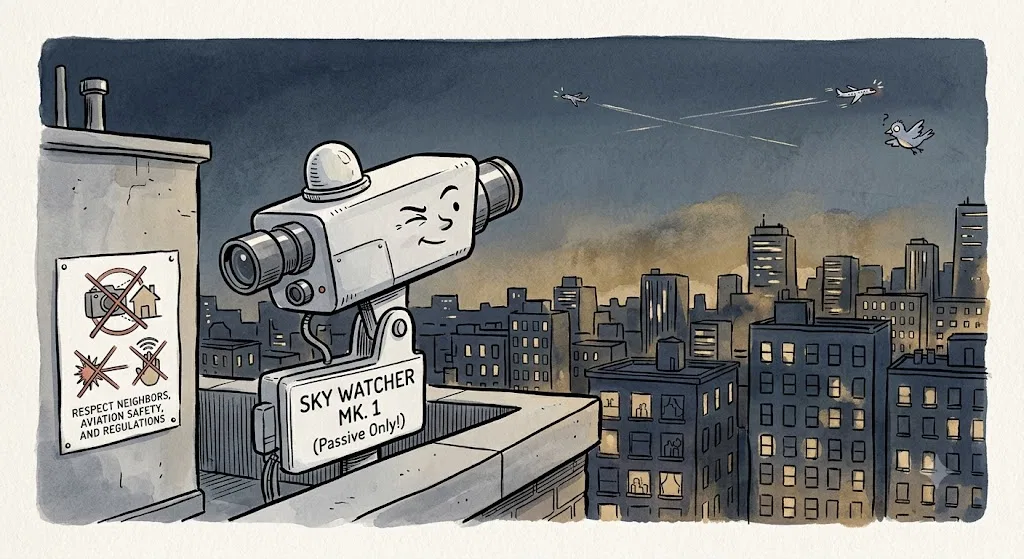
Automated sky monitoring stations do not normally need special “UFO detector” permission simply because a camera is pointed upwards. The harder questions are ordinary governance questions: does the system capture identifiable people, homes, number plates or voices; does it collect and republish aircraft tracking data; does it operate near sensitive sites; and does it use any active equipment, such as transmitters, radar or lasers, that could affect spectrum use or aviation safety. A credible UAP station is therefore not just a sensor stack. It is also a privacy, aviation-data and disclosure system.
The best rule of thumb is practical: collect the minimum data needed to analyse aerial events, avoid filming private spaces, document why each sensor is necessary, treat aircraft and radio data responsibly, and do not publish material that could create security or harassment risks. That governance layer matters because UAP research depends on public trust as much as on calibrated cameras and clocks. NASA’s UAP study stressed the need for better-calibrated, metadata-rich observations; it did not remove the need to collect those observations lawfully and proportionately.[NASA Science]science.nasa.govOpen source on nasa.gov.
Privacy Starts Where the Camera Sees More Than Sky
A sky station sounds benign because its target is above the horizon, but many real installations are mounted on roofs, poles, balconies, sheds or campus buildings. A wide-angle or all-sky lens may incidentally capture gardens, windows, streets, car parks or passers-by at the edge of the frame. A pan-tilt-zoom camera that follows objects can also swing down towards neighbouring property if it is not mechanically or digitally constrained. That is where a scientific instrument starts to look, in law and in public perception, like CCTV.
In the UK, the Information Commissioner’s Office tells household CCTV users to point cameras away from neighbours’ property, public areas and communal spaces where possible. The same guidance notes that complaints often arise when people think cameras are being used to spy on them, even where the owner’s motive is security rather than intrusion.[ICO]ico.org.ukOpen source on ico.org.uk. For organisations, the ICO’s video-surveillance guidance is broader: if a system processes personal data, it has to be managed under UK GDPR and the Data Protection Act 2018, with attention to installation, operation, public awareness and signage.[ICO]ico.org.ukOpen source on ico.org.uk.
The practical consequence for automated UFO detectors is that “we are only watching the sky” is not enough. Operators need to check what the system actually records. An all-sky scientific camera can usually be configured to mask the horizon, exclude nearby buildings, ignore low-elevation imagery, blur non-sky regions or discard frames unless an event rises above a threshold. These choices are not cosmetic. They can reduce the amount of personal data collected and make the station easier to justify.
A responsible station design should therefore answer a few plain questions before it goes live:
- What is visible at the edge of the frame? Test during day and night, because infrared and low-light cameras may reveal details that are not obvious in ordinary daylight.
- Can people, vehicles or homes be identified? If so, treat the footage as personal data and apply data-protection controls.
- Is continuous recording necessary? Many stations can use rolling buffers, event-triggered clips or metadata-first logging rather than keeping everything.
- How long is footage retained? The ICO says UK data-protection law does not prescribe a universal CCTV retention period; the purpose of the processing should determine how long data is kept.[ICO]ico.org.ukOpen source on ico.org.uk.
- How are neighbours and visitors informed? Even a small sign or public station page can prevent misunderstandings, especially if the station is visible from nearby homes.
The European Data Protection Board makes the same point in general GDPR terms: household exemptions are interpreted narrowly, and constant recording that covers a public space or a neighbour’s property can bring video devices within GDPR rules.[European Data Protection Board]edpb.europa.euOpen source on europa.eu. That matters for citizen-science stations because a hobbyist network can still create a public-facing data system. The more a station shares clips, metadata and live feeds outside the household, the weaker the argument that it is merely private domestic use.
Aircraft Data Is Useful, But Not Neutral
Automated UAP detectors need aviation context. Without it, ordinary aircraft, helicopters, drones, satellites and balloons can be mistaken for anomalies. ADS-B, short for Automatic Dependent Surveillance-Broadcast, is especially useful because many aircraft broadcast position and flight information that can be received by ground stations. The FAA describes ADS-B as a surveillance technology combining an aircraft’s positioning source, avionics and ground infrastructure to create a more precise surveillance interface than older radar-based systems.[Federal Aviation Administration]faa.govFederal Aviation Administration Automatic Dependent SurveillanceFederal Aviation Administration Automatic Dependent Surveillance
Scientific UAP systems already use this kind of data. The Galileo Project’s all-sky infrared camera work, for example, describes using ADS-B aircraft positions for extrinsic calibration, while its broader observatory architecture is built around multi-sensor capture, provenance and post-processing rather than isolated video clips.[arXiv]arxiv.orgOpen source on arxiv.org. Open aviation-data networks also show why ADS-B has become attractive to researchers: OpenSky describes itself as an open air-traffic data network using ADS-B, Mode-S, ADS-C, FLARM and VHF data for research, and its publications trace a large-scale sensor-network approach back to 2013–2014.[opensky-network.org]opensky-network.orgOpen source on opensky-network.org.
The difficulty is that aircraft tracking is not socially neutral. Some aircraft operators, private individuals, businesses, public officials and security organisations have argued that real-time flight tracking can create privacy and safety risks. In the United States, the FAA’s Limiting Aircraft Data Displayed programme lets aircraft owners ask for their flight data to be filtered from FAA SWIM feeds or from public display by participating websites.[Federal Aviation Administration]faa.govFederal Aviation Administration Limiting Aircraft Data Displayed (LADDFederal Aviation Administration Limiting Aircraft Data Displayed (LADD The FAA also offers a Privacy ICAO Address programme for eligible US-registered aircraft, acknowledging that some operators want to limit the availability of real-time ADS-B position and identification information.[Federal Aviation Administration]faa.govOpen source on faa.gov.
Those programmes do not make ADS-B private in a technical sense. ADS-B is broadcast from aircraft, and independent receivers can still collect signals directly. ADS-B Exchange, for example, describes itself as an independent global flight-data network displaying aircraft broadcasts as received, while Wired has reported on the conflict between open flight trackers, wealthy aircraft owners and platforms that suppress or filter some aircraft data.[ADS-B Exchange]adsbexchange.comOpen source on adsbexchange.com. The point for UAP stations is not that aircraft data must never be used. It is that operators should distinguish using aircraft data for classification from publicly amplifying real-time aircraft movements.
A good governance pattern is to ingest ADS-B or other aviation data locally, use it to rule out known traffic, and publish only what is needed for the UAP claim. For example, a public event record might say “matched to a known aircraft track” or “no ADS-B-correlated aircraft within the angular tolerance at the relevant time” without naming a private aircraft, exposing a registration or publishing a reusable real-time feed. Where a case genuinely depends on the aircraft identity, delayed, minimised or redacted release may be more proportionate than instant public posting.
Airspace Rules Mostly Bite When the Station Does More Than Observe
A passive optical camera pointed at the sky is usually not an airspace operator in the way a drone, aircraft, balloon or transmitter is. It is more like a telescope or weather camera. The legal risk changes when the station uses devices that can interfere with aircraft, radio spectrum or people on the ground.
The clearest boundary is lasers. In the UK, the Laser Misuse (Vehicles) Act 2018 created offences for shining or directing a laser beam towards vehicles or air traffic facilities, and the Civil Aviation Authority says offenders can face an unlimited fine and up to five years in prison for endangering an aircraft.[legislation.gov.uk]legislation.gov.ukOpen source on legislation.gov.uk. For UAP monitoring, that makes active laser ranging, pointing aids or alignment beams a high-risk choice around flight paths. Even low-power lasers can be misunderstood, misused or reported as a hazard if directed skywards.
Radio equipment is another boundary. Passive reception is different from transmission, but national rules still matter. Ofcom explains that unauthorised reception can involve offences of interception and disclosure under section 48 of the Wireless Telegraphy Act 2006, including using wireless apparatus with intent to obtain information about messages for which the listener is not an intended recipient.[www.ofcom.org.uk]ofcom.org.ukwww.ofcom.org.uk Rules on using radio equipmentwww.ofcom.org.uk Rules on using radio equipment That is especially relevant if a station proposes to record or stream airband voice communications. In the UK, publishing air-traffic-control audio is a very different risk from using open aircraft-position data to classify a light in the sky.
Active radar is more complicated again. Some UAP concepts use passive radar, which listens for reflections from existing transmitters, while others might be tempted by transmitting radar. The Galileo Project’s SkyWatch paper describes a passive multistatic radar concept based on commercial FM broadcast transmitters of opportunity, with receiver nodes estimating object positions and velocities.[arXiv]arxiv.orgOpen source on arxiv.org. By contrast, establishing an aeronautical radar ground station in the UK normally involves Ofcom licensing and CAA equipment approval processes, according to Ofcom’s aeronautical radar licence application guidance.[www.ofcom.org.uk]ofcom.org.ukwww.ofcom.org.uk Aeronautical radar ground station licence application formwww.ofcom.org.uk Aeronautical radar ground station licence application form
Drones add a separate issue. A fixed sky station may use drone-identification tools, but if the project itself flies drones to chase or image an event, it becomes subject to drone rules. The UK Civil Aviation Authority’s Drone Code emphasises respecting people and privacy when a drone carries a camera or listening device, and the CAA separately notes that drone users must comply with the same privacy regulations as anyone using a camera or recording device.[CAA]caa.co.ukOpen source on caa.co.uk. For automated UAP detection, that means the governance line is simple: fixed passive observation is one category; mobile airborne surveillance is another.
Sensitive Sites Change the Disclosure Calculation
The most sensitive UAP-monitoring problem is not whether a station can detect an object. It is whether publishing the data could expose a site’s security posture, patrol rhythm, sensor coverage, aircraft movements or blind spots. That concern is not hypothetical. The US All-domain Anomaly Resolution Office, AARO, reported in its fiscal year 2024 UAP report that its GREMLIN prototype sensor system had begun collections for detecting, tracking and characterising UAP, and that the next step was a 90-day “pattern of life” collection at a national-security site.[U.S. Department of War]media.defense.govFY24 CONSOLIDATED ANNUAL REPORT ON UAP 508FY24 CONSOLIDATED ANNUAL REPORT ON UAP 508
The phrase “pattern of life” is revealing. It means a sensor system is not just catching spectacular anomalies; it is building a baseline of ordinary activity. That baseline can be scientifically valuable because it helps distinguish birds, drones, aircraft, balloons, weather and sensor artefacts from genuinely unusual events. But near a military base, nuclear facility, airport, port, prison or critical-infrastructure site, the same baseline could also be operationally sensitive. A public feed that shows when aircraft usually depart, where unidentified drones tend to appear, or how cameras are positioned may be useful to more than researchers.
That creates a disclosure problem for citizen networks. Open science favours transparent data. Security practice sometimes favours delay, aggregation or withholding. The strongest answer is not blanket secrecy; that would destroy the scientific value of independent monitoring. Nor is it automatic publication of everything; that can be reckless. The better approach is tiered disclosure:
- Immediate internal record: preserve raw data, clocks, calibration, sensor settings and local processing logs so the event can be audited later.
- Rapid safety reporting: report apparent aviation hazards, unsafe drone activity, laser incidents or threats through the proper aviation, police or site-security channels.
- Delayed public release: publish clips and metadata after a short delay where real-time exposure could create risk.
- Redaction by default: remove exact station coordinates, private aircraft identifiers, house-level imagery, voices and site-security details unless they are essential to the claim.
- Independent review path: allow trusted researchers or institutions to inspect fuller data under controlled conditions when public release would be excessive.
This approach also protects credibility. A UAP station that posts dramatic clips without checking aircraft, satellite and local-security context may generate attention, but it will also generate avoidable false positives. NASA’s UAP report stressed that existing data problems include poor calibration, missing metadata and lack of multiple measurements; responsible disclosure is part of solving that problem, not a distraction from it.[NASA Science]science.nasa.govOpen source on nasa.gov.
Public Sharing Should Separate Evidence From Exposure
The hardest public-sharing cases are not the obvious false alarms. They are the cases where a clip looks unusual and the station operator wants outside help. Releasing the rawest possible material can aid independent analysis, but it can also expose bystanders, neighbouring property, aircraft identities, station vulnerabilities or sensitive locations. That tension is sharper for automated UFO detectors than for ordinary astronomy because the subject matter attracts intense public scrutiny, speculation and sometimes harassment.
A useful event package can be transparent without being indiscriminate. The public version should normally include the time window, general location, camera orientation, lens and sensor type, frame rate, weather context, angular motion, processing steps, and the result of checks against aircraft and satellite data. It does not always need raw audio, exact GPS coordinates, private registrations, unmasked horizon imagery or live station access.
This distinction becomes especially important when machine learning is involved. A classifier that labels “unknown” may simply mean “unknown to the model”, not “anomalous in the world”. Galileo Project publications describe observatory-class systems designed to conduct a census of aerial phenomena and recognise anomalies using multiple sensors and post-processing workflows.[arXiv]arxiv.orgOpen source on arxiv.org. That scientific framing should carry through to public release: the station should publish what was observed and how it was classified, not leap from “unmatched object” to a sensational conclusion.
Responsible sharing also means respecting negative results. If a station records a bright light and later matches it to an aircraft, satellite, meteor or balloon, the correction should remain attached to the original record. A public archive that keeps only the mysterious clips and silently removes explanations will train readers to overestimate anomaly rates. A better archive shows the full funnel: total detections, classified aircraft, classified satellites, insects or birds, weather artefacts, unresolved cases, and cases withdrawn after review.
The Governance Checklist for a Credible Sky Station
The governance burden does not need to make citizen or academic sky monitoring impossible. It simply needs to be designed in from the start. The most credible automated UAP stations will look less like secretive surveillance devices and more like well-run environmental sensors: documented purpose, minimised capture, calibrated instruments, access controls, clear retention rules and careful publication.
A practical policy for a station should cover five points.
Purpose and lawful basis. State whether the station is for scientific observation, aircraft-safety context, meteor detection, UAP research or another defined purpose. Avoid vague “anything interesting” surveillance if the equipment captures identifiable people or property. ICO guidance for surveillance systems repeatedly centres necessity, proportionality, public awareness and data minimisation.[ICO]ico.org.ukOpen source on ico.org.uk.
Field-of-view control. Use horizon masks, privacy masks, restricted pan-tilt limits and event thresholds. Recheck after hardware changes, software updates and seasonal changes, because a winter tree line or new mounting angle can expose homes that were previously hidden.
Aircraft-data handling. Use ADS-B and other aviation sources for filtering and calibration, but avoid publishing live private-aircraft tracking unless there is a clear public-interest reason and local law allows it. The FAA’s LADD and PIA programmes show that aviation authorities recognise a real privacy and security concern around aircraft data, even though independent reception remains technically possible.[Federal Aviation Administration]faa.govFederal Aviation Administration Limiting Aircraft Data Displayed (LADDFederal Aviation Administration Limiting Aircraft Data Displayed (LADD
Spectrum and active-sensor controls. Keep receive-only systems separate from transmitters, avoid skyward lasers, and check licensing before using radar or other radio-emitting equipment. Ofcom’s general licensing pages make clear that certain radio equipment and spectrum uses require a licence, while aeronautical radar ground-station guidance points to Ofcom licensing and CAA approval pathways.[www.ofcom.org.uk]ofcom.org.ukwww.ofcom.org.uk Licenceswww.ofcom.org.uk Licences
Disclosure and escalation. Decide in advance what is public, what is delayed, what is redacted and what is reported to authorities. A station near an airport, defence site or critical infrastructure should have stricter release rules than a rural meteor camera looking over open fields.
The final measure is cultural rather than technical: do not treat governance as an obstacle to discovery. For automated instrumented UFO detectors, good rules make the data more usable. They reduce false alarms, protect neighbours, keep aviation context from becoming doxxing material, and make it easier for scientists, journalists and officials to take the resulting observations seriously. A sky station that can explain not only what it recorded, but also why it was allowed to record it and why it chose to publish it, is a stronger instrument than one with better cameras but weaker judgement.
Amazon book picks
Further Reading
Books and field guides related to What Rules Apply to Sky Monitoring Stations?. Use these as the next step if you want deeper reading beyond the article.
Practical Cybersecurity Architecture
Covers governance and secure system design principles.

eBay marketplace picks
Marketplace Samples
Live-tested eBay searches with available results related to this page.


Endnotes
1.
Source: science.nasa.gov
Link:https://science.nasa.gov/wp-content/uploads/2023/09/uap-independent-study-team-final-report.pdf
2.
Source: ico.org.uk
Link:https://ico.org.uk/for-organisations/uk-gdpr-guidance-and-resources/cctv-and-video-surveillance/guidance-on-video-surveillance-including-cctv/how-can-we-comply-with-the-data-protection-principles-when-using-surveillance-systems/
3.
Source: ico.org.uk
Link:https://ico.org.uk/for-the-public/home-cctv-systems/
4.
Source: GOV.UK
Title: domestic cctv using cctv systems on your property
Link:https://www.gov.uk/government/publications/guidance-on-the-use-of-domestic-cctv/domestic-cctv-using-cctv-systems-on-your-property
5.
Source: ico.org.uk
Link:https://ico.org.uk/for-organisations/uk-gdpr-guidance-and-resources/cctv-and-video-surveillance/guidance-on-video-surveillance-including-cctv/
6.
Source: faa.gov
Title: Federal Aviation Administration Automatic Dependent Surveillance
Link:https://www.faa.gov/about/office_org/headquarters_offices/avs/offices/afx/afs/afs400/afs410/ads-b
7.
Source: arxiv.org
Link:https://arxiv.org/abs/2411.07956
8.
Source: arxiv.org
Title: arXiv Galileo Project Observatory Class System Architecture
Link:https://arxiv.org/abs/2506.00125
9.
Source: opensky-network.org
Link:https://opensky-network.org/
10.
Source: opensky-network.org
Link:https://opensky-network.org/about/publications
11.
Source: faa.gov
Title: Federal Aviation Administration Limiting Aircraft Data Displayed (LADD)
Link:https://www.faa.gov/pilots/ladd
12.
Source: faa.gov
Link:https://www.faa.gov/air_traffic/technology/equipadsb/privacy
13.
Source: wired.com
Link:https://www.wired.com/story/elon-musk-elonjet-flight-tracker-transparency
14.
Source: legislation.gov.uk
Link:https://www.legislation.gov.uk/ukpga/2018/9
15.
Source: caa.co.uk
Link:https://www.caa.co.uk/safety-initiatives/how-we-regulate/safety-plan/mitigating-key-safety-risks/lasers/
16.
Source: ofcom.org.uk
Title: www.ofcom.org.uk Rules on using radio equipment
Link:https://www.ofcom.org.uk/spectrum/radio-equipment/radio-spectrum-and-the-law
17.
Source: arxiv.org
Link:https://arxiv.org/abs/2305.18562
18.
Source: ofcom.org.uk
Title: www.ofcom.org.uk Aeronautical radar ground station licence application form
Link:https://www.ofcom.org.uk/siteassets/resources/documents/manage-your-licence/aeronautical/forms/ofw593.pdf?v=326577
19.
Source: caa.co.uk
Link:https://www.caa.co.uk/drones/getting-started-with-drones-and-model-aircraft/drone-code/protecting-people-s-privacy-points-21-to-26/
20.
Source: caa.co.uk
Link:https://www.caa.co.uk/drones/reporting-concerns-about-safety-privacy-and-illegal-flying/concerns-about-privacy-and-illegal-use-of-drones/
21.
Source: arxiv.org
Link:https://arxiv.org/abs/2305.18566
22.
Source: ofcom.org.uk
Title: www.ofcom.org.uk Licences
Link:https://www.ofcom.org.uk/licences
23.
Source: icao.int
Title: wp 479 en
Link:https://www.icao.int/sites/default/files/Meetings/a42/Documents/WP/wp_479_en.pdf
24.
Source: icao.int
Link:https://www.icao.int/sites/default/files/sp-files/safety/Documents/Laser%20Illuminations%20Progress/United%20Kingdom.pdf
25.
Source: GOV.UK
Title: drones are you flying yours safely and legally
Link:https://www.gov.uk/government/news/drones-are-you-flying-yours-safely-and-legally
26.
Source: GOV.UK
Title: update to surveillance camera code
Link:https://www.gov.uk/government/publications/update-to-surveillance-camera-code
27.
Source: GOV.UK
Title: tougher laser misuse laws come into force
Link:https://www.gov.uk/government/news/tougher-laser-misuse-laws-come-into-force
28.
Source: GOV.UK
Title: new measures to tackle the misuse of lasers gain royal assent
Link:https://www.gov.uk/government/news/new-measures-to-tackle-the-misuse-of-lasers-gain-royal-assent
29.
Source: aaro.mil
Link:https://www.aaro.mil/UAP-Cases/Official-UAP-Imagery/
30.
Source: aaro.mil
Title: UNCLASSIFIED FY23 Consolidated Annual Report on UAP Oct 25 2023 1236
Link:https://www.aaro.mil/Portals/136/PDFs/UNCLASSIFIED-FY23_Consolidated_Annual_Report_on_UAP-Oct_25_2023_1236.pdf
31.
Source: aaro.mil
Link:https://www.aaro.mil/
32.
Source: aaro.mil
Link:https://www.aaro.mil/Portals/136/PDFs/AARO_Mission_Brief_2025.pdf
33.
Source: aaro.mil
Link:https://www.aaro.mil/Congressional-Press-Products/
34.
Source: war.gov
Title: dr jon kosloski director aaro media roundtable on the fy24 consolidated annual
Link:https://www.war.gov/News/Transcripts/Transcript/Article/3965734/dr-jon-kosloski-director-aaro-media-roundtable-on-the-fy24-consolidated-annual/
35.
Source: war.gov
Title: department of defense releases the annual report on unidentified anomalous phen
Link:https://www.war.gov/News/Releases/Release/Article/3964824/department-of-defense-releases-the-annual-report-on-unidentified-anomalous-phen/
36.
Source: assets.publishing.service.gov.uk
Link:https://assets.publishing.service.gov.uk/media/5a7b91a240f0b62826a046c0/Surveillance_Camera_Code_of_Practice_WEB.pdf
37.
Source: ofcom.org.uk
Title: Radio controlled models
Link:https://www.ofcom.org.uk/spectrum/radio-equipment/Radio-controlled-models
38.
Source: ofcom.org.uk
Link:https://www.ofcom.org.uk/siteassets/resources/documents/manage-your-licence/maritime-radio/ofw449.pdf
39.
Source: ofcom.org.uk
Title: aeronautical licensing
Link:https://www.ofcom.org.uk/spectrum/radio-equipment/aeronautical-licensing
40.
Source: ofcom.org.uk
Title: short range devices
Link:https://www.ofcom.org.uk/spectrum/radio-equipment/short-range-devices
41.
Source: ofcom.org.uk
Link:https://www.ofcom.org.uk/spectrum/frequencies/spectrum-information
42.
Source: opensky-network.org
Link:https://opensky-network.org/about/faq
43.
Source: opensky-network.org
Link:https://opensky-network.org/data/scientific
44.
Source: legislation.gov.uk
Link:https://www.legislation.gov.uk/id/ukpga/2006/36
45.
Source: science.nasa.gov
Link:https://science.nasa.gov/uap/
46.
Source: science.nasa.gov
Link:https://science.nasa.gov/uap/faqs/
47.
Source: nasa.gov
Title: nasa to release discuss unidentified anomalous phenomena report
Link:https://www.nasa.gov/news-release/nasa-to-release-discuss-unidentified-anomalous-phenomena-report/
48.
Source: videosurveillance.blog.gov.uk
Title: surveillance camera code of practice
Link:https://videosurveillance.blog.gov.uk/category/surveillance-camera-code-of-practice/
49.
Source: arxiv.org
Link:https://arxiv.org/html/2505.06254v1
50.
Source: arxiv.org
Link:https://arxiv.org/html/2506.00125v1
51.
Source: bathnes.gov.uk
Title: CCTV Code of Practice Document 2025
Link:https://www.bathnes.gov.uk/sites/default/files/CCTV_Code_of_Practice_Document_2025.pdf
52.
Source: sky.com
Link:https://www.sky.com/help/articles/privacy-hub-home
53.
Source: roydonessex-parish.gov.uk
Link:https://roydonessex-parish.gov.uk/wp-content/uploads/2026/05/ICO-Video-surveillance-including-guidance-for-organisations-using-CCTV.pdf
54.
Source: cullomptontowncouncil.gov.uk
Link:https://cullomptontowncouncil.gov.uk/wp-content/uploads/2023/06/012-CCTV-Code-of-Practice.pdf
55.
Source: faa.gov
Link:https://www.faa.gov/pilots/ladd/request
56.
Source: space.com
Title: pentagon ufo uap office aaro sensors anomalies orbit
Link:https://www.space.com/pentagon-ufo-uap-office-aaro-sensors-anomalies-orbit
57.
Source: ofcomlive.my.site.com
Link:https://ofcomlive.my.site.com/
58.
Source: cnpd.public.lu
Link:https://cnpd.public.lu/content/dam/cnpd/en/dossiers-thematiques/videosurveillance/cnpd-lignes-directrices-vidosurveillance-en.pdf
59.
Source: met.police.uk
Link:https://www.met.police.uk/advice/advice-and-information/drones/drones/
60.
Source: ruskington.parish.lincolnshire.gov.uk
Title: drone activity over residential areas guidance for ruskington residents
Link:https://ruskington.parish.lincolnshire.gov.uk/news/article/204/drone-activity-over-residential-areas-guidance-for-ruskington-residents
61.
Source: ico.org.uk
Link:https://ico.org.uk/for-organisations/uk-gdpr-guidance-and-resources/cctv-and-video-surveillance/
62.
Source: edpb.europa.eu
Link:https://www.edpb.europa.eu/system/files/2026-04/summary_edpb_guidelines_201903_video_devices_en.pdf
63.
Source: adsbexchange.com
Link:https://www.adsbexchange.com/
64.
Source: media.defense.gov
Title: FY24 CONSOLIDATED ANNUAL REPORT ON UAP 508
Link:https://media.defense.gov/2024/Nov/14/2003583603/-1/-1/0/FY24-CONSOLIDATED-ANNUAL-REPORT-ON-UAP-508.PDF
65.
Source: Wikipedia
Title: Open Sky Network
Link:https://en.wikipedia.org/wiki/OpenSky_Network
66.
Source: Wikipedia
Title: The Galileo Project
Link:https://en.wikipedia.org/wiki/The_Galileo_Project
67.
Source: breakingdefense.com
Title: All-domain Anomaly Resolution Office
Link:https://breakingdefense.com/tag/all-domain-anomaly-resolution-office-aaro/
68.
Source: europarl.europa.eu
Link:https://www.europarl.europa.eu/doceo/document/E-9-2024-000318_EN.html
69.
Source: edpb.europa.eu
Title: edpb guidelines 201903 video devices en 0
Link:https://www.edpb.europa.eu/sites/default/files/files/file1/edpb_guidelines_201903_video_devices_en_0.pdf
70.
Source: caa.co.uk
Link:https://www.caa.co.uk/drones/moving-on-to-more-advanced-flying/privacy-rules-when-flying-drones/
71.
Source: caa.co.uk
Link:https://www.caa.co.uk/data-and-publications/publications/documents/content/cap-670-sa-202101/
72.
Source: caa.co.uk
Link:https://www.caa.co.uk/commercial-industry/airspace/communication-navigation-and-surveillance/aeronautical-radio-stations/
73.
Source: caa.co.uk
Link:https://www.caa.co.uk/publication/download/25586
74.
Source: adsbexchange.com
Link:https://www.adsbexchange.com/data-products/
75.
Source: globe.adsbexchange.com
Link:https://globe.adsbexchange.com/
76.
Source: ico.org.uk
Link:https://ico.org.uk/make-a-complaint/home-cctv-complaints/
77.
Source: ico.org.uk
Link:https://ico.org.uk/for-organisations/uk-gdpr-guidance-and-resources/cctv-and-video-surveillance/guidance-on-video-surveillance-including-cctv/additional-considerations-for-technologies-other-than-cctv/unmanned-aerial-systems-uas-drones/
78.
Source: committees.parliament.uk
Link:https://committees.parliament.uk/writtenevidence/62606/pdf/
79.
Source: play.google.com
Link:https://play.google.com/store/apps/details?hl=en_GB&id=appinventor.ai_ondraaudy.ADSBFT
Additional References
80.
Source: youtube.com
Link:https://www.youtube.com/watch?v=LwiRowV3DwA
Source snippet
Legal rules home cctv privacy neighbor data protection Are you breaking the law with your home CCTV setup?...
81.
Source: youtube.com
Title: Privacy in the Age of ADS-B
Link:https://www.youtube.com/watch?v=gLtBcLOY9xM
Source snippet
Episode 16 | Aviation’s New Privacy Crisis: How ADS-B, FAA Reform & Public Tracking Are...
82.
Source: youtube.com
Title: My neighbour’s CCTV’ camera is spying on me. What can I do? [LBC Legal Hour]
Link:https://www.youtube.com/watch?v=q0xgK2wlLSA
Source snippet
Privacy in the Age of ADS-B - Brought to you by BendixKing and SocialFlight...
83.
Source: fcc.gov
Link:https://www.fcc.gov/sites/default/files/interception_and_divulgence_of_radio_communications.pdf
84.
Source: archives.gov
Link:https://www.archives.gov/research/topics/uaps
85.
Source: youtube.com
Title: What’s the Law on CCTV, microphones and overlooking someone else?
Link:https://www.youtube.com/watch?v=go36aW2p0QM
Source snippet
Are you breaking the law with your home CCTV setup?...
86.
Source: bitkom.org
Link:https://www.bitkom.org/sites/main/files/2019-09/20190909-bitkom-position-edpb-guidelines-videosurveillance-and-processing-through-video-devices.pdf
87.
Source: enlutc.co.uk
Link:https://enlutc.co.uk/wp-content/uploads/2025/08/cctv-code-of-practice.pdf
88.
Source: le.ac.uk
Link:https://le.ac.uk/-/media/uol/docs/about-us/professional-services/estates/project-management-procedures-and-forms/design-guides/cctv-code-of-practice.pdf
89.
Source: eoportal.org
Link:https://www.eoportal.org/other-space-activities/ads-b
Topic Tree