Within Calibration
The tiny timing error that can fake mystery
Even good flight data can mislead a detector when camera timestamps, location records or pointing metadata are wrong.
On this page
- Why one second aircraft data needs accurate sensor time
- How timestamp drift spoils sky position matching
- Metadata checks that make cross matching trustworthy
Page outline Jump by section
Introduction
A surprisingly small timing error can make an ordinary aircraft look unexplained. Automated instrumented UFO or UAP detectors often compare camera observations against external aircraft data such as ADS-B broadcasts. The comparison sounds straightforward: if an aircraft was at a known position at a known time, the detector should find it in the corresponding part of the sky. In practice, that comparison only works when the detector’s own clock, timestamps and metadata are accurate.
 A camera that is one or two seconds out of sync can place a fast-moving aircraft in the wrong part of the sky. A detector may then conclude that the observed object has no matching flight track, creating an artificial anomaly. This is one reason why NASA’s UAP study repeatedly emphasised calibration, metadata quality and accurate sensor records as prerequisites for reliable analysis.[NASA Science]science.nasa.govNASA ScienceIndependent Study Team ReportAt present, analysis of UAP data is hampered by poor sensor calibration, the lack of multiple me…
Why one-second aircraft data needs accurate sensor time
Aircraft surveillance systems are built around time. ADS-B transmissions typically provide updated position information roughly once per second, allowing aircraft to be tracked continuously. The usefulness of those reports depends on knowing exactly when a position measurement was valid.[Wikipedia]WikipediaAutomatic Dependent Surveillance–BroadcastAutomatic Dependent Surveillance–Broadcast
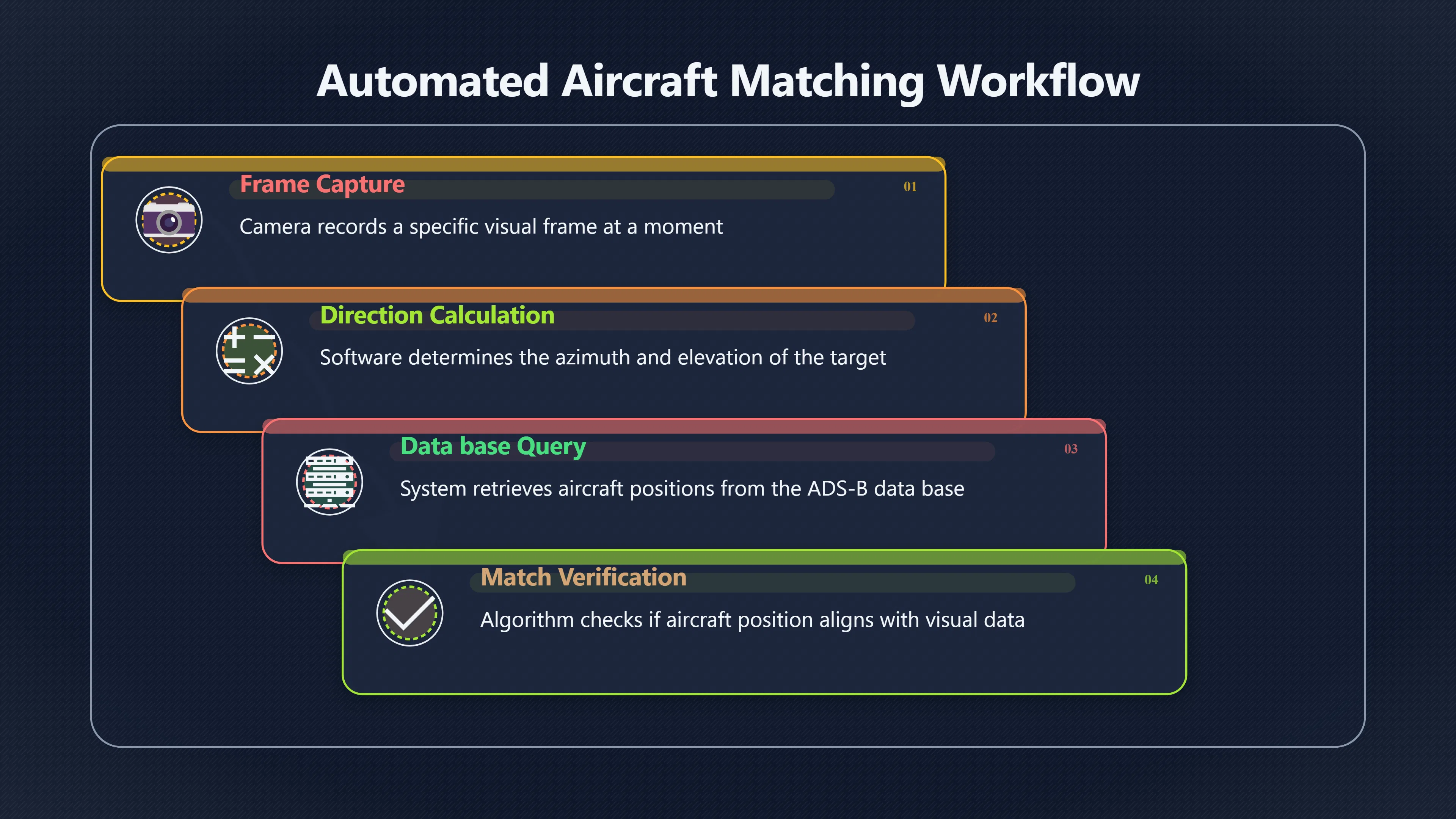
For a UFO detector, the matching process normally works like this:
- A camera records a frame at a specific time.
- The software calculates the direction of the observed object.
- Aircraft track data are queried for the same instant.
- The system checks whether any aircraft should appear at that sky position.
The entire chain assumes that the camera timestamp is correct. If the camera clock runs one second slow, the software may compare a frame taken at 22:15:31 with aircraft positions from 22:15:30. For a distant airliner moving hundreds of kilometres per hour, that difference can shift the expected position by a noticeable amount. For aircraft close to the sensor, the angular error can become even larger.
The problem is not limited to cameras. GPS receivers, telescope mounts, infrared imagers, radar systems and logging computers can all maintain separate clocks. Any disagreement between them introduces uncertainty into the cross-check process. Research on ADS-B timing has shown that even within aviation systems themselves, latency and timing offsets require careful accounting because position measurements and received reports are not always perfectly synchronised.[arXiv]arxiv.orgA study of uncompensated latency in ADS-B reportsby M George · 2020 · Cited by 2 — The total latency (TL) in ADS-B is the difference…
How timestamp drift spoils sky-position matching
Clock errors usually appear in two forms: fixed offset and drift.
A fixed offset means the system is consistently wrong by a known amount. A camera may always be 0.8 seconds behind UTC. Once discovered, this can often be corrected.
Drift is more dangerous. Here the clock slowly wanders over time. A detector may begin the night perfectly synchronised but end several hours later with a growing timestamp error.
The false anomaly mechanism
Consider an aircraft crossing the field of view at low elevation. The detector records a bright moving target and attempts to match it with ADS-B traffic.
If the detector clock has drifted:
- The aircraft’s reported position is retrieved for the wrong moment.
- The calculated azimuth and elevation no longer agree with the image.
- The matching algorithm may reject the aircraft candidate.
- The target is incorrectly classified as unmatched.
Nothing unusual occurred in the sky. The anomaly exists only because two datasets refer to different moments in time.
This failure mode becomes especially important when the detector uses narrow fields of view, long focal lengths or high-resolution tracking. A timing error that seems trivial in everyday computing can translate into significant angular displacement when tracking fast-moving aerial targets.
The broader sensor-fusion literature reaches the same conclusion. Studies of synchronised camera, LiDAR and inertial systems consistently show that inaccurate timestamps degrade position estimation and object association because measurements that should describe the same event no longer line up in time.[arXiv]arxiv.orgarXiv Open-Source Li DAR Time Synchronization System by Mimicking GNSS-clockOpen-Source LiDAR Time Synchronization System by Mimicking GNSS-clockJuly 6, 2021…
Why aircraft are particularly sensitive calibration targets
Aircraft are useful calibration references precisely because they move.
A stationary star remains in roughly the same position despite a modest timing error. An aircraft does not. As a result, aircraft quickly expose hidden clock problems.
A detector may appear accurate when tested against stars but fail during aircraft cross-checking because the moving target reveals timing mistakes that static calibration targets cannot. This makes routine aircraft matching an effective diagnostic tool for uncovering timestamp issues before they generate false UAP classifications.
When timing errors combine with other metadata mistakes
Clock problems rarely occur in isolation.
A one-second timing error can combine with:
- Incorrect GPS coordinates for the sensor site.
- Wrong camera orientation values.
- Delayed network logging.
- Latency introduced by video encoding.
- Frame timestamps generated after image capture rather than at exposure time.
The result is cumulative error.
Suppose a detector records a target and then stores the timestamp after image compression finishes. The recorded time may lag the actual exposure by hundreds of milliseconds or more. If clock drift and orientation error are also present, the system can miss a valid aircraft match even when each individual error seems small.
NASA’s UAP study highlighted the importance of complete sensor metadata for exactly this reason. Time of acquisition, calibration status and other contextual information are necessary to determine whether an apparent anomaly reflects an object in the sky or a measurement problem within the sensor system.[Wikisource]en.wikisource.orgPage:UAP Independent Study TeamPage:UAP Independent Study Team - Final Report.pdf/1512 Nov 2023 — Indeed, several apparent UAP have been demonstrated to be se…
A practical example of a misleading mismatch
Imagine an aircraft broadcasting ADS-B data once per second while travelling at typical cruise speed.
The detector sees a bright light and calculates that it should correspond to an aircraft bearing of 128°. The ADS-B database, queried using a clock that is 1.5 seconds wrong, predicts the aircraft at 126°. The matching tolerance is only one degree.
The software concludes:
- No aircraft match exists.
- The object deserves further scrutiny.
- The event is stored as potentially anomalous.
Later investigation reveals that the aircraft was the correct explanation all along. The mismatch was produced entirely by timing error.
This kind of outcome is not hypothetical. Aviation tracking systems that depend on multilateration and timing measurements are known to suffer degraded position estimates when timing information is inaccurate. Flight-tracking communities have documented aircraft tracks appearing to jump or wander because subsets of timing inputs were inconsistent.[FlightAware Discussions]discussions.flightaware.comA little more technical information.Read moreFlightAware DiscussionsAircraft position jumping around on radar map?December 15, 2016 — 15 Dec 2016 — It looks like one of the subset is…

Metadata checks that make cross-matching trustworthy
Reliable aircraft exclusion depends less on sophisticated classification algorithms than on disciplined timing control.
A robust automated sky-monitoring system typically includes several safeguards:
UTC-synchronised clocks. Every sensor should reference a common time standard, ideally derived from GNSS or another high-accuracy source.
Continuous drift monitoring. Synchronisation should be checked throughout operation rather than only at startup.
Exposure-time timestamps. Timestamps should correspond to the actual moment light reached the sensor, not when software later processed the frame.
Latency accounting. Known delays introduced by networking, buffering, encoding or storage should be measured and recorded.
Cross-sensor consistency tests. Aircraft visible simultaneously in multiple sensors provide a way to verify that all systems agree on timing.
Audit trails. Raw timestamps, synchronisation status and clock-health information should be stored alongside observations so that later investigators can reconstruct exactly how timing was handled.
These practices mirror recommendations emerging from both aviation tracking and UAP data-quality discussions: anomalies become more credible only after ordinary explanations have been tested using well-calibrated sensors with trustworthy metadata.[Wikisource+2NASA]en.wikisource.orgNASA Unidentified Anomalous Phenomena: Independent Study…The importance of detecting UAP with multiple, well-calibrated sens…
The real lesson for automated UFO detectors
Aircraft databases are powerful calibration tools, but they are not magic truth sources. They only help when the observing system knows precisely when and where its own measurements were made.
A detector that lacks accurate timing can transform a perfectly ordinary aircraft into an apparently unmatched target. The resulting mystery is not in the sky; it is in the metadata. For automated instrumented UFO detection, clock discipline is therefore not a minor engineering detail. It is a prerequisite for deciding whether an object is genuinely unusual or merely the victim of a timestamp that was off by a second.
Amazon book picks
Further Reading
Books and field guides related to The tiny timing error that can fake mystery. Use these as the next step if you want deeper reading beyond the article.
How to Measure Anything
Directly addresses measurement error, calibration, uncertainty and data quality issues that can create false anomalies.

Data Reduction and Error Analysis for the Physical Sciences
Explains timing errors, uncertainty propagation and validation methods relevant to sensor cross-matching.
Introduction to random signals and applied Kalman filtering
Relevant to timestamped tracking data, sensor fusion and matching observations against aircraft trajectories.

Fundamentals of Kalman filtering
Provides practical techniques for reconciling noisy sensor data and maintaining trustworthy track correlations.
eBay marketplace picks
Marketplace Samples
Example marketplace items related to this page. Use the search link to explore similar finds on eBay.



Endnotes
1.
Source: science.nasa.gov
Link:https://science.nasa.gov/wp-content/uploads/2023/09/uap-independent-study-team-final-report.pdf
Source snippet
NASA ScienceIndependent Study Team ReportAt present, analysis of UAP data is hampered by poor sensor calibration, the lack of multiple me...
2.
Source: nasa.gov
Title: update nasa shares uap independent study report names director
Link:https://www.nasa.gov/news-release/update-nasa-shares-uap-independent-study-report-names-director/
Source snippet
UPDATE: NASA Shares UAP Independent Study Report14 Sept 2023 — We found that NASA can help the whole-of-government UAP effort through sys...
3.
Source: Wikipedia
Title: Automatic Dependent Surveillance–Broadcast
Link:https://en.wikipedia.org/wiki/Automatic_Dependent_Surveillance%E2%80%93Broadcast
4.
Source: arxiv.org
Link:https://arxiv.org/pdf/2008.06352
Source snippet
A study of uncompensated latency in ADS-B reportsby M George · 2020 · Cited by 2 — The total latency (TL) in ADS-B is the difference...
5.
Source: arxiv.org
Title: arXiv A study of uncompensated latency in ADS-B reports
Link:https://arxiv.org/abs/2008.06352
6.
Source: arxiv.org
Title: arXiv [Open-Source]({{ ‘open-source/’ | relative_url }}) Li DAR Time Synchronization System by Mimicking GNSS-clock
Link:https://arxiv.org/abs/2107.02625
Source snippet
Open-Source LiDAR Time Synchronization System by Mimicking GNSS-clockJuly 6, 2021...
Published: July 6, 2021
7.
Source: en.wikisource.org
Title: Page:UAP Independent Study Team
Link:https://en.wikisource.org/wiki/Page%3AUAP_Independent_Study_Team_-_Final_Report.pdf/15
Source snippet
Page:UAP Independent Study Team - Final Report.pdf/1512 Nov 2023 — Indeed, several apparent UAP have been demonstrated to be se...
8.
Source: discussions.flightaware.com
Title: A little more technical information.Read more
Link:https://discussions.flightaware.com/t/aircraft-position-jumping-around-on-radar-map/19415
Source snippet
FlightAware DiscussionsAircraft position jumping around on radar map?December 15, 2016 — 15 Dec 2016 — It looks like one of the subset is...
Published: December 15, 2016
9.
Source: en.wikisource.org
Link:https://en.wikisource.org/wiki/NASA_Unidentified_Anomalous_Phenomena%3A_Independent_Study_Team_Report/Overall_Conclusions_and_Recommendations
Source snippet
NASA Unidentified Anomalous Phenomena: Independent Study...The importance of detecting UAP with multiple, well-calibrated sens...
10.
Source: science.nasa.gov
Link:https://science.nasa.gov/uap/
Source snippet
nasa.govUAP9 Jun 2022 — The study will focus on identifying available data, how best to collect future data, and how NASA can use that da...
11.
Source: en.wikisource.org
Title: Page:UAP Independent Study Team Final Report
Link:https://en.wikisource.org/wiki/Page%3AUAP_Independent_Study_Team_-_Final_Report.pdf/5
Source snippet
wikisource.orgPage:UAP Independent Study Team - Final Report.pdf/512 Nov 2023 — At present, analysis of UAP data is hampered by poor sens...
12.
Source: en.wikisource.org
Title: Responses to Statement of Task
Link:https://en.wikisource.org/wiki/NASA_Unidentified_Anomalous_Phenomena%3A_Independent_Study_Team_Report/Responses_to_Statement_of_Task
Source snippet
Unidentified Anomalous Phenomena: Independent...14 Oct 2023 — Indeed, several apparent UAP have been demonstrated to be sensor artifacts...
13.
Source: Wikipedia
Link:https://en.wikipedia.org/wiki/NASA_Unidentified_Anomalous_Phenomena_Independent_Study_Team
Source snippet
NASA Unidentified Anomalous Phenomena Independent...UAP originally stood for "unidentified aerial phenomena", but was expanded at the...
14.
Source: discussions.flightaware.com
Title: mlat sync
Link:https://discussions.flightaware.com/t/mlat-sync/54875
Source snippet
sync - ADS-B Flight Tracking10 Sept 2019 — Synchronizing the clocks is the first step and is necessary before any actual multilateration...
Additional References
15.
Source: researchgate.net
Link:https://www.researchgate.net/publication/321736587_ADS-B_vulnerabilities_and_a_security_solution_with_a_timestamp
Source snippet
(PDF) ADS-B vulnerabilities and a security solution with...ADS-BT monitors the discrepancy between the time of flight based on the times...
16.
Source: researchgate.net
Link:https://www.researchgate.net/figure/ADS-B-sync-hronization-to-radar-scan_fig3_224338492
Source snippet
ADS-B sync hronization to radar scan.The simplest time synchronization method is to synchronize with the radar scan. The radar reports d...
17.
Source: managingexpectations.net
Link:https://managingexpectations.net/blog/articles/nasa-uap-study-managing-expectations.html
Source snippet
NASA's UAP Study: What It Did — and Did Not — ConcludeThe panel said UAP analysis is hampered by “poor sensor calibration,” a lack of mul...
18.
Source: icao.int
Link:https://www.icao.int/sites/default/files/APAC/Meetings/2025/2025%20ICAO%20APAC%20Radio%20Navigation%20Symposium%20%20Radio%20N/8-Risks%20Beyond%20GNSS/SP22-ADS-B-spoofing-and-mitigating-measures.pdf
Source snippet
ADS-B spoofing and mitigating measuresErroneous ADS-B positions or ADS-B positions with poor accuracy indicators. Likely only affect one...
19.
Source: primitiveproton.com
Link:https://primitiveproton.com/unidentified-anomalous-phenomena-uap/
20.
Source: rev.com
Title: unidentified anomalous phenomena independent study report from nasa transcript
Link:https://www.rev.com/transcripts/unidentified-anomalous-phenomena-independent-study-report-from-nasa-transcript
Source snippet
UAP Independent Study Report from NASA18 Sept 2023 —... data collection that involves calibrating instruments, multiple measurements and...
21.
Source: aws.amazon.com
Title: asynchronous media processing on aws achieving broadcast quality at scale
Link:https://aws.amazon.com/blogs/media/asynchronous-media-processing-on-aws-achieving-broadcast-quality-at-scale/?tag=searcht-20
Source snippet
media processing on AWS26 Feb 2026 — Amazon Time Sync Service: Provides microsecond-accurate UTC synchronization across all compute nodes...
22.
Source: youtube.com
Link:https://www.youtube.com/watch?v=TQcqOW39ksk
Source snippet
Unidentified Anomalous Phenomena Independent Study ReportNASA commissioned an independent study team to examine unidentified anomalous ph...
23.
Source: avi-loeb.medium.com
Title: a new calculation on the fly to the nasa uap study 2dacaf860cac
Link:https://avi-loeb.medium.com/a-new-calculation-on-the-fly-to-the-nasa-uap-study-2dacaf860cac
Source snippet
New Calculation on the Fly to the NASA UAP Study - Avi LoebThe key in identifying an unusual signal lies in the data quality that makes i...
24.
Source: nevadacurrent.com
Title: nasa report finds no evidence that ufos are extraterrestrial
Link:https://nevadacurrent.com/2023/09/18/nasa-report-finds-no-evidence-that-ufos-are-extraterrestrial/
Source snippet
18 Sept 2023 — Analysis of this data is “hampered by poor sensor calibration, the lack of multiple measurements, the lack of sensor metad...
Topic Tree