Within False Positives
The Satellite Check Every UFO Alert Needs
Automated alerts should be compared with satellite positions and illumination before a bright moving light becomes a candidate event.
On this page
- What ephemerides can rule out
- Why flare brightness still needs geometry
- Where satellite checks can fail
Page outline Jump by section
Introduction
For an automated UFO detector, a bright moving light should not become a candidate anomaly until it has been compared against predicted satellite positions. Modern skies contain thousands of active satellites, rocket bodies and debris objects, many of which can produce striking visual effects. A simple positional check against orbital ephemerides—the predicted locations of known space objects at a given time—can eliminate a large fraction of otherwise intriguing alerts. Public tracking systems based on NORAD orbital data, such as CelesTrak and Heavens-Above, routinely predict visible satellite passes with sufficient accuracy for visual observation and identification.[CelesTrak+2Heavens-Above]celestrak.orgNORAD GP Element Sets Current DataBrightest Active Satellites. A set of graphs and tables that show everything from the age dist…
 Within an automated instrumented UFO detection framework, the satellite check is therefore not an optional follow-up. It is a required gate before escalation. A moving light that aligns with a known satellite track, visible illumination geometry and expected brightness behaviour is not an unexplained object. It is a successfully identified one.
The Satellite Check Every UFO Alert Needs
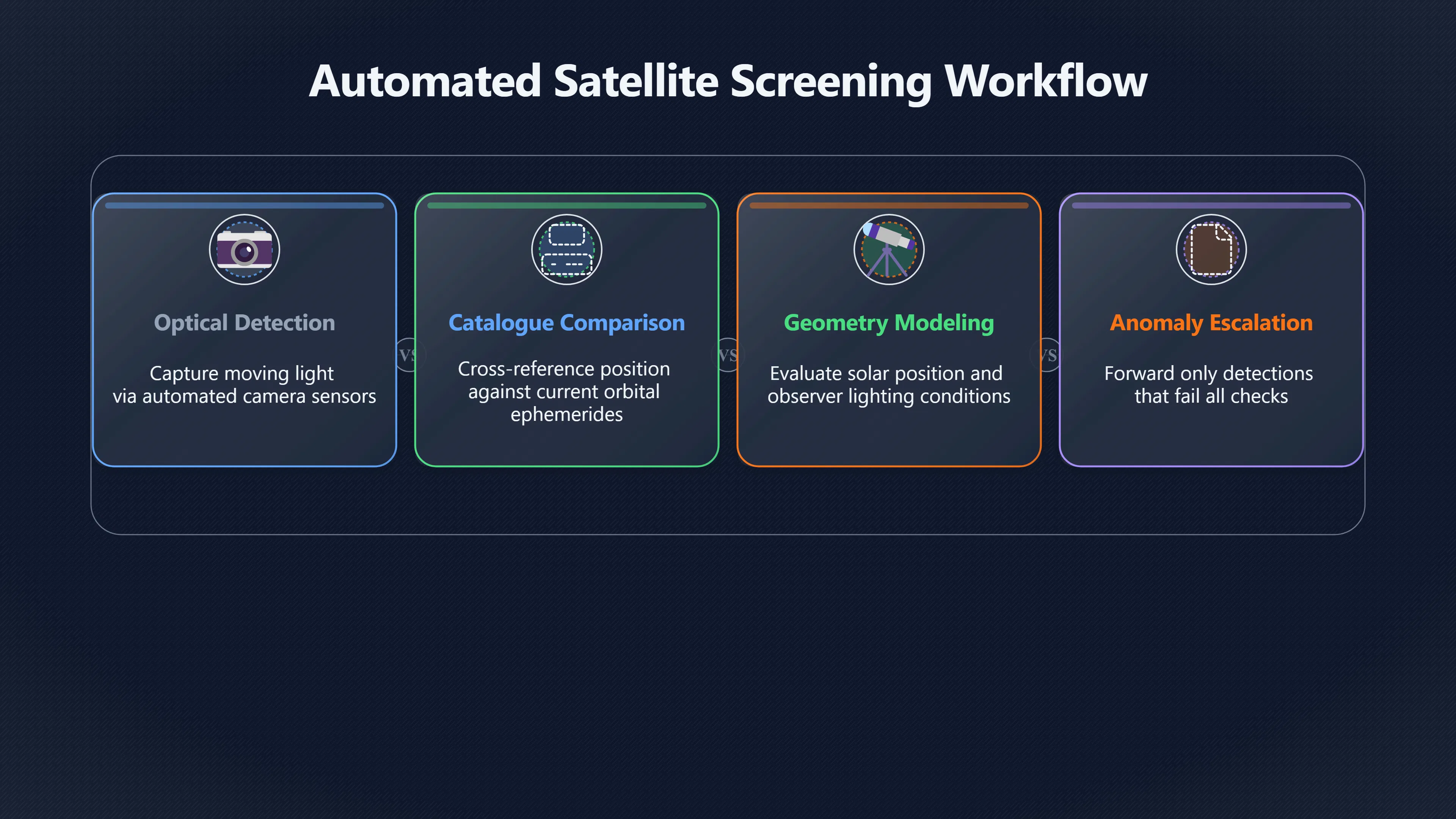
The minimum policy for an automated alert system is straightforward: every optical detection should be compared against a current catalogue of known orbital objects before analysts review it as a potential anomaly.
In practice, this means using Two-Line Element (TLE) data or equivalent orbital products to predict where satellites should appear in the sky at the exact time and location of the observation. Publicly available databases from CelesTrak and Space-Track provide continuously updated orbital information for tens of thousands of tracked objects.[CelesTrak+2Space-Track]celestrak.orgNORAD GP Element Sets Current DataBrightest Active Satellites. A set of graphs and tables that show everything from the age dist…
A useful automated workflow checks:
- Whether a known satellite was within the camera field of view.
- Whether the object’s predicted angular track matches the observed movement.
- Whether the satellite was illuminated by the Sun while the observer was in darkness or twilight.
- Whether the observed brightness falls within a plausible range for that object and geometry.
Only detections that fail these checks should advance to higher-priority investigation.
This approach mirrors established space-situational-awareness practice. Satellite operators, astronomers and tracking networks routinely use orbital predictions to identify and forecast visible passes. The same methodology is directly applicable to automated UFO monitoring.[CelesTrak]celestrak.orgVisually Observing Earth SatellitesOne of the most satisfying aspects of satellite predictions comes when you get to actually te…
What Ephemerides Can Rule Out
A good ephemeris comparison can eliminate several common categories of false positive.
Ordinary satellite passes. Low Earth orbit satellites often appear as steadily moving stars crossing the sky. Their tracks are predictable minutes, hours and days in advance. Matching an observed trajectory against known orbital predictions can rapidly identify such events.[Heavens-Above]heavens-above.comHeavens-AboveSatellite predictions and other astronomical data customised for your location… 10-day predictions for satel…
Satellite constellations. Large constellations create especially frequent confusion. Newly launched Starlink groups can appear as chains of lights moving together across the sky and are regularly reported as UFOs by observers unfamiliar with their appearance.[Space]space.comStarlink satellite train: how to see and track it in the night skyJune 1, 2026 — 5 May 2026 — In fact, Starlink satellite trains are…
Rocket stages and debris. Objects other than active satellites can reflect sunlight and generate unusual-looking motion or brightness changes. Ephemeris databases often include these catalogued objects as well.[CelesTrak]celestrak.orgNORAD GP Element Sets Current DataBrightest Active Satellites. A set of graphs and tables that show everything from the age dist…
Geostationary and high-altitude objects. Some objects appear nearly stationary relative to the stars while still producing brightness variations. Orbital prediction allows these objects to be distinguished from genuinely unknown stationary lights.[Janss]janss.krview articleDetermination of Geostationary Orbits (GEO) Satellite…by B Shin · 2019 · Cited by 4 — The accuracy of the determined orbit is eva…
The governance implication is simple: a detection system that does not perform these checks is effectively choosing to generate avoidable false alarms.
Why Flare Brightness Still Needs Geometry
Position matching alone is not enough. Brightness behaviour must also be checked.
Many UFO reports are triggered not by motion but by sudden changes in intensity. Satellites can brighten dramatically when reflective surfaces align with the Sun and observer. Historically, Iridium satellites produced famous flares visible across large regions of Earth. More recent observations have documented systematic flaring and bright reflections from Starlink satellites under specific geometric conditions.[Universe Today+2Spaceweather.com]universetoday.comhow to spot and track satellitesUniverse TodayHow to Spot and Track Satellites11 Jul 2013 — CALSky and Heavens-Above will also predict these events for your location. Di…
This matters because an observer may see:
- A light that suddenly appears.
- A rapid brightening followed by disappearance.
- A stationary-looking object that flashes briefly.
- Multiple objects brightening at similar sky positions.
Without illumination modelling, these behaviours can appear deliberate or anomalous.
A robust alert system therefore evaluates three geometric relationships simultaneously:
- Observer position.
- Satellite position.
- Solar position.
A satellite may be physically present in the correct location but invisible because it is in Earth’s shadow. Conversely, a satellite in sunlight can become conspicuous when reflective surfaces direct sunlight toward the observer. The event is explained not merely by orbital position but by orbital position combined with illumination geometry.[Universe Today+2Spaceweather.com]universetoday.comhow to spot and track satellitesUniverse TodayHow to Spot and Track Satellites11 Jul 2013 — CALSky and Heavens-Above will also predict these events for your location. Di…
For this reason, the correct question is not “Was a satellite nearby?” but “Was a satellite nearby and expected to be visible under the observed lighting conditions?”
Where Satellite Checks Can Fail
Although satellite screening is essential, it is not perfect.
The most common limitation is ephemeris quality. Public orbital data are predictions, not exact measurements. TLE-based tracking gradually loses accuracy as data age and orbital conditions change. Researchers and tracking organisations have repeatedly noted that prediction errors increase over time, especially for low Earth orbit objects affected by atmospheric drag and manoeuvres.[arXiv+3rhodesmill.org+3MDPI]rhodesmill.orgEarth Satellites — Skyfield documentationIn general, TLE data is accurate to about a kilometer or so at epoch…Read more…
Several specific failure modes matter for UFO detectors:
Stale orbital data. If a catalogue has not been updated recently, predicted positions can drift from reality. Some low-orbit satellites can accumulate meaningful errors within days.[rhodesmill.org+2satfleetlive.com]rhodesmill.orgEarth Satellites — Skyfield documentationIn general, TLE data is accurate to about a kilometer or so at epoch…Read more…
Satellite manoeuvres. Constellation satellites frequently adjust their orbits. Newly launched objects and manoeuvring spacecraft can temporarily deviate from publicly available predictions.[Universe Today]universetoday.comhow to spot and track satellitesUniverse TodayHow to Spot and Track Satellites11 Jul 2013 — CALSky and Heavens-Above will also predict these events for your location. Di…
Incomplete catalogues. Not every object in orbit is equally well tracked or publicly represented. Classification restrictions, recent launches and tracking uncertainties can leave temporary gaps.[Space-Track]space-track.orgHelp DocumentationWhat is 18 SDS's reporting criteria for conjunction data messages (CDMs) in the following orbital regimes: L…
Brightness uncertainty. Even when position predictions are accurate, brightness forecasts are much harder. Satellite orientation, surface properties and attitude changes can alter visibility in ways not captured by simple orbit propagation.[Spaceweather.com]spaceweatherarchive.com“Some of them showed very systematic flaring, …Read moreSatellite Flares (Part 1) - Spaceweather.com29 May 2019 — “I saw a pass of the Starlink Train about 15 degrees from zenith over Tuscaloos…
Because of these limitations, a failed satellite match should not automatically elevate an alert to anomalous status. Instead, it should trigger additional checks, such as obtaining fresher orbital data, consulting multiple catalogues or comparing observations from additional sensors.

A Governance Rule for Automated Detection Networks
The most effective policy is to treat satellite identification as a mandatory pre-escalation filter rather than an investigative afterthought.
An automated detector should store the results of every satellite comparison alongside the original observation: candidate object identifiers, angular separation from predicted tracks, illumination state, orbital-data age and confidence scores. Events that strongly match known orbital traffic should be closed automatically. Events that narrowly miss a match should be flagged for secondary review rather than immediately labelled unexplained.
This approach creates a documented audit trail and reduces analyst time spent on ordinary orbital traffic. More importantly, it prevents the system from mistaking the increasingly crowded and reflective near-Earth environment for evidence of genuinely unidentified phenomena. In a sky containing tens of thousands of tracked objects and growing satellite constellations, ephemeris validation is no longer a specialist enhancement. It is the baseline check that determines whether a UFO alert deserves further attention at all.[CelesTrak+2noirlab.edu]celestrak.orgNORAD GP Element Sets Current DataBrightest Active Satellites. A set of graphs and tables that show everything from the age dist…
Amazon book picks
Further Reading
Books and field guides related to The Satellite Check Every UFO Alert Needs. Use these as the next step if you want deeper reading beyond the article.
Satellite Orbits
Directly covers ephemerides, orbit propagation and satellite tracking used to eliminate false UFO alerts.
Fundamentals of Astrodynamics
Rating: 4.5/5 from 12 Google Books ratings
Explains orbital mechanics underlying satellite trajectory prediction and visibility analysis.
The Backyard Astronomer's Guide
Covers practical skywatching, satellite observations and techniques useful for identifying known objects before classifying anomalies.
Turn Left at Orion
Helps readers understand common celestial objects and observational misidentifications in the night sky.
eBay marketplace picks
Marketplace Samples
Live-tested eBay searches with available results related to this page.


Endnotes
1.
Source: celestrak.org
Link:https://celestrak.org/NORAD/elements/
Source snippet
NORAD GP Element Sets Current DataBrightest Active Satellites. A set of graphs and tables that show everything from the age dist...
2.
Source: heavens-above.com
Link:https://www.heavens-above.com/
Source snippet
Heavens-AboveSatellite predictions and other astronomical data customised for your location... 10-day predictions for satel...
3.
Source: celestrak.org
Link:https://celestrak.org/columns/v03n01/
Source snippet
Visually Observing Earth SatellitesOne of the most satisfying aspects of satellite predictions comes when you get to actually te...
4.
Source: space-track.org
Link:https://www.space-track.org/documentation
Source snippet
Help DocumentationWhat is 18 SDS's reporting criteria for conjunction data messages (CDMs) in the following orbital regimes: L...
5.
Source: celestrak.org
Link:https://www.celestrak.org/NORAD/documentation/gp-data-formats.php
Source snippet
A New Way to Obtain GP Data (aka TLEs)CelesTrak uses OLDEST with the Active satellites list to only show those satellite's whose GP data...
6.
Source: celestrak.org
Link:https://celestrak.org/SOCRATES/
Source snippet
Plus5 Apr 2023 — This service provides regular information on pending conjunctions on orbit over the coming week.Read more...
7.
Source: space.com
Link:https://www.space.com/starlink-satellite-train-how-to-see-and-track-it
Source snippet
Starlink satellite train: how to see and track it in the night skyJune 1, 2026 — 5 May 2026 — In fact, Starlink satellite trains are...
Published: June 1, 2026
8.
Source: janss.kr
Title: view article
Link:https://www.janss.kr/archive/view_article?pid=jass
Source snippet
Determination of Geostationary Orbits (GEO) Satellite...by B Shin · 2019 · Cited by 4 — The accuracy of the determined orbit is eva...
9.
Source: rhodesmill.org
Title: Earth Satellites — Skyfield documentation
Link:https://rhodesmill.org/skyfield/earth-satellites.html
Source snippet
In general, TLE data is accurate to about a kilometer or so at epoch...Read more...
10.
Source: mdpi.com
Link:https://www.mdpi.com/2226-4310/10/6/532
Source snippet
Research on Enhanced Orbit Prediction Techniques...by J Chen · 2023 · Cited by 24 — The position accuracy from TLE data is primarily inf...
11.
Source: satfleetlive.com
Link:https://satfleetlive.com/blogs/what-is-a-tle/
Source snippet
What is a TLE and How to Read ItFor most LEO satellites, a TLE that is more than 7–10 days old will start to show meaningful position err...
12.
Source: arxiv.org
Link:https://arxiv.org/abs/2605.19850
Source snippet
How long can you trust a Starlink TLE? An empirical comparison of SGP4 and high-fidelity propagation against operator-updated truth...
13.
Source: arxiv.org
Link:https://arxiv.org/abs/2212.08662
14.
Source: celestrak.org
Link:https://celestrak.org/publications/
Source snippet
Dr. T.S. Kelso: Publications10 Apr 2026 — Consideration of Collision "Consequence" in Satellite Conjunction Assessment and Risk Analysis...
15.
Source: arxiv.org
Link:https://arxiv.org/abs/2208.03226
16.
Source: noirlab.edu
Link:https://noirlab.edu/public/media/archives/techdocs/pdf/techdoc033.pdf
Source snippet
Working Group ReportsBy 2030, there may be more than 100,000. A massive cloud of satellites presents significant to existential impacts o...
17.
Source: arxiv.org
Link:https://arxiv.org/pdf/2506.13034
Source snippet
It offers...
18.
Source: celestrak.org
Link:https://celestrak.org/
19.
Source: youtube.com
Title: Celes Trak’s New Orbit Visualization Demo
Link:https://www.youtube.com/watch?v=3WQApciWVAU
Source snippet
Why "Racetrack" UFOs are mostly Starlink Flares...
20.
Source: universetoday.com
Title: how to spot and track satellites
Link:https://www.universetoday.com/articles/how-to-spot-and-track-satellites
Source snippet
Universe TodayHow to Spot and Track Satellites11 Jul 2013 — CALSky and Heavens-Above will also predict these events for your location. Di...
21.
Source: spaceweatherarchive.com
Link:https://spaceweatherarchive.com/2019/05/29/starlink-[satellite-flares
Source snippet
Satellite Flares (Part 1) - Spaceweather.com29 May 2019 — “I saw a pass of the Starlink Train about 15 degrees from zenith over Tuscaloos...
Published: May 2019
22.
Source: svs.gsfc.nasa.gov
Link:https://svs.gsfc.nasa.gov/search/?datasets=454
Source snippet
Spacecraft Orbit EphemerisCelesTrak Spacecraft Orbit. A 3D view of Earth surrounded by Global Navigation Satellite System (GNSS) satellit...
23.
Source: youtube.com
Title: Celes Trak Orbit Visualization
Link:https://www.youtube.com/watch?v=SmI5gx7ifS0
Source snippet
CelesTrak Orbit Visualization - Spacecast 26Dr. T.S. Kelso presents a brief overview of the new CelesTrak orbit visualization tool (Celes...
24.
Source: scss.tcd.ie
Link:https://www.scss.tcd.ie/Stephen.Farrell/ipn/background/computers-and-satellites/v03n01.html
Source snippet
tcd.ieCelesTrak: "Visually Observing Earth Satellites"8 Feb 2001 — One of the most satisfying aspects of satellite predictions comes when...
25.
Source: space.stackexchange.com
Title: what is the accuracy uncertainty of two line elements tles
Link:https://space.stackexchange.com/questions/6167/what-is-the-accuracy-uncertainty-of-two-line-elements-tles
Source snippet
is the accuracy / uncertainty of Two Line Elements...3 Dec 2014 — I use TLE sets supplied on this website to find the future position of...
26.
Source: space.stackexchange.com
Title: We know that models of satellite
Link:https://space.stackexchange.com/questions/7978/how-accurately-maximum-possible-accuracy-can-future-satellite-positions-be-pre
Source snippet
accurately (maximum possible accuracy) can future...Jan 29, 2015 — Agencies/organizations who own/operate satellites want to know their...
Additional References
27.
Source: ai-solutions.com
Link:https://ai-solutions.com/newsroom/machine-learned-atmospheric-force-model-trained-with-two-line-elements/
Source snippet
Orbital Decay Prediction: Machine Learning AdvancesDiscover how machine learning transforms orbital decay predictions with innovative atm...
28.
Source: facebook.com
Link:https://www.facebook.com/moonlitwonderspage/posts/this-week-a-train-of-60-satellites-is-crossingyour-sky-in-a-perfect-lineif-you-h/122173616552960741/
Source snippet
THIS WEEK, A TRAIN OF 60 SATELLITES IS CROSSING...If you have seen a string of bright evenly-spaced points of light moving slowly across...
29.
Source: themoonlight.io
Link:https://www.themoonlight.io/en/review/spacetrack-timeseries-time-series-dataset-towards-satellite-orbit-analysis
Source snippet
Time Series Dataset towards Satellite Orbit AnalysisThe paper presents SpaceTrack-TimeSeries, a novel, publicly accessible dataset design...
30.
Source: facebook.com
Link:https://www.facebook.com/groups/2365809903441367/posts/24963908966538139/
31.
Source: reddit.com
Link:https://www.reddit.com/r/Starlink/comments/ekr000/is_there_a_good_tracker_for_these/
32.
Source: issfd.org
Link:https://issfd.org/ISSFD_2009/CollisionRiskII/AIDA.pdf
Source snippet
Page 2. accuracy is therefore required to reveal the inherent modelling accuracy of the SGP4 analytical orbit model, as well...
33.
Source: indico.esa.int
Link:https://indico.esa.int/event/111/contributions/370/attachments/511/556/6th-ICATT-presentation.pdf
Source snippet
➢Accurate and fast orbit prediction information is a necessary requirement for the space applicatons, such as conjunction analysis...
34.
Source: researchgate.net
Link:https://www.researchgate.net/publication/271035873_Accuracy_of_Two-Line-Element_Data_for_Geostationary_and_High-Eccentricity_Orbits
Source snippet
Accuracy of Two-Line-Element Data for Geostationary and...TLEs have a limited accuracy, and come without information about the uncertain...
35.
Source: facebook.com
Link:https://www.facebook.com/groups/2365809903441367/posts/5282358921786436/
Source snippet
people below, their solar panels are aligned so that the sunlight skims...
36.
Source: amostech.com
Link:https://amostech.com/TechnicalPapers/2023/Poster/Constant.pdf
Source snippet
"Operator ephemeris data (found at [https://www.space-track..."](https://www.space-track...")...
Topic Tree