Within Provenance
What was the camera actually doing?
A strange dot means little unless the detector preserves exposure, focus, field of view, timing and calibration state.
On this page
- The settings needed for physical estimates
- Why calibration history changes the case
- How automatic tracking can mislead reviewers
Page outline Jump by section
Introduction
A UAP image or video is only as trustworthy as the state of the instrument that produced it. An unusual object recorded by an automated sky detector may appear compelling, but if the system cannot show its exposure, focus, field of view, gain, frame rate, timing, tracking mode and calibration status at the moment of capture, many physical conclusions become impossible or misleading. This is why sensor state sits at the heart of data provenance and chain of custody for automated instrumented UAP detectors: the image is the observation, while the sensor settings explain how that observation was created.
 NASA’s independent UAP study identified poor sensor calibration, missing sensor metadata and inadequate baseline measurements as major obstacles to scientific analysis. Rather than treating metadata as administrative detail, the report argues that calibration and complete sensor information are prerequisites for reliable interpretation.[NASA Science]science.nasa.govNASA ScienceIndependent Study Team ReportThe panel notes that, at present, gathering data on UAP is hampered by sensor calibration challe…
What physical estimates depend on camera settings?
The apparent size, speed, brightness and motion of an unknown object are not properties of the image alone. They emerge from a combination of the scene and the camera’s operating state.
For an automated UAP detector, several settings are essential.
- Exposure time. A long exposure can transform a point source into a streak or smear. Without knowing the shutter duration, investigators cannot distinguish between genuine object motion, camera motion and simple motion blur.
- Frame rate and frame timing. Velocity estimates require accurate intervals between frames. Variable frame rates, dropped frames or timestamp errors can produce false acceleration or incorrect trajectories.
- Field of view and focal length. A narrow field of view magnifies apparent motion, while a wide-angle lens compresses it. Without these parameters, angular measurements cannot be converted into meaningful physical estimates.
- Focus state. Defocused stars, planets or distant aircraft can produce large structured blobs or geometric shapes that appear unfamiliar. Autofocus hunting can alter apparent object size from one frame to the next.
- Gain or ISO settings. High electronic gain increases sensor noise and can exaggerate faint artefacts that disappear under different imaging conditions.
- Lens distortion model. Wide-angle optics introduce geometric distortion near image edges. Without calibration, measured object positions may contain systematic errors.
None of these values proves that a sighting has an ordinary explanation. Instead, they determine whether later measurements are scientifically defensible.
Why calibration history changes the case
Calibration is not a one-time event performed when a camera leaves the factory. Every instrument gradually changes through ageing, mechanical wear, temperature variation, contamination and software updates.
For automated UAP monitoring systems, calibration history answers questions such as:
- Was the lens recently replaced?
- Has the pointing model drifted since the previous calibration?
- Has the camera clock remained synchronised?
- Were dead pixels or hot pixels remapped?
- Was the detector operating within its specified temperature range?
- Did a firmware update alter image processing?
Without these records, investigators cannot determine whether unusual image features originated in the sky or within the instrument itself.
NASA’s UAP report stresses that calibration is what makes measurements reliable rather than merely recorded, and notes that some apparent anomalies have ultimately proved to be sensor artefacts once calibration information and metadata were examined carefully.[NASA Science]science.nasa.govNASA ScienceIndependent Study Team ReportThe panel notes that, at present, gathering data on UAP is hampered by sensor calibration challe…
For automated detector networks, calibration history should therefore travel with every event file rather than being stored separately. Future reviewers may need to reconstruct the instrument’s exact state years after an event occurred.
How automatic tracking can mislead reviewers
Modern automated sky systems increasingly rely on software to identify and follow moving targets. While this improves sensitivity, it also creates new opportunities for misunderstanding if tracking behaviour is not preserved.
A tracking algorithm may:
- centre the object by continuously moving the camera;
- digitally crop around the detected target;
- apply image stabilisation;
- switch between optical and digital zoom;
- change exposure dynamically while following the object;
- alter focus automatically during pursuit.
Viewed without accompanying metadata, the resulting video may suggest that the object itself changed direction, speed or brightness.
One common example involves automatic exposure. As a bright object moves against a dark sky, exposure algorithms may repeatedly adjust shutter speed and gain. The object can appear to pulse, brighten or fade even when its intrinsic brightness remains constant.
Similarly, autofocus systems may continually search for sharpness against featureless backgrounds. During these adjustments, distant lights can expand, contract or develop unusual shapes that disappear once focus stabilises.
Because these behaviours originate inside the instrument, every automatic adjustment should be recorded alongside the imagery. A future analyst should know not only where the camera was pointing but also why it changed its settings.
Sensor settings that should always be preserved
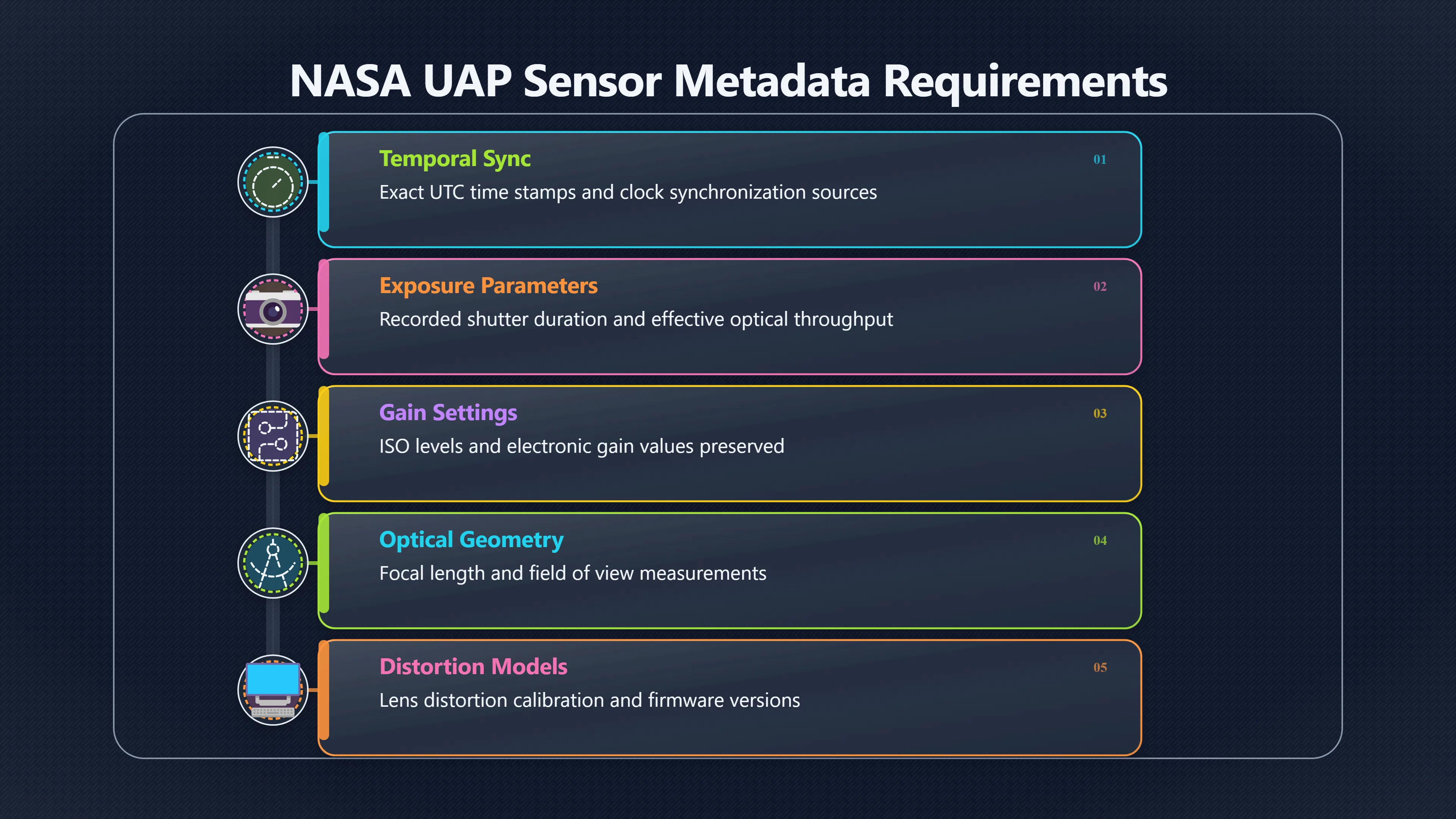
For automated instrumented UAP detection, the minimum useful sensor-state record extends beyond standard photographic metadata.
A scientifically useful event should preserve:
- exact UTC timestamp and clock synchronisation source;
- exposure duration;
- aperture or effective optical throughput where applicable;
- ISO or electronic gain;
- frame rate and any dropped-frame indicators;
- focal length or zoom position;
- focus distance or autofocus status;
- field of view;
- camera orientation and pointing solution;
- lens distortion calibration version;
- detector temperature if relevant;
- firmware and software version;
- tracking mode;
- image processing steps performed before storage.
These values allow independent analysts to reproduce measurement assumptions rather than infer them from the final image.
The 2025 AARO workshop paper similarly recommends structured metadata describing sensor characteristics, time, location, provenance and technical context so that observations remain interpretable across organisations and over time.[AARO]aaro.mil2025 UAP Workshop Paper2025 UAP Workshop: Narrative Data, Infrastructures, and…This report concludes with recommended actionable next steps to establish…
Why raw imagery is often more valuable than processed video
Many publicly circulated UAP videos have already undergone compression, cropping, stabilisation or enhancement before investigators ever see them.
Each processing step can remove information needed to reconstruct the original observation.
For example:
- digital stabilisation changes pixel motion;
- compression removes subtle intensity information;
- sharpening creates artificial edges;
- denoising may eliminate faint objects or introduce synthetic textures;
- interpolation inserts frames that never existed.
When the original sensor settings are unavailable, these processing choices become difficult or impossible to reverse.
For automated detector networks, preserving raw sensor output alongside processed visualisations provides a permanent reference that later analytical methods can revisit. As imaging software improves, archived raw data often gains scientific value rather than becoming obsolete.
Rolling shutter and other sensor artefacts
Many modern CMOS cameras expose different rows of pixels at slightly different times rather than exposing the entire frame simultaneously. This “rolling shutter” behaviour can distort rapidly moving objects or images captured while the camera itself is moving.
The result may include:
- tilted objects;
- curved trajectories;
- stretched shapes;
- apparent wobble;
- inconsistent geometry between consecutive frames.
Photogrammetry and computer vision research has shown that rolling shutter effects can introduce measurable geometric errors unless they are modelled explicitly during analysis. These distortions become especially important when estimating position, speed or direction from a single camera.[ADS]ui.adsabs.harvard.eduADS Photogrammetric Accuracy and Modeling of Rolling Shutter…by J Vautherin · 2016 · Cited by 137 — Competitive accuracies can be obta…
This does not make rolling-shutter cameras unsuitable for automated UAP monitoring. It means their operating mode and calibration parameters must be preserved so later analysis can compensate for known sensor behaviour.
The practical lesson for automated UAP detectors
A convincing automated UAP event is not simply one with a clear image. It is one whose complete sensor state allows independent investigators to reconstruct what the camera was actually doing at every stage of the observation.
When exposure, focus, field of view, timing, calibration history and tracking behaviour accompany the imagery, reviewers can calculate angular motion, assess uncertainty, identify possible artefacts and compare measurements across multiple sensors. When those settings are missing, even remarkably clear footage may have limited scientific value because the observation cannot be reproduced or properly tested.
For automated instrumented detector networks, preserving sensor state is therefore not an optional engineering convenience. It is part of the evidence itself.
Amazon book picks
Further Reading
Books and field guides related to What was the camera actually doing?. Use these as the next step if you want deeper reading beyond the article.

Digital image processing
Provides background on imaging, noise and measurement limits.

Handbook of machine vision
Explains camera settings, optics, calibration and image measurement.


Digital Image Processing, Global Edition
First published 2018. Subjects: Image processing, digital techniques.
eBay marketplace picks
Marketplace Samples
Example marketplace items related to this page. Use the search link to explore similar finds on eBay.
Endnotes
1.
Source: science.nasa.gov
Link:https://science.nasa.gov/wp-content/uploads/2023/09/uap-independent-study-team-final-report.pdf
Source snippet
NASA ScienceIndependent Study Team ReportThe panel notes that, at present, gathering data on UAP is hampered by sensor calibration challe...
2.
Source: nasa.gov
Title: update nasa shares uap independent study report names director
Link:https://www.nasa.gov/news-release/update-nasa-shares-uap-independent-study-report-names-director/
Source snippet
UPDATE: NASA Shares UAP Independent Study Report14 Sept 2023 — We found that NASA can help the whole-of-government UAP effort through sys...
3.
Source: aaro.mil
Title: 2025 UAP Workshop Paper
Link:https://www.aaro.mil/Portals/136/PDFs/Information%20Papers/2025_UAP_Workshop_Paper.pdf
Source snippet
2025 UAP Workshop: Narrative Data, Infrastructures, and...This report concludes with recommended actionable next steps to establish...
4.
Source: science.nasa.gov
Link:https://science.nasa.gov/uap/
Source snippet
nasa.govUAP9 Jun 2022 — The study will focus on identifying available data, how best to collect future data, and how NASA can use that da...
5.
Source: aaro.mil
Title: UAP Records
Link:https://www.aaro.mil/UAP-Records/
Source snippet
/Information Papers13 Feb 2026 — In August 2025, AARO sponsored a workshop on UAP Narrative Data, Infrastructures, and Analysis in partne...
Published: August 2025
6.
Source: aaro.mil
Link:https://www.aaro.mil/Portals/136/PDFs/AARO_Mission_Brief_2025.pdf
Source snippet
to anomalies. ▫ Advancing scientific understanding of UAP.Read more...
7.
Source: ui.adsabs.harvard.edu
Link:https://ui.adsabs.harvard.edu/abs/2016ISPAnIII3..139V/abstract
Source snippet
ADS Photogrammetric Accuracy and Modeling of Rolling Shutter...by J Vautherin · 2016 · Cited by 137 — Competitive accuracies can be obta...
Additional References
8.
Source: uapedia.ai
Link:https://uapedia.ai/wiki/ganzfeld-and-the-uap-data-problem/
Source snippet
Ganzfeld and the UAP Data ProblemIt argues that current UAP analysis is hampered by poor sensor calibration, lack of multiple measurement...
9.
Source: thedebrief.org
Link:https://thedebrief.org/all-domain-anomaly-resolution-office-hosts-private-workshop-with-civilian-researchers-universities-and-government-agencies/
Source snippet
All-domain Anomaly Resolution Office Hosts Private...26 Feb 2026 — The white paper notes AARO seeks a “multi-disciplinary and community...
10.
Source: rev.com
Title: unidentified anomalous phenomena independent study report from nasa transcript
Link:https://www.rev.com/transcripts/unidentified-anomalous-phenomena-independent-study-report-from-nasa-transcript
Source snippet
UAP Independent Study Report from NASA18 Sept 2023 —... calibrating instruments, multiple measurements and ensuring SIR metadata. Most U...
11.
Source: managingexpectations.net
Link:https://managingexpectations.net/blog/articles/nasa-uap-study-managing-expectations.html
Source snippet
One of the most useful parts of the NASA report is its unglamorous focus on measurement quality. The panel...Read more...
12.
Source: thenationalnews.com
Title: nasas ufo report advises us government on how to detect mysterious objects
Link:https://www.thenationalnews.com/world/us-news/2023/09/14/nasas-ufo-report-advises-us-government-on-how-to-detect-mysterious-objects/
Source snippet
Nasa's UFO report reveals how public can help hunt for...14 Sept 2023 — Released online on Thursday, the 36-page document says that exis...
13.
Source: avi-loeb.medium.com
Title: a new calculation on the fly to the nasa uap study 2dacaf860cac
Link:https://avi-loeb.medium.com/a-new-calculation-on-the-fly-to-the-nasa-uap-study-2dacaf860cac
Source snippet
New Calculation on the Fly to the NASA UAP Study - Avi LoebRubin Observatory in Chile will survey the entire southern sky every four days...
14.
Source: ralphbuncheinstitute.org
Title: nasa unidentified anomalous phenomena independent study team report
Link:https://ralphbuncheinstitute.org/nasa-unidentified-anomalous-phenomena-independent-study-team-report/
Source snippet
Figuring out the truth behind Unidentified Anomalous Phenomena (UAPs) takes more than speculation, it requires hard science.Read more...
15.
Source: media.defense.gov
Title: FY24 CONSOLIDATED ANNUAL REPORT ON UAP 508
Link:https://media.defense.gov/2024/Nov/14/2003583603/-1/-1/0/FY24-CONSOLIDATED-ANNUAL-REPORT-ON-UAP-508.PDF
Source snippet
Year 2024 Consolidated Annual Report on...14 Nov 2024 — AARO updates its public-facing website, www.aaro.mil, with declassified UAP data...
16.
Source: aui.edu
Title: aaro releases report on unidentified anomalous phenomena uap
Link:https://aui.edu/aaro-releases-report-on-unidentified-anomalous-phenomena-uap/
Source snippet
AARO Releases Report on Unidentified Anomalous...The U.S. Department of Defense recently released 2025 UAP Workshop: Narrative Data, Inf...
17.
Source: nevadacurrent.com
Title: nasa report finds no evidence that ufos are extraterrestrial
Link:https://nevadacurrent.com/2023/09/18/nasa-report-finds-no-evidence-that-ufos-are-extraterrestrial/
Source snippet
18 Sept 2023 — Analysis of this data is “hampered by poor sensor calibration, the lack of multiple measurements, the lack of sensor metad...
Topic Tree