Within Edge Computer
Why sky stations cannot upload everything
High-volume stations need local triage because continuous multimodal recording can create more data than reviewers can use.
On this page
- Where the daily data volume comes from
- What full fidelity storage should protect
- How summaries keep networks searchable
Page outline Jump by section
Introduction
A modern automated UAP sky station can generate far more information than is practical to upload, store indefinitely or inspect manually. The challenge is not simply bandwidth: it is deciding, in real time, which data deserve full scientific preservation and which can safely be reduced to summaries. The Observatory Class Integrated Computing Platform (OCICP) developed by the Galileo Project illustrates the scale of the problem, reporting approximately 350 GB of multimodal data per observatory per day, with most of the volume produced by infrared and all-sky optical cameras. At that rate, even a modest network of stations would rapidly create many terabytes every week, making indiscriminate cloud upload both expensive and analytically inefficient.[arXiv]arxiv.orgarXiv Galileo Project Observatory Class System ArchitectureGalileo Project Observatory Class System ArchitectureMay 30, 2025…
 For automated instrumented UFO detectors, edge data triage is therefore part of the scientific instrument rather than merely an engineering convenience. Local computing decides which observations retain full-resolution sensor records, which become searchable summaries, and which can be discarded as routine environmental activity without compromising future scientific review.
Why sky stations cannot upload everything
The intuitive solution—record everything continuously and analyse it later—breaks down once several calibrated sensors operate simultaneously. Continuous visible-light imaging, infrared arrays, environmental sensors, aircraft transponder receivers and system telemetry all produce independent streams that must remain time-synchronised if later analysis is to reconstruct an event accurately. Uploading every frame would require substantial network capacity while filling archives with overwhelmingly ordinary observations.
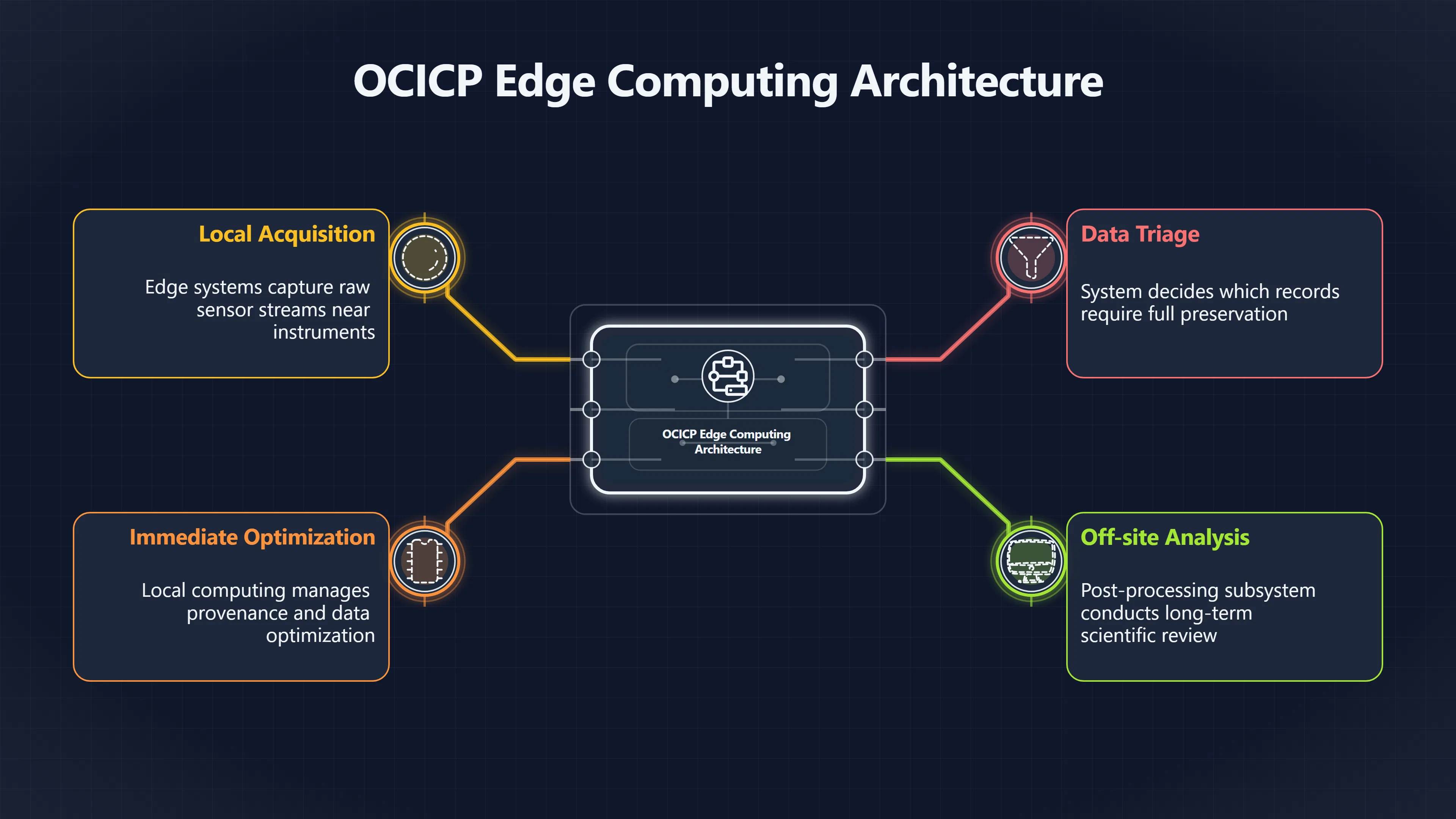
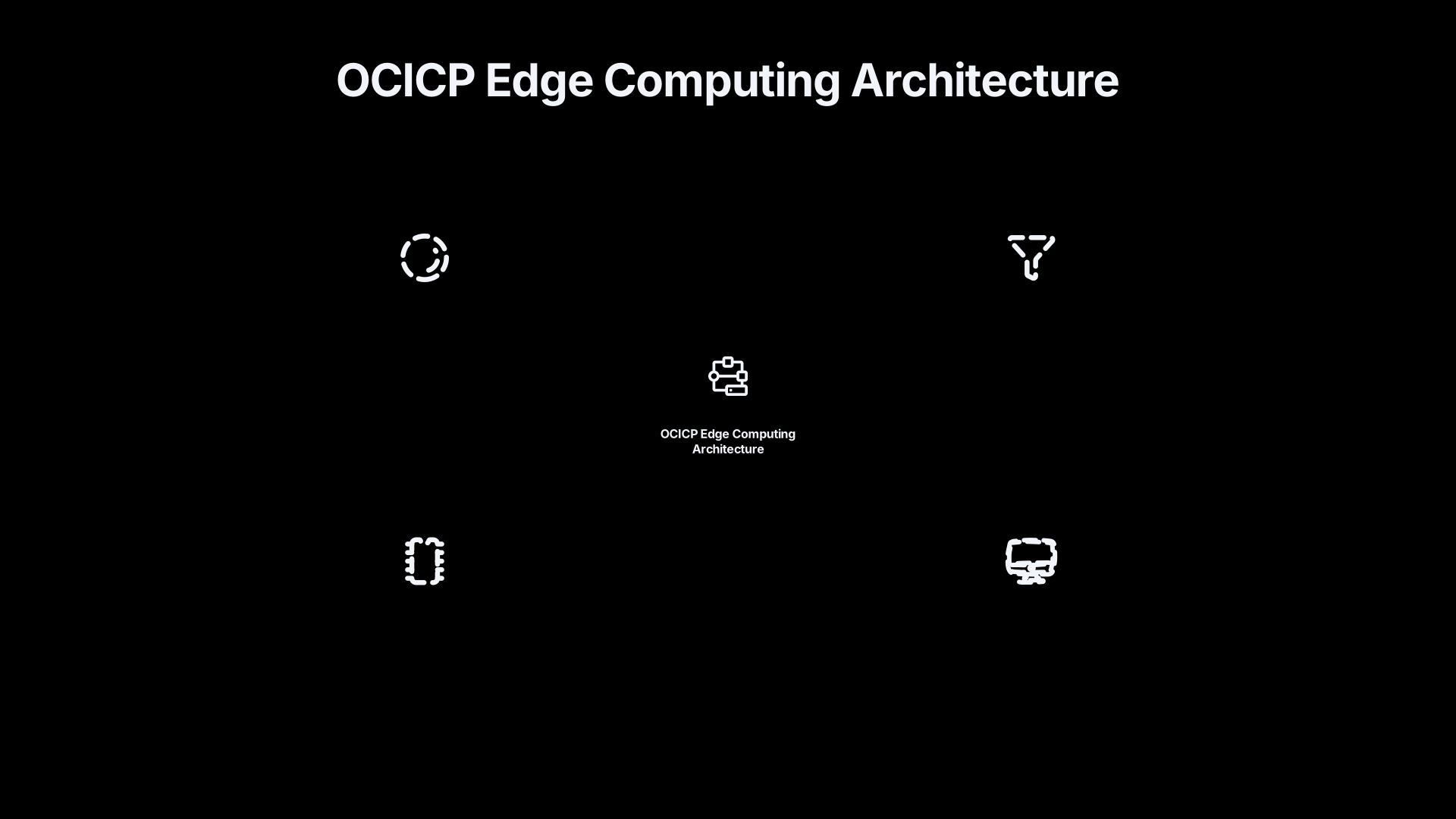
The OCICP architecture explicitly separates this workload into an Edge Computing Subsystem, located beside the instruments, and an off-site Post-Processing Subsystem. The edge system performs immediate acquisition, optimisation and provenance management, while longer-term scientific analysis occurs after the most valuable observations have already been selected. This division reduces unnecessary network traffic without sacrificing scientifically useful measurements.[arXiv]arxiv.orgarXiv Galileo Project Observatory Class System ArchitectureGalileo Project Observatory Class System ArchitectureMay 30, 2025…
The important point is that edge triage is not synonymous with aggressive deletion. Its objective is to preserve scientific value while reducing redundant information.
Where the daily data volume comes from
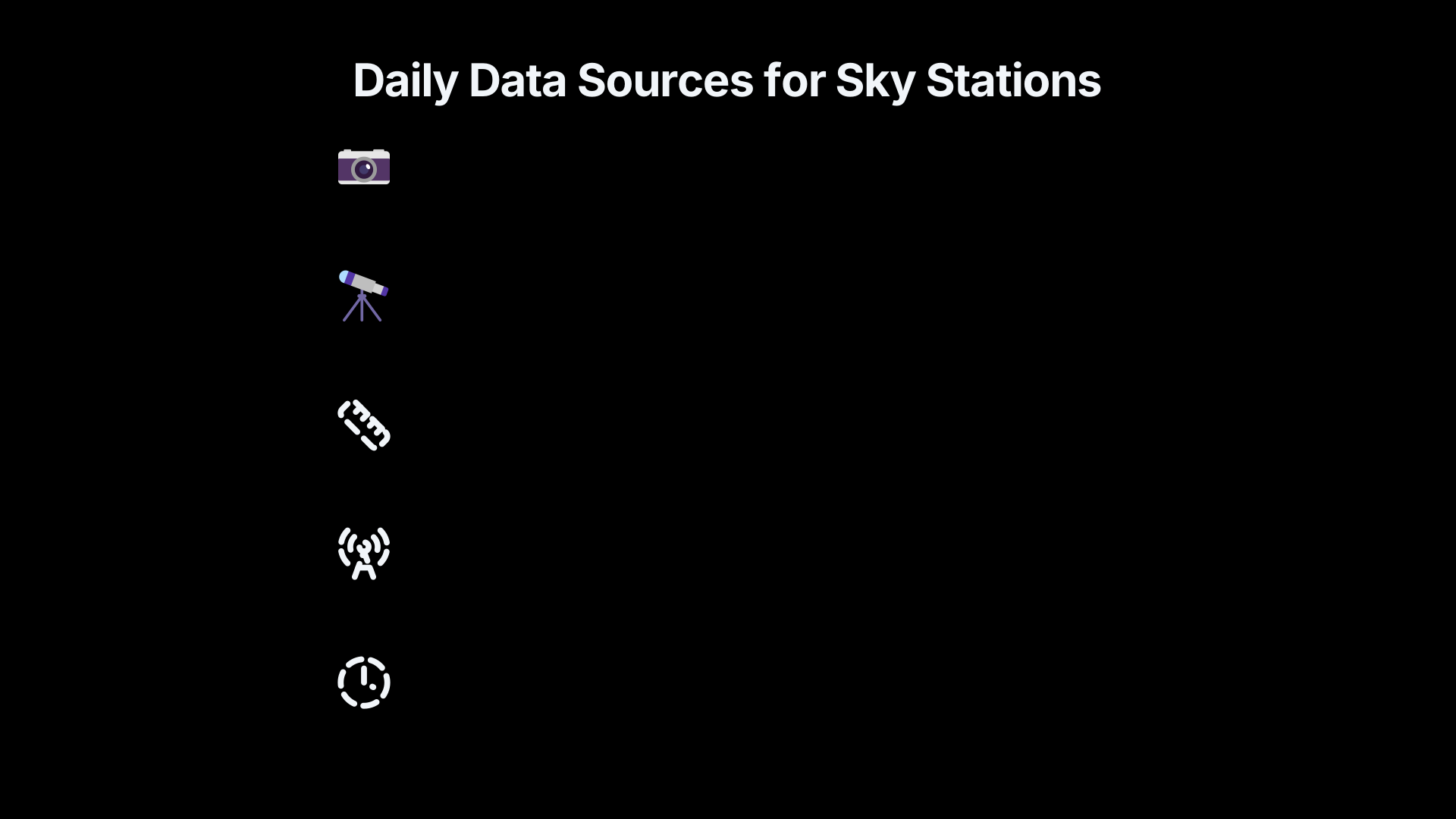
The reported daily total of roughly 350 GB is dominated by continuous imaging rather than rare anomalous events. Wide-field cameras monitor the sky without interruption because unexpected phenomena cannot be scheduled. Infrared systems often contribute even larger data volumes owing to multiple detectors, high frame rates and continuous acquisition.
Additional storage requirements come from:
- Continuous all-sky visible imagery.
- Infrared camera arrays operating throughout observation periods.
- Calibration frames required to characterise sensor behaviour.
- Environmental measurements such as weather and illumination.
- Aircraft identification feeds and other contextual reference data.
- Time-synchronisation records and system health logs.
Most of these data streams describe normal operating conditions rather than unusual observations. Ironically, those “boring” measurements remain essential because they provide the baseline needed to distinguish genuine anomalies from instrument artefacts or environmental effects.
NASA’s Independent Study Team repeatedly highlighted that poor calibration, missing metadata and insufficient baseline observations make many historical UAP reports difficult or impossible to interpret scientifically. Better instruments alone are insufficient if the surrounding contextual information is lost.[NASA Science]science.nasa.govNASA ScienceIndependent Study Team ReportIn short, calibration ensures that future data gathered are reliable and accurate, while gatheri…
What full-fidelity storage should protect
A common misconception is that edge processing should immediately compress or overwrite anything appearing uninteresting. For scientific observatories, that approach risks destroying exactly the information later investigators need.
Instead, high-fidelity preservation is generally reserved for observations that satisfy predefined criteria such as:
- Multiple sensors detecting the same event simultaneously.
- Motion inconsistent with known aircraft or satellites after local checks.
- Unusual thermal behaviour accompanying optical observations.
- Rapid brightness changes or transient luminous events.
- Events exceeding confidence thresholds established during calibration.
When those conditions occur, the observatory should preserve substantially more than the detected object itself. Valuable records include:
- Raw sensor frames before any image enhancement.
- Pre-event and post-event buffers providing context.
- Accurate timestamps.
- Camera settings and calibration state.
- Environmental measurements.
- Processing logs documenting every automated decision.
This emphasis reflects a broader scientific principle. Future investigators must be able to reconstruct not only what the system observed but also how the observation was acquired and processed. NASA identifies comprehensive metadata and calibration records as prerequisites for trustworthy analysis because apparently anomalous observations have previously proved to be sensor artefacts once sufficient contextual information became available.[NASA Science+2Wikisource]science.nasa.govNASA ScienceIndependent Study Team ReportIn short, calibration ensures that future data gathered are reliable and accurate, while gatheri…
How summaries keep networks searchable
Most observations do not require permanent storage as raw imagery. Instead, edge systems can produce compact analytical summaries that preserve discovery value while dramatically reducing storage requirements.
Rather than transmitting every frame, a station may generate structured records containing:
- Detection time and duration.
- Sky coordinates.
- Estimated trajectory.
- Brightness and infrared characteristics.
- Cross-checks against known aircraft databases.
- Sensor confidence scores.
- Hashes or references linking back to archived raw data if preserved.
These summaries become searchable catalogues that allow researchers to identify candidate events without repeatedly examining hundreds of gigabytes of video. If an event later proves scientifically interesting, the associated raw recording can be retrieved using the preserved references.
This layered approach mirrors broader edge-computing practice across sensor-intensive systems: computationally inexpensive decisions occur near the instruments, while computationally expensive interpretation is reserved for fewer, higher-value observations.[arXiv]arxiv.orgarXiv Galileo Project Observatory Class System ArchitectureGalileo Project Observatory Class System ArchitectureMay 30, 2025…
The principal risk: throwing away tomorrow’s evidence
Edge triage inevitably involves judgement, and every filtering decision carries scientific risk.
A threshold set too low overwhelms reviewers with ordinary birds, aircraft, insects and weather. A threshold set too high may permanently discard genuinely unusual observations before anyone knows they were significant.
This creates several design challenges:
- Bias towards expected events. Machine-learning filters trained mostly on common aerial objects may incorrectly reject unfamiliar but legitimate observations.
- Software evolution. As detection algorithms improve, investigators may wish they had retained raw data previously classified as routine.
- False confidence. A concise event summary cannot replace the evidential value of synchronised raw measurements.
- Resource constraints. Storage, bandwidth and electrical power all limit how conservatively a remote observatory can archive data.
Consequently, many observatory designs favour tiered retention rather than simple keep-or-delete decisions. High-confidence ordinary observations may be summarised, uncertain cases may receive medium-term storage, and only the strongest candidates receive permanent archival preservation.

Data triage is a scientific decision, not merely a storage decision
The significance of a 350 GB observation day is not that modern storage devices cannot accommodate it. Individual stations certainly can. The challenge emerges when calibrated observatories operate continuously for months or years and are multiplied across regional or global networks.
In that setting, indiscriminate collection becomes counterproductive because reviewers spend increasing effort searching through routine activity instead of evaluating the small fraction of observations that genuinely merit scientific attention.
Edge data triage therefore performs three complementary functions. It preserves the highest-value raw observations intact, converts routine activity into searchable metadata, and reduces unnecessary transmission without sacrificing the calibration, provenance and contextual information required for credible scientific investigation. That balance is essential if automated instrumented UFO detectors are to produce evidence that is both operationally manageable and scientifically defensible.[arXiv+2NASA Science]arxiv.orgarXiv Galileo Project Observatory Class System ArchitectureGalileo Project Observatory Class System ArchitectureMay 30, 2025…
Amazon book picks
Further Reading
Books and field guides related to Why sky stations cannot upload everything. Use these as the next step if you want deeper reading beyond the article.
Designing Data-Intensive Applications
Directly addresses efficient storage, streaming and data reduction.

Fundamentals of Data Engineering
Relevant to organizing, retaining and processing large sensor datasets.


eBay marketplace picks
Marketplace Samples
Live-tested eBay searches with available results related to this page.

Endnotes
1.
Source: arxiv.org
Title: arXiv Galileo Project Observatory Class System Architecture
Link:https://arxiv.org/abs/2506.00125
Source snippet
Galileo Project Observatory Class System ArchitectureMay 30, 2025...
Published: May 30, 2025
2.
Source: arxiv.org
Link:https://arxiv.org/html/2506.00125v1
Source snippet
1 Introduction30 May 2025 — In this paper, we present the backbone of the system described above, our Observatory Class Integrated Comput...
Published: May 2025
3.
Source: science.nasa.gov
Link:https://science.nasa.gov/wp-content/uploads/2023/09/uap-independent-study-team-final-report.pdf
Source snippet
NASA ScienceIndependent Study Team ReportIn short, calibration ensures that future data gathered are reliable and accurate, while gatheri...
4.
Source: nasa.gov
Title: update nasa shares uap independent study report names director
Link:https://www.nasa.gov/news-release/update-nasa-shares-uap-independent-study-report-names-director/
Source snippet
UPDATE: NASA Shares UAP Independent Study Report14 Sept 2023 — We found that NASA can help the whole-of-government UAP effort through sys...
5.
Source: en.wikisource.org
Title: Page:UAP Independent Study Team
Link:https://en.wikisource.org/wiki/Page%3AUAP_Independent_Study_Team_-_Final_Report.pdf/15
Source snippet
wikisource.orgPage:UAP Independent Study Team - Final Report.pdf/1512 Nov 2023 — Indeed, several apparent UAP have been demonstrated to b...
6.
Source: en.wikisource.org
Title: Page:UAP Independent Study Team Final Report
Link:https://en.wikisource.org/wiki/Page%3AUAP_Independent_Study_Team_-_Final_Report.pdf/5
Source snippet
wikisource.orgPage:UAP Independent Study Team - Final Report.pdf/512 Nov 2023 — At present, analysis of UAP data is hampered by poor sens...
7.
Source: en.wikisource.org
Link:https://en.wikisource.org/wiki/NASA_Unidentified_Anomalous_Phenomena%3A_Independent_Study_Team_Report/Responses_to_Statement_of_Task
Source snippet
Unidentified Anomalous Phenomena: Independent...14 Oct 2023 — The panel notes that, at present, gathering data on UAP is hampered by sen...
8.
Source: science.nasa.gov
Link:https://science.nasa.gov/uap/
Source snippet
nasa.govUAP9 Jun 2022 — The UAP Independent Study shall report on the following questions: What types of scientific data currently collec...
9.
Source: utwente.nl
Link:https://www.utwente.nl/en/edge/about/
Source snippet
EDGE | EDGE Research Centre8 Apr 2025 — EDGE has several labs in which we explore interdisciplinary projects that address broader challen...
Additional References
10.
Source: ngiot.eu
Link:https://ngiot.eu/iot-and-edge-computing-instruments-priorities-and-partnerships/
Source snippet
IoT and Edge Computing: Instruments, Priorities and...Edge computing lies between physical things in the real world as monitored and con...
11.
Source: reddit.com
Link:https://www.reddit.com/r/nasa/comments/16ij1ym/nasa_has_released_the_unidentified_anomalous/
Source snippet
NASA has released the Unidentified Anomalous...DOD and NASA now both say there are objects in the air that they can't identify. This UAP...
12.
Source: evidence-standards.vercel.app
Link:https://evidence-standards.vercel.app/
Source snippet
UAP Caucus: Evidence StandardsSensor metadata and camera calibration info... Cross-referencing with sensor data, video evidence, and phy...
13.
Source: youtube.com
Link:https://www.youtube.com/watch?v=TQcqOW39ksk
Source snippet
Unidentified Anomalous Phenomena Independent Study ReportNASA commissioned an independent study team to examine unidentified anomalous ph...
14.
Source: artemis-ia.eu
Title: iot and edge computing instruments priorities and partnerships
Link:https://artemis-ia.eu/news/iot-and-edge-computing-instruments-priorities-and-partnerships.html
Source snippet
IoT and Edge Computing: Instruments, Priorities...3 Mar 2021 — Edge computing lies between physical things in the real world as monitore...
15.
Source: nevadacurrent.com
Title: nasa report finds no evidence that ufos are extraterrestrial
Link:https://nevadacurrent.com/2023/09/18/nasa-report-finds-no-evidence-that-ufos-are-extraterrestrial/
Source snippet
18 Sept 2023 — Analysis of this data is “hampered by poor sensor calibration, the lack of multiple measurements, the lack of sensor metad...
16.
Source: thedebrief.org
Title: nasas unidentified anomalous phenomena report key takeaways
Link:https://thedebrief.org/nasas-unidentified-anomalous-phenomena-report-key-takeaways/
Source snippet
NASA's Unidentified Anomalous Phenomena Report14 Sept 2023 — “At present, analysis of UAP data is hampered by poor sensor calibration, th...
17.
Source: research.vu.nl
Title: Together they form a unique fingerprint. Exploratory Study
Link:https://research.vu.nl/en/publications/the-dark-side-of-cloud-and-edge-computing-an-exploratory-study/
Source snippet
Dark Side of Cloud and Edge Computingby K Tocze · 2022 · Cited by 18 — Dive into the research topics of 'The Dark Side of Cloud and Edge...
18.
Source: nextgov.com
Title: nasa report finds no evidence ufos are extraterrestrial
Link:https://www.nextgov.com/ideas/2023/09/nasa-report-finds-no-evidence-ufos-are-extraterrestrial/390350/
Source snippet
NASA report finds no evidence that UFOs are extraterrestrial15 Sept 2023 — Analysis of this data is “hampered by poor sensor calibration...
19.
Source: spaceanddefense.io
Title: nasa new director of unidentified anomalous phenomena
Link:https://spaceanddefense.io/nasa-new-director-of-unidentified-anomalous-phenomena/
Source snippet
15 Sept 2023 — We found that NASA can help the whole-of-government UAP effort through systematic data calibration, multiple measurements...
Topic Tree