Within Infrared
What Galileo's Infrared Sky Census Found
The Galileo Project's Dalek results show a sky full of ordinary tracks before any claim of anomaly becomes meaningful.
On this page
- Half a million reconstructed tracks
- Why most outliers were mundane
- What remained ambiguous after review
Page outline Jump by section
Introduction
The Galileo Project’s first published infrared sky census is notable less for discovering anomalies than for establishing a quantitative baseline of what an automated UAP observatory actually sees. Using its eight-camera long-wave infrared “Dalek” array during a five-month commissioning period in 2024, the project reconstructed roughly half a million aerial trajectories. The overwhelming majority were ultimately consistent with ordinary airborne objects or environmental phenomena. That result is scientifically important because any future claim of an unusual object depends first on demonstrating that familiar objects can be detected, tracked and filtered reliably. Rather than producing evidence of extraordinary craft, the commissioning dataset primarily demonstrates the scale of routine sky traffic and the difficulty of separating genuine unknowns from incomplete observations.[arXiv]arxiv.orgCommissioning An All-Sky Infrared Camera Array for Detection Of Airborne ObjectsNovember 12, 2024…
Half a million reconstructed tracks
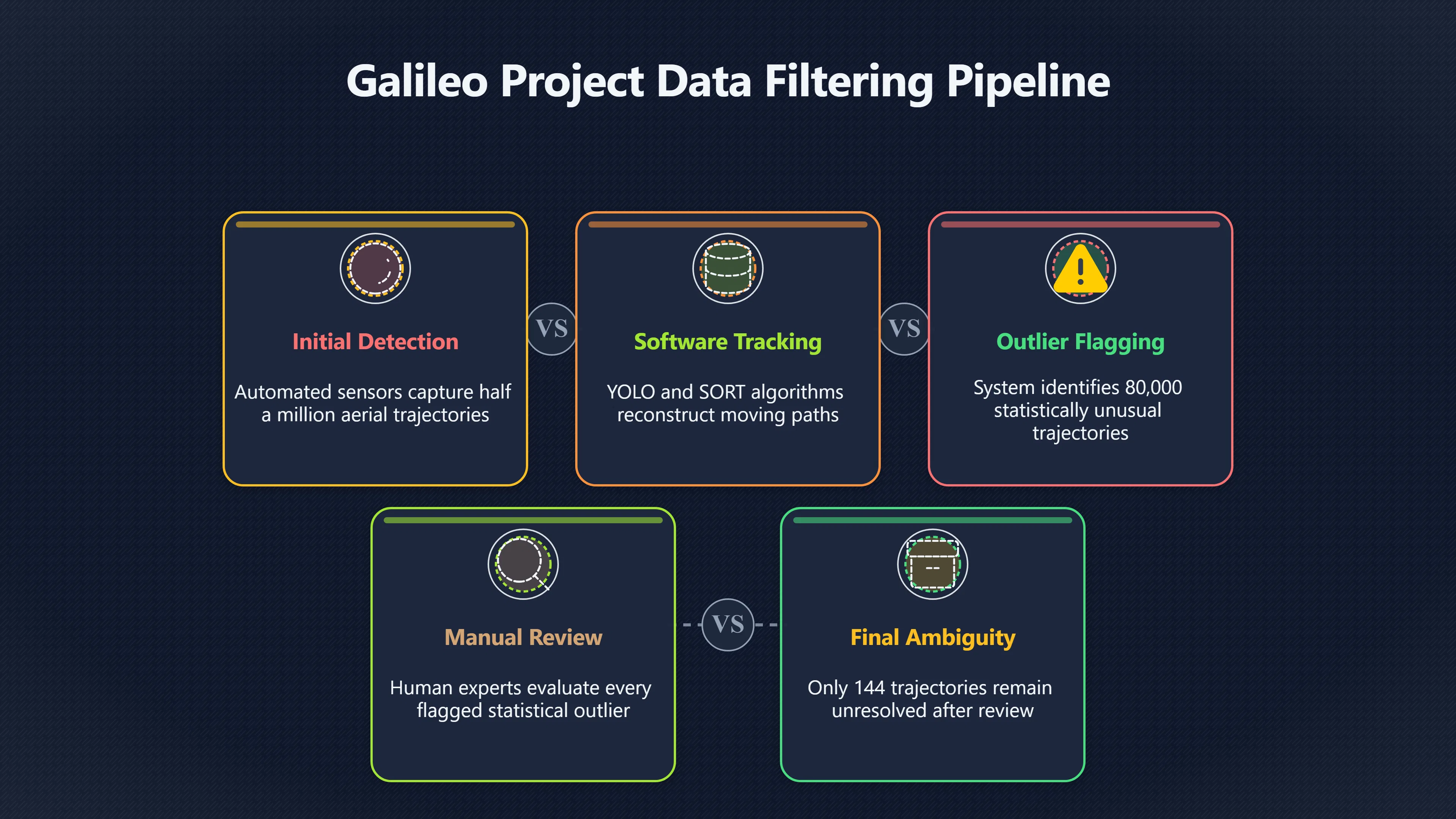
The commissioning campaign monitored the sky continuously between January and May 2024 using the Dalek infrared array as the principal detection instrument within a wider multi-sensor observatory. Computer vision software first detected moving objects and reconstructed their trajectories before additional filtering and human review were applied. The published pipeline combined the YOLO (You Only Look Once) object detector with the SORT (Simple Online and Realtime Tracking) tracker, creating a reproducible workflow rather than relying on eyewitness reports or manually selected videos.[arXiv]arxiv.orgCommissioning An All-Sky Infrared Camera Array for Detection Of Airborne ObjectsNovember 12, 2024…
The headline numbers illustrate how rapidly an automated observatory accumulates data:
- Approximately 500,000 reconstructed object trajectories during five months.
- Around 16% of trajectories—roughly 80,000—were automatically flagged as statistical outliers for closer inspection.
- Every flagged case was then reviewed manually rather than being accepted as anomalous simply because software identified it as unusual.
- Only 144 trajectories remained unresolved after this review process.[arXiv+2Medium]arxiv.orgCommissioning An All-Sky Infrared Camera Array for Detection Of Airborne ObjectsNovember 12, 2024…
These figures are significant because they show that “outlier” does not mean “unidentified”. Statistical outlier detection is intentionally conservative: it is designed to capture anything that differs from the bulk of observations, even when those differences ultimately have ordinary explanations.
Why most outliers were mundane
The commissioning paper emphasises that unusual-looking tracks usually arose from limitations of observation rather than evidence of extraordinary flight behaviour. The infrared cameras could measure angular motion across the sky, but a single Dalek installation could not directly determine an object’s distance.
That missing range information creates several ambiguities. An apparently fast-moving object might instead be a nearby insect. An oddly shaped infrared signature may represent an aircraft viewed at an unusual angle, atmospheric effects, or thermal blooming rather than an unfamiliar vehicle. Without knowing how far away an object is, speed, size and acceleration cannot be determined uniquely.[arXiv]arxiv.orgCommissioning An All-Sky Infrared Camera Array for Detection Of Airborne ObjectsNovember 12, 2024…
The project therefore treated many software-selected outliers as expected false positives produced by ordinary circumstances, including:
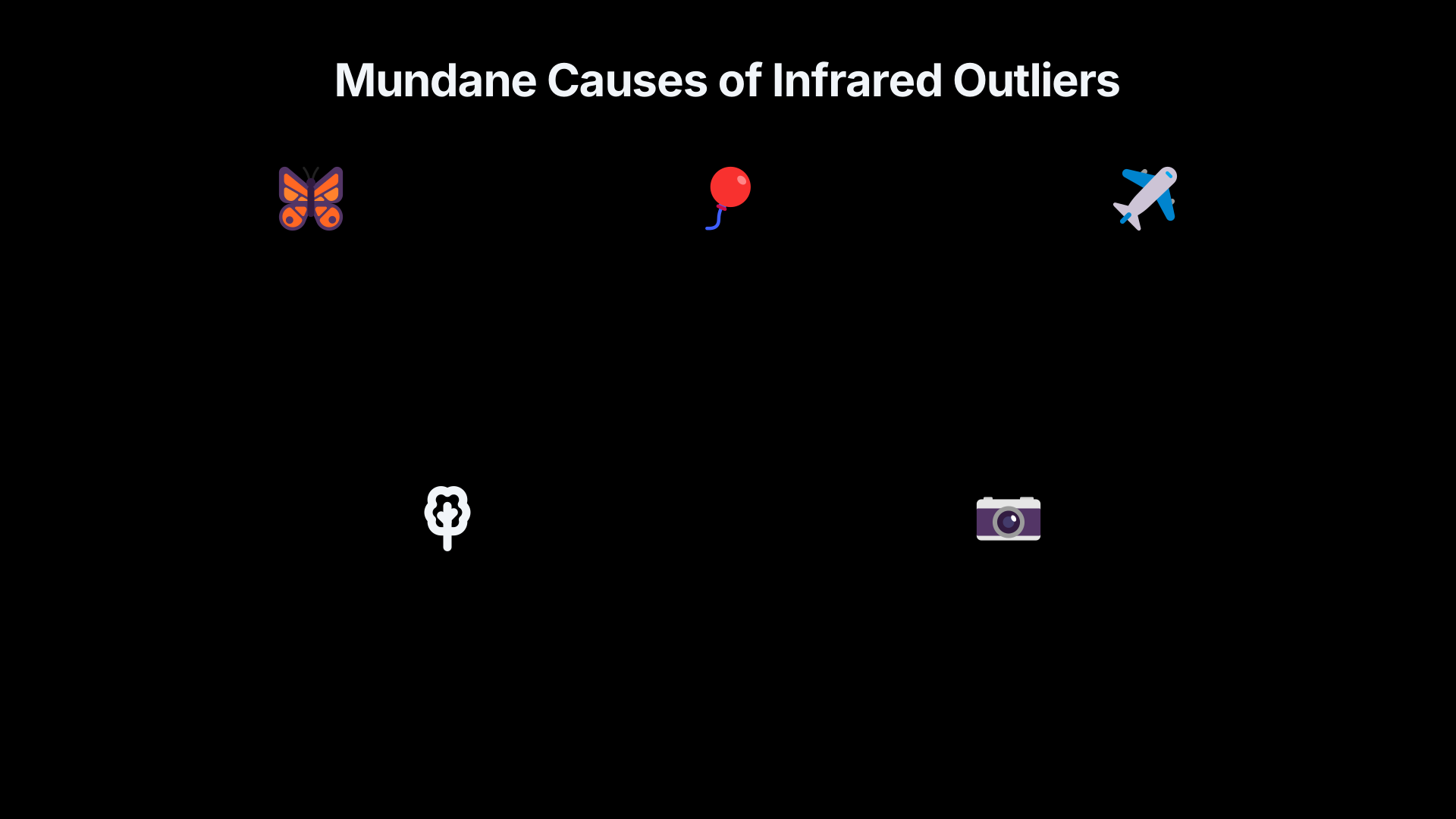
- insects or other nearby biological objects;
- birds viewed under changing thermal conditions;
- balloons or drifting airborne material;
- conventional aircraft observed under unusual geometries;
- clouds, foliage or environmental interference;
- imaging artefacts associated with weather or sensor conditions.[arXiv]arxiv.orgCommissioning An All-Sky Infrared Camera Array for Detection Of Airborne ObjectsNovember 12, 2024…
This is precisely the kind of result a calibration study aims to produce. A scientifically useful UAP observatory must first demonstrate that it can recognise the overwhelming background population before assigning significance to anything left over.
What remained ambiguous after review
The most frequently quoted result from the study is that only 144 trajectories remained ambiguous after examining approximately 80,000 software-selected outliers. Importantly, the authors do not present these objects as evidence of non-human technology or unexplained physics.
Instead, the paper repeatedly identifies the absence of distance measurements as the dominant reason these events could not be classified confidently. The ambiguous category therefore represents unresolved observations rather than confirmed anomalies. The authors explicitly state that the remaining cases are likely to be mundane objects whose identity cannot be established using a single observing station.[arXiv+2Medium]arxiv.orgCommissioning An All-Sky Infrared Camera Array for Detection Of Airborne ObjectsNovember 12, 2024…
The study also reports a statistical upper limit on ambiguous outliers during the commissioning period after accounting for systematic uncertainty. This upper bound is intended as a conservative estimate for future performance evaluation rather than a count of genuinely anomalous objects.[Medium]avi-loeb.medium.comCommissioning Data on Half a Million Objects in the Sky from…This data contains half a million objects, observed during these 5…

Why the missing distance measurement matters
The commissioning dataset identifies stereoscopic observation as the principal improvement needed for future surveys. Multiple Dalek arrays observing the same target from different locations would allow triangulation, producing direct estimates of distance.
Once range is known, researchers can calculate:
- true velocity rather than apparent angular motion;
- physical size instead of image size;
- acceleration in three dimensions;
- whether observed manoeuvres remain unusual after geometric corrections.
Without these measurements, many apparently remarkable trajectories remain fundamentally underdetermined. The Galileo team therefore proposes geographically separated observing stations specifically to eliminate this weakness in the first commissioning dataset.[arXiv+2Medium]arxiv.orgCommissioning An All-Sky Infrared Camera Array for Detection Of Airborne ObjectsNovember 12, 2024…
What the census contributes to automated UAP detection
The main contribution of the Dalek census is methodological rather than sensational. It demonstrates that an automated infrared observatory can continuously monitor the sky, reconstruct hundreds of thousands of trajectories, cross-check detections against known aircraft data, and reduce a vast stream of observations to a very small number requiring expert review.[arXiv]arxiv.orgCommissioning An All-Sky Infrared Camera Array for Detection Of Airborne ObjectsNovember 12, 2024…
Equally important is what the dataset does not claim. It does not report confirmed exotic craft, establish evidence for non-human technology, or argue that the remaining ambiguous tracks represent extraordinary phenomena. Instead, it provides an empirical baseline showing that the night sky is dominated by ordinary traffic and observational complications. Only after that baseline has been measured can future observations be evaluated against it with scientific credibility.
Within the development of automated, instrumented UFO detectors, that may be the commissioning study’s most durable result: before searching for rare anomalies, researchers must first understand—and quantitatively characterise—the immense population of entirely ordinary objects that fill the infrared night sky.[arXiv+2Phys.org]arxiv.orgCommissioning An All-Sky Infrared Camera Array for Detection Of Airborne ObjectsNovember 12, 2024…
Amazon book picks
Further Reading
Books and field guides related to What Galileo's Infrared Sky Census Found. Use these as the next step if you want deeper reading beyond the article.
The UFO Experience
Explains systematic approaches to evaluating aerial sightings, complementing automated survey methodologies.
The Demon-Haunted World
Reinforces the importance of skeptical analysis, statistical baselines, and evidence when interpreting unusual observations.

UFOs : Generals, Pilots, and Government Officials Go on the R...
Provides context for modern scientific investigation of unexplained aerial phenomena and the need for rigorous observational data.

Introduction to infrared and electro-optical systems
Directly relates to the infrared cameras and sensing technologies used in automated sky surveys.
Endnotes
1.
Source: arxiv.org
Link:https://arxiv.org/abs/2411.07956
Source snippet
Commissioning An All-Sky Infrared Camera Array for Detection Of Airborne ObjectsNovember 12, 2024...
Published: November 12, 2024
2.
Source: phys.org
Title: 2025 04 sky infrared camera dalek alien
Link:https://phys.org/news/2025-04-sky-infrared-camera-dalek-alien.html
Source snippet
An all-sky infrared camera named Dalek continues the...9 Apr 2025 — Galileo Project proposes an All-Sky Infrared Camera (Dalek) detect a...
3.
Source: avi-loeb.medium.com
Link:https://avi-loeb.medium.com/commissioning-data-on-half-a-million-objects-in-the-sky-from-the-galileo-project-observatory-are-a23bd084233a
Source snippet
Commissioning Data on Half a Million Objects in the Sky from...This data contains half a million objects, observed during these 5...
4.
Source: youtube.com
Link:https://www.youtube.com/watch?v=zHn69IQSIcg
Source snippet
The Galileo Project | Prof. Avi Loeb...
5.
Source: youtube.com
Title: The Galileo Project | Prof. Avi Loeb
Link:https://www.youtube.com/watch?v=aHNqktsrMSY
Source snippet
Avi Loeb - The Galileo Project, UFO's over Ukraine & Papua New Guinea Meteor...
Additional References
6.
Source: thedebrief.org
Link:https://thedebrief.org/galileo-project-releases-commissioning-data-on-half-a-million-aerial-objects-are-any-of-them-uap/
Source snippet
of eight uncooled infrared cameras placed on half a sphere. the five-month...
7.
Source: youtube.com
Title: Avi Loeb
Link:https://www.youtube.com/watch?v=scUETBQoIZU
Source snippet
A New Interstellar Object, Alien Technology, and the Scientific Debate | Avi Loeb - YouTube Event Horizon · 38K views...
8.
Source: youtube.com
Link:https://www.youtube.com/watch?v=P8gXqa-z95U
Source snippet
A New Interstellar Object, Alien Technology, and the Scientific Debate | Avi Loeb...
9.
Source: youtube.com
Title: Inside the AI Alien Hunting Project at Harvard
Link:https://www.youtube.com/watch?v=oDAY0_wRjxA
Source snippet
Harvard’s AI Skywatcher Is Tracking UFOs in Real Time | Inside the Galileo Project...
Topic Tree