Within Sky Detectors
Why UAP Detectors Need Computers On Site
Automated stations need local computing to trigger cameras, preserve data, and avoid sending every boring frame for review.
On this page
- Real time triggering and sensor control
- Local storage and data triage
- What happens after the event is captured
Page outline Jump by section
Introduction
Automated instrumented UFO detectors, usually framed today as UAP detectors, cannot work as passive sky cameras that simply upload everything. A fixed all-sky station may run all night, every night, across visible, infrared, acoustic, radio and environmental sensors. Without local computing, the result is mostly storage overload: clouds, birds, insects, aircraft, satellites, wind-blown camera shake and ordinary sensor noise. The core job of edge computing is to make quick decisions at the station itself: detect motion, steer or trigger instruments, preserve the right seconds of raw data, attach metadata, and decide what is worth sending for later review.
That shift matters because the central weakness in UAP evidence is not a shortage of dramatic clips; it is a shortage of calibrated, time-synchronised, multi-sensor records. NASA’s 2023 UAP study identified poor sensor calibration, missing metadata, lack of multiple measurements and lack of baseline data as major obstacles to analysis. Edge computing is one practical way to attack those problems before the evidence is lost.[NASA Science]science.nasa.govScience Independent Study Team ReportNASA ScienceIndependent Study Team ReportSeptember 13, 2023 — At present, analysis of UAP data is hampered by poor sensor calibration, th…
Why the computer has to be at the station
A sky station is different from a normal security camera because the interesting event may last only seconds, may move across the field of view quickly, and may need several sensors to respond at once. If the decision is made only after video has gone to a remote server, the system may miss the chance to zoom, change exposure, start high-rate recording, save pre-event frames or ask a neighbouring sensor to look in the same direction.
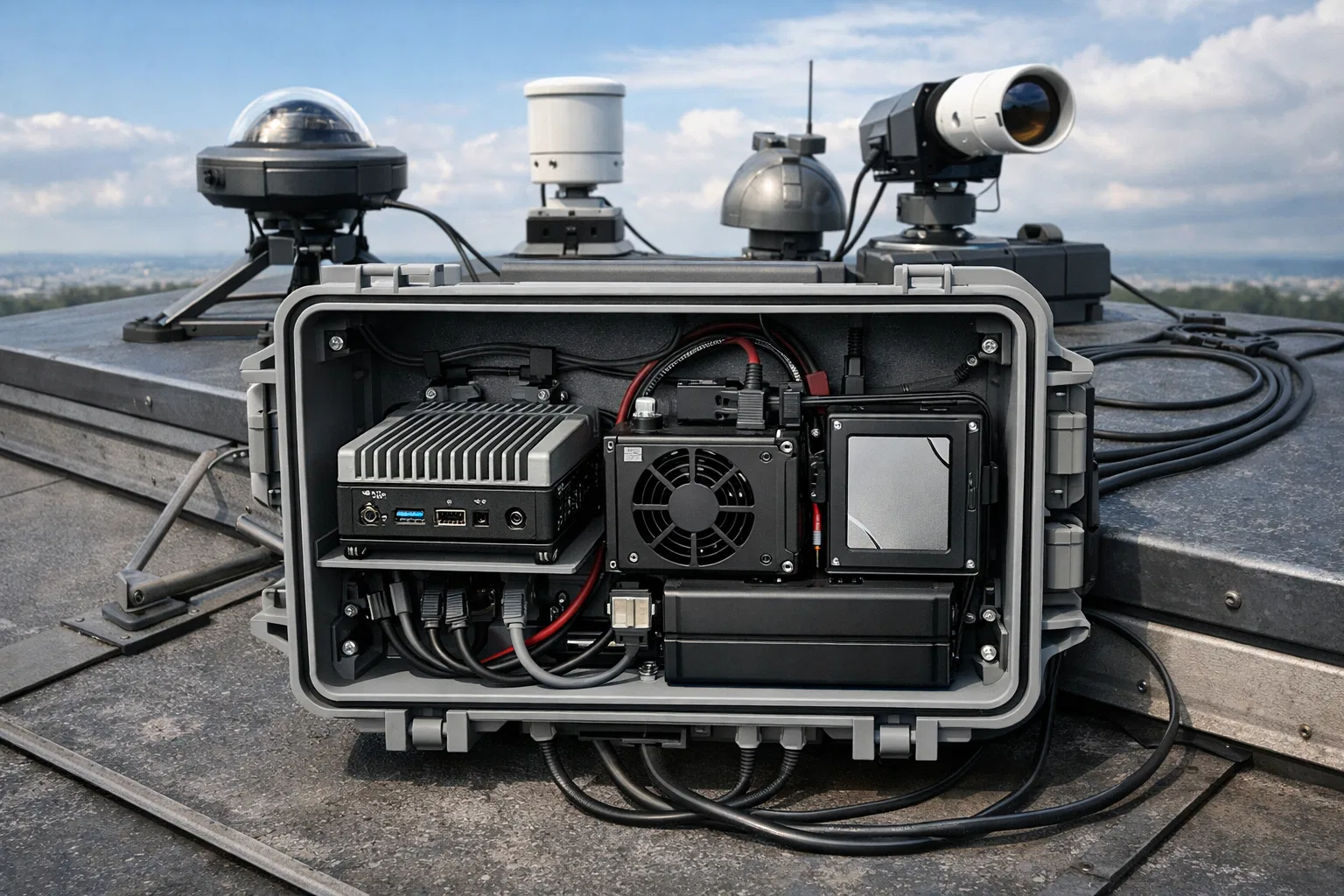
The Galileo Project’s Observatory Class Integrated Computing Platform makes this division explicit. Its architecture separates an on-site Edge Computing Subsystem from an off-site Post-Processing Subsystem. The edge side handles real-time data acquisition, sensor optimisation and provenance management at the observatory; the post-processing side supports later analysis, commissioning, census operations and performance monitoring.[arXiv]arxiv.orgarXiv Galileo Project Observatory Class System ArchitectureGalileo Project Observatory Class System ArchitectureMay 30, 2025…
That architecture reflects a simple implementation rule: the first decision about an event must be made close to the instruments. A wide-field camera might notice a moving point; an infrared array might keep a thermal trace; an acoustic sensor might indicate aircraft noise; an ADS-B receiver might show a known aircraft at the same bearing. The station has to align those signals in time quickly enough to decide whether the event is ordinary, interesting or technically invalid.
The data volume makes this unavoidable. The Galileo architecture paper reports that its observatory platform was generating about 350 GB of multimodal data per day, with most of that coming from the Dalek infrared camera array and the Alcor all-sky camera. That is before a global network of stations is considered. Continuous upload of every frame would be expensive, inefficient and analytically noisy; local triage is not a luxury but part of the detector.[arXiv]arxiv.org1 Introduction30 May 2025 — Objects detected by detection cameras are correlated with ADS-B… Commissioning Galileo Project's All…
Real-time triggering and sensor control
A good sky-station trigger is not just “something moved”. It is a local decision that an event has crossed a threshold worth protecting. That threshold may be a moving object entering a region of sky, a track that does not match an aircraft database, a sudden luminous flash, an unusual infrared signature, a radio-frequency spike, or a multi-sensor coincidence.
UFODAP’s tools show this in a practical, small-system form. Its OTDAU software is described as using one or optionally two cameras to detect and track moving objects, with support for USB webcams, IP cameras and Wi-Fi transfer from Canon DSLR cameras. UFODAP also describes moving-target detection and tracking using a pan-tilt-zoom camera and its Optical Tracking Data Acquisition Unit software.[UFODAP]ufodap.myshopify.comUFODAPCameras for UFO/UAP tracking and data collectionOTDAU software requires one camera, and optionally two, to detect and then track moving objects. It provides for three types of har…
The key implementation move is that the camera or local computer does not merely record a scene. It notices a candidate target, maintains a track, and can trigger recording or tracking behaviour. UFODAP’s user-guide material states that an OTDAU trigger occurs when a qualified tracking event begins, while an MSDAU trigger can be signalled when a sensor, including an RF scanner, exceeds its configured trigger level.[handprint.com]handprint.comOpen source on handprint.com.
This matters because a sky event is often easier to analyse if the system reacts while it is happening. A station can:
- preserve seconds before and after the trigger, not just the frame that crossed the threshold;
- switch a narrow-field or pan-tilt camera towards the candidate target;
- raise the recording rate or save a less-compressed stream;
- mark the exact sensor settings, sky position, clock time and trigger reason;
- query local aircraft data, weather and sensor-health checks before the event becomes a mystery clip detached from its context.
Sky Hub, an earlier citizen-science effort now closely related in spirit to Sky360-style sky watching, framed the same design around “edge processing”: local smart trackers would process camera and sensor data and upload unusual phenomena rather than every ordinary frame. Space.com’s 2021 account described a crowd-sourced network of smart sensors using edge processing to upload anomalous-event data to the cloud.[Space]space.comSpotting UFOs: Do-it-yourself sky surveillance comes onlineSpotting UFOs: Do-it-yourself sky surveillance comes online
Local storage and data triage
The phrase “data triage” can sound like throwing evidence away, but in sky monitoring it is how evidence survives. A station has to decide what to keep at full fidelity, what to compress, what to summarise as metadata, and what to discard after a buffer expires. Otherwise, a long-running network drowns itself in routine images of the ordinary sky.
The UAPx field expedition illustrates the imbalance. In a one-week 2021 Catalina Island field campaign, the team reported about one hour of triggered visible or night-vision video, over 600 hours of untriggered far-infrared video, and 55 hours of background radiation measurements. The useful scientific lesson was not only what they captured, but how much untriggered material a serious expedition can accumulate even over a short period.[arXiv]arxiv.orgOpen source on arxiv.org.
A sky station therefore needs layered storage. The usual pattern is a rolling buffer for recent raw or near-raw data, event clips protected when a trigger fires, structured metadata for routine operation, and lower-volume summaries that can be uploaded or searched. For UAP work, the metadata is not secondary. It is often what decides whether a bright dot is an aircraft, a satellite, a meteor, a reflection or something unresolved.
The Galileo architecture treats provenance as an edge responsibility, not merely a later database task. In practice, provenance means preserving the chain of facts around the event: which sensor recorded it, how the sensor was calibrated, what algorithm or threshold produced the trigger, what time reference was used, and what other sensors were doing at the same moment.[arXiv]arxiv.orgarXiv Galileo Project Observatory Class System ArchitectureGalileo Project Observatory Class System ArchitectureMay 30, 2025…
This is where edge computing changes the quality of the evidence. A human witness may remember that something was “fast” or “silent”; a local computing stack can store the frame rate, exposure, azimuth, elevation, thermal calibration state, local weather, acoustic background and whether an aircraft transponder was present in the same interval. That does not automatically identify the object, but it narrows the space of honest explanations.
Sorting ordinary sky traffic before it becomes a mystery
Most candidate detections at a sky station will not be anomalous. Aircraft, satellites, drones, birds, insects, balloons, meteors, clouds, lens artefacts and camera noise all produce triggers unless the system is taught to recognise them. Edge computing is where many of those first-pass exclusions happen.
ADS-B is especially important for aircraft filtering. The FAA describes Automatic Dependent Surveillance–Broadcast as a surveillance technology combining an aircraft’s positioning source, avionics and ground infrastructure; ADS-B Out broadcasts GPS location, altitude, ground speed and other data once per second.[Federal Aviation Administration]faa.govFederal Aviation Administration Automatic Dependent SurveillanceFederal Aviation Administration Automatic Dependent Surveillance
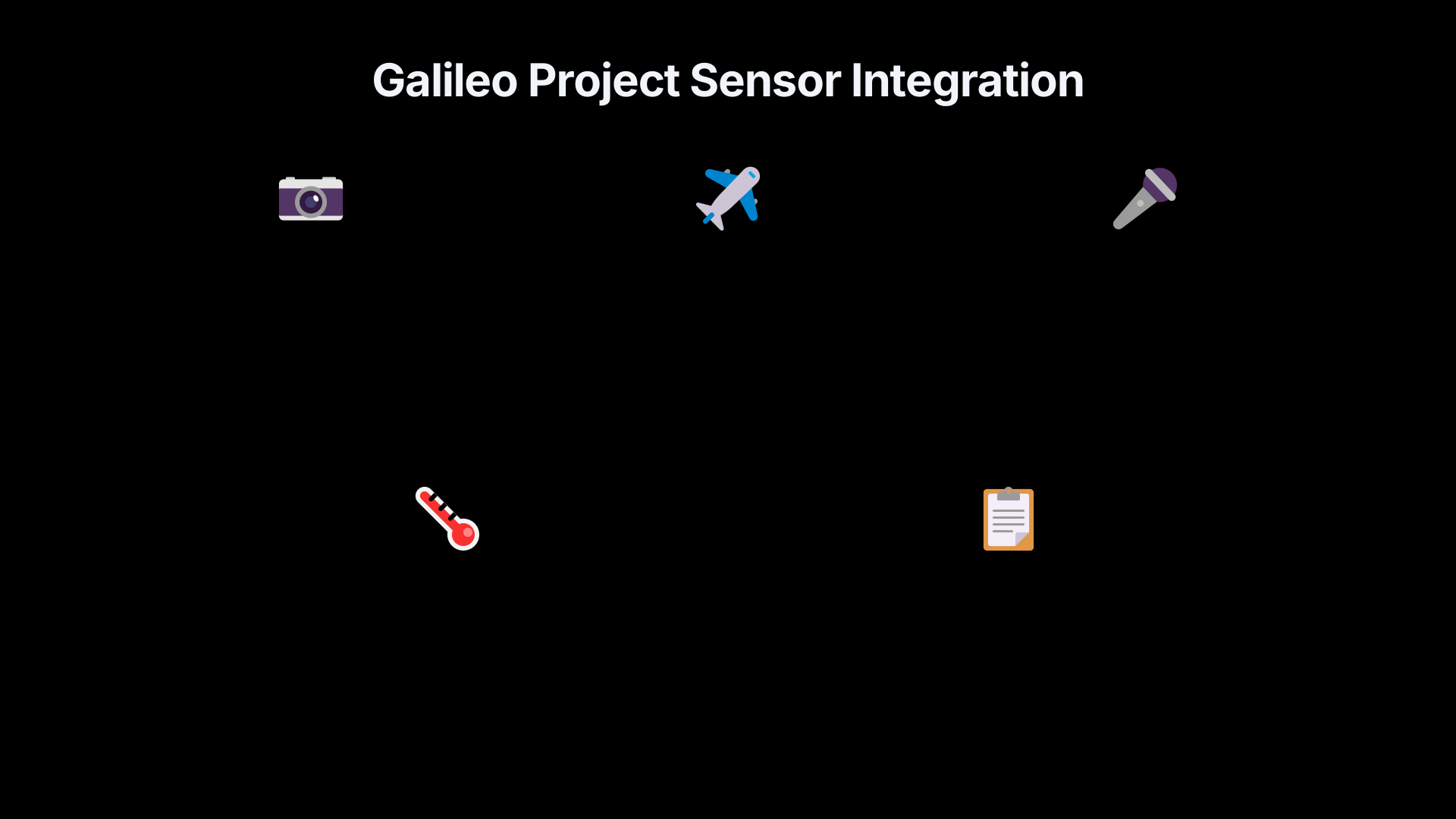
The Galileo Project’s infrared work uses this idea directly. Its all-sky infrared camera array uses eight long-wave infrared FLIR Boson 640 cameras to observe the sky, and its calibration work includes using ADS-B aircraft positions for extrinsic camera calibration. In commissioning, the team reconstructed roughly 500,000 trajectories of aerial objects over five months, then used outlier searches and manual review to identify ambiguous cases.[arXiv]arxiv.orgOpen source on arxiv.org.
That example shows why local decisions should not be confused with final conclusions. The station can flag, correlate and preserve; the later analysis can ask whether a trajectory is physically plausible, whether the same object appears in another sensor, and whether the event is explained by aircraft, weather or instrument behaviour. In the Galileo commissioning work, a toy outlier search based on large sinuosity initially flagged about 16% of trajectories, but manual review reduced the ambiguous set to 144 trajectories, likely mundane but not fully resolved at that stage without distance, kinematics or additional modalities.[arXiv]arxiv.orgOpen source on arxiv.org.
That is a healthy result for an automated detector. The edge system should be sensitive enough not to miss candidates, but the scientific pipeline must be conservative enough not to convert every algorithmic outlier into a claim. Edge computing creates candidate evidence; it does not remove the need for calibration, baseline statistics and sceptical review.
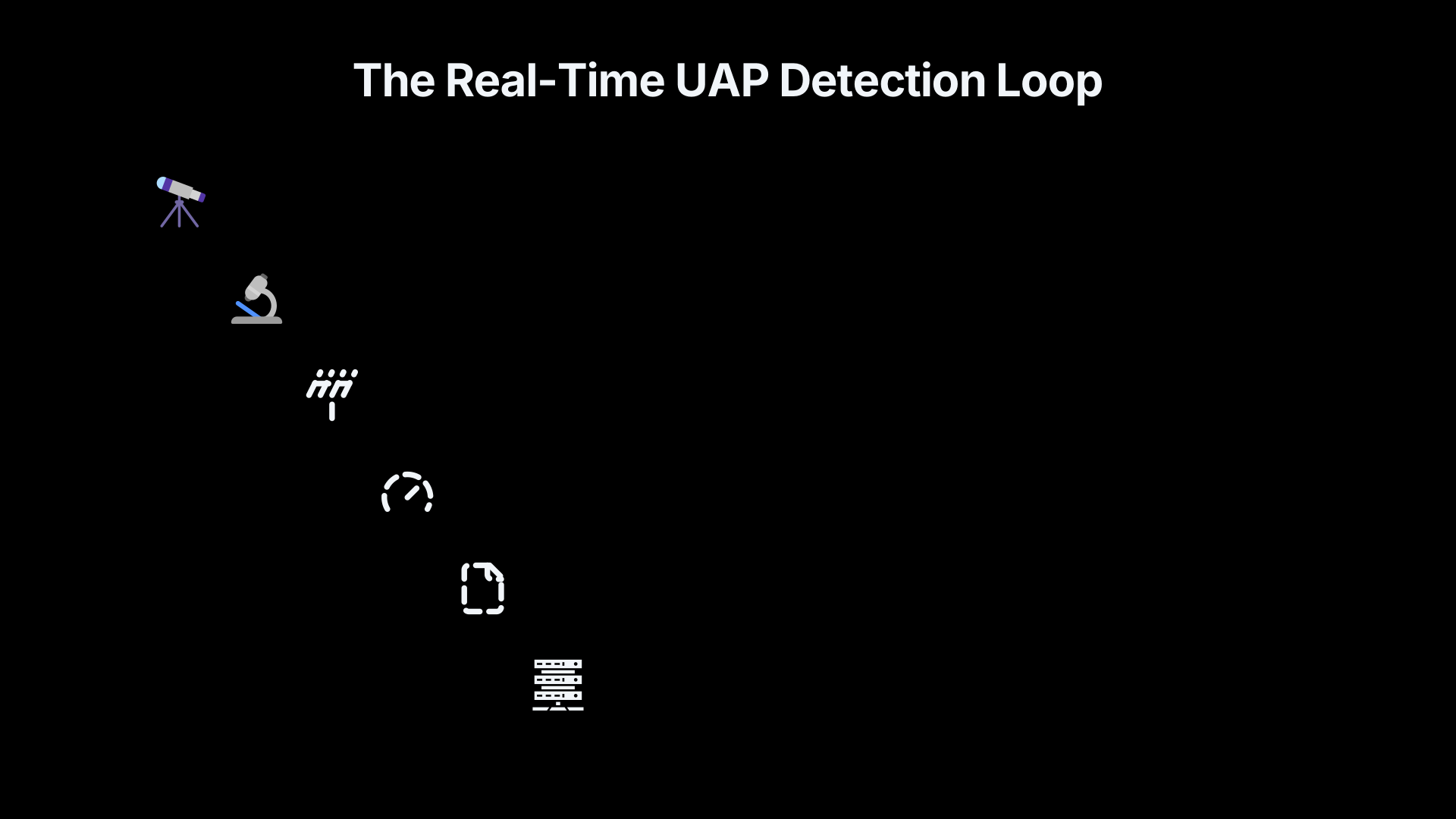
The station’s decision loop
A real-time UAP detector can be understood as a decision loop rather than a single camera. The loop is short, repetitive and local:
- Sense: wide-field visible, infrared, acoustic, radio and environmental instruments collect continuous data.
- Detect: local software identifies motion, brightness changes, thermal signatures, sound features or sensor-threshold crossings.
- Associate: the station checks whether detections line up across sensors, time windows and known-aircraft data.
- Act: it saves protected data, changes camera settings, steers a pan-tilt unit, or raises the quality of recording.
- Triage: it classifies the event as ordinary, uncertain, technically suspect or worth deeper review.
- Export: it uploads event packages, not endless unfiltered sky footage.
This loop is already visible across current projects. Sky360 describes itself as an open-source global sky-observation network using AI-powered tracking stations to detect, track, identify and analyse aerial phenomena.[Sky360]sky360.orgOpen source on sky360.org. Sky Hub’s tracker concept used NVIDIA Jetson hardware and machine-learning methods to process and record real-time data from cameras and environmental sensors.[Medium]medium.comBuilding a Sky Hub UAP TrackerBuilding a Sky Hub UAP Tracker The Galileo Project’s computing papers place automated collection, processing and sensor fusion at the centre of a multimodal observatory.[World Scientific]worldscientific.comOpen source on worldscientific.com.
The edge hardware does not need to be exotic in every case. Citizen stations may use single-board computers, small GPUs, IP cameras and local storage. More advanced observatories may use multi-camera arrays, precision timekeeping, calibrated mounts, weatherproofed enclosures and dedicated acquisition servers. What matters is not the brand of computer but whether the station can make reliable decisions before the event disappears.
What happens after the event is captured
Once a trigger package exists, the work moves from immediate reaction to slower analysis. The event package should include the preserved sensor data, timestamps, calibration records, processing logs, environmental context and any first-pass labels. A later pipeline can then reconstruct the object’s apparent trajectory, compare it with aircraft and satellite data, check weather and cloud conditions, examine acoustic or RF coincidences, and decide whether the event is explained, ambiguous or invalid.
The Galileo architecture describes this separation as edge collection and post-processing analysis. The edge subsystem works at the observatory site; the post-processing subsystem supports workflows such as commissioning, census operations, science operations and system-effectiveness monitoring.[arXiv]arxiv.orgarXiv Galileo Project Observatory Class System ArchitectureGalileo Project Observatory Class System ArchitectureMay 30, 2025… That distinction is important because the edge system is optimised for speed and preservation, while the later system is optimised for careful inference.
This also protects against a common misunderstanding in UAP discussions: a detector should not be designed to “spot aliens”. It should be designed to build a disciplined catalogue of aerial events, most of which will be ordinary. NASA’s UAP report stresses the need for better calibrated, multi-measurement, metadata-rich and baseline-aware data; a sky station’s edge computer is the part of the system that makes those qualities possible at the moment of capture.[NASA Science]science.nasa.govScience Independent Study Team ReportNASA ScienceIndependent Study Team ReportSeptember 13, 2023 — At present, analysis of UAP data is hampered by poor sensor calibration, th…
The hard trade-offs
Edge computing improves sky stations, but it also creates design risks. A detector that is too sensitive records endless birds, insects, aircraft and noise. A detector that is too strict may miss the rare event it was built to catch. A model trained poorly on ordinary objects may reproduce its blind spots at every station in a network. A system that stores only algorithm-approved clips may discard the pre-event or negative evidence needed to understand what happened.
There is also a trust problem. If an automated UAP station produces only a cropped clip and a confidence score, it has not solved the evidential problem; it has hidden it inside software. The stronger design keeps raw or near-raw event data, logs the trigger reason, stores calibration state, and allows later reviewers to reconstruct the decision path. This is why provenance and baseline data are as important as object detection.
Real-time object-detection research outside UAP studies shows why the edge approach is technically plausible but still constrained. NVIDIA’s Jetson ecosystem is marketed for real-time sensor processing and visual AI on embedded systems, while recent drone-detection work has used Jetson Nano hardware with YOLO-style object detection to reduce response time and energy use.[NVIDIA]nvidia.comOpen source on nvidia.com. But sky stations face a harder open-world problem than many controlled detection tasks: they are looking across changing weather, daylight, darkness, stars, clouds, aircraft lights, sensor glare and rare events that may not be well represented in training data.
The best systems therefore combine simple physics-aware checks with machine learning. Background subtraction, blob detection, multi-object tracking, ADS-B correlation, known-satellite checks, weather context and sensor-health monitoring may be less glamorous than a single AI label, but together they make the station more honest. Sky Hub’s BOB tracker, for example, describes movement detection through background subtraction and blob detection, then uses a multi-object tracker to maintain tracks on objects in the sky.[Medium]medium.comBOB: The Universal Object Tracker | by David MooreBOB: The Universal Object Tracker | by David Moore
Why edge compute is the practical heart of UAP detection
The distinctive value of an automated instrumented UFO detector is not that it watches the sky. Many cameras can do that. Its value is that it can notice, preserve and contextualise a fleeting event before human attention arrives. Edge computing is the mechanism that makes this possible.
A well-designed sky station does three things at once. It reduces boring data so the network can operate continuously. It protects interesting data with enough surrounding context to make later analysis fair. And it coordinates sensors quickly enough that a moving point of light can become a time-stamped, calibrated, multi-modal event package rather than another isolated video.
That does not guarantee spectacular discoveries. In fact, the most useful early output may be the opposite: a growing baseline of ordinary aerial activity, known false alarms, algorithm failures and explainable outliers. Over time, that baseline is what lets a station say, with more credibility, that a future event is not merely unidentified because the camera was late, the metadata was missing, or the data were thrown away.
Amazon book picks
Further Reading
Books and field guides related to Why UAP Detectors Need Computers On Site. Use these as the next step if you want deeper reading beyond the article.
Designing Data-Intensive Applications
Explains distributed systems, streaming data and edge-style processing concepts.
Artificial Intelligence
Rating: 4.5/5 from 10 Google Books ratings
Provides background on intelligent decision-making for automated systems.

Computer Vision
Covers image processing and vision methods used in automated detection.

Fundamentals of Data Engineering
Explains storage, pipelines and processing relevant to edge observatories.
eBay marketplace picks
Marketplace Samples
Live-tested eBay searches with available results related to this page.



Endnotes
1.
Source: science.nasa.gov
Title: Science Independent Study Team Report
Link:https://science.nasa.gov/wp-content/uploads/2023/09/uap-independent-study-team-final-report.pdf
Source snippet
NASA ScienceIndependent Study Team ReportSeptember 13, 2023 — At present, analysis of UAP data is hampered by poor sensor calibration, th...
Published: September 13, 2023
2.
Source: arxiv.org
Title: arXiv Galileo Project Observatory Class System Architecture
Link:https://arxiv.org/abs/2506.00125
Source snippet
Galileo Project Observatory Class System ArchitectureMay 30, 2025...
Published: May 30, 2025
3.
Source: arxiv.org
Link:https://arxiv.org/html/2506.00125v1
Source snippet
1 Introduction30 May 2025 — Objects detected by detection cameras are correlated with ADS-B... Commissioning Galileo Project's All...
Published: May 2025
4.
Source: ufodap.myshopify.com
Title: UFODAPCameras for UFO/UAP tracking and data collection
Link:https://ufodap.myshopify.com/collections/cameras
Source snippet
OTDAU software requires one camera, and optionally two, to detect and then track moving objects. It provides for three types of har...
5.
Source: ufodap.com
Link:https://ufodap.com/technology
Source snippet
Dap Camera, Science and TechnologyMoving target detection and tracking using a Pan-Tilt-Zoom (PTZ) camera and the Optical Tracking Data A...
6.
Source: handprint.com
Link:https://www.handprint.com/UFO/UFODAP_User_Guide.pdf
7.
Source: space.com
Title: Spotting UFOs: Do-it-yourself sky surveillance comes online
Link:https://www.space.com/spotting-ufos-sky-hub-surveillance
8.
Source: arxiv.org
Link:https://arxiv.org/abs/2312.00558
9.
Source: faa.gov
Title: Federal Aviation Administration Automatic Dependent Surveillance
Link:https://www.faa.gov/about/office_org/headquarters_offices/avs/offices/afx/afs/afs400/afs410/ads-b
10.
Source: faa.gov
Title: ins outs
Link:https://www.faa.gov/air_traffic/technology/equipadsb/capabilities/ins_outs
11.
Source: arxiv.org
Link:https://arxiv.org/abs/2411.07956
12.
Source: arxiv.org
Link:https://arxiv.org/html/2411.07956v1
13.
Source: sky360.org
Link:https://www.sky360.org/
14.
Source: medium.com
Title: Building a Sky Hub UAP Tracker
Link:https://medium.com/skyhub10/building-a-sky-hub-uap-tracker-95e1750f2c63
15.
Source: nvidia.com
Link:https://www.nvidia.com/en-gb/autonomous-machines/embedded-systems/
16.
Source: medium.com
Title: BOB: The Universal Object Tracker | by David Moore
Link:https://medium.com/%40jdxm21/bob-the-universal-object-tracker-82082916b016
17.
Source: arxiv.org
Link:https://arxiv.org/html/2512.22399v1
18.
Source: arxiv.org
Link:https://arxiv.org/html/2602.22464v1
19.
Source: arxiv.org
Link:https://arxiv.org/pdf/2305.18555
20.
Source: arxiv.org
Link:https://arxiv.org/pdf/1805.11479
21.
Source: arxiv.org
Link:https://arxiv.org/pdf/2305.18566
22.
Source: ar5iv.labs.arxiv.org
Link:https://ar5iv.labs.arxiv.org/html/2303.14917
23.
Source: arxiv.org
Link:https://arxiv.org/html/2411.02401v1
24.
Source: arxiv.org
Link:https://arxiv.org/pdf/gr-qc/0104064
25.
Source: arxiv.org
Link:https://arxiv.org/html/2605.02339v1
26.
Source: arxiv.org
Link:https://arxiv.org/html/2512.17948v2
27.
Source: arxiv.org
Link:https://arxiv.org/html/2312.00558v4
28.
Source: arxiv.org
Link:https://arxiv.org/pdf/2303.14917
29.
Source: arxiv.org
Link:https://arxiv.org/html/2502.06794v1
30.
Source: arxiv.org
Link:https://arxiv.org/pdf/1506.04836
31.
Source: arxiv.org
Link:https://arxiv.org/pdf/2305.18551
32.
Source: ufodap.com
Link:https://ufodap.com/faq
33.
Source: space.com
Title: 26321 noctilucent night shining clouds summer skywatching
Link:https://www.space.com/26321-noctilucent-night-shining-clouds-summer-skywatching.html
34.
Source: space.com
Title: nasa ufo uap study team first results revealed
Link:https://www.space.com/nasa-ufo-uap-study-team-first-results-revealed
35.
Source: avi-loeb.medium.com
Link:https://avi-loeb.medium.com/commissioning-data-on-half-a-million-objects-in-the-sky-from-the-galileo-project-observatory-are-a23bd084233a
36.
Source: avi-loeb.medium.com
Link:https://avi-loeb.medium.com/a-scientific-alternative-to-government-[disclosure
37.
Source: medium.com
Link:https://medium.com/skyhub10/monitoring-the-environment-with-a-sky-hub-tracker-1e540676c154
38.
Source: medium.com
Link:https://medium.com/faa/ads-b-101-ae33179be8f7
39.
Source: science.nasa.gov
Link:https://science.nasa.gov/uap/
40.
Source: oig.dot.gov
Link:https://www.oig.dot.gov/related-library-items-tags/ads-b
41.
Source: papers.cool
Link:https://papers.cool/arxiv/2506.00125
42.
Source: worldscientific.com
Link:https://www.worldscientific.com/doi/full/10.1142/S2251171723400081?srsltid=AfmBOooAoe6jNI6dpUmgOOd-NHb2V4HHhn_YI-EW6rFtCaxQ92eX6KTt
43.
Source: worldscientific.com
Link:https://www.worldscientific.com/doi/10.1142/S2251171723400068?srsltid=AfmBOoouX0H-_wDu1OHvRBlY9VGcXFU15CDqgIrdv6YpIyIfT77Kvco_
44.
Source: worldscientific.com
Link:https://www.worldscientific.com/doi/full/10.1142/S2251171723400081?srsltid=AfmBOore6PvqP0aZgqm9cCmTeH3oHUgRL2UF6ZURui5EUO7SDRRMwDMy
45.
Source: worldscientific.com
Link:https://www.worldscientific.com/doi/10.1142/S2251171723400068?srsltid=AfmBOoq0-5Q_65Nd-EX6FpZykicRg6AoAgqyBN5FSi5sNMrDRnlwcpaT
46.
Source: Wikipedia
Title: The Galileo Project
Link:https://en.wikipedia.org/wiki/The_Galileo_Project
47.
Source: Wikipedia
Title: Automatic Dependent Surveillance–Broadcast
Link:https://en.wikipedia.org/wiki/Automatic_Dependent_Surveillance%E2%80%93Broadcast
48.
Source: ufodap.myshopify.com
Link:https://ufodap.myshopify.com/
49.
Source: ufodap.myshopify.com
Link:https://ufodap.myshopify.com/collections/systems/systems
50.
Source: linkedin.com
Link:https://www.linkedin.com/pulse/nvidia-jetson-empowering-real-time-video-segmentation-celestino-cfyuf
Additional References
51.
Source: youtube.com
Title: Dr. Richard Cloete
Link:http://www.youtube.com/watch?v=6TTxREJ9w4g
Source snippet
Beyond Public Disclosure: Aliens, Non-Human Intelligence, & Galileo Project | Dr. Richard Cloete...
52.
Source: youtube.com
Link:http://www.youtube.com/watch?v=bebrvjf9wL4
Source snippet
Listening for UFOs - The Galileo Project's Search for UAP - with Andy Mead | Merged EP0115...
53.
Source: youtube.com
Link:http://www.youtube.com/watch?v=ZUBrIlxlNdI
Source snippet
Dr. Richard Cloete - Harvard Astrophysics Computer Scientist, Galileo Project Researcher...
54.
Source: youtube.com
Title: Using AI to detect strange events in the sky
Link:http://www.youtube.com/watch?v=nHMEfP68jqI
Source snippet
AI & Aliens: New Eyes on Ancient Questions // Richard Cloete // MLOps Podcast #288 MLOps.community · 216 views...
55.
Source: youtube.com
Title: Listening for UFOs
Link:http://www.youtube.com/watch?v=87POecVP-s4
Source snippet
Using AI to detect strange events in the sky...
56.
Source: researchgate.net
Link:https://www.researchgate.net/publication/371163445_The_Scientific_Investigation_of_Unidentified_Aerial_Phenomena_UAP_Using_Multimodal_Ground-Based_Observatories
57.
Source: researchgate.net
Link:https://www.researchgate.net/publication/391817538_Initial_results_from_the_first_field_expedition_of_UAPx_to_study_unidentified_anomalous_phenomena
58.
Source: facebook.com
Link:https://www.facebook.com/itvnews/posts/a-nasa-report-into-unidentified-flying-objects-ufos-has-found-no-evidence-that-t/686500760179269/
59.
Source: eoportal.org
Link:https://www.eoportal.org/other-space-activities/ads-b
60.
Source: nbaa.org
Link:https://nbaa.org/aircraft-operations/communications-navigation-surveillance-cns/ads-b/
Topic Tree
Follow this branch
Parent topic
Sky DetectorsRelated pages 29
- Camera Handoff Can a detector react before the object is gone?
- Data Triage Why sky stations cannot upload everything
- Health Checks Is the sky event real or the station misbehaving?
- Pre Trigger Why the seconds before a trigger matter
- Trigger Rules When should a sky station hit record?
- +1 more in sidebar