Within Baselines
What a 90 Day Sky Watch Can Learn
A fixed-site collection over weeks or months can reveal local traffic, blind spots, and repeat artefacts before rare events are judged.
On this page
- What a fixed site collection can establish
- Why short dramatic clips lack a control group
- How longer baselines improve later case review
Page outline Jump by section
Introduction
A 90-day sky collection is not an arbitrary waiting period. For automated instrumented UAP (Unidentified Anomalous Phenomena) detection, it is a practical way to establish what “normal” looks like before any observation is treated as unusual. A fixed sensor watching the same sky over weeks and months accumulates a local control dataset: regular aircraft routes, satellite passes, seasonal weather, wildlife activity, recurring camera artefacts and changes in lighting. Only after those patterns are understood can investigators judge whether a later detection genuinely falls outside the site’s expected behaviour.
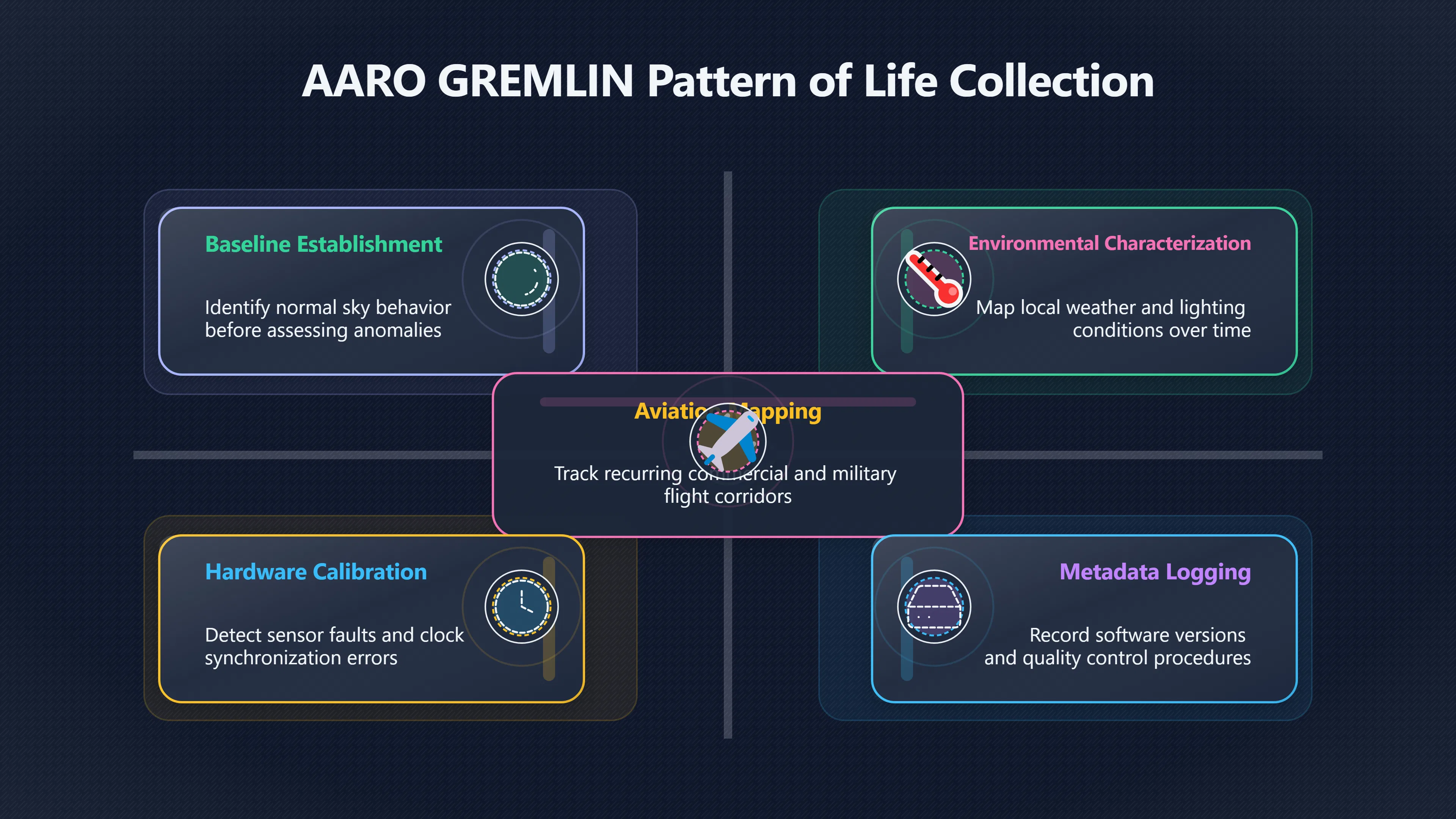
 This approach has moved from a scientific ideal to an operational requirement. NASA’s independent UAP study concluded that the absence of baseline data, calibrated sensors and comprehensive metadata is one of the main obstacles to meaningful analysis. In parallel, the U.S. Department of Defense’s All-domain Anomaly Resolution Office (AARO) announced that its GREMLIN prototype sensor system would undertake a 90-day “pattern of life” collection at a national-security site before using the system for anomaly assessment.[NASA Science]science.nasa.govScience Independent Study Team ReportNASA ScienceIndependent Study Team ReportSeptember 13, 2023 — The study of Unidentified Anomalous Phenomena (UAP) presents a unique scien…
What a fixed-site collection can establish
A sky-monitoring station does more than record objects. Over a prolonged deployment it characterises the observing environment itself.
After roughly three months of continuous operation, investigators can begin to answer questions that are impossible to resolve from isolated sightings:
- Which commercial air corridors dominate different hours of the day?
- How often do satellites produce bright flares from particular viewing angles?
- Which weather conditions generate the highest false-alarm rates?
- How frequently do birds, insects or drifting debris trigger motion detection?
- Which parts of the sky are routinely affected by haze, low cloud or light pollution?
- How stable are the instruments over changing temperatures and humidity?
The resulting archive becomes a site-specific reference rather than a generic catalogue of possible explanations. That distinction matters because every observing location has its own geography, lighting environment and air traffic.
A detector placed near an airport, military training area or coastline will develop a completely different pattern of ordinary activity from one located in a remote desert or mountain valley. A baseline therefore has to be local rather than assumed from another observatory or region. NASA similarly argues that understanding coincident environmental conditions and maintaining structured, well-calibrated datasets are essential prerequisites for rigorous scientific investigation.[NASA Science]science.nasa.govScience Independent Study Team ReportNASA ScienceIndependent Study Team ReportSeptember 13, 2023 — The study of Unidentified Anomalous Phenomena (UAP) presents a unique scien…
Why short dramatic clips lack a control group
Many widely discussed UAP videos share the same limitation: they preserve the event but not the surrounding context.
A single clip rarely reveals:
- whether the same apparent behaviour occurred dozens of times previously;
- whether the sensor regularly produces similar artefacts;
- whether weather conditions were unusual;
- whether nearby aircraft or satellites routinely create comparable signatures; or
- whether software tracking algorithms were operating normally.
Without that comparison set, investigators are forced to rely on reconstruction instead of direct measurement.
A long-running automated station changes the problem. Instead of asking whether one event looks unusual in isolation, investigators can ask whether it differs statistically from thousands of previous observations recorded by the same calibrated instruments under comparable conditions.
That shift mirrors normal scientific practice. In most observational sciences, claims about rare events are evaluated against an established background distribution rather than against intuition or eyewitness impressions.
Why about 90 days is operationally useful
There is no universal scientific rule stating that exactly 90 days is optimal. The value is operational rather than mathematical.
A three-month campaign is long enough to expose variations that shorter deployments often miss, including:
- weekday versus weekend aviation patterns;
- changing sunrise and sunset geometry;
- lunar illumination cycles;
- multiple weather systems;
- maintenance issues affecting sensors;
- recurring local events such as seasonal bird movements or agricultural activity.
It also provides enough repeated observations to estimate normal detection rates instead of relying on a handful of examples.
Importantly, this duration allows engineers to refine the observing system itself. Calibration errors, clock synchronisation problems, image-processing artefacts and hardware faults often become apparent only after sustained operation. Detecting these issues before declaring anomalies improves confidence in later investigations.
This is consistent with AARO’s description of its GREMLIN deployment as a “pattern of life” collection rather than an anomaly hunt. The purpose is to understand routine activity before drawing conclusions from future detections.[U.S. Department of War]media.defense.govFY24 CONSOLIDATED ANNUAL REPORT ON UAP 508Department of WarFiscal Year 2024 Consolidated Annual Report on…14 Nov 2024 — The next step for GREMLIN is a 90-day pattern of life co…
How longer baselines improve later case review
The greatest value of a baseline often appears months after it has been collected.
When an apparently unusual event occurs, investigators can immediately compare it with earlier observations from the same location:
- Has the same trajectory appeared previously?
- Does the infrared signature resemble known aircraft recorded under similar atmospheric conditions?
- Is the object’s apparent acceleration consistent with earlier examples of parallax or tracking error?
- Did environmental sensors record comparable weather conditions on previous nights?
- Does the event coincide with recurring satellite geometry?
Instead of debating a single observation, analysts work with a historical database.
This also enables quantitative rather than subjective assessment. Rather than saying an object “looked unusual”, investigators can ask how frequently similar measurements occurred during thousands of hours of observation and whether the new event falls outside the established statistical distribution.
Reducing bias in UAP investigations
Long-duration collections also address several forms of observational bias.
One is reporting bias. Traditional UAP databases depend on people deciding that something appeared unusual enough to report. Automated monitoring records ordinary and unusual events alike.
Another is geographic bias. AARO has noted that many reports naturally cluster around national-security locations because those areas have trained observers and reporting mechanisms. Building local baselines helps determine whether the apparent concentration reflects genuinely unusual activity or simply where observations are most likely to be collected. Officials have said that, after establishing a baseline near national-security sites, similar investigations could be expanded to other regions for comparison.[DefenseScoop]defensescoop.comuap aaro chief unveils pentagon annual caseload analysis new effortsDefenseScoop'The truly anomalous': New AARO chief unveils Pentagon's…14 Nov 2024 — For instance, he confirmed AARO's prototype sensor…
A further benefit is reducing confirmation bias. When every event is logged automatically according to the same criteria, investigators are less likely to preserve only the dramatic cases while ignoring the routine observations that provide essential context.
Governance and scientific credibility
A 90-day collection is also a governance tool. It establishes documented procedures before controversial cases arise.
A well-managed baseline campaign typically records:
- sensor calibration history;
- software versions;
- environmental metadata;
- maintenance records;
- timing accuracy;
- quality-control procedures.
These records improve transparency and reproducibility. Future reviewers can determine not only what the instruments detected but also whether the observing system itself was functioning correctly.
This reflects a broader trend in official UAP research. NASA’s independent study emphasised calibrated instruments, multiple sensors, metadata and systematic collection rather than reliance on isolated reports. AARO has similarly framed its sensor programme around scientifically rigorous collection and characterisation before attempting to identify truly anomalous events.[NASA Science+2AARO]science.nasa.govScience Independent Study Team ReportNASA ScienceIndependent Study Team ReportSeptember 13, 2023 — The study of Unidentified Anomalous Phenomena (UAP) presents a unique scien…

The practical lesson
For automated instrumented UAP detectors, the most valuable product of a 90-day deployment is usually not a spectacular sighting. It is the detailed map of ordinary sky behaviour that makes future investigations more reliable.
By documenting routine traffic, environmental conditions, sensor limitations and recurring artefacts at one fixed location, an extended collection creates the local baseline against which later observations can be tested. That baseline transforms anomaly detection from a judgement based largely on surprise into one grounded in measured comparison, reducing false positives while increasing confidence that any genuinely unusual event has been evaluated against a well-understood record of what normally occurs overhead.
Amazon book picks
Further Reading
Books and field guides related to What a 90-Day Sky Watch Can Learn. Use these as the next step if you want deeper reading beyond the article.
How to Measure Anything
Fits the page’s focus on building a useful baseline before judging anomalies.
The Signal and the Noise
Relevant to separating meaningful outliers from noisy background observations.
The Demon-Haunted World
Supports the idea that extraordinary claims need controlled comparison, not dramatic clips.
NightWatch
Encourages sustained sky familiarity, seasonal comparison, and recognition of ordinary patterns.
eBay marketplace picks
Marketplace Samples
Example marketplace items related to this page. Use the search link to explore similar finds on eBay.




Endnotes
1.
Source: science.nasa.gov
Title: Science Independent Study Team Report
Link:https://science.nasa.gov/wp-content/uploads/2023/09/uap-independent-study-team-final-report.pdf
Source snippet
NASA ScienceIndependent Study Team ReportSeptember 13, 2023 — The study of Unidentified Anomalous Phenomena (UAP) presents a unique scien...
Published: September 13, 2023
2.
Source: media.defense.gov
Title: FY24 CONSOLIDATED ANNUAL REPORT ON UAP 508
Link:https://media.defense.gov/2024/Nov/14/2003583603/-1/-1/0/FY24-CONSOLIDATED-ANNUAL-REPORT-ON-UAP-508.PDF
Source snippet
Department of WarFiscal Year 2024 Consolidated Annual Report on...14 Nov 2024 — The next step for GREMLIN is a 90-day pattern of life co...
3.
Source: defensescoop.com
Title: uap aaro chief unveils pentagon annual caseload analysis new efforts
Link:https://defensescoop.com/2024/11/14/uap-aaro-chief-unveils-pentagon-annual-caseload-analysis-new-efforts/
Source snippet
DefenseScoop'The truly anomalous': New AARO chief unveils Pentagon's...14 Nov 2024 — For instance, he confirmed AARO's prototype sensor...
4.
Source: aaro.mil
Link:https://www.aaro.mil/
Source snippet
AARO HomeWelcome to the website for the All-domain Anomaly Resolution Office (AARO). Our team of experts leads the U.S. government's effo...
Additional References
5.
Source: avi-loeb.medium.com
Link:https://avi-loeb.medium.com/nasa-aaro-and-the-[galileo
Source snippet
medium.comNASA, AARO and the Galileo Project Agree on the Need for a...NASA, AARO and the Galileo Project Agree on the Need for a Scient...
6.
Source: read-me.org
Title: fiscal year 2024 consolidated annual report on unidentified anomalous phenomena
Link:https://read-me.org/more-social-sciences/2024/12/21/fiscal-year-2024-consolidated-annual-report-on-unidentified-anomalous-phenomena
Source snippet
Fiscal Year 2024 Consolidated Annual Report on...21 Dec 2024 — This report covers unidentified anomalous phenomena (UAP) reports from Ma...
7.
Source: youtube.com
Link:https://www.youtube.com/watch?v=MUQgQlWw5b4
Source snippet
SOMETHING IS HAPPENING — We Are Detecting Anomalous Objects | What They Don't Explain - YouTube SOMETHING IS HAPPENING — We Are Detecting...
8.
Source: metabunk.org
Title: aaro 2024 annual report on uap.13762
Link:https://www.metabunk.org/threads/aaro-2024-annual-report-on-uap.13762/
Source snippet
AARO 2024 Annual Report on UAP14 Nov 2024 — It noted that the next step for Gremlin, the Gremlin capability, is conducting a 90-day patte...
9.
Source: hsdl.org
Title: 2024 annual report uap
Link:https://www.hsdl.org/c/2024-annual-report-uap/
Source snippet
2024 Annual Report on Unidentified Anomalous Phenomena15 Nov 2024 — This report details UAP incidents from May 1, 2023 to June 1, 2024...
Published: May 1, 2023
10.
Source: youtube.com
Link:https://www.youtube.com/watch?v=op_wCAep23o
Source snippet
UAP Revelations with AARO's Dep. Director Lt. Col. (ret.) Tim Phillips...
11.
Source: youtube.com
Title: Is There Extraterrestrial Life? — NASA Releases New UFO Report | FULL EVENT
Link:https://www.youtube.com/watch?v=i0M7AhxPk9w
Source snippet
Inside NASA's UAP Report with Commission Chair David Spergel & Neil deGrasse Tyson...
12.
Source: dni.gov
Title: 4020 uap 2024
Link:https://www.dni.gov/index.php/newsroom/reports-publications/reports-publications-2024/4020-uap-2024
Source snippet
2024 Consolidated Annual Report on Unidentified...14 Nov 2024 — The classified report has been submitted to Congress, and the unclassifi...
13.
Source: youtube.com
Title: UAP Revelations with AARO’s Dep. Director Lt. Col. (ret.) Tim Phillips
Link:https://www.youtube.com/watch?v=yAaO4P4Jc1U
Source snippet
Unidentified Anomalous Phenomena Independent Study Report...
14.
Source: youtube.com
Title: Unidentified Anomalous Phenomena Independent Study Report
Link:https://www.youtube.com/watch?v=TQcqOW39ksk
Source snippet
Is There Extraterrestrial Life? — NASA Releases New UFO Report | FULL EVENT...
Topic Tree