Within Hessdalen
Why One Camera Was Not Enough
A second observing position 171 metres away addressed the first station's biggest weakness: one camera could not measure distance.
On this page
- The range problem in single camera sightings
- How the 171 metre camera baseline helped
- Why triangulation still depended on usable matches
Page outline Jump by section
Introduction
Hessdalen’s automated monitoring station solved one problem that had plagued earlier investigations: it could watch the valley continuously. However, the original system introduced a new limitation. A single camera could record a bright light, but it could not reliably determine how far away that light was. A distant object and a nearby object can appear almost identical in a lone image, making speed, size and altitude estimates highly uncertain. To address that weakness, Project Hessdalen added a second camera site approximately 171 metres from the original station. The goal was straightforward: turn sightings from simple images into measurable events by using triangulation to estimate distance.[Hessdalen Project]hessdalen.orgWith two camera is it possible to calculate the distance to …Read moreHessdalen ProjectAutomatic Measurement Station (AMS) - (2)16 Nov 2017 — Two color cameras, mounted 171 m apart, was connected to this two…
 Within the history of automated instrumented UFO and UAP detection, this was an important shift. The second site was not added to collect more photographs. It was added to extract geometry from photographs, allowing researchers to ask where a light actually was rather than merely whether it had appeared.[Hessdalen Project]hessdalen.orgWith two camera is it possible to calculate the distance to …Read moreHessdalen ProjectAutomatic Measurement Station (AMS) - (2)16 Nov 2017 — Two color cameras, mounted 171 m apart, was connected to this two…
The Range Problem in Single-Camera Sightings
The first generation of the Hessdalen Automatic Measurement Station began operating in 1998 and quickly recorded unusual luminous events. Yet the system’s designers recognised a critical limitation. According to Project Hessdalen’s technical documentation, “System 1 had not the possibility to know the distance to the lights detected.”[Hessdalen Project]hessdalen.orgWith two camera is it possible to calculate the distance to …Read moreHessdalen ProjectAutomatic Measurement Station (AMS) - (2)16 Nov 2017 — Two color cameras, mounted 171 m apart, was connected to this two…
This limitation matters because distance is the foundation for almost every other measurement. Without it:
- An object’s apparent motion cannot be converted into a real speed.
- Its apparent brightness cannot be translated into a reliable estimate of emitted light.
- Its apparent size cannot be separated from perspective effects.
- Researchers cannot confidently determine whether a light is close to the ground, high above the valley, or far beyond the mountains.[Hessdalen Project]hessdalen.orgWith two camera is it possible to calculate the distance to …Read moreHessdalen ProjectAutomatic Measurement Station (AMS) - (2)16 Nov 2017 — Two color cameras, mounted 171 m apart, was connected to this two…
Many UFO videos suffer from exactly this problem. A single viewpoint records angular motion across the sky, but angular motion alone does not reveal actual distance. An object moving slowly nearby can produce an image similar to a distant object moving rapidly. Hessdalen’s researchers concluded that continuous observation was not enough; they also needed a way to measure range.[Hessdalen Project]hessdalen.orgWith two camera is it possible to calculate the distance to …Read moreHessdalen ProjectAutomatic Measurement Station (AMS) - (2)16 Nov 2017 — Two color cameras, mounted 171 m apart, was connected to this two…

How the 171 Metre Camera Baseline Helped
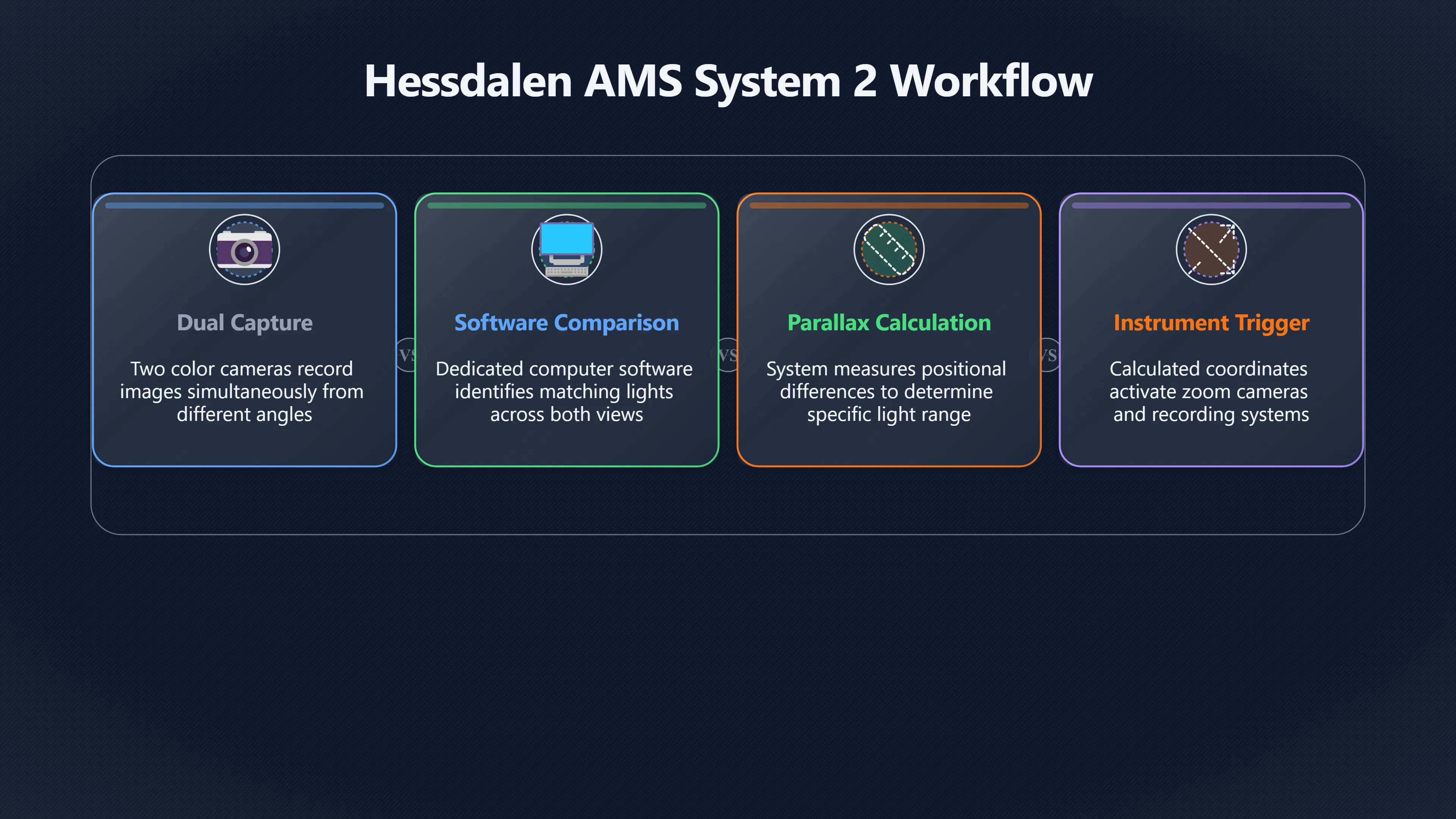
The solution was implemented as part of Hessdalen AMS System 2, which entered operation in 2001. The upgraded system linked two colour cameras positioned 171 metres apart and connected them to a dedicated “two-camera” computer. Project documentation states that the separation was specifically intended to allow calculation of the distance to recorded lights.[Hessdalen Project]hessdalen.orgWith two camera is it possible to calculate the distance to …Read moreHessdalen ProjectAutomatic Measurement Station (AMS) - (2)16 Nov 2017 — Two color cameras, mounted 171 m apart, was connected to this two…
The principle was the same as human depth perception. Two observers looking at the same object from slightly different positions see it against different backgrounds. By measuring that positional difference, known as parallax, it becomes possible to calculate distance through triangulation.[Hessdalen Project]hessdalen.orgWith two camera is it possible to calculate the distance to …Read moreHessdalen ProjectAutomatic Measurement Station (AMS) - (2)16 Nov 2017 — Two color cameras, mounted 171 m apart, was connected to this two…
In practice, the Hessdalen system worked as follows:
- Both cameras captured images continuously.
- Software compared the two views.
- When the same light appeared in both cameras, the system measured its direction from each site.
- Using the known 171-metre separation, the software calculated the light’s position and range.
- The result could then trigger additional instruments, including zoom cameras and recording systems. Hessdalen Project
This was a significant engineering improvement because it transformed the cameras from passive recording devices into a measurement instrument. Instead of merely documenting that a light existed, the system attempted to determine where it existed. Hessdalen Project
The physical layout remained part of the station for years afterward. Project Hessdalen’s station description notes that one camera was located at the original “Blue Box” site while another was placed at an upper station roughly 171 metres away, creating the baseline needed for geometric calculations. Hessdalen Project
Why Triangulation Still Depended on Usable Matches
Adding a second camera did not automatically solve every measurement problem. Triangulation only works when both cameras observe the same target clearly and at nearly the same time. If a light appears in one camera but not the other, no reliable distance can be calculated. Hessdalen Project
This requirement introduced several practical challenges:
- Very faint lights might be visible in only one camera.
- Weather, haze or cloud could affect one viewpoint differently from the other.
- Fast-moving lights might not be captured in matching positions.
- False alarms from aircraft, stars, reflections or image noise could complicate matching procedures. Hessdalen Project
The Hessdalen documentation shows that the software was designed around this constraint. The system specifically looked for a light appearing in both cameras before triggering distance calculations and activating follow-up instruments. In other words, the baseline created the possibility of range measurement, but successful triangulation still depended on obtaining two usable observations of the same event. Hessdalen Project
This is an important lesson for later automated UAP observatories. Multiple sensors are valuable only when they can be synchronised and correlated. A second viewpoint increases information content, but only if the event can be confidently identified across both viewpoints. Hessdalen Project
What the Second Site Revealed About Automated UFO Detection
The decision to add a second camera site illustrates a broader evolution in instrumented UFO monitoring. Early systems focused on recording unusual events. The Hessdalen upgrade shifted attention toward measuring them.
The change reflected a practical understanding that photographs alone rarely settle questions about unidentified aerial phenomena. Distance, altitude and trajectory are often the missing variables. By introducing a 171-metre baseline, Project Hessdalen attempted to obtain those variables directly rather than infer them from witness testimony or single-camera imagery. Hessdalen Project
The second site therefore addressed the most fundamental weakness of the original station. One camera could prove that a light had been seen. Two separated cameras offered the possibility of determining where the light actually was. That distinction made the Hessdalen system a more sophisticated prototype for later automated, multi-sensor UAP detection networks. Hessdalen Project
Amazon book picks
Further Reading
Books and field guides related to Why One Camera Was Not Enough. Use these as the next step if you want deeper reading beyond the article.
The UFO Experience
Focuses on systematic observation, classification, and scientific treatment of unusual aerial phenomena.

UFOs : Generals, Pilots, and Government Officials Go on the R...
Covers evidence-based investigation methods and the challenge of obtaining reliable observational data.
Identified Flying Objects
Discusses interpretation of observed aerial phenomena and the importance of observational evidence.
UFOs
NEW YORK TIMES BESTSELLER • Impeccably researched, this riveting journalistic investigation separates fact from fiction, and documents th...
eBay marketplace picks
Marketplace Samples
Example marketplace items related to this page. Use the search link to explore similar finds on eBay.


Endnotes
2.
Source: old.hessdalen.org
Link:https://old.hessdalen.org/station/
Source snippet
Hessdalen ProjectProject Hessdalen - AMS21 Jan 2019 — Another CCD cam, cam 1 is located in a tree at the upper station, 171 meter south-e...
3.
Source: Wikipedia
Title: Hessdalen AMS
Link:https://en.wikipedia.org/wiki/Hessdalen_AMS
Source snippet
Hessdalen AMSThe Hessdalen Automatic Measurement Station (or Hessdalen AMS) is an automatically working observation station in the Hes...
Additional References
4.
Source: researchgate.net
Link:https://www.researchgate.net/publication/228609015_A_long-term_scientific_survey_of_the_Hessdalen_phenomenon
Source snippet
A long-term scientific survey of the Hessdalen phenomenonPDF | The balls of light which appear in the Hessdalen valley in Norway are exem...
5.
Source: researchgate.net
Link:https://www.researchgate.net/figure/Flow-chart-of-the-Automatic-Measurement-Station-in-Hessdalen-System-2_fig1_241556861
Source snippet
Flow-chart of the Automatic Measurement Station in...Before its operations started, the Hessdalen Automated Measuring Station (AMS) was...
6.
Source: facebook.com
Link:https://www.facebook.com/groups/625436697499583/posts/7266561173387069/
Source snippet
essdalen valley and for which there is no agreed upon explanation?...
7.
Source: facebook.com
Link:https://www.facebook.com/61583174895936/videos/the-hessdalen-lights-have-stumped-scientists-for-40-yearsin-a-remote-valley-in-n/1607905727171889/
Source snippet
in the permanent network was recording at two thirty-9 in the...
8.
Source: naturphilosophie.co.uk
Title: The Hessdalen Light Phenomenon, Norway
Link:https://naturphilosophie.co.uk/2023/05/07/identifying-the-unidentified-the-hessdalen-light-phenomenon-norway/
Source snippet
7 May 2023 — The Hessdalen light phenomenon started in late 1981, when local people reported seeing lights down the valle...
Published: May 2023
9.
Source: youtube.com
Link:https://www.youtube.com/watch?v=KaFWf5wYkaM
Source snippet
The Mystery Of Norway's Hessdalen Lights Phenomenon | UFO: Trick Of The Light | Spark...
10.
Source: youtube.com
Link:https://www.youtube.com/shorts/NBn6P6g9ckc
Source snippet
Norway. Scientists have studied them with cameras, [radar]({{ 'radar/' | relative_url }})...
11.
Source: youtube.com
Title: The Hessdalen Lights Have Stumped Scientists for 40 Years
Link:https://www.youtube.com/watch?v=YihXXHJ8VKc
Source snippet
Mysterious Hessdalen Lights Baffle Scientists | The Proof Is Out There | The UnXplained Zone...
12.
Source: Wikipedia
Title: Hessdalen lights
Link:https://en.wikipedia.org/wiki/Hessdalen_lights
Source snippet
Hessdalen lightsThe Hessdalen lights are unidentified lights which have been observed in a 12-kilometre-long (7.5 mi) stretch of the H...
13.
Source: meetingorganizer.copernicus.org
Title: EGU2011 9137
Link:https://meetingorganizer.copernicus.org/EGU2011/EGU2011-9137.pdf
Source snippet
Hessdalen PhenomenaThe lifetime has been measured up to two hours. The intensity can be so strong that the ground, more than 20 m beneath...
Topic Tree