Within Open Data
Can UAP Data Be Open Without Being Reckless?
Tiered access can let the public test UAP claims while protecting bystanders, private locations, aircraft movements, and sensitive sensors.
On this page
- What belongs in public redacted releases
- When qualified reviewers need fuller records
- How archives preserve unreleased forensic data
Page outline Jump by section
Introduction
Open UAP data does not have to mean publishing every sensor feed, precise location or classified measurement. A better approach is tiered access: release enough information for independent testing and replication, while restricting details that could expose private individuals, reveal sensitive sensor capabilities, compromise security, or encourage misuse. This model is already common in fields that balance scientific openness with legitimate confidentiality, including health research, government data management and controlled research repositories. Applied to automated instrumented UAP detectors, tiered access helps solve a central credibility problem: allowing independent verification without treating every observation as information that must be made universally public. NASA’s independent UAP study emphasises the need for calibrated, well-documented data, while government UAP investigators have also highlighted that many cases cannot be resolved without richer sensor information than can safely be released publicly.[NASA Science]science.nasa.govScience Independent Study Team ReportNASA ScienceIndependent Study Team ReportSeptember 13, 2023 — The study of Unidentified Anomalous Phenomena (UAP) presents a unique scien…
What belongs in public redacted releases?
The public layer should contain everything necessary to evaluate scientific claims without exposing information that creates unnecessary privacy or security risks. The aim is not to hide evidence but to separate evidence from sensitive operational details.
A well-designed public release might include:
- Near-raw imagery or sensor outputs sufficient for independent analysis.
- Accurate timestamps, possibly rounded where necessary to protect sensitive operations.
- Calibration information, detector specifications, and processing history.
- Environmental context such as weather, astronomical conditions and known satellite or aircraft databases used during analysis.
- Documentation explaining every redaction so readers know what has been withheld and why.
Redaction should be limited to information whose disclosure creates identifiable risks. Examples include:
- Exact coordinates of privately owned detector installations.
- Continuous surveillance footage containing identifiable members of the public.
- Detailed military sensor pointing information.
- Information revealing classified sensor performance, detection limits or operational procedures.
- Data that could expose critical infrastructure or protected facilities.
Equally important is preserving analytical transparency. If image regions are blurred, metadata removed or timestamps shifted, those modifications should be documented rather than hidden. Readers can then judge how the redactions affect confidence in the conclusions.
This approach differs from releasing only edited highlight videos. NASA’s study argues that scientific credibility depends on calibration, metadata and robust acquisition methods rather than visually striking imagery alone.[NASA Science]science.nasa.govScience Independent Study Team ReportNASA ScienceIndependent Study Team ReportSeptember 13, 2023 — The study of Unidentified Anomalous Phenomena (UAP) presents a unique scien…
When qualified reviewers need fuller records
Some questions cannot be answered from public data alone. High-resolution radar returns, full infrared recordings, engineering telemetry or classified sensor parameters may be essential for determining whether an apparent anomaly is a genuine object, a reflection, an imaging artefact or another explainable phenomenon.
A second access tier can therefore allow vetted reviewers to inspect more complete records under controlled conditions. Potential reviewers might include:
- Independent scientists with appropriate expertise.
- Instrumentation specialists.
- Statisticians and image analysts.
- Government inspectors or auditors.
- Researchers working under confidentiality agreements where justified.
The important principle is that access decisions should depend on competence and governance rather than organisational affiliation alone. Transparent review procedures, audit logs and published review criteria help prevent accusations that evidence is being hidden simply because it is inconvenient.
This is particularly relevant because several publicly released UAP cases remain unresolved precisely because accompanying telemetry or multimodal observations are unavailable. The All-domain Anomaly Resolution Office (AARO) has publicly noted that some released infrared videos cannot support definitive conclusions without corroborating sensor data. A qualified review process can allow fuller evaluation while avoiding indiscriminate public release of operationally sensitive information.[AARO]aaro.milUAP ImageryHowever, due to the absence of corroborating telemetry or multi-modal sensor data, AARO cannot determine whether the obser…

How archives preserve unreleased forensic data
A third tier should consist of complete forensic archives that preserve every original record, even when much of it cannot immediately be released.
Such archives should retain:
- Original sensor outputs without lossy recompression.
- Complete metadata.
- Clock synchronisation records.
- Calibration files.
- Software versions and processing logs.
- Chain-of-custody documentation.
- Records of every analytical step performed.
Maintaining immutable archival copies serves several purposes.
First, future investigators may possess better analytical methods than today’s reviewers. Machine learning, improved calibration techniques or newly available reference datasets could allow previously ambiguous events to be reinterpreted.
Second, preserving untouched originals prevents accusations that evidence has been altered over time.
Third, archives support accountability. If portions of a record are withheld for security reasons today, the original material still exists for later review, declassification or historical research when circumstances change.
Many scientific disciplines already distinguish between public datasets, controlled-access repositories and long-term preservation copies. The principle is not unique to UAP research but reflects established data governance practice. Controlled-access research repositories similarly preserve sensitive datasets while requiring stronger security controls and managed access for authorised users.[Grants.gov]grants.nih.govGrants.gov NI H Security Best Practices for Controlled-Access DataSecurity Best Practices for Controlled-Access Data…July 10, 2024 — 25 Jul 2024 — This document establishes National Institutes of Heal…
Why tiered access improves scientific credibility
Some critics argue that any withholding of data weakens confidence. In practice, the opposite can be true if restrictions are narrowly justified and transparently documented.
Confidence increases when investigators can demonstrate:
- what data exist;[nps.edu]nps.eduCan you explain what prevents AARO from releasing clearer data or.Read moreUnidentified Anomalous Phenomena: Science and AnalysisHow do you balance public interest in UAP with the need to protect classified infor…
- which portions are public;
- which portions are restricted;
- why restrictions apply;
- who has reviewed the restricted material; and
- whether independent reviewers reached similar conclusions.
This framework avoids the false choice between total secrecy and unrestricted publication. Instead of asking the public to trust unseen evidence, it creates documented pathways through which qualified scrutiny can occur while respecting legitimate privacy and security constraints.
Government information security frameworks use similar principles for handling controlled but unclassified information, limiting access according to risk while preserving accountability, auditability and appropriate sharing. Although UAP detector networks would have different objectives, the governance logic is directly applicable.[NIST Publications]nvlpubs.nist.govSP.800 171r3NIST PublicationsNIST.SP.800-171r3.pdfby R Ross · 2024 · Cited by 158 — This publication provides federal agencies with recommended secur…
A practical governance model for automated UAP detector networks
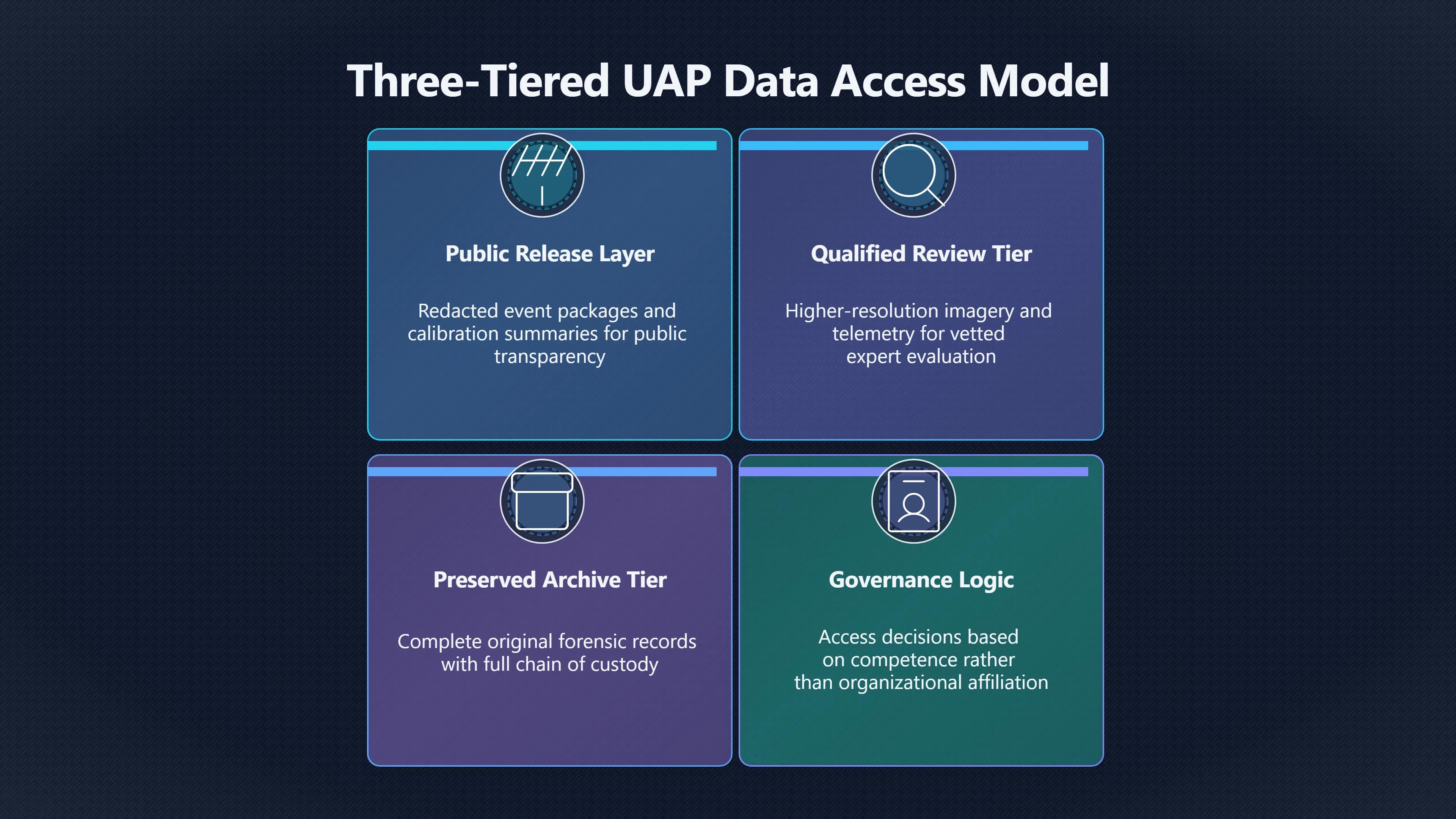
For automated instrumented UAP detectors, a three-level publication model provides a balanced compromise between openness and protection:
Access levelTypical contentsPrimary purposePublic releaseRedacted event packages, calibration summaries, analysis methods, contextual data and documented redactionsIndependent replication and public transparencyQualified reviewHigher-resolution imagery, fuller metadata, precise timing, additional sensor records and restricted operational informationIndependent expert evaluation under controlled accessPreserved archiveComplete original forensic record with chain of custody and all supporting filesLong-term verification, future re-analysis and eventual declassification where appropriate
Such a structure aligns with the broader goal of open, reproducible UAP research without assuming that every sensor record should become immediately available worldwide. The stronger the evidence, the less it should depend on trust alone and the more it should rely on carefully documented access, reproducible methods and preserved original records.
Amazon book picks
Further Reading
Books and field guides related to Can UAP Data Be Open Without Being Reckless?. Use these as the next step if you want deeper reading beyond the article.

UFOs : Generals, Pilots, and Government Officials Go on the R...
Discusses evidence quality and official investigations.

eBay marketplace picks
Marketplace Samples
Example marketplace items related to this page. Use the search link to explore similar finds on eBay.



Endnotes
1.
Source: science.nasa.gov
Title: Science Independent Study Team Report
Link:https://science.nasa.gov/wp-content/uploads/2023/09/uap-independent-study-team-final-report.pdf
Source snippet
NASA ScienceIndependent Study Team ReportSeptember 13, 2023 — The study of Unidentified Anomalous Phenomena (UAP) presents a unique scien...
Published: September 13, 2023
2.
Source: aaro.mil
Link:https://www.aaro.mil/UAP-Cases/Official-UAP-Imagery/
Source snippet
UAP ImageryHowever, due to the absence of corroborating telemetry or multi-modal sensor data, AARO cannot determine whether the obser...
3.
Source: aaro.mil
Link:https://www.aaro.mil/
Source snippet
AARO HomeUnidentified Anomalous Phenomena (UAP) means (A) airborne objects that are not immediately identifiable; (B) transmedium objects...
4.
Source: nvlpubs.nist.gov
Title: SP.800 171r3
Link:https://nvlpubs.nist.gov/nistpubs/SpecialPublications/NIST.SP.800-171r3.pdf
Source snippet
NIST PublicationsNIST.SP.800-171r3.pdfby R Ross · 2024 · Cited by 158 — This publication provides federal agencies with recommended secur...
5.
Source: nvlpubs.nist.gov
Title: SP.800 53r5
Link:https://nvlpubs.nist.gov/nistpubs/specialpublications/NIST.SP.800-53r5.pdf
Source snippet
NIST PublicationsSecurity and Privacy Controls for Information Systems and...by JT FORCE · 2020 · Cited by 399 — NIST is responsible for...
6.
Source: aaro.mil
Link:https://www.aaro.mil/Portals/136/PDFs/Information%20Papers/AARO_Declassification_Info_Paper_2025.pdf
Source snippet
AARO and the Declassification ProcessAARO is responsible for receiving, processing, and adjudicating UAP reports, and routinely accesses...
7.
Source: nvlpubs.nist.gov
Title: SP.800 171r2
Link:https://nvlpubs.nist.gov/nistpubs/SpecialPublications/NIST.SP.800-171r2.pdf
Source snippet
SP 800-171r2 (PDF)14 May 2024 — The CUI Program is designed to address several deficiencies in managing and protecting unclassified infor...
Published: May 2024
8.
Source: grants.nih.gov
Title: Grants.gov NI H Security Best Practices for Controlled-Access Data
Link:https://grants.nih.gov/sites/default/files/flmngr/NIH-Security-BPs-for-Controlled-Access-Repositories.pdf
Source snippet
Security Best Practices for Controlled-Access Data...July 10, 2024 — 25 Jul 2024 — This document establishes National Institutes of Heal...
Published: July 10, 2024
Additional References
9.
Source: egnyte.com
Link:https://www.egnyte.com/guides/governance/cmmc/cui-protection
Source snippet
CUI Protection Strategies for Digital and Physical DataCUI does not fall under classified information protocols, it is governed by standa...
10.
Source: www3.research.ucla.edu
Title: complying nih controlled access repository security requirements nist 800 171
Link:https://www3.research.ucla.edu/nih-data-management-and-sharing-policy/complying-nih-controlled-access-repository-security-requirements-nist
Source snippet
with NIH Controlled Access repository security...NIH has strengthened the security requirements to better protect participant privacy an...
11.
Source: war.gov
Title: dod examining unidentified anomalous phenomena
Link:https://www.war.gov/News/News-Stories/Article/Article/3965403/dod-examining-unidentified-anomalous-phenomena/
Source snippet
14 Nov 2024 — AARO has taken meaningful steps to improve data collection and retention, bolster sensor development, effectively triage UA...
12.
Source: media.defense.gov
Link:https://media.defense.gov/2024/Nov/14/2003583603/-1/-1/0/FY24-CONSOLIDATED-ANNUAL-REPORT-ON-UAP-508.PDF
Source snippet
Year 2024 Consolidated Annual Report on...14 Nov 2024 — In spring of 2024, the Department reviewed and approved its GENADMIN guidance on...
13.
Source: netwrix.com
Title: Build a practical, audit-ready approach to CUI protection
Link:https://netwrix.com/en/resources/blog/controlled-unclassified-information/
Source snippet
CUI Protection: Handle Controlled Unclassified Info Securely20 Apr 2026 — Learn what CUI is, how to classify it, and what NIST 800-171 an...
14.
Source: youtube.com
Title: AVI LOEB: “These objects could be a national security issue for the US”
Link:https://www.youtube.com/watch?v=63yMz4QxWtU
Source snippet
This AARO UAP presentation by Sean Kirkpatrick details how the office handles classified military sensor data, highlighting the constant...
15.
Source: nps.edu
Title: Can you explain what prevents AARO from releasing clearer data or.Read more
Link:https://nps.edu/documents/110773463/165192597/CTX-EAG-Special-Issue-2026.pdf
Source snippet
Unidentified Anomalous Phenomena: Science and AnalysisHow do you balance public interest in UAP with the need to protect classified infor...
16.
Source: Wikipedia
Title: All domain Anomaly Resolution Office
Link:https://en.wikipedia.org/wiki/All-domain_Anomaly_Resolution_Office
Source snippet
All-domain Anomaly Resolution OfficeNASA's UAP independent study team held a public meeting in June 2023 showing further UAP footage r...
Published: June 2023
17.
Source: research.uga.edu
Title: controlled unclassified information
Link:https://research.uga.edu/research-security/controlled-unclassified-information/
Source snippet
Unclassified Information – Research SecurityThe CUI Registry is the online repository for all information, guidance, policy, and requirem...
18.
Source: youtube.com
Title: All-domain Anomaly Resolution Office (AARO): a Duality in Mission Regarding UAPs
Link:https://www.youtube.com/watch?v=bi0H_mkwTW0
Source snippet
AVI LOEB: "These objects could be a national security issue for the US"...
Topic Tree