Within Acoustics
Does the Engine Fit the Light?
Aircraft sounds arrive late and from earlier positions, so audio must be matched to video with timing and geometry.
On this page
- Engine, propeller and rotor sound clues
- Why moving sources need delay correction
- How audio turns aircraft guesses into tests
Page outline Jump by section
Introduction
Aircraft are among the most common explanations for lights that move across the night sky, but matching a visible track to its sound is less straightforward than it appears. Unlike light, which reaches an observer almost instantly, sound travels through air at roughly 343 m/s under typical conditions. An aircraft several kilometres away can therefore be seen in one position while the engine noise reaching the microphone was emitted when the aircraft was somewhere else entirely. Any automated instrumented UFO detector that compares cameras with microphones must account for this delay, together with the aircraft’s motion and the changing direction of the sound. Ignoring these effects can produce false mismatches or make an ordinary aircraft appear acoustically inconsistent. Correctly modelling them turns recorded engine noise into a useful test rather than a vague clue.[Dael+2research.chalmers.se]dael.euracoustics.orgSound pressure radiated by a point-source in arbitrary…January 21, 2024 — by B Kayser · 2023 — The present work aims at improving…

Does the engine fit the light?
The central question is not whether an engine was heard, but whether the recorded sound is consistent with the observed flight path.
Suppose a camera records a bright light crossing the southern sky. A microphone records a growing jet rumble eight seconds later. That delay does not automatically mean the sound belongs to a different source. If the aircraft was approximately 2.7 km away when seen, an eight-second propagation delay is entirely plausible because the sound left the aircraft well before it reached the observer.
An automated system therefore compares several quantities simultaneously:
- the optical track reconstructed from the camera;
- the estimated aircraft position when each sound was emitted rather than when it was heard;
- the expected propagation time through the atmosphere;
- the direction from which the sound should arrive;
- whether the changing pitch and loudness match the aircraft’s motion.
Only when these independent measurements agree does the audio strengthen the aircraft explanation.
Engine, propeller and rotor sound clues
Different aircraft produce distinctive acoustic signatures, although they should never be treated as unique fingerprints.
Jet aircraft typically generate broad, low-frequency engine noise mixed with aerodynamic turbulence. During approach or departure, the spectrum changes gradually as engine power varies. The sound usually builds slowly, reaches maximum intensity near the closest point of approach, then fades.
Propeller aircraft often contain strong tonal components produced by blade-passing frequencies and engine harmonics. These repeated tones are particularly useful because they allow software to estimate Doppler shifts as the aircraft approaches and recedes. Research has shown that even a single calibrated microphone can estimate aspects of a passing propeller aircraft’s trajectory from these frequency changes, while multiple microphones improve localisation accuracy.[Diva Portal]diva-portal.orgDiva PortalAcoustic Source Localization in a Network of Doppler Shift…September 2, 2015 — The motion of a passing acoustic source can…
Helicopters produce a characteristic rhythmic modulation caused by rotating blades. Rather than a smooth engine hum, the signal contains repeating blade impulses whose timing changes as geometry evolves.
For an automated detector, these characteristics are not used to identify an exact aircraft model. Instead, they provide evidence that the sound behaves like a powered aircraft rather than an unrelated environmental noise.
Why moving sources need delay correction
Delay correction is the key difference between matching aircraft sounds and matching stationary noises.
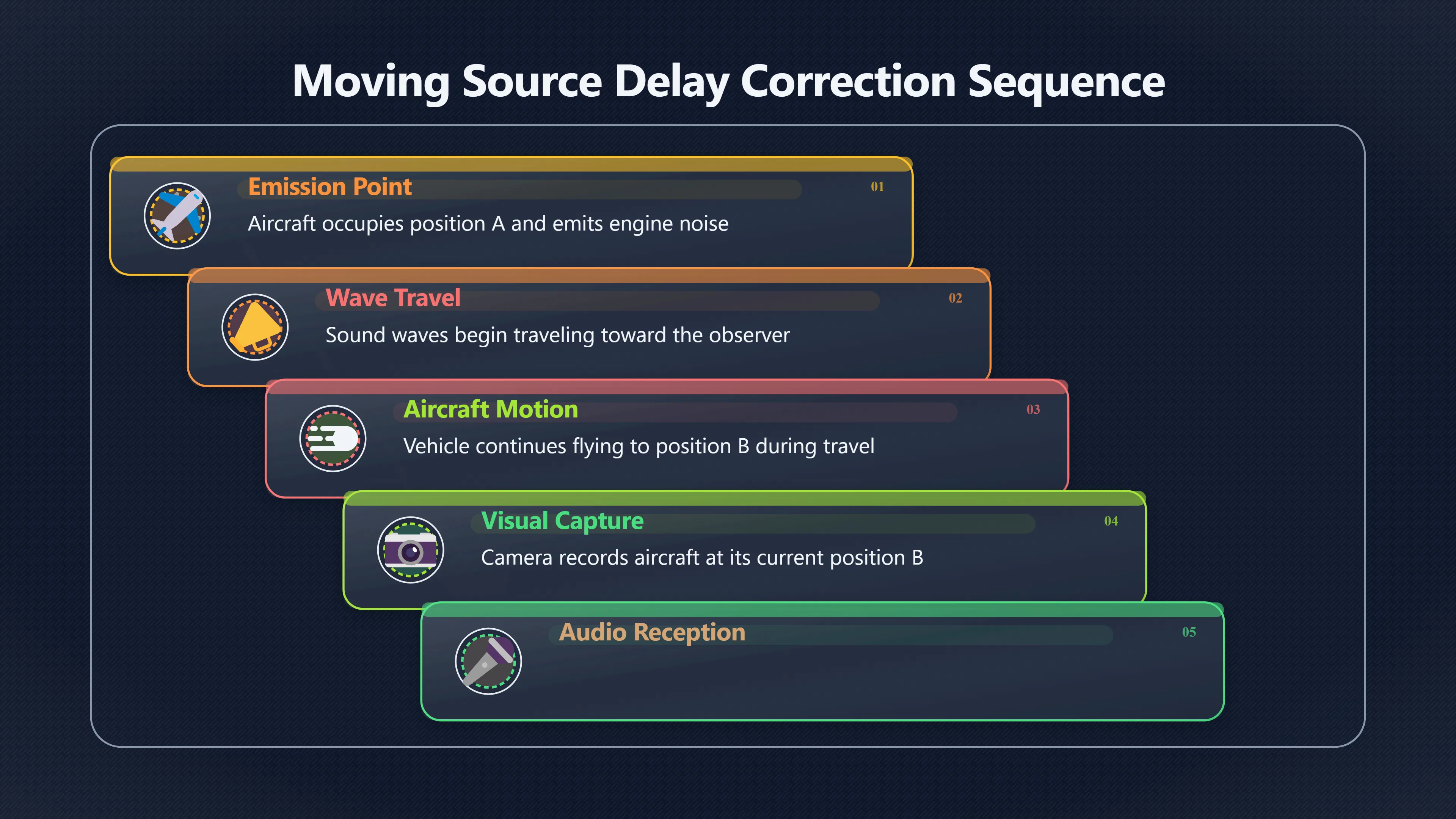
A fixed sound source, such as a factory siren, simply requires accounting for the travel time from source to microphone. A moving aircraft continually changes position while each sound wave is travelling.
The sequence is:
- The aircraft occupies position A and emits engine noise.[youtube.com]youtube.comAircraft Community Noise SimulationFlight Tests - Ep.13: Noise Measurement Tests…
- The sound begins travelling toward the observer.
- During those seconds, the aircraft continues flying to position B.
- The camera records the aircraft near position B.
- The microphone receives sound that originated near position A.
Without correcting for this “retarded” source position, software would incorrectly compare the video with the aircraft’s current location rather than the location from which the recorded sound was actually emitted. Modern moving-source acoustic models explicitly include this propagation delay because it materially affects predicted arrival times, levels and apparent source geometry.[Dael+2research.chalmers.se]dael.euracoustics.orgSound pressure radiated by a point-source in arbitrary…January 21, 2024 — by B Kayser · 2023 — The present work aims at improving…
The error becomes increasingly important for:
- distant aircraft;
- fast-moving aircraft;
- shallow viewing angles across the horizon;
- systems attempting sub-second timing accuracy.
Doppler shift provides an additional consistency check
Aircraft rarely maintain a constant observed pitch.
As an aircraft approaches, successive sound waves are compressed, producing a higher observed frequency. After the closest point of approach, the waves become stretched and the apparent pitch falls. This familiar Doppler effect is measurable by automated signal-processing software rather than relying on human hearing.[Diva Portal]diva-portal.orgDiva PortalAcoustic Source Localization in a Network of Doppler Shift…September 2, 2015 — The motion of a passing acoustic source can…
For sky-monitoring systems, Doppler information serves two purposes.
First, it helps estimate whether the source is approaching or receding at the time each sound was emitted.
Second, the measured frequency curve can be compared with the optical motion. A camera showing an aircraft moving steadily away should not coincide with an audio record showing an increasing Doppler shift characteristic of an approaching source. Such inconsistencies suggest that the sound and light may originate from different objects.
Research into passive acoustic aircraft tracking routinely exploits these Doppler measurements to estimate source trajectories without transmitting any signals, demonstrating that the effect contains useful geometric information rather than merely altering perceived pitch.[IET Research Journal+2UPCommons]ietresearch.onlinelibrary.wiley.comiet rsn.2016.0159IET Research JournalPassive acoustic system for tracking low‐flying aircraft1 Dec 2016 — The following study presents the acoustic aircra…
How microphone arrays improve matching
A single microphone provides timing and spectral information, but a synchronised array adds directional evidence.
By comparing tiny differences in arrival time between microphones, beamforming and localisation algorithms estimate the incoming direction of the sound. This estimated acoustic bearing can then be compared directly with the aircraft’s position derived from video.
A successful match requires several independent quantities to agree:
- bearing from the microphone array;
- visual azimuth from the camera;
- propagation-corrected arrival time;
- expected Doppler evolution;
- plausible sound level for the estimated distance.
Agreement across multiple independent measurements is considerably stronger evidence than matching any one feature alone. Passive acoustic tracking systems developed for aircraft surveillance use exactly this principle, combining multiple microphones with motion models to estimate aircraft position and trajectory.[IET Research Journal+2UPCommons]ietresearch.onlinelibrary.wiley.comiet rsn.2016.0159IET Research JournalPassive acoustic system for tracking low‐flying aircraft1 Dec 2016 — The following study presents the acoustic aircra…

How audio turns aircraft guesses into tests
The practical value of aircraft acoustics is that they convert a qualitative explanation into a measurable hypothesis.
Instead of saying, “it might have been an aircraft”, the detector can ask:
- Would engine noise have reached the microphones at the observed time?
- Should the sound have come from that direction?
- Does the Doppler pattern match the observed motion?
- Is the measured loudness reasonable for the estimated range?
- Are the optical and acoustic tracks consistent after correcting for sound-travel delay?
If the answers are consistently positive, the aircraft explanation gains substantial support.
If they consistently fail—for example, if a supposedly nearby low-flying aircraft would have produced a strong, correctly timed engine signature that is entirely absent—the mismatch becomes evidence that the visual event deserves further investigation. It does not prove an anomalous object, but it justifies looking more carefully at alternative explanations such as distant aircraft, satellites, balloons, optical effects, or sensor artefacts before reaching any extraordinary conclusion.
Amazon book picks
Further Reading
Books and field guides related to Does the Engine Fit the Light?. Use these as the next step if you want deeper reading beyond the article.

UFOs : Generals, Pilots, and Government Officials Go on the R...
Places aircraft identification within broader UAP investigations.

eBay marketplace picks
Marketplace Samples
Live-tested eBay searches with available results related to this page.
Endnotes
1.
Source: dael.euracoustics.org
Link:https://dael.euracoustics.org/confs/fa2023/data/articles/000177.pdf
Source snippet
Sound pressure radiated by a point-source in arbitrary...January 21, 2024 — by B Kayser · 2023 — The present work aims at improving...
Published: January 21, 2024
2.
Source: research.chalmers.se
Title: 540965 Fulltext
Link:https://research.chalmers.se/publication/540965/file/540965_Fulltext.pdf
Source snippet
Aircraft Noise Prediction: from Trajectory to Synthesisby EM Thoma · 2024 · Cited by 5 — The issue of aircraft noise gained significant a...
3.
Source: diva-portal.org
Link:https://www.diva-portal.org/smash/get/diva2%3A646335/FULLTEXT01.pdf
Source snippet
Diva PortalAcoustic Source Localization in a Network of Doppler Shift...September 2, 2015 — The motion of a passing acoustic source can...
Published: September 2, 2015
4.
Source: upcommons.upc.edu
Title: ommons Aircraft localization using a passive acoustic method
Link:https://upcommons.upc.edu/bitstreams/a00f4ad0-dc9b-4b95-b88c-520b7b1a5184/download
Source snippet
by SR Martín Román · 2016 · Cited by 10 — The method relies on the Doppler effect influencing the signals received by a mesh of microphon...
5.
Source: Wikipedia
Title: Doppler effect
Link:https://en.wikipedia.org/wiki/Doppler_effect
6.
Source: ietresearch.onlinelibrary.wiley.com
Title: iet rsn.2016.0159
Link:https://ietresearch.onlinelibrary.wiley.com/doi/10.1049/iet-rsn.2016.0159
Source snippet
IET Research JournalPassive acoustic system for tracking low‐flying aircraft1 Dec 2016 — The following study presents the acoustic aircra...
Additional References
7.
Source: eucass.eu
Link:https://www.eucass.eu/component/docindexer/?id=6150&task=download
Source snippet
AIRCRAFT NOISE PREDICTION IN THE IESTA PROGRAMThis paper presents the acoustic model dedicated to the aircraft noise prediction. Based on...
8.
Source: eaglepubs.erau.edu
Title: Eagle Pubs Aeroacoustics of Flight Vehicles –
Link:https://eaglepubs.erau.edu/introductiontoaerospaceflightvehicles/chapter/noise-of-flight-vehicles/
Source snippet
Eagle PubsAeroacoustics of Flight Vehicles – Introduction to...by JG Leishman · 2023 · Cited by 2 — In the context of aircraft, the rele...
9.
Source: youtube.com
Title: The Proof Is Out There: Catalina UAPx
Link:https://www.youtube.com/watch?v=Tp7c_xMjUow
Source snippet
Sources of Noise – Aeroacoustics | Online Program (Sample Video Lecture) - YouTube Sources of Noise – Aeroacoustics | Online Program (Sam...
10.
Source: acnsci.org
Link:https://acnsci.org/journal/index.php/jec/article/view/1201
Source snippet
Acoustic Doppler localisation and tracking in 3D space with...by AV Riabko · 2025 · Cited by 1 — This study extends Doppler-based acoust...
11.
Source: youtube.com
Title: Flight Tests
Link:https://www.youtube.com/watch?v=wsmj-SHVI3w
Source snippet
Low Altitude Airspace Monitoring Using Passive Acoustics...
12.
Source: youtube.com
Title: Aircraft Community Noise Simulation
Link:https://www.youtube.com/watch?v=4t_0FGxnRm0
Source snippet
Flight Tests - Ep.13: Noise Measurement Tests...
13.
Source: youtube.com
Title: Low Altitude Airspace Monitoring Using Passive Acoustics
Link:https://www.youtube.com/watch?v=aLQeWCvwYn8
Source snippet
The Proof Is Out There: Catalina UAPx...
14.
Source: Wikipedia
Title: 3D sound localization
Link:https://en.wikipedia.org/wiki/3D_sound_localization
Topic Tree