Within Buy or Build
Should Sky Tracking Software Be Open?
Commercial tracking can reduce setup work, while open code lets builders inspect thresholds, failures and updates directly.
On this page
- What vendor software hides and simplifies
- What open repositories let builders inspect
- How updates can help or destabilise a station
Page outline Jump by section
Introduction
Choosing between commercial sky-tracking software and open-source code is ultimately a question of trust rather than convenience. In an automated instrumented UAP detector, the software decides which pixels represent motion, which events are discarded as false alarms, when recordings begin and end, and what metadata are preserved. Those decisions directly affect whether an unusual event can later be evaluated independently.
 Commercial software often reduces installation effort by hiding technical complexity behind polished interfaces and integrated workflows. Open-source projects take the opposite approach, exposing detection algorithms, configuration files and development history so that users can inspect, modify and reproduce the software’s behaviour. For builders interested in scientific credibility rather than simply collecting interesting videos, understanding these trade-offs is as important as choosing cameras or sensors. NASA’s independent UAP study likewise emphasised that future progress depends on robust, transparent data collection and reproducible analysis rather than isolated observations.[NASA Science]science.nasa.govScience Independent Study Team ReportNASA ScienceIndependent Study Team ReportSeptember 13, 2023 — The study of Unidentified Anomalous Phenomena (UAP) presents a unique scien…
What vendor software hides and simplifies
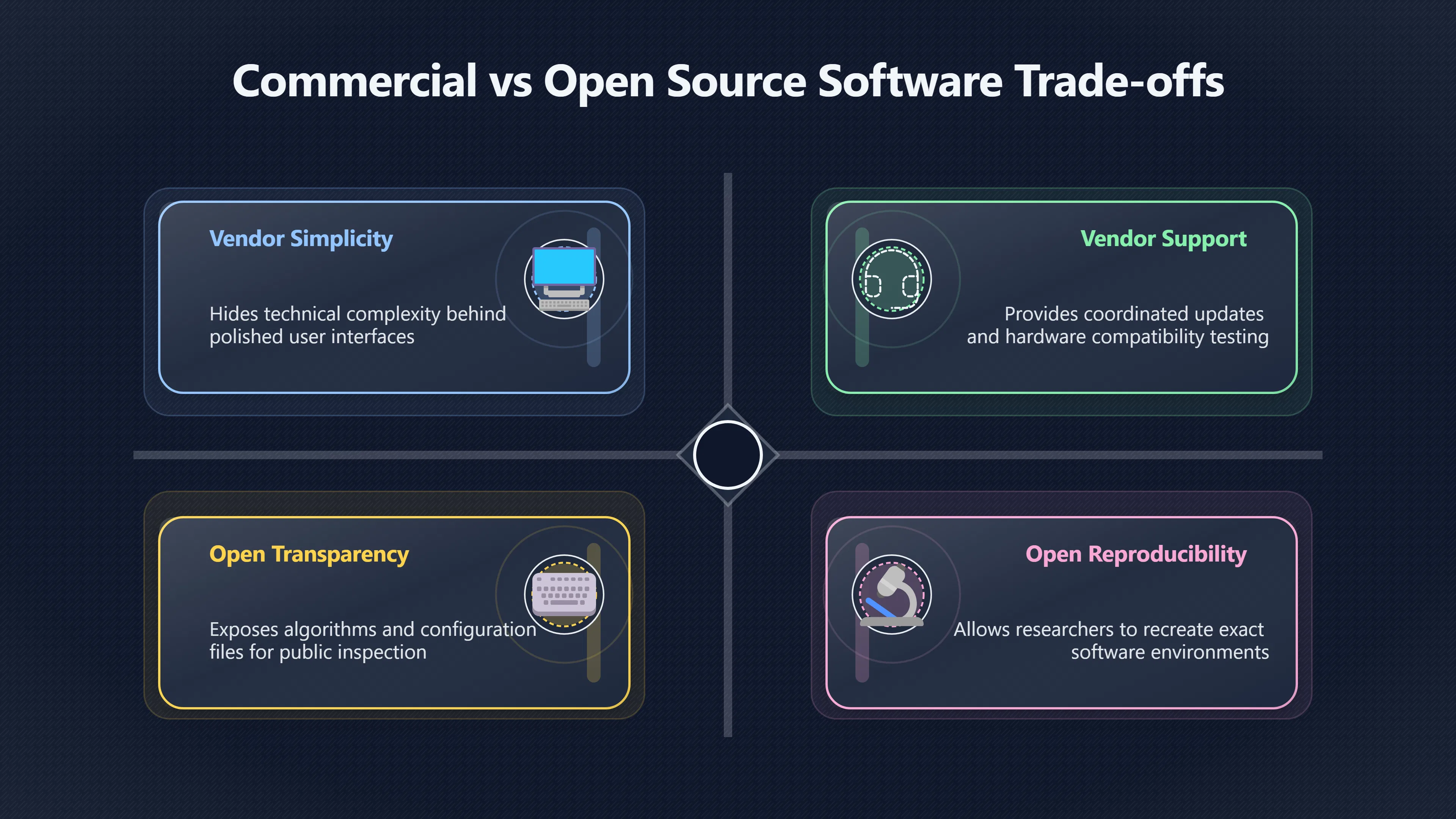
Commercial detection software typically shields users from the details of computer vision. Instead of asking users to tune background subtraction, motion thresholds, object classification or camera synchronisation, vendors present a relatively small number of settings while embedding much of the decision-making inside proprietary software.
That simplification has genuine advantages. A newcomer can assemble a functioning monitoring station much faster than if they had to integrate camera drivers, object tracking libraries, logging systems and user interfaces themselves. Commercial packages also tend to provide coordinated updates, technical support and hardware compatibility testing, reducing the likelihood of installation failures.
The trade-off is reduced visibility into how detections are produced. A user may know that an object was recorded but not precisely:
- what numerical thresholds triggered recording;
- which filtering rules rejected competing objects;
- whether compression altered the stored imagery;
- whether updates changed detection behaviour;
- which intermediate data were discarded before saving.
These questions matter because software can unintentionally introduce observational bias. A detector that suppresses slow-moving objects, rejects dim targets or aggressively filters insects may also remove genuinely unusual events under certain conditions. Without access to the underlying algorithms or detailed documentation, outside investigators cannot easily determine whether a missed or accepted detection reflects the sky or the software itself.
This does not imply that proprietary software is scientifically unreliable. Rather, it means independent verification depends more heavily on vendor documentation, exported metadata and retained raw recordings than on direct inspection of the processing pipeline.
What open repositories let builders inspect
Open-source projects expose much more than downloadable software. They typically publish source code, issue trackers, revision histories and technical discussions that reveal exactly how the detector works and why design decisions were made.
Projects such as the open-source BOB Universal Object Tracker, the Sky360 ecosystem, the Raspberry Pi Meteor Station (RMS), and other community repositories demonstrate this development model. Developers can inspect motion detection routines, tracking algorithms, camera interfaces and logging behaviour, then propose improvements through publicly visible code reviews.[VICE+3Medium+3GitHub]medium.comBOB: The Universal Object Tracker | by David MooreBOB: The Universal Object Tracker | by David MooreMay 5, 2024 — open source software solution to detecting, tracking and recording…
For someone building an automated UAP station, that transparency offers several practical benefits:
- Detection thresholds can be examined rather than assumed.
- False-positive filters can be adjusted for local conditions.
- Bugs can often be identified publicly instead of waiting for vendor acknowledgement.
- Independent researchers can reproduce the same software environment.
- Archived versions allow historical detections to be re-analysed using the exact code that originally generated them.
Equally important, open repositories expose limitations instead of hiding them. Many projects openly list unfinished features, known bugs and planned improvements. For example, early versions of community UFO detection software explicitly describe themselves as prototypes and invite contributions to improve hardware support and detection algorithms rather than implying complete reliability.[GitHub]github.comUFOID/UFO-DetectorThe UFO Detector is a software that allows the autonomous video recording of unidentifiable flying objects. This…
That visibility helps users judge maturity realistically. A station built on open software may require more technical skill, but users can usually determine whether an unexpected behaviour results from a documented limitation or an unexplained anomaly.

Why transparency improves reproducibility
For observational science, reproducibility extends beyond sharing images. Other investigators should be able to reconstruct how an event was detected.
If software records only the final video clip, later reviewers cannot determine why recording started when it did. By contrast, an openly documented processing chain may reveal:
- preprocessing applied to each frame;
- image calibration procedures;
- tracking confidence scores;
- rejected candidate objects;
- software version used during detection.[facebook.com]facebook.comyone used this and have any comments on what it's like please?…
Meteor observing networks provide useful comparisons because they face similar challenges of continuously monitoring large areas of sky while rejecting enormous numbers of false detections. Open software ecosystems such as RMS and the Global Meteor Network document their detection pipelines, calibration procedures and processing methods so participating stations can produce consistent results across many observers.[Springer+3GitHub+3Global Meteor Network]github.comCroatianMeteorNetwork/RMS: RPi Meteor StationThe RMS software provides a complete, automated pipeline for meteor observation. It cu…
Although meteor detection and UAP monitoring are different scientific problems, both illustrate how transparent software helps multiple stations compare observations using consistent processing rules.
How updates can help or destabilise a station
Software updates are often presented as straightforward improvements, but long-term sky monitoring introduces a more complicated governance problem.
A vendor update may improve tracking accuracy, reduce processor load or fix false triggers. However, if an update silently changes motion thresholds or object classification behaviour, data collected before and after the update may no longer be directly comparable.
Open-source software faces a similar challenge, but with an important difference: users can usually inspect release notes, compare source-code revisions or continue operating an older version if maintaining dataset consistency is more important than obtaining new features.
Good operational practice therefore includes recording:
- software version;
- configuration files;
- camera firmware version;
- calibration dates;
- update history.
These records allow later investigators to determine whether an apparent change in detection frequency reflects changing skies or changing software.
Long-running scientific observatories routinely preserve software provenance for precisely this reason. The software becomes part of the instrument, not merely something running alongside it.
Software trust is a governance decision
The distinction between commercial and open software is not simply technical; it is a governance choice about who controls evidence.
With proprietary software, users delegate many implementation decisions to the vendor. They trust that updates, filtering rules and processing choices have been designed responsibly and documented sufficiently for their purposes.
With open-source software, responsibility shifts toward the operator and community. Builders gain the ability to audit and customise the code but also assume responsibility for maintaining it, validating changes and avoiding accidental regressions.
NASA’s recommendations for future UAP investigation consistently favour better characterised datasets, reproducible analytical methods and transparent handling of observations rather than dependence on opaque processing. Those principles do not require every detector to use open-source software, but they do suggest that the more observable the software’s behaviour, the easier it becomes for independent researchers to evaluate both ordinary detections and genuinely unusual events.[NASA Science]science.nasa.govScience Independent Study Team ReportNASA ScienceIndependent Study Team ReportSeptember 13, 2023 — The study of Unidentified Anomalous Phenomena (UAP) presents a unique scien…
Amazon book picks
Further Reading
Books and field guides related to Should Sky Tracking Software Be Open?. Use these as the next step if you want deeper reading beyond the article.
UFOs : Generals, Pilots, and Government Officials Go on the R...
Frames the need for transparent evidence.
The UFO Experience: A Scientific Inquiry
Reinforces reproducible investigative methods.
Programming Computer Vision With Python
Useful for open-source tracking software development.

Computer Vision: Algorithms and Applications
Explains motion detection and tracking algorithms.
eBay marketplace picks
Marketplace Samples
Example marketplace items related to this page. Use the search link to explore similar finds on eBay.
Endnotes
1.
Source: science.nasa.gov
Title: Science Independent Study Team Report
Link:https://science.nasa.gov/wp-content/uploads/2023/09/uap-independent-study-team-final-report.pdf
Source snippet
NASA ScienceIndependent Study Team ReportSeptember 13, 2023 — The study of Unidentified Anomalous Phenomena (UAP) presents a unique scien...
Published: September 13, 2023
2.
Source: nasa.gov
Title: update nasa shares uap independent study report names director
Link:https://www.nasa.gov/news-release/update-nasa-shares-uap-independent-study-report-names-director/
Source snippet
UPDATE: NASA Shares UAP Independent Study Report14 Sept 2023 — The report contains the external study team's findings and recommendations...
3.
Source: medium.com
Title: BOB: The Universal Object Tracker | by David Moore
Link:https://medium.com/%40jdxm21/bob-the-universal-object-tracker-82082916b016
Source snippet
BOB: The Universal Object Tracker | by David MooreMay 5, 2024 — open source software solution to detecting, tracking and recording...
Published: May 5, 2024
4.
Source: github.com
Link:https://github.com/CroatianMeteorNetwork/RMS
Source snippet
CroatianMeteorNetwork/RMS: RPi Meteor StationThe RMS software provides a complete, automated pipeline for meteor observation. It cu...
5.
Source: github.com
Link:https://github.com/UFOID/UFO-Detector
Source snippet
UFOID/UFO-DetectorThe UFO Detector is a software that allows the autonomous video recording of unidentifiable flying objects. This...
6.
Source: vice.com
Title: ufo hunters built an open source ai system to scan the skies
Link:https://www.vice.com/en/article/ufo-hunters-built-an-open-source-ai-system-to-scan-the-skies/
Source snippet
UFO Hunters Built an Open-Source AI System To Scan The...9 May 2023 — An open source citizen science project called Sky360, which aims t...
Published: May 2023
7.
Source: link.springer.com
Link:https://link.springer.com/article/10.1007/s11038-017-9511-z
Source snippet
Operating at small automatic observatories (stations)...
8.
Source: science.nasa.gov
Link:https://science.nasa.gov/uap/
Source snippet
nasa.govUAP9 Jun 2022 — The study will focus on identifying available data, how best to collect future data, and how NASA can use that da...
9.
Source: globalmeteornetwork.org
Link:https://globalmeteornetwork.org/wiki/
Source snippet
the Global Meteor Network wiki page!10 Mar 2026 — The goal is to observe the night sky using low-light video cameras and produce meteor t...
10.
Source: globalmeteornetwork.org
Link:https://globalmeteornetwork.org/wordpress/wp-content/uploads/2018/11/Vida_IMC2016_proceedings_final.pdf
Source snippet
Open-source meteor detection software for low-cost single-...by D Vida · Cited by 22 — In this paper new and improved algorithms are pre...
11.
Source: globalmeteornetwork.groups.io
Title: io Allsky Project on github
Link:https://globalmeteornetwork.groups.io/g/main/topic/allsky_project_on_github/34864046
Source snippet
Project on github - possible to bring two...Imagine joining these two networks with all their cameras - what an improvement for meteor d...
Additional References
12.
Source: [ufodap]({{ ‘ufodap/’ | relative_url }}). myshopify.com
Link:https://ufodap.myshopify.com/
Source snippet
UFODAP ShopEnables simultaneous tracking and recording of data from multiple cameras and other instruments. See the PTDAU section for mor...
13.
Source: seemoo.tu-darmstadt.de
Link:https://www.seemoo.tu-darmstadt.de/tools/
Source snippet
tu-darmstadt.deTools, Software, and Datasetsopen-source software projects and datasets. The app scans your surroundings in the background...
14.
Source: wevolver.com
Link:https://www.wevolver.com/article/how-cams-the-cameras-for-allsky-meteor-surveillance-project-detects-long-period-comets-through-machine-learning
Source snippet
How CAMS, the Cameras for Allsky Meteor Surveillance...31 Mar 2022 — The CAMS project uses affordable low-light camera arrays to monitor...
15.
Source: youtube.com
Link:https://www.youtube.com/watch?v=TQcqOW39ksk
Source snippet
Unidentified Anomalous Phenomena Independent Study ReportNASA commissioned an independent study team to examine unidentified anomalous ph...
16.
Source: ralphbuncheinstitute.org
Title: nasa unidentified anomalous phenomena independent study team report
Link:https://ralphbuncheinstitute.org/nasa-unidentified-anomalous-phenomena-independent-study-team-report/
Source snippet
Figuring out the truth behind Unidentified Anomalous Phenomena (UAPs) takes more than speculation, it requires hard science.Read more...
17.
Source: leonarddavid.com
Title: nasa report released unidentified anomalous phenomena uap
Link:https://www.leonarddavid.com/nasa-report-released-unidentified-anomalous-phenomena-uap/
Source snippet
Unidentified Anomalous Phenomena (UAP) – UPDATED14 Sept 2023 — NASA has released its Unidentified Anomalous Phenomena (UAP) report comple...
18.
Source: reddit.com
Link:https://www.reddit.com/r/UFOs/comments/1ah3hi7/i_am_relaunching_the_ufo_detector_project_with_a/
Source snippet
I am relaunching the UFO Detector project with a new deviceThe new product is a compact, portable device that can be installed anywhere t...
19.
Source: facebook.com
Link:https://www.facebook.com/groups/172438633343696/posts/1650359452218266/
Source snippet
yone used this and have any comments on what it's like please?...
20.
Source: pulsar-photonics.de
Title: open source monitoring tool sentry
Link:https://www.pulsar-photonics.de/blog/open-source-monitoring-tool-sentry/
Source snippet
Open-Source-Monitoring-Tool "Sentry"25 Jul 2025 — Mit Sentry können wir: Fehler frühzeitig erkennen, bevor sie zu einem Ausfall führen; P...
21.
Source: youtube.com
Link:https://www.youtube.com/watch?v=bQo08JRY0iM
Source snippet
anomalous phenomena (UAPs) – that is, observations of...
Topic Tree