Within Starlink
Can the Track Match a Known Satellite?
Current orbital data lets detectors compare a recorded track against known satellites before treating it as unexplained.
On this page
- What ephemeris matching tests
- Why stale orbital data causes false alerts
- How to make matches auditable
Page outline Jump by section
Introduction
Automated sky cameras can only treat a moving light as genuinely unexplained after asking a simpler question: does its observed path match the predicted path of a known satellite? For modern systems, especially those operating during twilight when low-Earth-orbit satellites are brightest, ephemeris matching is the primary method for excluding Starlink and other satellite constellations before an event reaches a human analyst. The challenge is no longer simply downloading orbital data. Starlink satellites manoeuvre frequently, are launched in large groups, and can produce brief specular reflections that appear far brighter than an ordinary satellite. A reliable detector therefore needs a reproducible orbit-matching pipeline, continuous orbital updates, and an auditable record showing why a candidate was accepted or rejected as a satellite.[AARO]aaro.milCorrelations of Starlink Satellite Flaring with UAPCorrelations of Starlink Satellite Flaring with UAP…January 24, 2025 — by A An · 2024 — This paper discusses specular and diffuse…

Can the Track Match a Known Satellite?
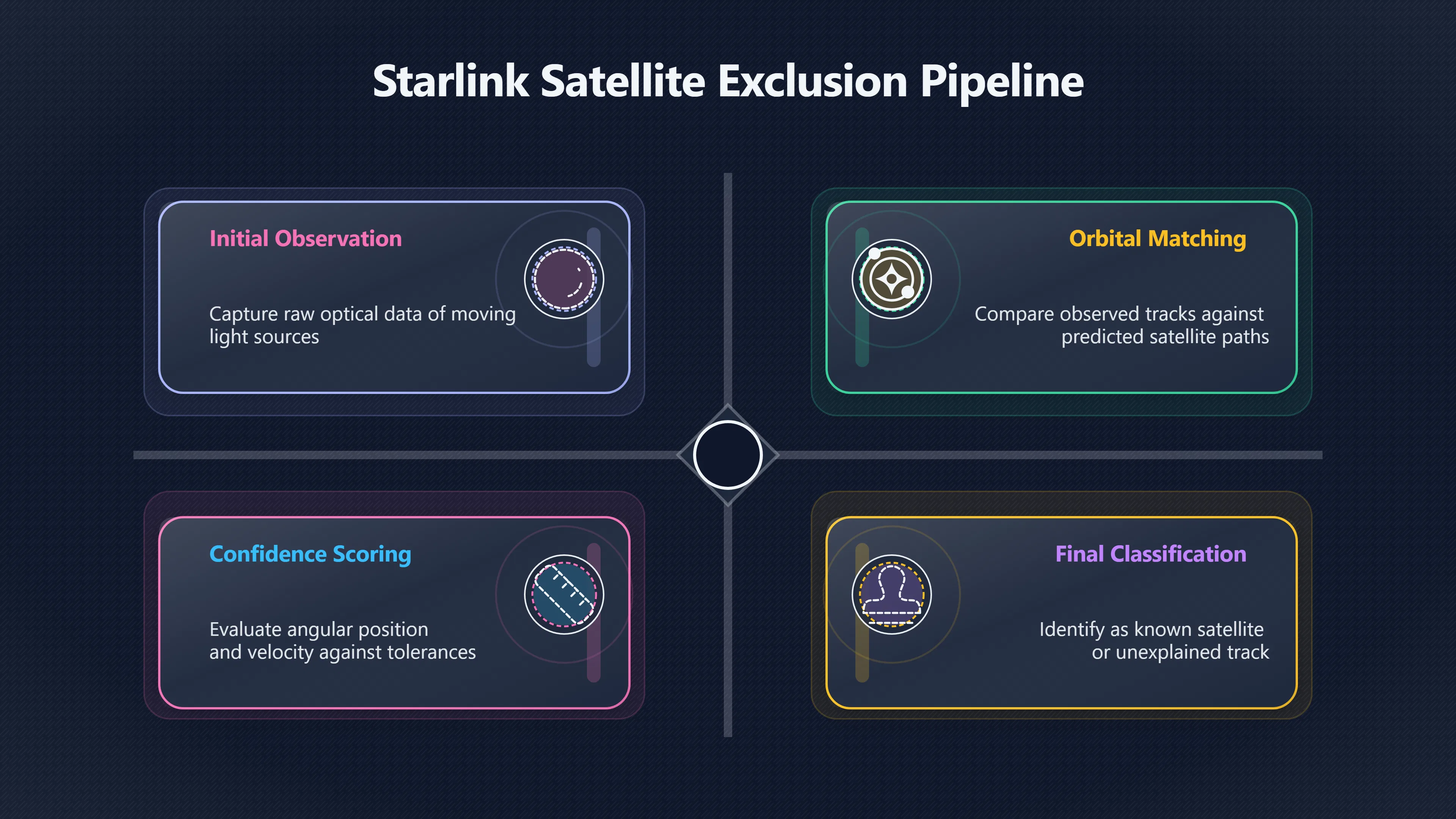
Ephemeris matching compares an observed object with predicted satellite positions computed from orbital element data. In practice, the detector propagates the orbit of every candidate satellite to the exact observation time, projects those positions into the camera’s field of view, and tests whether any predicted track agrees with the measured one within defined tolerances.
For an automated UFO or UAP detector, the comparison should involve more than a single positional coincidence. A robust implementation evaluates several independent quantities:
- Angular position: does the predicted location fall within the measurement uncertainty?
- Track direction: does the observed motion match the predicted bearing?
- Angular speed: is the apparent velocity consistent with orbital motion?
- Timing: does the object appear and disappear when the predicted pass occurs?
- Visibility geometry: is the satellite actually illuminated by the Sun while the observer is in darkness?
- Brightness consistency: although less reliable than geometry, does the observed light curve broadly resemble expectations for that satellite?
Using multiple tests reduces accidental matches in crowded low-Earth-orbit environments, where hundreds of satellites may be above the horizon simultaneously.
Most implementations rely on publicly available General Perturbations (GP) element sets—commonly distributed as Two-Line Elements (TLEs)—propagated with the standard SGP4 orbital model. Modern libraries such as Skyfield use these data directly and explicitly warn that prediction quality depends on the age and quality of the underlying orbital elements.[Rhodes Mill]rhodesmill.orgRhodes Mill Earth Satellites — Skyfield documentationTLE element set's predictions are…
Why Starlink Makes Orbit Matching Harder
Starlink introduces several complications that distinguish it from older satellite populations.
First, satellites are frequently manoeuvred. During launch deployment they actively climb through a sequence of parking and operational orbits, meaning their trajectories diverge from simple ballistic predictions. Researchers developing automated tracking methods found that newly deployed Starlink spacecraft required recursive orbit updates rather than relying on a single initial TLE, achieving reliable associations only by continually incorporating fresh observations.[RAA Journal]raa-journal.orgRAA JournalTracklet-to-object Matching for Climbing Starlink Satellites…October 14, 2022 — by B Li · 2022 · Cited by 14 — This paper p…
Second, Starlink satellites often travel in dense groups. A wide-field camera may record several nearly parallel tracks simultaneously, so the matching software must identify which prediction corresponds to which observation instead of merely confirming that “a Starlink was nearby”.
Third, optical appearance is a poor discriminator. The same satellite may be almost invisible during one pass yet produce an intense specular glint on another because of changing Sun-spacecraft-observer geometry. The orbital match therefore carries more evidential weight than brightness alone. AARO’s analysis of satellite flaring emphasises that such reflections can readily be mistaken for anomalous objects unless orbital context is considered.[AARO]aaro.milCorrelations of Starlink Satellite Flaring with UAPCorrelations of Starlink Satellite Flaring with UAP…January 24, 2025 — by A An · 2024 — This paper discusses specular and diffuse…
Why Stale Orbital Data Causes False Alerts
Ephemeris matching is only as reliable as the orbital data supplied to it.
Public TLEs are snapshots of an orbit at a particular epoch. As atmospheric drag, attitude changes and propulsion alter a spacecraft’s motion, prediction errors grow with time. Skyfield’s documentation cautions that TLE accuracy naturally degrades as one moves away from the epoch for which the elements were generated.[Rhodes Mill]rhodesmill.orgRhodes Mill Earth Satellites — Skyfield documentationTLE element set's predictions are…
For Starlink this matters because satellites manoeuvre routinely. Recent empirical work comparing propagated public TLEs with later operator-derived orbital information found that median position errors increase substantially over periods of several days, with kilometre-scale errors appearing even after relatively short intervals and much larger along-track divergence after a week. While this 2026 study has not yet undergone full peer review, its findings are consistent with the operational expectation that frequently updated element sets are essential for precision matching.[arXiv]arxiv.orgHow long can you trust a Starlink TLE? An empirical comparison of SGP4 and high-fidelity propagation against operator-updated truth…
The practical consequences for an automated detector include:
- rejecting a genuine satellite because its prediction misses the recorded track;
- falsely classifying a known satellite as unexplained;
- associating the observation with the wrong member of a satellite cluster;
- producing inconsistent classifications when historical data are reprocessed using newer orbital elements.
A detector that claims a “non-match” without recording the age of the orbital catalogue cannot distinguish between an unknown object and an outdated ephemeris.
Improving Match Quality with Better Ephemerides
Many operational systems now supplement traditional public TLE catalogues with higher-quality orbital products where available.
CelesTrak distributes Supplemental GP (SupGP) element sets derived from operator-provided ephemerides for several constellations, including Starlink. These products are intended to reduce latency and improve positional accuracy compared with element sets derived solely from surveillance observations, making them particularly useful for exclusion pipelines where false positives are costly.[CelesTrak]celestrak.orgCurrent Supplemental GP Element SetsSupplemental GP Data. Starlink Matching Results, All Launches: 3,654* Derived from latest St…
For automated instrumented detectors, a sensible priority order is:
- Operator-supplied or supplemental ephemerides when available.
- Fresh public GP/TLE or OMM (Orbit Mean-Elements Message) data.
- Older public elements only with progressively larger uncertainty envelopes.
- No satellite exclusion once the uncertainty exceeds a predefined threshold.
This hierarchy allows the software to express confidence quantitatively instead of treating every orbital prediction as equally reliable.
How to Make Matches Auditable
An exclusion is only scientifically useful if another investigator can reproduce it.
Rather than storing only the statement “matched Starlink”, the detector should preserve the evidence used to reach that decision, including:
- the exact orbital element file and its publication time;
- satellite catalogue identifiers;
- propagation software and version;
- observation timestamp after clock calibration;
- observer position and camera calibration;
- residual angular error between prediction and observation;
- acceptance thresholds used by the matching algorithm;
- alternative candidate satellites considered and rejected.
Keeping these records allows later reviewers to rerun the propagation if improved orbital data become available. An event can then be reclassified transparently rather than relying on undocumented judgement.
This approach also separates two distinct conclusions:
- Positive exclusion: the observation matches a known satellite within documented tolerances.
- No reliable match: available orbital data cannot confidently explain the observation.
Those conclusions are not equivalent. The second reflects uncertainty in the catalogue or prediction, not necessarily evidence for an anomalous object.
What an Orbit Match Does—and Does Not—Prove
Ephemeris matching is best viewed as a falsification tool. If an observed trajectory agrees closely with a predicted Starlink pass using appropriate orbital data, the simplest explanation is that the detector recorded that satellite, regardless of whether the light briefly resembled a flare or an apparently unusual object.
Conversely, failure to obtain a match should trigger additional checks before an event is considered unexplained. Investigators should verify clock synchronisation, camera pointing calibration, catalogue freshness, propagation settings, and whether a recently launched or manoeuvring satellite could have escaped accurate prediction. Only after those ordinary explanations have been examined does an unmatched track become a meaningful candidate for further investigation.
For automated instrumented UFO detection, ephemeris matching is therefore not merely a convenience but a core quality-control stage. As satellite constellations continue to expand, the credibility of any unexplained-event catalogue increasingly depends on demonstrating that known spacecraft were excluded using current, reproducible orbital information rather than assumption or visual impression.
Amazon book picks
Further Reading
Books and field guides related to Can the Track Match a Known Satellite?. Use these as the next step if you want deeper reading beyond the article.
Fundamentals of Astrodynamics
Rating: 4.5/5 from 12 Google Books ratings
Explains orbit propagation principles.
eBay marketplace picks
Marketplace Samples
Example marketplace items related to this page. Use the search link to explore similar finds on eBay.

Endnotes
1.
Source: aaro.mil
Title: Correlations of Starlink Satellite Flaring with UAP
Link:https://www.aaro.mil/Portals/136/PDFs/Information%20Papers/AARO_Satellite_Flaring_Paper.pdf
Source snippet
Correlations of Starlink Satellite Flaring with UAP...January 24, 2025 — by A An · 2024 — This paper discusses specular and diffuse...
Published: January 24, 2025
2.
Source: celestrak.org
Link:https://celestrak.org/NORAD/elements/supplemental/
Source snippet
Current Supplemental GP Element SetsSupplemental GP Data. Starlink Matching Results, All Launches: 3,654* Derived from latest St...
3.
Source: raa-journal.org
Link:https://www.raa-journal.org/issues/all/2022/v22n11/202211/P020221110639422377110.pdf
Source snippet
RAA JournalTracklet-to-[object Matching]({{ 'object-matching/' | relative_url }}) for Climbing Starlink Satellites...October 14, 2022 — by B Li · 2022 · Cited by 14 — This paper p...
Published: October 14, 2022
4.
Source: arxiv.org
Link:https://arxiv.org/abs/2605.19850
Source snippet
How long can you trust a Starlink TLE? An empirical comparison of SGP4 and high-fidelity propagation against operator-updated truth...
5.
Source: arxiv.org
Link:https://arxiv.org/html/2605.19850v1
Source snippet
How long can you trust a Starlink TLE? An empirical...19 May 2026 — An empirical comparison of SGP4 and high-fidelity propagation agains...
Published: May 2026
6.
Source: celestrak.org
Link:https://celestrak.org/NORAD/documentation/gp-data-formats.php
Source snippet
A New Way to Obtain GP Data (aka TLEs)CelesTrak uses OLDEST with the Active satellites list to only show those satellite's whose GP data...
7.
Source: celestrak.org
Link:https://celestrak.org/NORAD/elements/
Source snippet
NORAD GP Element Sets Current DataA set of graphs and tables that show everything from the age distribution of the latest GP data, recent...
8.
Source: celestrak.org
Title: IA C-25-A6.7.1 Page 1 of 7 IAC-25
Link:https://celestrak.org/publications/IAC/2025/IAC-25%2CA6%2C7%2C1%2Cx99453%2CPaper.pdf
Source snippet
IAC-25-A6.7.1 Page 1 of 7 IAC-25-...Abstract. Increasing orbital congestion, with satellites that maneuver more frequently, has uncovere...
9.
Source: celestrak.org
Link:https://celestrak.org/publications/AAS/07-127/
Source snippet
Publications [AAS 07-127]1 Jul 2022 — This paper will assess the suitability of these approaches by comparing SGP4 ephemerides to precisi...
10.
Source: arxiv.org
Link:https://arxiv.org/html/2506.13034v1
Source snippet
Time Series Dataset towards Satellite Orbit Analysis16 Jun 2025 — This study seeks to address this gap by collecting and curating a repre...
11.
Source: rhodesmill.org
Title: Rhodes Mill Earth Satellites — Skyfield documentation
Link:https://rhodesmill.org/skyfield/earth-satellites.html
Source snippet
TLE element set's predictions are...
12.
Source: pypi.org
Link:https://pypi.org/project/sgp4/
Source snippet
Track Earth satellites given TLE data, using up-to-date 2020 SGP4 routines. uses it to compute the positions of satellites in Earth orbit...
13.
Source: apify.com
Title: celestrak tle satellites scraper
Link:https://apify.com/parseforge/celestrak-tle-satellites-scraper
Source snippet
Celestrak Satellite TLE Tracker Scraper15 May 2026 — The CelesTrak Satellites Orbital Catalog Scraper pulls the official CelesTrak orbita...
Published: May 2026
Additional References
14.
Source: conference.sdo.esoc.esa.int
Link:https://conference.sdo.esoc.esa.int/proceedings/sdc5/paper/57/SDC5-paper57.pdf
Source snippet
determination issues and results to incorporate optical...by DA Vallado · Cited by 12 — The data center concept conclusively demonstrate...
15.
Source: reddit.com
Link:https://www.reddit.com/r/Starlink/comments/enpdft/which_tracking_site_has_the_correct_info/
16.
Source: researchgate.net
Link:https://www.researchgate.net/publication/381565374_Maneuver_strategies_of_Starlink_satellite_based_on_SpaceX-released_ephemeris
Source snippet
Maneuver strategies of Starlink satellite based on SpaceX...13 Jun 2024 — PDF | On Jun 1, 2024, Airong Liu and others published Maneuver...
17.
Source: satchecker.readthedocs.io
Link:https://satchecker.readthedocs.io/en/latest/api.html
Source snippet
GET /tle/. Calculate [satellite ephemeris]({{ 'ephemeris-checks/' | relative_url }}) with a user-specified TLE at a specific Julian Date. Query...Read more...
18.
Source: en.moonbooks.org
Title: How to Plot Satellite Ground Tracks with Python Using Skyfield
Link:https://en.moonbooks.org/Articles/How-to-Plot-Satellite-Ground-Tracks-with-Python-Using-Skyfield-/
Source snippet
to Plot Satellite Ground Tracks with Python Using Skyfield?12 Jan 2026 — Skyfield performs high-precision orbital propagation using the...
19.
Source: space.stackexchange.com
Link:https://space.stackexchange.com/questions/63850/given-historical-tle-s-how-do-i-determine-the-path-orbit-lla-of-a-satellite-for
Source snippet
TLE's are not very accurate. Every time SGP4 changes to a new TLE, you will see a "jump" in the orbital...
20.
Source: astron.nl
Title: Second-Generation Starlink Satellites Leak 30
Link:https://www.astron.nl/starlink-satellites/
Source snippet
The second generation 'V2-mini' Starlink satellites emit up to 32 times brighter unintended radio waves than satellites from the pr...
21.
Source: github.com
Link:https://github.com/tannerkoza/celestrak-orbital-data
Source snippet
onstellations in LEO. The data is sourced from CelesTrak...Read more...
22.
Source: oas.inaf.it
Title: satconst AstroTalk OAS 3Nov2020
Link:https://www.oas.inaf.it/wp-content/uploads/2020/11/satconst_AstroTalk-OAS_3Nov2020.pdf
Source snippet
AND OTHER SATELLITE CONSTELLATIONS:24 Oct 2020 — Ephemeris: accurate, public, frequently updated, new format (now TLE) including covarian...
23.
Source: youtube.com
Title: Why “Racetrack” UFOs are mostly Starlink Flares
Link:https://www.youtube.com/watch?v=_VmrRGln1XA
Source snippet
Mick West satellite tracking ufo Why "Racetrack" UFOs are mostly Starlink Flares Mick West...
Topic Tree