Within Weather
What weather belongs in a UAP file?
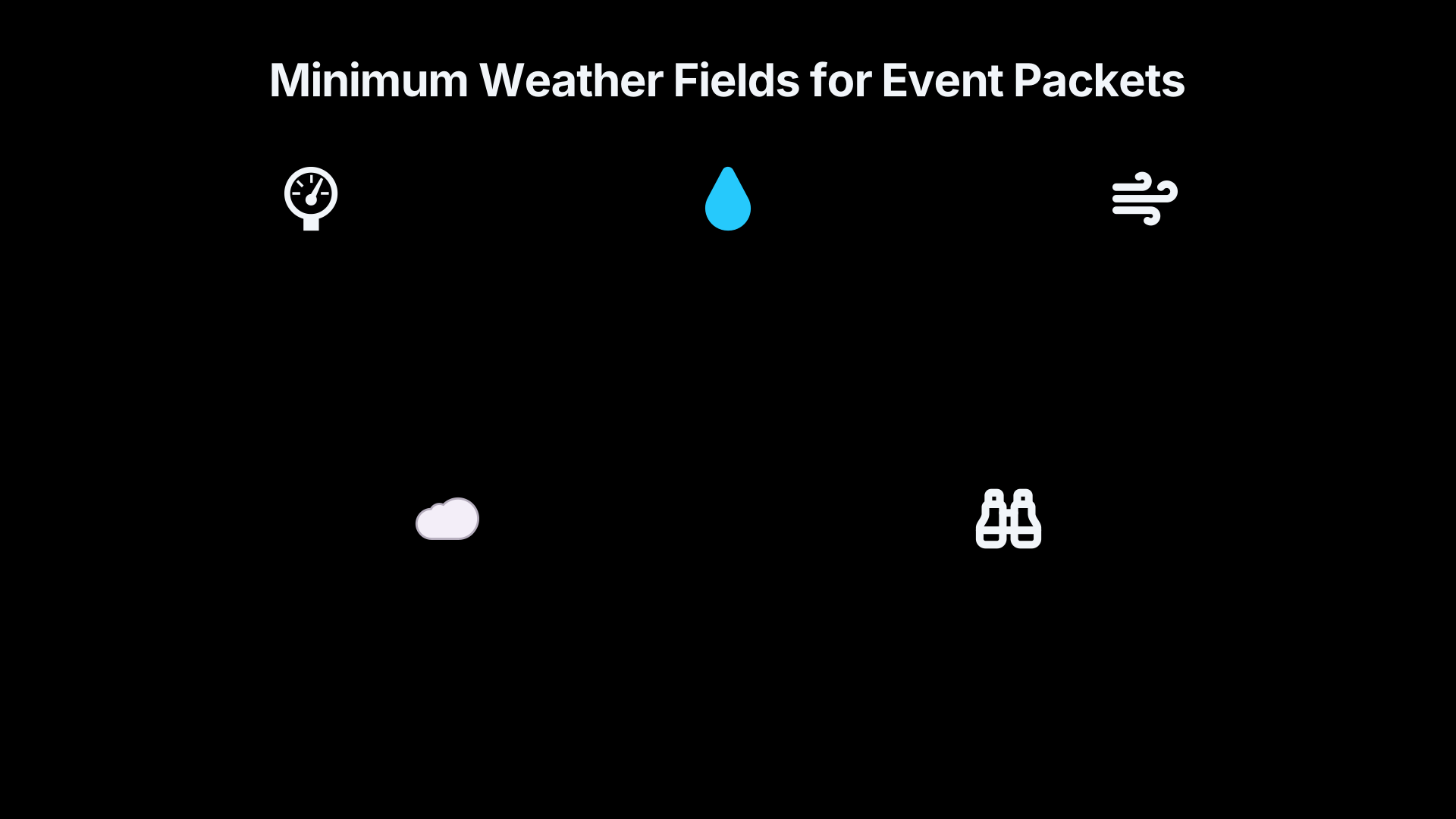
Temperature, humidity, pressure, wind, cloud, precipitation and sensor status make a UAP clip reviewable instead of impressionistic.
On this page
- Minimum weather fields for a useful event packet
- Linking weather data to camera and sensor metadata
- How missing context weakens chain of evidence
Page outline Jump by section
Introduction
A defensible UAP event record is more than a video, photograph or sensor trace. It is a package of evidence that allows other investigators to determine what the observing system was looking through, whether the environment could have influenced the observation, and whether the recorded behaviour is consistent with known atmospheric conditions. Weather metadata therefore serves as evidence, not decoration.
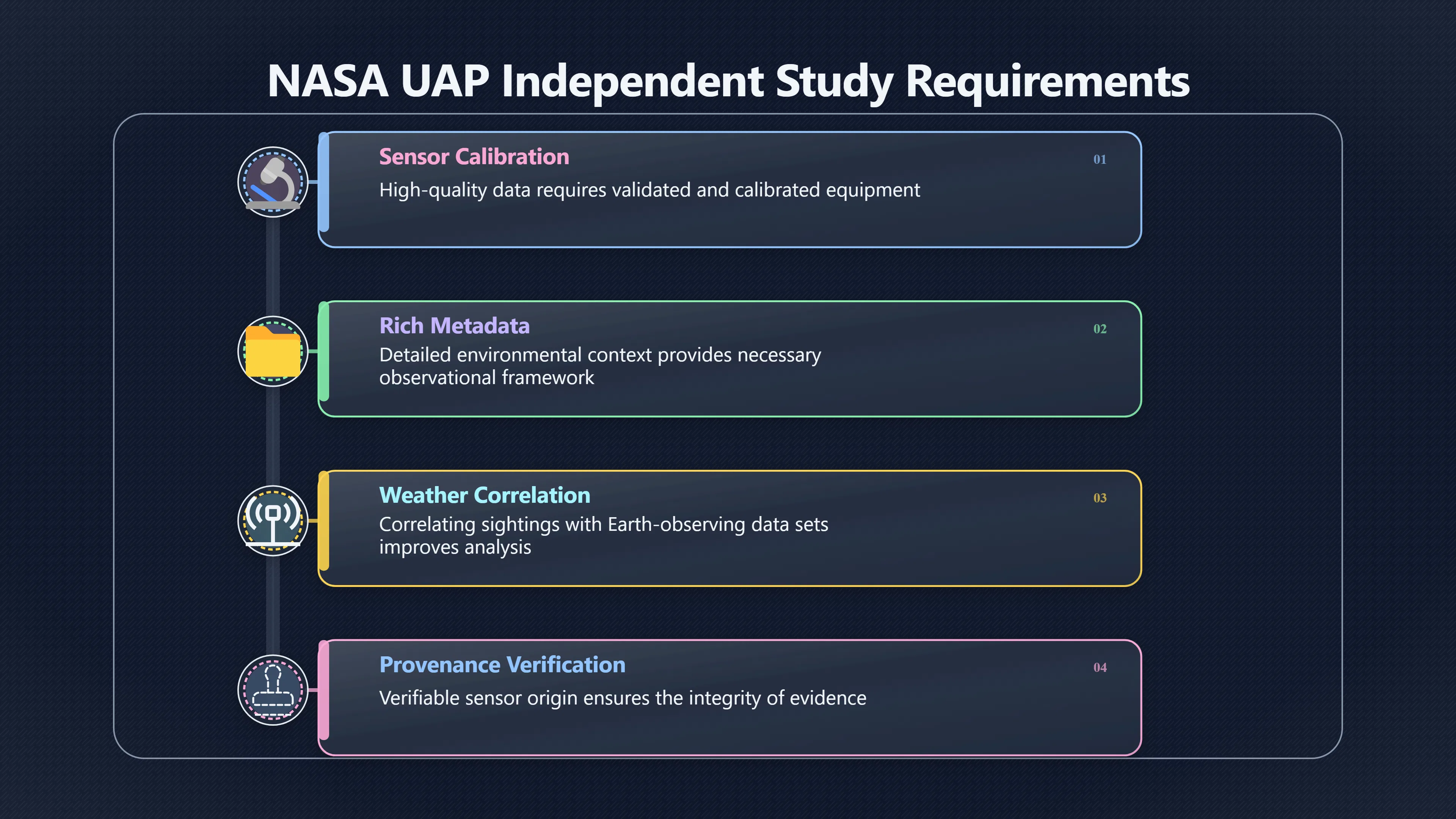
 This distinction has become increasingly important as automated, instrumented UAP detection systems replace anecdotal observation with continuous monitoring. NASA’s 2023 Independent Study Team concluded that meaningful progress depends on better-calibrated sensors, richer metadata and the inclusion of environmental information that can be correlated with observations. It specifically identified weather and other Earth-observing datasets as valuable context for analysing UAP reports.[NASA Science+2NASA]science.nasa.govNASA ScienceIndependent Study Team ReportThese data sets could help to identify weather, ocean, and other environmental characteristics c…
Minimum weather fields for a useful event packet
The objective is not to create a complete meteorological archive for every detection. Instead, the event packet should preserve enough information that another analyst can independently reconstruct the observing conditions at the moment the event occurred.
A practical minimum dataset includes:
- UTC timestamp with sub-second precision where possible.
- Observer location (latitude, longitude and elevation).
- Air temperature.
- Relative humidity.
- Atmospheric pressure.
- Surface wind speed and direction, including the averaging interval.
- Cloud cover, cloud type where observable, and estimated cloud base or ceiling.
- Visibility or estimated atmospheric transparency.
- Precipitation status, including drizzle, rain, snow or hail.
- Fog, mist, haze, smoke or dust if present.
- Nearby lightning or thunderstorm activity.
- Weather sensor health, including calibration status and any detected faults.
These variables mirror the information routinely collected in professional meteorological observing systems because each directly affects optical propagation, infrared performance or the movement of airborne objects. International guidance from the World Meteorological Organization (WMO) treats temperature, pressure, humidity, wind, precipitation and cloud observations as core meteorological variables measured using standardised methods.[World Meteorological Organization]wmo.intMEASUREMENT OF METEOROLOGICAL VARIABLES; Chapter 1. General; Chapter 2. Measurement of temperature; Chapter 3. Measurement of atmosphe…
A single value is often less useful than a short time series. Recording weather measurements for several minutes before and after an event helps distinguish transient atmospheric changes from persistent background conditions.
Linking weather data to camera and sensor metadata
Weather information only becomes evidential when it can be linked unambiguously to the sensor that generated the observation.
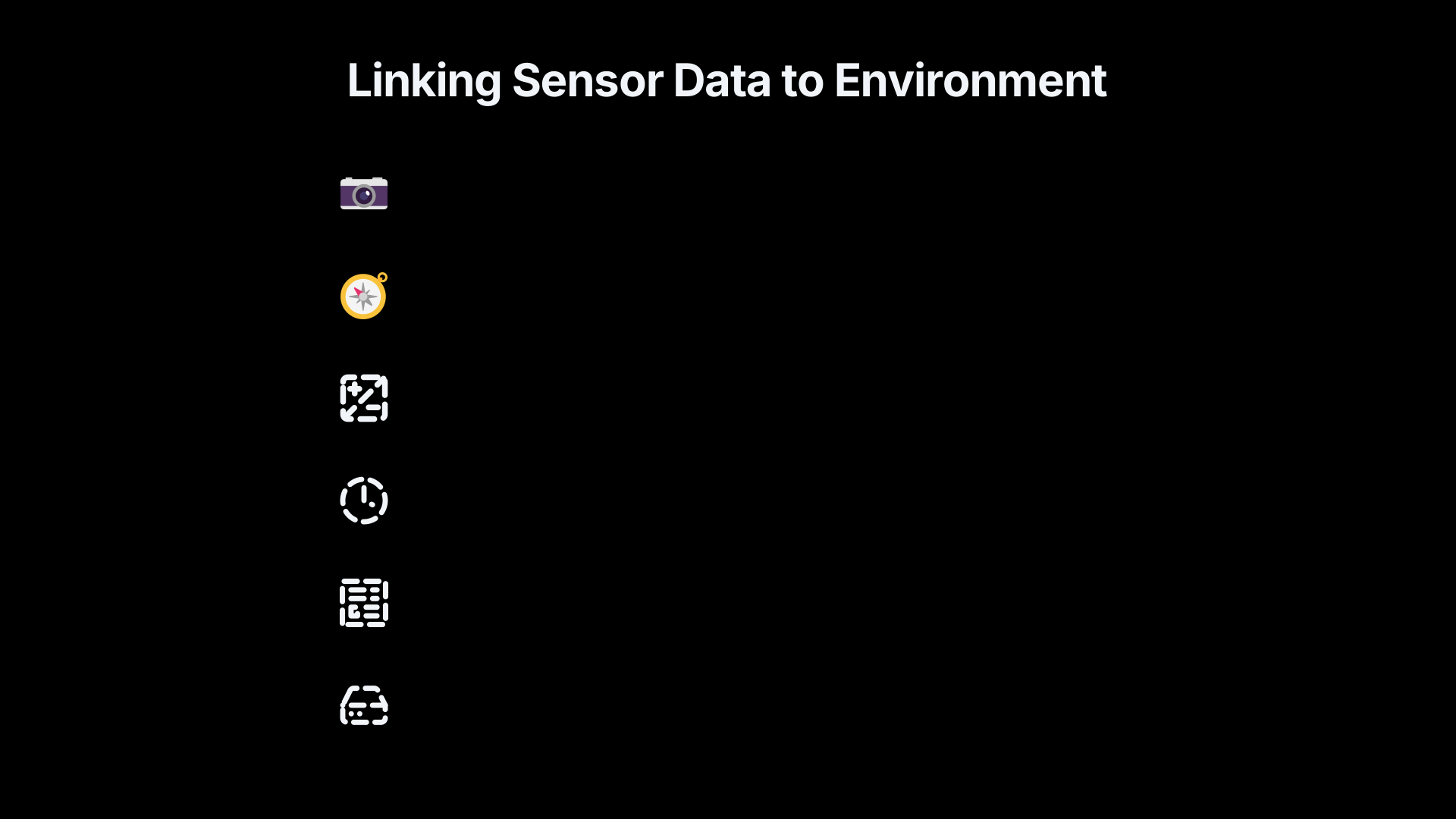
Each event should therefore associate environmental measurements with:
- camera identifier;
- sensor orientation (azimuth and elevation);
- lens and filter configuration;
- exposure settings;
- detector gain and frame rate;
- GPS position;
- synchronised clock source;
- software version;
- event identifier.
This linkage allows later investigators to determine whether an apparent anomaly resulted from atmospheric conditions, sensor behaviour or an interaction between both.
For example, increasing humidity combined with falling temperature may coincide with condensation on a camera enclosure. Strong winds may explain vibration in long-focal-length imagery. Thin cloud moving across the field of view may account for fluctuating brightness in a distant object. Without synchronised metadata, these relationships remain speculative rather than testable.
NASA’s Independent Study Team emphasised that metadata describing both the observed object and the observing instrument is essential because apparently unusual events have later proved to be sensor artefacts once calibration records and metadata were examined.[Wikisource]en.wikisource.orgPage:UAP Independent Study TeamPage:UAP Independent Study Team - Final Report.pdf/1512 Nov 2023 — Indeed, several apparent UAP have been demonstrated to be se…
Why weather measurements need provenance
Recording weather values alone is insufficient if their origin cannot be verified.
A defensible event record should preserve:
- the weather sensor model;
- calibration date;
- sampling interval;
- measurement uncertainty where known;
- firmware version;
- sensor location relative to the camera;
- whether values came from an on-site station or an external source.
This distinction matters because conditions can vary substantially over short distances. A regional weather report may accurately describe the surrounding area while failing to capture fog in a valley, sea-breeze effects along a coastline or cloud passing directly through the camera’s field of view.
Professional meteorological networks maintain extensive metadata describing station location, instrumentation, observing methods and equipment history precisely because observational context affects interpretation. Similar principles strengthen the evidential value of automated UAP monitoring.[NCEI]ncei.noaa.govfespans, including identifiers, names, locations, observation times…Read more…
Weather context that improves interpretation
Some environmental measurements become especially valuable when unusual observations occur.
Wind profiles. Surface wind may differ markedly from winds a few hundred or several thousand metres above ground. Comparing apparent object motion with upper-air observations can reveal whether an object is drifting with atmospheric flow rather than performing controlled manoeuvres.
Cloud structure. Knowing cloud base, cloud movement and cloud thickness helps determine whether an object passed behind a cloud, emerged through a gap or remained in front of the cloud layer throughout the event.
Visibility and aerosols. Smoke, haze and suspended particles affect contrast, colour and apparent brightness. A bright source viewed through varying aerosol concentrations can appear to pulse or change colour.
Precipitation. Rain or snow may generate false detections through reflections, illuminated droplets or transient streaks crossing the camera field.
Temperature and humidity. These variables influence thermal contrast for infrared systems and increase the likelihood of lens fogging or enclosure condensation.
The important point is not that weather explains every report, but that it provides measurable variables against which competing explanations can be tested.
Integrating external weather observations
Many automated detector networks benefit from combining local measurements with authoritative external datasets.
Useful complementary sources include:
- airport METAR observations;
- upper-air radiosonde launches;
- weather radar imagery;
- satellite cloud products;
- lightning detection networks;
- numerical weather model analyses.
These datasets should supplement rather than replace local measurements. A station-mounted weather sensor records the immediate observing environment, while regional and national datasets provide broader atmospheric context.
NASA’s report specifically highlighted the value of combining UAP observations with existing Earth science datasets to characterise coincident environmental conditions rather than treating each sighting as an isolated observation.[NASA Science]science.nasa.govNASA ScienceIndependent Study Team ReportThese data sets could help to identify weather, ocean, and other environmental characteristics c…
How missing context weakens the chain of evidence
Many disputed UAP recordings cannot be resolved because essential environmental information was never preserved.
Typical deficiencies include:
- no recorded wind conditions;
- uncertain cloud coverage;
- unknown visibility;
- inaccurate timestamps;
- missing sensor calibration records;[en.wikisource.org]en.wikisource.orgPage:UAP Independent Study Teamwikisource.orgPage:UAP Independent Study Team - Final Report.pdf/512 Nov 2023 — At present, analysis of UAP data is hampered by poor sens…
- inability to determine whether weather measurements were local or regional;
- no indication of weather sensor failures.
These omissions limit independent verification. Analysts may still propose explanations, but they cannot rigorously test them against the actual observing conditions.
Conversely, comprehensive weather metadata narrows the range of plausible interpretations. If wind, cloud motion, atmospheric transparency, precipitation and sensor health all remain inconsistent with conventional explanations, the event becomes stronger as an observational dataset—not because weather proves an extraordinary interpretation, but because ordinary environmental causes have been more thoroughly evaluated.
Building an evidence-quality event packet
For automated instrumented UAP detectors, weather metadata should be treated as a permanent component of every recorded event rather than an optional annotation added later.
A robust event packet therefore combines:
- synchronised timestamps;
- calibrated weather measurements;
- complete camera and sensor metadata;
- environmental provenance;
- continuous logging before, during and after the event;
- immutable storage preserving the original observations.
This approach shifts the discussion from subjective impressions of unusual footage towards reproducible evidence. Weather metadata cannot identify an unknown object on its own, but it provides the environmental framework needed for independent review, replication and scientifically defensible analysis.
Amazon book picks
Further Reading
Books and field guides related to What weather belongs in a UAP file?. Use these as the next step if you want deeper reading beyond the article.

UFOs : Generals, Pilots, and Government Officials Go on the R...
Provides context for richer, sensor-based case documentation.
eBay marketplace picks
Marketplace Samples
Topic-anchored marketplace searches for visual, collectible, or second-hand items related to this page.
Endnotes
1.
Source: science.nasa.gov
Link:https://science.nasa.gov/wp-content/uploads/2023/09/uap-independent-study-team-final-report.pdf
Source snippet
NASA ScienceIndependent Study Team ReportThese data sets could help to identify weather, ocean, and other environmental characteristics c...
2.
Source: nasa.gov
Title: update nasa shares uap independent study report names director
Link:https://www.nasa.gov/news-release/update-nasa-shares-uap-independent-study-report-names-director/
Source snippet
UPDATE: NASA Shares UAP Independent Study Report14 Sept 2023 — We found that NASA can help the whole-of-government UAP effort through sys...
3.
Source: en.wikisource.org
Title: Page:UAP Independent Study Team
Link:https://en.wikisource.org/wiki/Page%3AUAP_Independent_Study_Team_-_Final_Report.pdf/5
Source snippet
wikisource.orgPage:UAP Independent Study Team - Final Report.pdf/512 Nov 2023 — At present, analysis of UAP data is hampered by poor sens...
4.
Source: wmo.int
Link:https://wmo.int/guide-instruments-and-methods-of-observation-wmo-no
Source snippet
MEASUREMENT OF METEOROLOGICAL VARIABLES; Chapter 1. General; Chapter 2. Measurement of temperature; Chapter 3. Measurement of atmosphe...
5.
Source: community.wmo.int
Link:https://community.wmo.int/site/knowledge-hub/programmes-and-initiatives/instruments-and-methods-of-observation-programme-imop/guide-instruments-and-methods-of-observation-wmo-no-8
Source snippet
to Instruments and Methods of Observation (WMO-No. 8)PROCESS FOR UPDATING THE WMO-No. 8. Procedure for updating the Guide to Instruments...
6.
Source: en.wikisource.org
Title: Page:UAP Independent Study Team
Link:https://en.wikisource.org/wiki/Page%3AUAP_Independent_Study_Team_-_Final_Report.pdf/15
Source snippet
Page:UAP Independent Study Team - Final Report.pdf/1512 Nov 2023 — Indeed, several apparent UAP have been demonstrated to be se...
7.
Source: ncei.noaa.gov
Link:https://www.ncei.noaa.gov/access/homr/
Source snippet
fespans, including identifiers, names, locations, observation times...Read more...
8.
Source: en.wikisource.org
Link:https://en.wikisource.org/wiki/NASA_Unidentified_Anomalous_Phenomena%3A_Independent_Study_Team_Report/Responses_to_Statement_of_Task
Source snippet
NASA Unidentified Anomalous Phenomena: Independent...14 Oct 2023 — Thus, NASA can help determine whether specific environmenta...
9.
Source: community.wmo.int
Title: int Data Access and Use
Link:https://community.wmo.int/site/knowledge-hub/programmes-and-initiatives/wmo-space-programme-wsp/data-access-and-use-3
Source snippet
Access and Use - WMO CommunityAdditional observations of atmospheric Temperature and Humidity profile are also provided by measuring the...
10.
Source: community.wmo.int
Title: int CIM O Guide
Link:https://community.wmo.int/site/knowledge-hub/programmes-and-initiatives/weather-radar-observations/cimo-guide
Source snippet
Guide - WMO CommunityThe Preliminary 2018 Edition of the Guide to Meteorological Instruments and Methods of Observation (WMO-No. 8, CIMO...
11.
Source: community.wmo.int
Title: int Data Access
Link:https://community.wmo.int/data-access
Source snippet
Access - WMO CommunityData Access Basic information on access to satellite data and related information of relevance to WMO: See the Prod...
12.
Source: community.wmo.int
Link:https://community.wmo.int/standards-and-requirements-climate-observations
Source snippet
Technical references: Guide to Climatological Practices.Read more...
13.
Source: community.wmo.int
Title: int Knowledge-sharing Portal
Link:https://community.wmo.int/site/knowledge-hub/programmes-and-initiatives/instruments-and-methods-of-observation-programme-imop/knowledge-sharing-portal
Source snippet
wmo.intKnowledge-sharing Portal - WMO CommunityPurpose of this web portal is to enable Members to share their experience and knowledge on...
14.
Source: weather.gov
Link:https://www.weather.gov/media/epz/mesonet/CWOP-WMO8.pdf
Source snippet
Instruments and Methods of Observation was published in 1954 and consisted of twelve chapters. Since then.Read more...
15.
Source: science.nasa.gov
Link:https://science.nasa.gov/uap/
Source snippet
nasa.govUAP9 Jun 2022 — The UAP Independent Study shall report on the following questions: What types of scientific data currently collec...
16.
Source: en.wikisource.org
Title: Page:UAP Independent Study Team Final Report
Link:https://en.wikisource.org/wiki/Page%3AUAP_Independent_Study_Team_-_Final_Report.pdf/31
Source snippet
Status of Existing Data. NASA collects an enormous amount of data using highly-calibrated, validated equipment from a variety of...Read...
17.
Source: youtube.com
Title: UAP Independent Study Event Post-Meeting Media Teleconference (
Link:https://www.youtube.com/watch?v=C3uXUfgSadU
Published: May 31, 2023
18.
Source: research.reading.ac.uk
Title: reading.ac.uk Observatory metadata
Link:https://research.reading.ac.uk/meteorology/atmospheric-observatory/observatory-metadata/
Source snippet
metadata - Meteorology - ResearchThis observation includes 'eye' observations of cloud amount and types, present weather, visibility and...
19.
Source: seedmech.com
Link:https://www.seedmech.com/documents_folder/wmo_no_8.pdf
Source snippet
WORLD METEOROLOGICAL ORGANIZATIONThe purpose of the Guide to Meteorological Instruments and Methods of Observation is to support these ac...
20.
Source: amc.namem.gov.mn
Title: namem.gov.mn Guide to Instruments and Methods of Observation
Link:https://amc.namem.gov.mn/wp-content/uploads/WMO/1.%208_I-2023_en.pdf?_t=1638837866
Source snippet
Guide to Instruments and Methods of Observation... Many other Manuals and Guides issued by WMO refer to particular applications of meteo...
Additional References
21.
Source: reddit.com
Link:https://www.reddit.com/r/nasa/comments/16ij1ym/nasa_has_released_the_unidentified_anomalous/
Source snippet
NASA has released the Unidentified Anomalous...NASA has released the Unidentified Anomalous Phenomena independent study team's report wi...
22.
Source: news.sky.com
Link:https://news.sky.com/story/nasa-ufo-report-live-scientists-to-release-unidentified-anomalous-phenomena-findings-12960933
Source snippet
UFO report - live: Scientists release Unidentified...14 Sept 2023 — NASA has released a report on Unidentified Anomalous Phenomena - com...
23.
Source: iklim.bmkg.go.id
Link:https://iklim.bmkg.go.id/bmkgadmin/storage/regulasi/Guide%20to%20WIGOS%201165-2019_en.pdf
24.
Source: youtube.com
Link:https://www.youtube.com/watch?v=YXBsIOGsZE0
Source snippet
REPLAY! NASA Unidentified Anomalous Phenomena...NASA defines UAP as observations of events in the sky that cannot be identified associat...
25.
Source: avi-loeb.medium.com
Title: a new calculation on the fly to the nasa uap study 2dacaf860cac
Link:https://avi-loeb.medium.com/a-new-calculation-on-the-fly-to-the-nasa-uap-study-2dacaf860cac
Source snippet
New Calculation on the Fly to the NASA UAP Study - Avi LoebThe NASA Study will examine unclassified data on UAP in an attempt to separate...
26.
Source: Wikipedia
Title: NASA Unidentified Anomalous Phenomena Independent Study Team
Link:https://en.wikipedia.org/wiki/NASA_Unidentified_Anomalous_Phenomena_Independent_Study_Team
Source snippet
NASA Unidentified Anomalous Phenomena Independent...UAPs are defined as phenomena or observations of events in the air, sea, space, a...
27.
Source: nevadacurrent.com
Title: nasa report finds no evidence that ufos are extraterrestrial
Link:https://nevadacurrent.com/2023/09/18/nasa-report-finds-no-evidence-that-ufos-are-extraterrestrial/
Source snippet
18 Sept 2023 — Analysis of this data is “hampered by poor sensor calibration, the lack of multiple measurements, the lack of sensor metad...
28.
Source: uncclearn.org
Link:https://www.uncclearn.org/wp-content/uploads/library/wmo107.pdf
Source snippet
Instruments and Methods of Observation (WMO 1996) sets the required accuracy of...Read more...
29.
Source: astronomy.com
Title: nasa wants to take ufos seriously and scientifically
Link:https://www.astronomy.com/science/nasa-wants-to-take-ufos-seriously-and-scientifically/
Source snippet
NASA wants to take UFOs seriously — and scientifically19 Sept 2023 — The report highlighted the importance of gathering UAP data systemat...
30.
Source: aqxsolutions.com.au
Link:https://aqxsolutions.com.au/2024/11/28/wmo-guidelines-automatic-weather-station/
Source snippet
Automatic Weather Station: The WMO's Guidelines28 Nov 2024 — The “Guide to Instruments and Methods of Observation,” commonly known as WMO-No...
Topic Tree