Within Buy or Build
The Outdoor Problems That Break Sky Detectors
Condensation, insects, dirty domes and heat can make a detector miss events or create false ones before the software matters.
On this page
- Condensation, dirt and insects
- Heat, vibration and focus drift
- Design choices that make repairs easier
Page outline Jump by section
Introduction
An automated UFO detector can have excellent software, accurate time synchronisation and high-quality cameras yet still produce unreliable evidence because of ordinary outdoor problems. Condensation, insects, dust, heat, vibration and ageing plastic domes can all reduce image quality or generate false detections before any tracking algorithm has a chance to analyse the scene. For both commercial and DIY open-source systems, weatherproofing is therefore part of the measurement system rather than an optional mechanical detail. A detector that survives outdoors while maintaining stable optics, focus and sensor performance is more likely to produce data that can be independently evaluated than one that simply remains powered on.
Condensation, dirt and insects
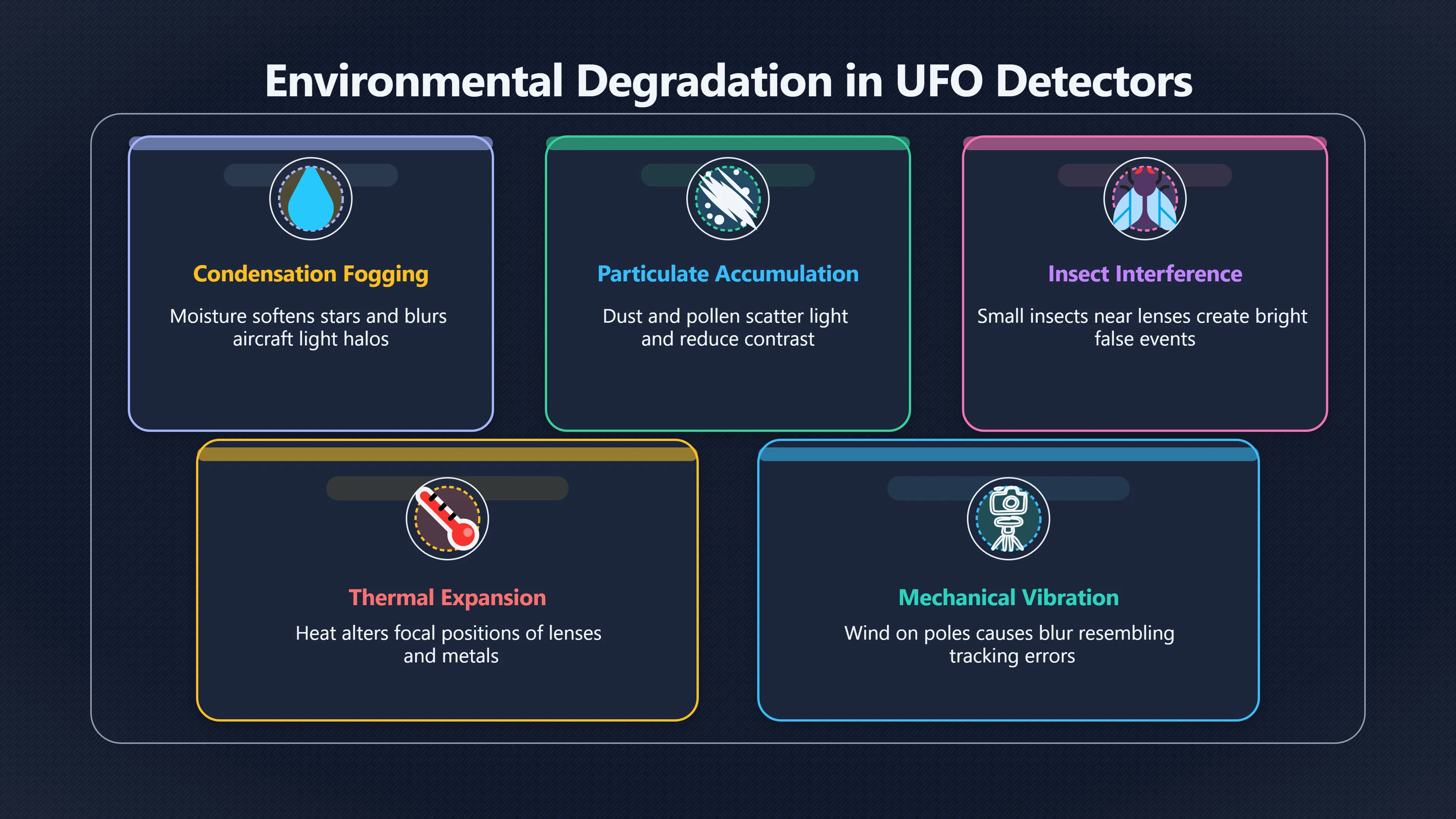
Condensation is one of the most common causes of silent data degradation. It affects both the outside of protective domes and the optical surfaces inside an enclosure.
When a clear dome or camera window cools below the surrounding air’s dew point, moisture forms on the surface. Instead of producing an obvious equipment failure, condensation typically softens stars, blurs aircraft lights into large halos and lowers contrast across the entire frame. Motion-detection software may respond by missing faint objects or incorrectly classifying diffuse reflections as moving targets. Dew is particularly troublesome because it often develops gradually over the course of the night, meaning early observations may be sharp while later recordings become unusable without any warning from the software. Astronomy imaging systems commonly address this with low-power dew heaters that gently warm the optical window rather than attempting to heat the entire enclosure. Excessive heating is avoided because it can create its own optical problems through rising warm air and unnecessary power consumption.[AstroBackyard]astrobackyard.comAstro Backyard Dew Heaters for AstrophotographyDew Heaters for Astrophotography - Keep Your Telescope/…November 2, 2017 — They are flexible, heat-emitting straps that w…
Internal condensation is a different failure mode. Even a housing with a high ingress-protection rating traps humid air when it is sealed. Overnight cooling can push that trapped air below its dew point, causing moisture to condense on lenses, sensor windows or electronic assemblies. Simply buying a waterproof enclosure does not prevent this. The internal humidity must also be managed using careful sealing, controlled ventilation where appropriate or replaceable desiccant packs. Temperature cycling alone is sufficient to produce repeated fogging inside many supposedly sealed camera housings.[Rosahl]micro-dehumidifier.comRosahlCondensation Control in Sealed CCTV Cameras: an OEM…March 23, 2026 — 23 Mar 2026 — In a perfectly sealed camera, temperature cyc…
Dirt creates slower but equally important degradation. Outdoor domes accumulate:
- Wind-blown dust that reduces contrast.
- Pollen that scatters bright lights.
- Bird droppings that obscure large parts of the field.
- Water spots from rain that dry into permanent deposits.
- Salt deposits in coastal locations.
Unlike dramatic failures, these contaminants often build up gradually, making it difficult to notice declining sensitivity unless regular reference images are reviewed.
Insects introduce another class of false events. Small insects flying close to an infrared illuminator or camera lens appear far brighter than their actual size because they are extremely close to the optics. Spiders frequently exploit warm enclosures by building webs directly across the field of view, where passing strands repeatedly trigger motion detection. These are well-known issues in outdoor CCTV systems and transfer directly to automated sky-monitoring stations.
Heat, vibration and focus drift
Keeping water out is only part of weatherproofing. Thermal stability is equally important.
Direct sunlight can raise the internal temperature of a weatherproof housing well above ambient air temperature. High temperatures increase electronic noise, shorten component life and can alter the focal position of lenses as plastics and metals expand. A detector carefully focused during a cool evening may become slightly defocused after a hot afternoon and remain that way throughout the night unless focus is checked again.
Wide-angle lenses often have substantial depth of field, masking small focus changes, but detectors using telephoto lenses or pan-tilt-zoom cameras are much more sensitive to thermal expansion. Even modest shifts can enlarge point sources enough to affect automated detection thresholds.
Cooling solutions also require balance. Continuous fans may reduce electronics temperature but can introduce dust, insects and humidity into the enclosure if poorly filtered. Completely sealed housings avoid contamination but require careful thermal design so that internal temperatures remain within specification. Many commercial outdoor cameras rely on passive heat sinking or controlled internal airflow rather than unrestricted ventilation for exactly this reason.[Rosahl]micro-dehumidifier.comRosahlCondensation Control in Sealed CCTV Cameras: an OEM…March 23, 2026 — 23 Mar 2026 — In a perfectly sealed camera, temperature cyc…
Mechanical vibration is another underestimated problem. Wind acting on lightweight poles, flexible tripods or poorly braced mounts causes image blur that resembles tracking errors. Repeated vibration also changes camera alignment over weeks or months. Since automated UAP detectors often compare object trajectories against calibrated star fields, even small changes in pointing can reduce positional accuracy if not periodically verified.

Design choices that make repairs easier
The most reliable sky stations are designed for maintenance rather than assuming maintenance will never be necessary.
Useful design choices include:
- Accessible optical windows. Domes and protective windows should be removable without dismantling the entire station, making routine cleaning straightforward.
- Replaceable desiccant. Moisture absorbers eventually saturate and should be easy to inspect and replace.
- Cable strain relief. Outdoor cables move in wind and during temperature changes. Proper strain relief prevents connectors from loosening or allowing water ingress.
- Service loops and drip loops. Allowing cables to hang below connectors before entering the enclosure helps rainwater drip away rather than following the cable into the housing.
- Separate electronics and optics. Isolating heat-producing electronics from the camera window reduces local thermal gradients and simplifies servicing.
- Health monitoring. Logging enclosure temperature, humidity and power consumption provides early warning that environmental conditions are drifting before image quality visibly declines.
DIY builders often overlook maintainability while concentrating on software features. Commercial systems frequently package these practical details into weatherproof enclosures, but even professionally designed hardware still requires periodic inspection. Outdoor installations exposed year-round inevitably accumulate environmental wear that no enclosure completely eliminates.
Why weatherproofing affects scientific credibility
For automated instrumented UFO detection, weatherproofing is not merely about protecting expensive equipment. It directly affects the credibility of every recorded event.
A blurred frame caused by dew, a bright streak produced by an insect centimetres from the lens or a slowly drifting focus caused by thermal expansion can all resemble unusual phenomena if environmental conditions are not documented. Conversely, poor weatherproofing can make genuinely interesting events impossible to analyse because image quality has quietly deteriorated over hours or weeks.
Commercial systems often reduce these risks through integrated outdoor housings, environmental sensors and tested mechanical designs, while DIY systems require the builder to engineer these protections independently. In either case, routine cleaning, humidity control, thermal management and stable mounting are as important to trustworthy observations as object-detection algorithms or machine-learning classifiers. A sky station that remains optically stable through changing weather produces evidence that is far easier to verify than one that merely survives outdoors.
Amazon book picks
Further Reading
Books and field guides related to The Outdoor Problems That Break Sky Detectors. Use these as the next step if you want deeper reading beyond the article.


eBay marketplace picks
Marketplace Samples
Example marketplace items related to this page. Use the search link to explore similar finds on eBay.

Endnotes
1.
Source: astrobackyard.com
Title: Astro Backyard Dew Heaters for Astrophotography
Link:https://astrobackyard.com/dew-heaters-astrophotography/
Source snippet
Dew Heaters for Astrophotography - Keep Your Telescope/...November 2, 2017 — They are flexible, heat-emitting straps that w...
Published: November 2, 2017
2.
Source: micro-dehumidifier.com
Link:https://micro-dehumidifier.com/condensation-control-sealed-cctv-cameras-oem/
Source snippet
RosahlCondensation Control in Sealed CCTV Cameras: an OEM...March 23, 2026 — 23 Mar 2026 — In a perfectly sealed camera, temperature cyc...
Published: March 23, 2026
Additional References
3.
Source: photographingspace.com
Link:https://www.photographingspace.com/dew-proofing/
Source snippet
How to Dew-Proof Your Camera LensLens heater/dew heater strap: A small powered heating band wrapped around the lens area is a common solu...
4.
Source: reddit.com
Link:https://www.reddit.com/r/telescopes/comments/1qba2pl/how_to_prevent_dew_in_my_dome/
Source snippet
How to prevent dew in my dome: r/telescopesHi, The school I work at has this awesome dome, but the dew is getting really bad during thes...
5.
Source: facebook.com
Link:https://www.facebook.com/groups/172438633343696/posts/1558501078070771/
Source snippet
I have a 80mm fan that runs constantly to keep the Pi5 and camera cool. I think that might be a mistake. I’m...
6.
Source: altairastro.help
Link:https://www.altairastro.help/info-instructions/faq/how-do-i-stop-dew-moisture-forming-on-the-outside-of-my-tec-camera-optical-window/
Source snippet
e front face of the camera and this usually clears it.Read more...
7.
Source: amazon.co.uk
Link:https://www.amazon.co.uk/Astronomical-Telescopes-Defogging-Anti-Condensation-Astronomy/dp/B0F323ZJKB?tag=searcht-20
Source snippet
w heater, designed for robustness and practicality.Read more...
8.
Source: youtube.com
Link:https://www.youtube.com/watch?v=Ki8jMwBaZ78
Source snippet
Using everything I have learned from the last year, I engineered a better version of my all sky camera. This one is performing much bette...
9.
Source: stargazerslounge.com
Link:https://stargazerslounge.com/topic/250320-lots-of-dew-in-all-sky-camera-dome/
Source snippet
Stargazers LoungeLOTS of dew in all-sky-camera dome:(- DIY Astronomer14 Aug 2015 — I found I needed a heater purely to disperse moistur...
10.
Source: youtube.com
Link:https://www.youtube.com/watch?v=j_Z7wwRWuNY
Source snippet
"1 Year Timelapse: [https://www.youtube.com/watch?v=Ki8jMwBaZ78..."](https://www.youtube.com/watch?v=Ki8jMwBaZ78...")...
11.
Source: youtube.com
Link:https://www.youtube.com/watch?v=fNCqcC54NUw
Source snippet
raphy community. I hope to clear up many of the unknowns...
12.
Source: youtube.com
Title: Zak La Joie
Link:https://www.youtube.com/watch?v=YRCQ2IVVCCs&list=PLnl2is7kXYTUt98t0g-w0VFwf1fHqW4uQ
Source snippet
This is my Allsky Camera build. This camera is located on the corner of my astro observatory and records the night (and day) skies. I oft...
Topic Tree