Within Sky Detectors
Why Weather Belongs in UFO Detection
Weather data helps analysts test whether clouds, wind, humidity, pressure, or atmospheric effects shaped an event.
On this page
- Which weather variables matter
- How weather explains some alarms
- Why co located sensors beat later lookups
Page outline Jump by section
Introduction
Weather belongs in UFO detection because a sky record without environmental context is often only a picture of uncertainty. For automated instrumented UAP detectors, local weather data can show whether an apparent object was moving with the wind, partly hidden by cloud, distorted by atmospheric refraction, brightened by haze, or misread because visibility and sensor contrast changed during the event. The practical goal is not to explain every report away, but to separate genuinely unexplained cases from cases shaped by ordinary sky conditions.
NASA’s 2023 UAP independent study made this point in scientific terms: existing UAP analysis is limited by poor calibration, missing sensor metadata and lack of baseline data, while Earth-observing data could help identify weather, ocean and other environmental characteristics coincident with UAP observations.[Wikisource]en.wikisource.orgPage:UAP Independent Study TeamPage:UAP Independent Study Team In automated detector networks, weather sensors turn that broad principle into event-level evidence.
Which weather variables matter
The minimum useful weather record for an instrumented UAP station is not a generic daily forecast. It is a time-stamped description of what the camera, radar, microphone or other sensor was looking through at the moment of detection.
For aerial analysis, the core variables are wind, visibility, cloud, temperature, humidity, pressure and precipitation. Aviation weather reports use a similar cluster: METAR observations report wind, visibility, weather phenomena, sky condition, temperature, dew point and altimeter setting, with special reports triggered by changes such as wind shifts, visibility drops, thunderstorms, precipitation and ceiling changes.[National Weather Service]weather.govNational Weather Service Microsoft WordNational Weather Service Microsoft Word That matters because UAP detectors face many of the same viewing problems as aviation observers: a small light, dark spot or ambiguous track may look very different under clear dry air, low cloud, fog, rain, dust, high humidity or rapidly changing wind.
Wind is especially important because many common UAP candidates are passive or semi-passive objects. Balloons, airborne debris, smoke plumes, some drones in drift, and high-altitude material can move in ways that seem purposeful from one camera angle but are consistent with wind once upper-air data are checked. Surface wind alone is not enough. The National Weather Service describes weather balloons and radiosondes as the best platform for observing temperature, wind, relative humidity and pressure above the ground, with observations transmitted during ascent through the atmosphere.[National Weather Service]weather.govNational Weather Service Education Corner weather balloonNational Weather Service Education Corner weather balloon A UAP record that includes only ground-level wind may miss the flow carrying an object at 3,000, 20,000 or 80,000 feet.
Humidity, temperature and pressure matter because they affect both atmosphere and instrument. They shape haze, fog, refraction, cloud formation and visibility; they can also influence sensor performance, camera focus, condensation and enclosure behaviour. UFODAP’s multi-sensor unit includes a barometer, temperature and humidity sensors, GPS timing, inertial sensors and a magnetometer in a rugged enclosure, showing how even citizen-science UAP systems increasingly treat environmental measurement as part of the event record rather than an optional note.[UFODAP]ufodap.comOpen source on ufodap.com.
Cloud data deserve special attention. A cloud layer can be the object, the screen behind the object, or the clue that the object is farther away than it looks. Cloud base and ceiling also help analysts test claimed altitude, range and speed. If a luminous object appears to pass “through” cloud in a video, knowing the cloud height, thickness and movement can distinguish a nearby object crossing in front of a cloud from a distant light intermittently obscured by it.

How weather explains some alarms
Weather does not explain every unresolved UAP record, but it explains enough false alarms that an automated detector should treat it as a first-class data stream. The U.S. intelligence community’s 2021 preliminary UAP assessment listed “natural atmospheric phenomena” as one explanatory category, including ice crystals, moisture and thermal fluctuations that may register on some infrared and radar systems; it also listed airborne clutter such as birds, balloons, small drones and debris.[Director of National Intelligence]dni.govOpen source on dni.gov. AARO’s public imagery page likewise includes official cases resolved as balloons and migratory birds, alongside unresolved reports still under analysis.[AARO]aaro.milOfficial UAP ImageryOfficial UAP Imagery
The key point is that environmental explanations often work through interaction rather than simple substitution. A weather balloon is not “weather” in the same sense as fog, but interpreting it depends on weather: launch schedules, altitude winds, ascent or descent profile, illumination, cloud cover and visibility. A bird flock is biological, but its detectability in infrared imagery may change with background temperature, humidity and viewing geometry. A satellite train is not atmospheric, but haze, thin cloud and twilight can make it appear as a strange string of lights rather than recognisable spacecraft.
Several recurring alarm patterns are weather-sensitive:
Stationary or slow lights near clouds. Low cloud, haze and moisture can scatter light from aircraft, towers, vehicles, the Moon or bright planets. If the camera is zoomed, out of focus or auto-exposing, a common light source may appear larger, softer or more structured than it is.
Fast apparent motion. A nearby insect, bird, windblown object or raindrop crossing a wide-field lens can appear to move at impossible speed if its range is unknown. Weather context helps because wind, precipitation and visibility can indicate whether small near-field targets were likely.
Infrared contrast surprises. Thermal cameras do not see the world as human eyes do. Background temperature, cloud temperature, humidity and atmospheric absorption can alter contrast. An object may look unusually dark or bright because the sensor is comparing it with sky, sea, cloud or terrain at a different temperature.
Mirage and refraction effects. Temperature gradients can bend light, shift apparent positions and make distant objects visible or distorted near horizons. This is particularly relevant for coastal, desert, mountain and cold-water settings, where strong vertical temperature contrasts can occur.
Cloud-shaped “craft”. Lenticular clouds and other structured clouds are a classic source of UFO reports because they can be smooth, lens-shaped and apparently stationary relative to terrain while winds flow through them. Weather evidence does not merely name the cloud type; it checks whether wind over terrain, humidity and cloud levels made that explanation plausible at the time.
The best automated systems do not ask “is it weather or UAP?” as a binary question. They ask whether the recorded event is consistent with known meteorology, known objects moving in meteorological conditions, sensor artefacts produced by those conditions, or something that remains anomalous after those tests.
Why co-located sensors beat later lookups
Looking up the nearest weather station after an event is useful, but it is weaker than measuring conditions at the detector. Weather changes over distance, altitude and minutes. A station 20 kilometres away may report clear conditions while the detector sits under a local cloud bank, sea fog, valley inversion or wind shear. For UAP analysis, that difference can decide whether a case is mundane, ambiguous or worth escalating.
Co-located sensors also solve a timing problem. Many UAP reports are short. If a camera trigger lasts six seconds, an hourly weather report may miss the gust, cloud break or visibility change that made the detection possible. Aviation practice recognises this by issuing special observations when significant thresholds change, not only on the hour.[Federal Aviation Administration]faa.govFederal Aviation Administration Chapter 7. Safety of FlightFederal Aviation Administration Chapter 7. Safety of Flight UAP detectors need the same logic: environmental data should be sampled continuously or at high enough cadence to match the event.
The UFODAP presentation states the problem bluntly: traditional UFO/UAP data collection has often been after the fact, with questionable provenance, and coincident environmental effects are often not measured at the time of sighting.[handprint.com]handprint.comPower Point PresentationPower Point Presentation Co-located weather sensing is a direct answer to that weakness. It records not just what the sky looked like, but what the observing system was experiencing.
This matters for chain of evidence. A useful UAP record should preserve:
- the event time and location;
- camera pointing, zoom, exposure and frame rate;
- local temperature, humidity, pressure and wind;
- cloud cover, cloud base or sky condition where available;
- precipitation, visibility and sky brightness;
- aircraft, satellite and balloon context;
- whether the sensor housing, lens or mount was affected by weather.
Without those details, later analysis may be forced to infer too much from a video frame. With them, analysts can test hypotheses instead of arguing from impressions.

What current detector projects already show
The most serious automated UAP projects now treat weather and environmental context as part of the instrument package. The Galileo Project’s multimodal observatory concept explicitly includes environmental sensors for ambient temperature, pressure, humidity and wind velocity, alongside cameras, radar-style receivers, radio spectrum analysers, microphones, magnetic-field sensors and energetic-particle measurements. Its stated reason for multiple modalities is to recognise artefacts and corroborate true detections.[galileo.hsites.harvard.edu]galileo.hsites.harvard.eduOpen source on harvard.edu.
That design choice is important because weather data are not a decorative add-on. They help each other sensor mean more. Optical cameras need visibility, cloud and sky brightness. Infrared cameras need temperature and humidity context. Acoustic sensors need wind and precipitation context because wind noise and rain can swamp weak signals. Radio and radar-style systems need atmospheric and environmental metadata to separate real tracks from clutter or propagation effects.
The Galileo Project’s later Observatory Class Integrated Computing Platform paper frames the broader problem as one of fragmented, uncalibrated data with insufficient metadata, and describes a system intended for real-time data acquisition, sensor optimisation and provenance management.[arXiv]arxiv.orgar Xiv1ar Xiv1 That is exactly where weather belongs: not as a human note attached later, but as metadata bound to the detection.
UAPx’s Catalina field expedition illustrates the same lesson from a different angle. The team deployed visible-light and infrared cameras, radiation detectors and other instruments, collected hundreds of hours of infrared video, and reported that several initially ambiguous observations were later resolved through analysis, while one primary ambiguity remained.[arXiv]arxiv.orgOpen source on arxiv.org. Its paper includes a specific subsection on Doppler weather radar, showing how external environmental and weather datasets can become part of case resolution rather than background decoration.[arXiv]arxiv.orgOpen source on arxiv.org.
Government work points in the same direction. AARO’s GREMLIN sensor suite is described publicly as a system for detecting, tracking and characterising UAP, with plans for a 90-day “pattern of life” deployment at a national security site.[Breaking Defense]breakingdefense.comOpen source on breakingdefense.com. A pattern-of-life campaign only works if it can distinguish unusual events from the normal local mix of aircraft, birds, satellites, balloons, drones, weather and sensor noise. Environmental baselines are therefore not peripheral; they are part of knowing what “normal” looks like.
Weather does not close a case by itself
Weather context is powerful, but it can also be overused. A report should not be dismissed merely because clouds, wind or humidity were present. The test is whether the environmental data explain the observed timing, motion, brightness, spectrum, range and sensor response.
For example, wind data can support a balloon hypothesis only if the object’s apparent motion, estimated altitude and timing are consistent with the wind profile. Cloud data can support an obscuration hypothesis only if the cloud layer was actually in the relevant line of sight. Humidity and temperature data can support a haze, fog or refraction explanation only if the optical geometry and local conditions match. A weather explanation that ignores the object’s measured track is no better than an extraordinary explanation that ignores the weather.
This is why co-located weather sensors should be paired with cross-checks rather than treated as a shortcut. A strong record combines local weather with aircraft transponder data, satellite predictions, astronomical positions, radar or passive radio measurements, multi-camera triangulation and the detector’s own calibration history. NASA’s report emphasised the value of calibrated sensors, advanced modelling and data analysis, and long-term Earth-system baselines for detecting and examining anomalies.[NASA Science]science.nasa.govOpen source on nasa.gov. Weather data help build that baseline, but they do not replace the rest of the measurement chain.
The practical standard for useful UAP weather records
A useful automated UAP weather record should answer three questions: what was the sky doing, what was the atmosphere doing to the sensor, and what ordinary objects or effects become plausible under those conditions?
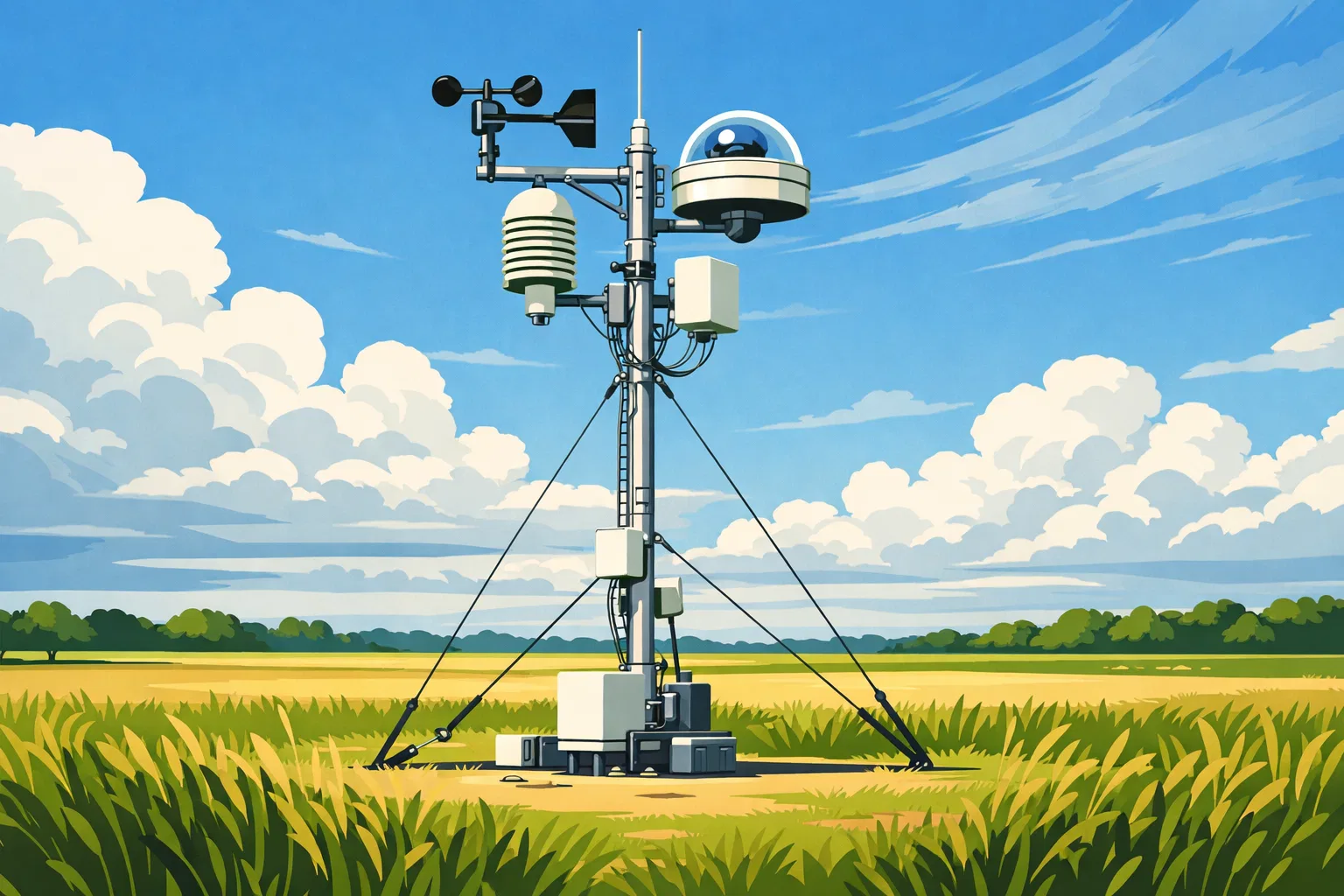
For a fixed sky station, the practical standard is a local weather package with synchronised timestamps and known calibration. At minimum, it should log temperature, humidity, pressure, wind speed and wind direction. Better stations add rain detection, sky brightness, cloud estimation, all-sky imagery, lightning data, lens or enclosure temperature, and links to external METAR, radar, satellite and upper-air datasets. For higher-quality analysis, the system should preserve raw or near-raw weather readings rather than only summary labels such as “clear” or “cloudy”.
The most valuable design choice is synchronisation. Weather readings need to be tied to the same clock as the cameras and other detectors. A barometer reading five minutes late, a wind sensor on a separate unsynchronised logger, or a weather lookup with no exact station distance can still help, but it weakens the evidential chain. GPS time, network time checks and clear file provenance make the weather record usable in later reconstruction.
Placement also matters. A wind sensor blocked by a wall, a temperature sensor heated by electronics, or a humidity sensor inside a poorly ventilated enclosure may produce misleading context. Weather instrumentation should be documented with the same care as cameras: height above ground, mounting location, shielding, calibration, sampling rate and maintenance history.
Why this changes the quality of UAP evidence
Weather sensing changes UAP records because it moves analysis from impression to comparison. Instead of asking whether a light “looked strange”, analysts can ask whether its apparent speed fits wind drift, whether it crossed a known cloud layer, whether visibility was low enough to hide reference points, whether humidity could have degraded contrast, whether an infrared target stood out only because of background temperature, or whether a gust coincided with vibration in the camera mount.
It also helps protect the genuinely interesting cases. When ordinary explanations are ruled out carefully, the remaining anomaly is stronger. A case that survives weather, aircraft, satellite, balloon, bird, drone and sensor-artefact checks is more valuable than a dramatic video with missing context. Conversely, a case resolved by weather evidence is not a failure of the detector. It is the detector doing its job: turning an alarm into a classified, evidence-backed event.
For automated instrumented UFO detectors, weather sensors are therefore not just meteorological accessories. They are part of the credibility system. They record the medium through which every sky observation passes, and they give later investigators a way to decide whether an event was unusual in the sky, unusual in the sensor, or unusual only because the environment was missing from the record.
Amazon book picks
Further Reading
Books and field guides related to Why Weather Belongs in UFO Detection. Use these as the next step if you want deeper reading beyond the article.

UFOs : Generals, Pilots, and Government Officials Go on the R...
Highlights the importance of high-quality observational evidence and corroborating data.
Weather For Dummies
Explains the core weather variables that affect aerial observations and sensor interpretation.
The AMS Weather Book
Covers visibility, clouds, storms, and other conditions that influence observations.
Meteorology today
Provides detailed coverage of atmospheric processes relevant to interpreting unusual sky observations.
eBay marketplace picks
Marketplace Samples
Live-tested eBay searches with available results related to this page.




Endnotes
1.
Source: en.wikisource.org
Title: Page:UAP Independent Study Team
Link:https://en.wikisource.org/wiki/Page%3AUAP_Independent_Study_Team_-_Final_Report.pdf/5
2.
Source: science.nasa.gov
Link:https://science.nasa.gov/wp-content/uploads/2023/09/uap-independent-study-team-final-report.pdf
3.
Source: weather.gov
Title: National Weather Service Microsoft Word
Link:https://www.weather.gov/media/surface/WSOH8.pdf
4.
Source: weather.gov
Title: National Weather Service Education Corner weather balloon
Link:https://www.weather.gov/gjt/education_corner_balloon
5.
Source: ufodap.com
Link:https://ufodap.com/technology
6.
Source: aaro.mil
Title: Official UAP Imagery
Link:https://www.aaro.mil/UAP-Cases/Official-UAP-Imagery/
7.
Source: handprint.com
Title: Power Point Presentation
Link:https://www.handprint.com/UFO/UFODAP_Presentation.pdf
8.
Source: galileo.hsites.harvard.edu
Link:https://galileo.hsites.harvard.edu/publications/scientific-investigation-unidentified-aerial-phenomena-uap-using-multimodal
9.
Source: arxiv.org
Title: ar Xiv1
Link:https://arxiv.org/html/2506.00125v1
10.
Source: arxiv.org
Link:https://arxiv.org/html/2312.00558v3
11.
Source: science.nasa.gov
Link:https://science.nasa.gov/uap/
12.
Source: science.nasa.gov
Link:https://science.nasa.gov/uap/faqs/
13.
Source: nasa.gov
Title: update nasa shares uap independent study report names director
Link:https://www.nasa.gov/news-release/update-nasa-shares-uap-independent-study-report-names-director/
14.
Source: nasa.gov
Link:https://www.nasa.gov/news-release/nasa-to-release-discuss-unidentified-anomalous-phenomena-report/
15.
Source: media.defense.gov
Title: FY24 CONSOLIDATED ANNUAL REPORT ON UAP 508
Link:https://media.defense.gov/2024/Nov/14/2003583603/-1/-1/0/FY24-CONSOLIDATED-ANNUAL-REPORT-ON-UAP-508.PDF
16.
Source: media.defense.gov
Title: DOPSR 2024 0263 AARO HISTORICAL RECORD REPORT VOLUME 1 2024
Link:https://media.defense.gov/2024/Mar/08/2003409233/-1/-1/0/DOPSR-2024-0263-AARO-HISTORICAL-RECORD-REPORT-VOLUME-1-2024.PDF
17.
Source: galileo.hsites.harvard.edu
Link:https://galileo.hsites.harvard.edu/
18.
Source: galileo.hsites.harvard.edu
Link:https://galileo.hsites.harvard.edu/search
19.
Source: galileo.hsites.harvard.edu
Link:https://galileo.hsites.harvard.edu/FAQ
20.
Source: arxiv.org
Link:https://arxiv.org/abs/2411.07956
21.
Source: arxiv.org
Link:https://arxiv.org/abs/2312.00558
22.
Source: ufodap.com
Link:https://ufodap.com/faq
23.
Source: avi-loeb.medium.com
Link:https://avi-loeb.medium.com/commissioning-data-on-half-a-million-objects-in-the-sky-from-the-galileo-project-observatory-are-a23bd084233a
24.
Source: en.wikisource.org
Title: Responses to Statement of Task
Link:https://en.wikisource.org/wiki/NASA_Unidentified_Anomalous_Phenomena%3A_Independent_Study_Team_Report/Responses_to_Statement_of_Task
25.
Source: aaro.mil
Link:https://www.aaro.mil/
26.
Source: aaro.mil
Title: Next UAP Report Documents
Link:https://www.aaro.mil/Next-AARO-Home-redesign/Next-Parent/Next-UAP-Report-Documents/
27.
Source: aaro.mil
Link:https://www.aaro.mil/FAQ/
28.
Source: weather.gov
Title: Chapter 11
Link:https://www.weather.gov/media/zhu/ZHU_Training_Page/Met_Tutorials/Weather_Theory.pdf
29.
Source: news.sky.com
Link:https://news.sky.com/story/nasa-ufo-report-live-scientists-to-release-unidentified-anomalous-phenomena-findings-12960933
30.
Source: faa.gov
Title: Federal Aviation Administration Chapter 7. Safety of Flight
Link:https://www.faa.gov/air_traffic/publications/atpubs/aim_html/chap7_section_1.html
31.
Source: dni.gov
Link:https://www.dni.gov/files/ODNI/documents/assessments/Prelimary-Assessment-UAP-20210625.pdf
32.
Source: breakingdefense.com
Link:https://breakingdefense.com/2024/11/gremlin-but-no-aliens-pentagon-uap-office-plans-first-deployment-of-new-sensor-suite/
33.
Source: faa.gov
Title: FAA H 8083 28A FAA Web
Link:https://www.faa.gov/sites/faa.gov/files/FAA-H-8083-28A_FAA_Web.pdf
34.
Source: dni.gov
Title: 4020 uap 2024
Link:https://www.dni.gov/index.php/newsroom/reports-publications/reports-publications-2024/4020-uap-2024
35.
Source: dni.gov
Title: Unclassified 2022 Annual Report UAP
Link:https://www.dni.gov/files/ODNI/documents/assessments/Unclassified-2022-Annual-Report-UAP.pdf
36.
Source: Wikipedia
Title: The Galileo Project
Link:https://en.wikipedia.org/wiki/The_Galileo_Project
37.
Source: ufodap.myshopify.com
Link:https://ufodap.myshopify.com/
38.
Source: ufodap.myshopify.com
Title: Cameras for UFO/UAP tracking and data collection
Link:https://ufodap.myshopify.com/collections/cameras
39.
Source: weather.cod.edu
Link:https://weather.cod.edu/notes/metar.html
Additional References
40.
Source: youtube.com
Title: NASA releases “Unidentified Anomalous Phenomena” flying object report
Link:http://www.youtube.com/watch?v=A-e-SmrGT0Y
Source snippet
NASA UAP Independent Study Team report science NASA: UAP Study Report Highlights IFLScience...
41.
Source: youtube.com
Title: International group of scientists searches for alien technology
Link:http://www.youtube.com/watch?v=KhiwoZ_rRwY
Source snippet
NASA releases "Unidentified Anomalous Phenomena" flying object report...
42.
Source: aviationweather.gov
Link:https://aviationweather.gov/gfa/
43.
Source: youtube.com
Title: Is This the Future of UFO Research? | The Galileo Project
Link:http://www.youtube.com/watch?v=4H0M8TdrgOs
Source snippet
International group of scientists searches for alien technology...
44.
Source: youtu.be
Title: Science with Gleb Solomin
Link:https://youtu.be/EnTXXyKSL64?si=fC2iXwQMyK1jCYFV
Source snippet
Galileo Project: Investigating the Science Behind Unidentified Anomalous Phenomena 🛸 #uap UAP Global Network...
45.
Source: war.gov
Title: department of defense releases the annual report on unidentified anomalous phen
Link:https://www.war.gov/News/Releases/Release/Article/3964824/department-of-defense-releases-the-annual-report-on-unidentified-anomalous-phen/
46.
Source: war.gov
Title: dr jon kosloski director aaro media roundtable on the fy24 consolidated annual
Link:https://www.war.gov/News/Transcripts/Transcript/Article/3965734/dr-jon-kosloski-director-aaro-media-roundtable-on-the-fy24-consolidated-annual/
47.
Source: researchgate.net
Link:https://www.researchgate.net/publication/278390344Instrumented_Monitoring_of_Aerial_Anomalies-_A_Scientific_Approach_to_the_Investigation_On_Anomalous_Atmospheric_Light_Phenomena
48.
Source: researchgate.net
Link:https://www.researchgate.net/publication/371163445_The_Scientific_Investigation_of_Unidentified_Aerial_Phenomena_UAP_Using_Multimodal_Ground-Based_Observatories
49.
Source: researchgate.net
Link:https://www.researchgate.net/publication/367076053_The_Scientific_Investigation_of_Unidentified_Aerial_Phenomena_UAP_Using_Multimodal_Ground-based_Observatories
Topic Tree