Within Review
A Better Way to Label UFO Alerts
Transparent categories separate explained cases, probable identifications, data-poor reports, and genuinely unresolved events without exaggerating uncertainty.
On this page
- Why binary labels distort the record
- The value of data poor categories
- How public archives can show uncertainty
Page outline Jump by section
Introduction
An automated instrumented UFO detector should not end its work by declaring an event either “identified” or “unidentified”. A more informative approach is to classify alerts by the quality of the evidence and the strength of the investigation. France’s GEIPAN (the UAP investigation office within the French space agency CNES) provides a useful model because its categories distinguish between confirmed explanations, probable explanations, cases that lack enough information, and cases that remain unexplained despite adequate investigation. That distinction matters for automated detection systems because it prevents poor-quality observations from being mistaken for genuine anomalies while making clear which alerts deserve further expert review.[cnes-geipan.fr+2cnes-geipan.fr]cnes-geipan.fr5. Classification into A, B, C, D · 6. Anonymizing the…Read more…

A Better Way to Label UFO Alerts
GEIPAN’s classification system is deliberately modest. Rather than treating every unresolved report as mysterious, it asks a simpler question: how much confidence does the available evidence support?
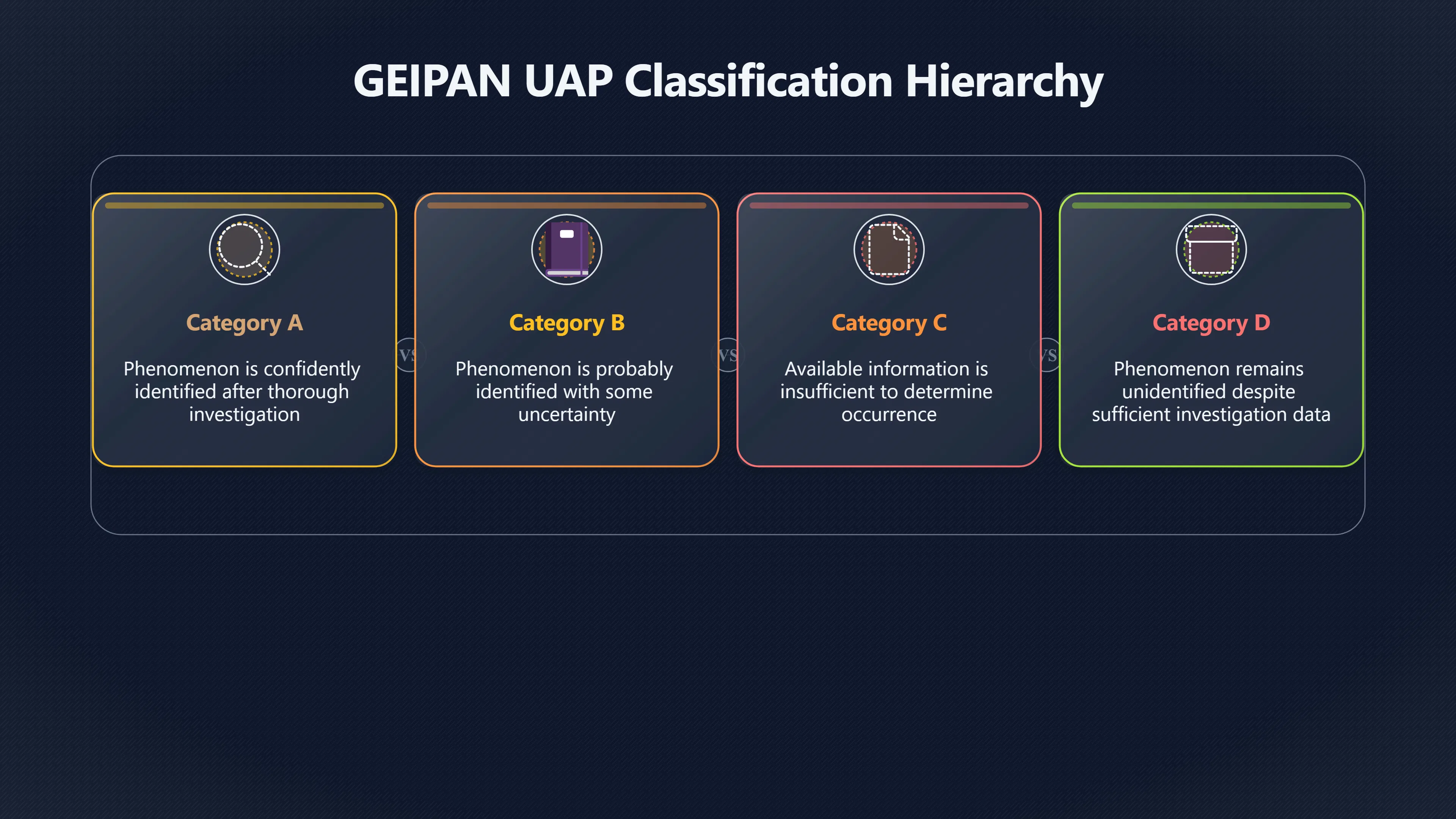
Its four principal categories are:
- Category A: the phenomenon is confidently identified after investigation.
- Category B: the phenomenon is probably identified, although some uncertainty remains.
- Category C: the available information is insufficient to determine what occurred.
- Category D: the phenomenon remains unidentified after investigation despite sufficient information being available for analysis.[cnes-geipan.fr]cnes-geipan.fr· Classification B: Phenomenon probably identified after investigation. · Classification C:…Read more…
For automated detector networks, these categories are better understood as outcomes of a review process rather than labels attached by the detection software itself. The detector generates a candidate event; human reviewers, supporting data and later analysis determine where that event belongs.
This approach also reinforces an important scientific principle emphasised by NASA’s Independent UAP Study Team: uncertainty should be represented explicitly rather than hidden behind overly confident classifications. Artificial intelligence is only as reliable as the quality and completeness of the data on which it is trained and evaluated.[NASA Science]science.nasa.govNASA ScienceIndependent Study Team ReportAI and ML in studying UAP depends critically upon the quality of the data used to train the AI a…
Why Binary Labels Distort the Record
A simple “UFO” versus “not UFO” decision encourages several kinds of error.
First, it treats incomplete evidence as though it carried the same weight as well-documented observations. A blurry single-frame light, for example, may be impossible to identify, but that does not mean it represents an unusual physical event.
Second, binary labels create misleading performance statistics. If every unresolved alert is counted as anomalous, the apparent success rate of a detector becomes dominated by poor-quality observations rather than meaningful detections.
Third, binary systems make machine learning harder. Algorithms trained on poorly separated classes may learn to associate image quality, weather conditions or sensor noise with “anomalies” instead of recognising genuine differences between ordinary and unusual observations.
GEIPAN’s categories avoid these problems by separating uncertainty arising from missing information from uncertainty arising after careful investigation. That distinction improves both scientific interpretation and public communication.[cnes-geipan.fr+2cnes-geipan.fr]cnes-geipan.fr· Classification B: Phenomenon probably identified after investigation. · Classification C:…Read more…
The Value of Data-Poor Categories
Perhaps the most instructive feature of the GEIPAN model is Category C: reports that cannot be identified because the available evidence is inadequate.
For automated detector networks, this category is extremely valuable.
Rather than forcing every alert into either “identified” or “unexplained”, a data-poor category acknowledges common operational limitations such as:
- cloud cover obscuring the object;
- only one sensor recording the event;
- incomplete metadata;
- insufficient image resolution;
- interrupted tracking;
- missing calibration information.
Treating these events separately prevents them from contaminating the genuinely unresolved set. A detector that honestly reports “insufficient evidence” is behaving more scientifically than one that confidently labels the same event anomalous.
NASA’s UAP study reached a similar conclusion from a different direction. The report repeatedly argues that most current UAP datasets suffer from inconsistent, incomplete or poorly calibrated observations, making data quality itself a primary obstacle to reliable analysis.[NASA Science]science.nasa.govNASA ScienceIndependent Study Team ReportAI and ML in studying UAP depends critically upon the quality of the data used to train the AI a…
Human Review Turns Machine Alerts into Reliable Classifications
GEIPAN’s published methodology demonstrates that classification comes only after investigation, not immediately after a report is received.
Its workflow includes receiving the report, creating a case file, conducting an initial analysis, carrying out additional investigation where needed, assigning one of the four classifications, and publishing appropriately anonymised results.[cnes-geipan.fr]cnes-geipan.fr5. Classification into A, B, C, D · 6. Anonymizing the…Read more…
An automated observatory can adopt the same philosophy by treating machine outputs as intermediate products.
A practical review pipeline might look like this:
- Generate an automated alert.
- Compare against aircraft, satellite, astronomical and weather databases.
- Review raw imagery and sensor diagnostics.
- Check for instrument artefacts or software tracking failures.
- Assign an evidence category rather than a simple anomaly label.
- Revisit cases if additional information later becomes available.
Importantly, GEIPAN explicitly allows Categories C and D to be reconsidered when new evidence emerges. That makes classification a living process instead of a permanent verdict.[cnes-geipan.fr]cnes-geipan.fr· Classification B: Phenomenon probably identified after investigation. · Classification C:…Read more…
How Public Archives Can Show Uncertainty
Another lesson from the GEIPAN model is transparency.
Because classifications are published alongside investigative outcomes rather than collapsed into a single “unexplained” list, researchers and the public can distinguish between different kinds of uncertainty.
For an automated detector archive, each alert could expose information such as:
- the confidence level of the identification;
- which sensors contributed;
- whether independent data sources agreed;
- whether human reviewers reached consensus;
- whether additional observations are needed;
- whether the case remains open for future reanalysis.
This provides a more accurate historical record than a simple count of “UFO detections”. It also enables later improvements in software or external databases to revisit older events without rewriting history.
Publicly separating “insufficient information” from “investigated but unresolved” also reduces the risk that readers interpret every unexplained case as evidence for extraordinary explanations. GEIPAN itself stresses that “unidentified” refers to the outcome of an investigation rather than to any particular hypothesis about the phenomenon’s nature.[cnes-geipan.fr]cnes-geipan.frThe GEIPAN's missionThe GEIPAN uses UAP (Unidentified Aerospace Phenomena) and not UFO. The term UFO has the double default of talking ab…
What Detector Networks Can Learn
The main contribution of a GEIPAN-style framework is governance rather than technology. It teaches that a trustworthy detector network should classify the strength of the evidence, not merely the apparent strangeness of an observation.
In practice, that means rewarding careful separation between:
- events confidently explained;
- events probably explained;[researchgate.net]researchgate.netPDF) A global picture of unidentified anomalous phenomena. (2022, October 4). A growing share of Americans believe aliens are responsibl…
- events that cannot yet be judged because the data are inadequate; and
- events that remain unexplained after a thorough review.
Such a system produces cleaner training data, more meaningful public statistics and a more scientifically honest archive. Most importantly, it prevents automated alerts from being interpreted as discoveries before the evidence justifies that conclusion.[cnes-geipan.fr+2cnes-geipan.fr]cnes-geipan.fr· Classification B: Phenomenon probably identified after investigation. · Classification C:…Read more…
Amazon book picks
Further Reading
Books and field guides related to A Better Way to Label UFO Alerts. Use these as the next step if you want deeper reading beyond the article.

UFOs : Generals, Pilots, and Government Officials Go on the R...
Focuses on evidence quality and documented cases.
eBay marketplace picks
Marketplace Samples
Live-tested eBay searches with available results related to this page.




Endnotes
1.
Source: cnes-geipan.fr
Link:https://www.cnes-geipan.fr/en/node/416
Source snippet
5. Classification into A, B, C, D · 6. Anonymizing the...Read more...
2.
Source: cnes-geipan.fr
Link:https://www.cnes-geipan.fr/en/node/412
Source snippet
· Classification B: Phenomenon probably identified after investigation. · Classification C:...Read more...
3.
Source: science.nasa.gov
Link:https://science.nasa.gov/wp-content/uploads/2023/09/uap-independent-study-team-final-report.pdf
Source snippet
NASA ScienceIndependent Study Team ReportAI and ML in studying UAP depends critically upon the quality of the data used to train the AI a...
4.
Source: nasa.gov
Link:https://www.nasa.gov/news-release/nasa-to-release-discuss-unidentified-anomalous-phenomena-report/
Source snippet
NASA to Release, Discuss Unidentified Anomalous...There are currently a limited number of high-quality observations of UAP, which ma...
5.
Source: cnes-geipan.fr
Link:https://www.cnes-geipan.fr/
Source snippet
un phénomène · Méthodologie.Read more...
6.
Source: cnes-geipan.fr
Link:https://www.cnes-geipan.fr/en/node/58791
Source snippet
tified after investigation. A revisit...Read more...
7.
Source: cnes-geipan.fr
Link:https://www.cnes-geipan.fr/en/node/58792
Source snippet
The GEIPAN's missionThe GEIPAN uses UAP (Unidentified Aerospace Phenomena) and not UFO. The term UFO has the double default of talking ab...
8.
Source: cnes-geipan.fr
Link:https://www.cnes-geipan.fr/en/node/58787
Source snippet
ClassificationThe GEIPAN's work is also scrutinized and criticized by some UFO blogs and associations who are pros of the alien hypothesi...
9.
Source: cnes-geipan.fr
Link:https://www.cnes-geipan.fr/en/missions-methodes-et-resultats
Source snippet
n hypothesis.. Image. GEIPAN 40ans Humour. Not...Read more...
10.
Source: cnes-geipan.fr
Link:https://www.cnes-geipan.fr/en/node/58788
Source snippet
in A, B, C, D1 or D2 · 6.Read more...
11.
Source: geipan.fr
Link:https://www.geipan.fr/en/faq-page
12.
Source: cnes.fr
Link:https://cnes.fr/en/projects/geipan
Source snippet
7 Jul 2025 — GEIPAN, the French UAP research and information group created by CNES in 1977, collects, analyses and archives information o...
13.
Source: videotheque.cnes.fr
Link:https://videotheque.cnes.fr/index.php?id_doc=39029&id_panier=&rang=115&urlaction=doc
Source snippet
classification with text minning and machine...GEIPAN classification with text minning and machine learning Jean-Marc Wattecamps; Titre...
14.
Source: science.nasa.gov
Link:https://science.nasa.gov/uap/
Source snippet
nasa.govUAP9 Jun 2022 — A study team to examine unidentified anomalous phenomena (UAPs) – that is, observations of events in the sky that...
15.
Source: nasa.gov
Title: update nasa shares uap independent study report names director
Link:https://www.nasa.gov/news-release/update-nasa-shares-uap-independent-study-report-names-director/
Source snippet
UPDATE: NASA Shares UAP Independent Study Report14 Sept 2023 — The report contains the external study team's findings and recommendations...
16.
Source: space.com
Title: nasa ufo study group better data needed
Link:https://www.space.com/nasa-ufo-study-group-better-data-needed
Source snippet
UFOs will remain mysterious without better data, NASA...31 May 2023 — NASA's UAP study team stressed that the biggest roadblock standing...
Published: May 2023
17.
Source: Wikipedia
Link:https://en.wikipedia.org/wiki/GEIPAN
Source snippet
GEIPANGEIPAN (an acronym in French for Groupe d'Études et d'Informations sur les Phénomènes Aérospatiaux Non-identifiés, or Unidentif...
Additional References
18.
Source: researchgate.net
Link:https://www.researchgate.net/publication/376891986_A_global_picture_of_unidentified_anomalous_phenomena_Towards_a_cross-cultural_understanding_of_a_potentially_universal_issue
Source snippet
(PDF) A global picture of unidentified anomalous phenomena. (2022, October 4). A growing share of Americans believe aliens are responsibl...
19.
Source: researchgate.net
Link:https://www.researchgate.net/publication/369507030_GEIPAN_classification_with_text_mining_and_machine_learning
Source snippet
GEIPAN classification with text mining and machine learningText mining and machine learning, parts of big data analysis, could effectivel...
20.
Source: academieairespace.com
Link:https://academieairespace.com/event/geipan-studies-uaps-ufos/?lang=en
Source snippet
GEIPAN studies UAPs/UFOs | AAEGEIPAN studies aerospace observations, unexplained phenomena observed in the sky, that have been reported t...
21.
Source: uapedia.ai
Link:https://uapedia.ai/wiki/geipan-frances-official-uap-unit/
Source snippet
GEIPAN: France's Official UAP UnitThe agency uses a structured classification system (A/B/C/D1/D2) based on weirdness and consistency, wi...
22.
Source: academia.edu
Link:https://www.academia.edu/101922617/The_Reliability_of_UFO_Witness_Testimony
23.
Source: facebook.com
Title: why are ufo files being released nowin 2026 the pentagon released 162 classified
Link:https://www.facebook.com/AskImtinan/posts/why-are-ufo-files-being-released-nowin-2026-the-pentagon-released-162-classified/1553980029628646/
Source snippet
Why Are UFO Files Being Released NOW? In 2026, the...UFOs / UAPs Did you know that "Unidentified Flying Objects" (UFO) are now called "U...
24.
Source: arxiv.org
Link:https://arxiv.org/pdf/2403.15368
Source snippet
Closing the Information Gap in Unidentified Anomalous...by GR Stahlman · 2024 · Cited by 8 — As emphasized by NASA [6], UAP-related data...
25.
Source: youtube.com
Link:https://www.youtube.com/watch?v=TQcqOW39ksk
Source snippet
Unidentified Anomalous Phenomena Independent Study ReportNASA commissioned an independent study team to examine unidentified anomalous ph...
26.
Source: Wikipedia
Title: NASA Unidentified Anomalous Phenomena Independent Study Team
Link:https://en.wikipedia.org/wiki/NASA_Unidentified_Anomalous_Phenomena_Independent_Study_Team
Source snippet
NASA Unidentified Anomalous Phenomena Independent...UAPs are defined as phenomena or observations of events in the air, sea, space, a...
27.
Source: portal.hr
Link:https://www.portal.hr/en/novosti/hr/78513-francuski-znanstvenici-demistificiraju-fenomen-nlo-a
Source snippet
UFO: Out of 3037 cases, only about a hundred are unsolved18 Feb 2024 — FRENCH SCIENTISTS DEMYSTIFY THE UFO PHENOMENON... Since its incep...
Topic Tree