Within Fixed vs Portable
What UAPx Learned the Hard Way
The UAPx Catalina expedition showed that mobile multi-sensor work can collect rich data while still missing crucial corroboration.
On this page
- The Catalina field setup and recorded data
- Missing metadata, inactive sensors, and timing problems
- What future portable teams can fix before deployment
Page outline Jump by section
Introduction
The 2021 UAPx expedition to Catalina Island is one of the clearest case studies of what a portable, multi-sensor UAP field campaign can achieve—and where it can fail. Rather than demonstrating that mobile deployments are either successful or unsuccessful, the expedition showed that portable systems can gather large volumes of potentially valuable data while still falling short of the level of corroboration needed to make strong scientific claims. The team’s own post-expedition analysis is unusually candid about missing metadata, sensor synchronisation problems, inactive equipment, and the practical compromises that accompany temporary field deployments. Those lessons are valuable not only for UAP research but for any attempt to build automated, instrumented UFO detection systems that must operate outside permanent observatories.[arXiv]arxiv.orgInitial Results From the First Field Expedition of UAPx to Study Unidentified Anomalous PhenomenaDecember 1, 2023…
The Catalina field setup and recorded data
The July 2021 expedition near Avalon on Catalina Island was designed as a temporary, multi-instrument observing campaign rather than a permanent monitoring station. UAPx deployed visible-light cameras, infrared cameras, radiation detectors and other environmental instruments, with software intended to identify moving targets through automated image differencing and related techniques. The objective was to collect simultaneous measurements from different sensors so that any unusual observation could be examined from multiple independent perspectives rather than relying on a single video clip.[arXiv]arxiv.orgInitial Results From the First Field Expedition of UAPx to Study Unidentified Anomalous PhenomenaDecember 1, 2023…
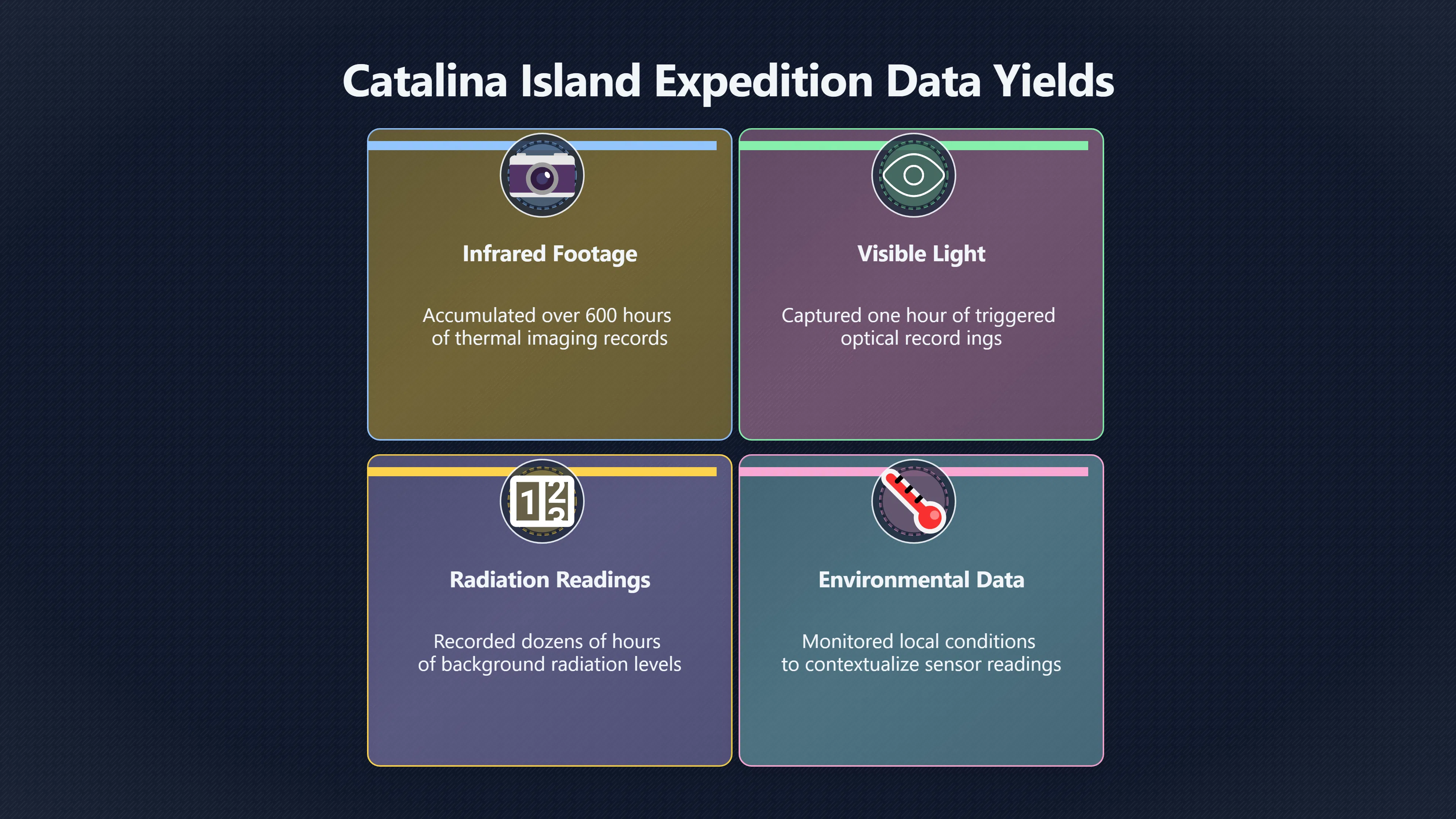
The campaign successfully demonstrated that a portable observatory can record substantial datasets in a relatively short period. According to the published results, the expedition accumulated more than 600 hours of infrared video, approximately one hour of triggered visible and near-infrared recordings, and dozens of hours of background radiation measurements. Most initially interesting observations were ultimately assigned conventional explanations after closer analysis, illustrating that multi-sensor recording helps eliminate false positives as well as search for genuine anomalies.[arXiv]arxiv.orgInitial Results From the First Field Expedition of UAPx to Study Unidentified Anomalous PhenomenaDecember 1, 2023…
Perhaps the most important outcome was methodological rather than observational. The expedition showed that transporting a diverse sensor suite into the field is feasible, but simply collecting many data streams does not guarantee that they can later be combined into a coherent reconstruction of an event.
Missing metadata, inactive sensors, and timing problems
The strongest lessons from the Catalina expedition came from the project’s own discussion of its limitations.
One recurring issue involved incomplete metadata. Scientific analysis depends not only on images but also on precise records of camera orientation, calibration, timestamps, environmental conditions and instrument status. Where those supporting records were incomplete or inconsistent, the evidential value of otherwise interesting observations fell sharply because investigators could not confidently reconstruct what every instrument was measuring at exactly the same moment.[arXiv]arxiv.orgInitial Results From the First Field Expedition of UAPx to Study Unidentified Anomalous PhenomenaDecember 1, 2023…
Timing presented another major obstacle. Portable systems assembled in the field often consist of independent instruments that were not originally designed to operate as a tightly synchronised observatory. Even modest uncertainties in clock synchronisation make it difficult to determine whether apparent detections on different sensors truly occurred simultaneously or merely appeared close together after later processing. For rare, short-lived events, accurate synchronisation becomes essential rather than desirable.[arXiv]arxiv.orgInitial Results From the First Field Expedition of UAPx to Study Unidentified Anomalous PhenomenaDecember 1, 2023…
The expedition also exposed the practical consequences of inactive or unavailable sensors. Some instruments were not operating continuously, while others did not provide corroborating observations during candidate events. As a result, potentially interesting detections could not always be cross-validated across independent measurement channels. Instead of strengthening the evidence, missing observations left investigators unable to distinguish between a genuine physical phenomenon, an instrumental artefact or a coincidence.
This is particularly important because modern multimodal observatory concepts are built around redundancy. Independent optical, infrared, radio, acoustic and environmental measurements are intended to confirm or reject one another. When one or more components are absent, the scientific confidence associated with any remaining observation drops considerably.[ResearchGate]researchgate.netResearchGate(PDF) The Scientific Investigation of Unidentified Aerial…May 29, 2023 — This study aims to highlight outlier events withi…
Another practical limitation was operational workload. Temporary field campaigns require researchers to transport equipment, establish power supplies, align instruments, verify calibration and monitor system health while simultaneously observing the sky. Permanent observatories spread those activities over weeks or months, whereas portable expeditions compress them into a narrow deployment window, increasing the likelihood that configuration problems survive into data collection.

What future portable teams can fix before deployment
The UAPx paper does more than acknowledge shortcomings; it proposes improvements that future portable observing campaigns can implement before arriving in the field. Many of these recommendations closely parallel broader guidance later emphasised by NASA’s Independent Study Team.
Key improvements include:
- Synchronise every sensor to a common time reference. GPS-disciplined clocks or equivalent timing systems reduce uncertainty when comparing observations across different instruments.
- Record comprehensive metadata automatically. Camera pointing, exposure settings, calibration status, weather conditions and system health should accompany every observation instead of relying on manual notes.
- Increase redundancy. Multiple overlapping cameras and complementary sensor types reduce the impact of individual equipment failures or blind spots.
- Verify instrument readiness before observing begins. Portable campaigns have limited observing time, making pre-deployment testing essential.
- Use quantitative detection thresholds. The UAPx team recommends statistical criteria intended to reduce confirmation bias and distinguish meaningful outliers from routine background variation.
- Design the expedition around corroboration rather than individual sensors. An isolated camera detection should be treated as a candidate event requiring confirmation, not as sufficient evidence by itself.[arXiv]arxiv.orgInitial Results From the First Field Expedition of UAPx to Study Unidentified Anomalous PhenomenaDecember 1, 2023…
These recommendations align closely with the broader direction of multimodal ground-based observatories proposed by projects such as the Galileo Project. Rather than depending on a single impressive image, future portable systems are expected to integrate optical, infrared, radio, acoustic and environmental measurements into a unified event record in which every sensor contributes to the same timeline.[arXiv]arxiv.orgOpen source on arxiv.org.
What Catalina changed about portable detector design
The Catalina expedition demonstrated that mobility remains a major advantage. Portable systems can be deployed rapidly to reported hotspots, military training areas or locations where recurring observations are claimed, something impossible for permanently fixed observatories.
However, UAPx also showed that mobility imposes scientific costs. Every temporary deployment begins without months of baseline calibration, without long-term environmental characterisation and with a greater risk that sensors will not operate as a perfectly integrated network. The expedition therefore shifted the emphasis from merely transporting sophisticated instruments into the field to ensuring that those instruments function as a coherent observatory with reliable timing, complete metadata and overlapping measurements.
For designers of automated instrumented UFO detectors, this may be the expedition’s most durable lesson: portability can bring the sensors to the event, but only rigorous preparation and robust cross-sensor integration can turn a fleeting observation into scientifically persuasive evidence.[arXiv+2NASA Science]arxiv.orgInitial Results From the First Field Expedition of UAPx to Study Unidentified Anomalous PhenomenaDecember 1, 2023…

Amazon book picks
Further Reading
Books and field guides related to What UAPx Learned the Hard Way. Use these as the next step if you want deeper reading beyond the article.

UFOs : Generals, Pilots, and Government Officials Go on the R...
Matches the article's emphasis on evidence quality and multi-source data.

The handbook of astronomical image processing
Relevant to calibration, synchronization, and image analysis.
eBay marketplace picks
Marketplace Samples
Example marketplace items related to this page. Use the search link to explore similar finds on eBay.




Endnotes
1.
Source: arxiv.org
Link:https://arxiv.org/abs/2312.00558
Source snippet
Initial Results From the First Field Expedition of UAPx to Study Unidentified Anomalous PhenomenaDecember 1, 2023...
Published: December 1, 2023
2.
Source: science.nasa.gov
Link:https://science.nasa.gov/wp-content/uploads/2023/09/uap-independent-study-team-final-report.pdf
Source snippet
NASA ScienceIndependent Study Team ReportAt present, analysis of UAP data is hampered by poor sensor calibration, the lack of multiple me...
3.
Source: arxiv.org
Link:https://arxiv.org/pdf/2305.18566
Source snippet
¯eld investigation in the vicinity of Catalina... [radar]({{ 'radar/' | relative_url }}) data. The quantities measured during an event are.Read more...
4.
Source: researchgate.net
Link:https://www.researchgate.net/publication/371163445_The_Scientific_Investigation_of_Unidentified_Aerial_Phenomena_UAP_Using_Multimodal_Ground-Based_Observatories
Source snippet
ResearchGate(PDF) The Scientific Investigation of Unidentified Aerial...May 29, 2023 — This study aims to highlight outlier events withi...
Published: May 29, 2023
5.
Source: arxiv.org
Link:https://arxiv.org/abs/2305.18566
6.
Source: researchgate.net
Link:https://www.researchgate.net/publication/391817538_Initial_results_from_the_first_field_expedition_of_UAPx_to_study_unidentified_anomalous_phenomena
Source snippet
Initial results from the first field expedition of UAPx to study...23 Jan 2026 — Unidentified anomalous phenomena (UAP) continue to pres...
7.
Source: ntrs.nasa.gov
Title: Data Expedition Platform Project AGU 2021
Link:https://ntrs.nasa.gov/api/citations/20210025307/downloads/Data%20Expedition%20Platform%20Project%20AGU%202021.pdf
Source snippet
Expedition Platform Project AGU 2021by DM Ostrenga · 2021 — Pilot project successfully demonstrates foundational capabilities of making N...
Additional References
8.
Source: reddit.com
Link:https://www.reddit.com/r/UFOs/comments/rqjb60/what_did_uapx_discover/
Source snippet
What did UAPx discover?: r/UFOsUAPx made some big claims in their end of year statement announcing "significant discoveries in understan...
9.
Source: rev.com
Title: unidentified anomalous phenomena independent study report from nasa transcript
Link:https://www.rev.com/transcripts/unidentified-anomalous-phenomena-independent-study-report-from-nasa-transcript
Source snippet
UAP Independent Study Report from NASA18 Sept 2023 — The NASA independent study team did not find any evidence that UAP have an extraterr...
10.
Source: ralphbuncheinstitute.org
Title: nasa unidentified anomalous phenomena independent study team report
Link:https://ralphbuncheinstitute.org/nasa-unidentified-anomalous-phenomena-independent-study-team-report/
Source snippet
Figuring out the truth behind Unidentified Anomalous Phenomena (UAPs) takes more than speculation, it requires hard science.Read more...
11.
Source: Wikipedia
Title: NASA Unidentified Anomalous Phenomena Independent Study Team
Link:https://en.wikipedia.org/wiki/NASA_Unidentified_Anomalous_Phenomena_Independent_Study_Team
Source snippet
NASA Unidentified Anomalous Phenomena Independent...UAPs are defined as phenomena or observations of events in the air, sea, space, a...
12.
Source: ui.adsabs.harvard.edu
Link:https://ui.adsabs.harvard.edu/abs/2025PrAeS.15601099S/abstract
Source snippet
results from the first field expedition of UAPx to study...by M Szydagis · 2025 · Cited by 15 — Both observable-light and infrared camer...
13.
Source: spaceanddefense.io
Title: nasa new director of unidentified anomalous phenomena
Link:https://spaceanddefense.io/nasa-new-director-of-unidentified-anomalous-phenomena/
Source snippet
15 Sept 2023 — NASA's new Director of UAP Research will develop and oversee the implementation of NASA's scientific vision for UAP resear...
14.
Source: zenodo.org
Link:https://zenodo.org/records/10982656/files/%281%29%20Detectable_Signatures_of_UAP_Dissertation.pdf?download=1
Source snippet
Aerospace Phenomena (UAP) encounter. Research into reported UAP...Read more...
15.
Source: pubmed.ncbi.nlm.nih.gov
Link:https://pubmed.ncbi.nlm.nih.gov/35960418/
Source snippet
nih.govOn-Field Deployment and Validation for Wearable Devicesby C Kuo · 2022 · Cited by 94 — The objective of this paper is to summarize...
16.
Source: semanticscholar.org
Link:https://www.semanticscholar.org/paper/29ccad2a0081bf577c89210a3b327bae4c370f09
Source snippet
[PDF] Initial results from the first field expedition of UAPx to...1 Dec 2023 — In July 2021, faculty from the UAlbany Department of Phy...
Published: July 2021
17.
Source: isprs-archives.copernicus.org
Title: isprs archives XLVIII 1 W6 2025 17 2025
Link:https://isprs-archives.copernicus.org/articles/XLVIII-1-W6-2025/17/2025/isprs-archives-XLVIII-1-W6-2025-17-2025.pdf
Source snippet
The monitoring of large infrastructures such as bridges, dams, and Tailings Storage Facilities (TSFs) is critical for ensuring structural...
Topic Tree