Within Galileo
Can Galileo Catch Events Before They Vanish?
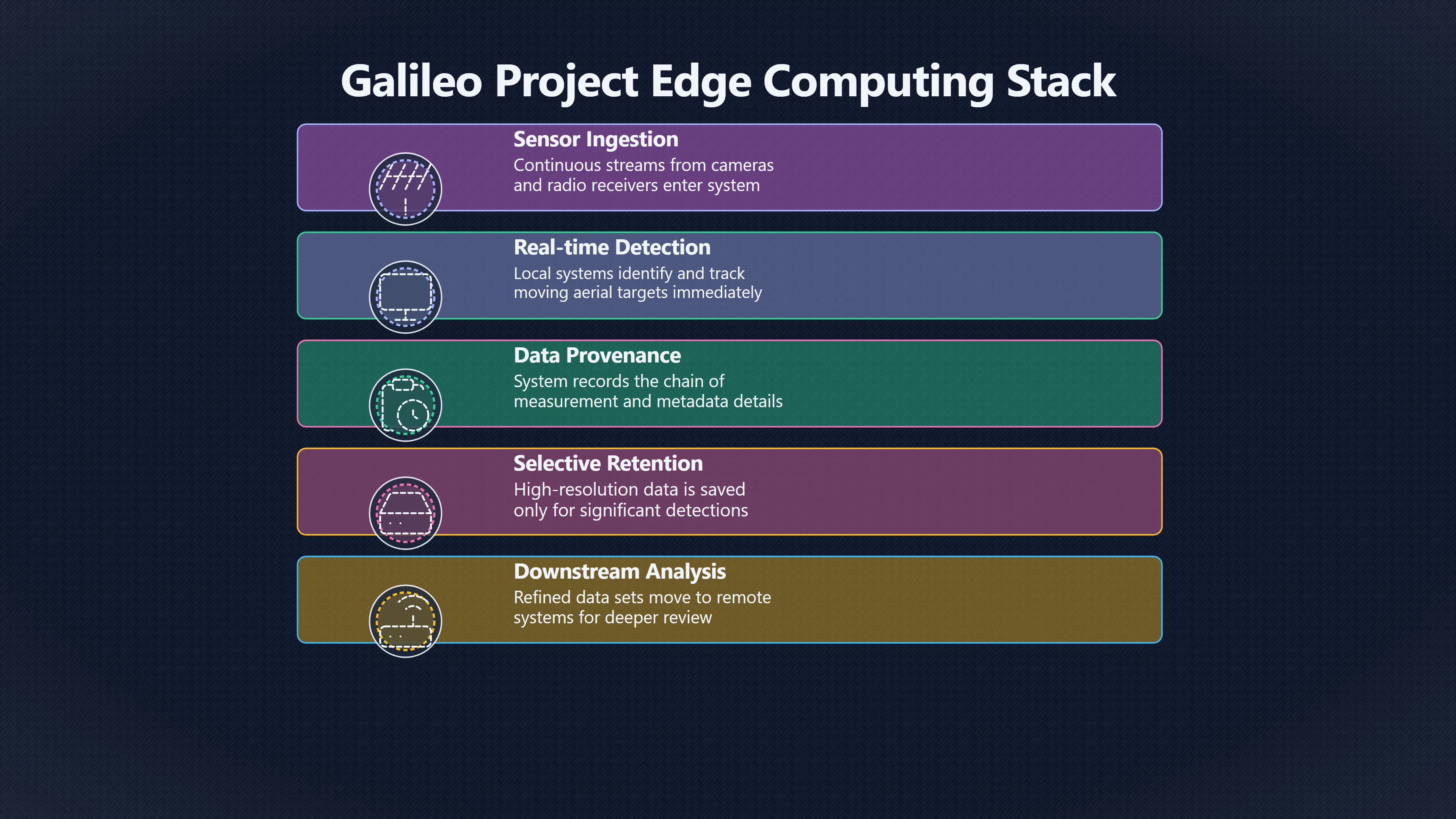
Galileo's on-site computing is meant to catch brief aerial events, coordinate sensors and preserve the records needed for later review.
On this page
- Why transient objects need local processing
- How sensors, clocks and storage work together
- What a complete event record should preserve
Page outline Jump by section
Introduction
Can Galileo catch unusual aerial events before they vanish? The project’s answer is increasingly centred on edge computing: processing data at the observatory itself, rather than sending everything elsewhere for later analysis. For a system designed to detect brief, fast-moving and potentially rare aerial phenomena, local computing changes what can be recorded, how sensors respond, and whether a fleeting event becomes a scientifically useful dataset or disappears as an unverified anomaly. Recent Galileo Project architecture papers describe an observatory design in which on-site computing handles real-time acquisition, sensor coordination and data provenance before deeper analysis occurs in downstream systems.[arXiv]arxiv.orgarXiv Galileo Project Observatory Class System ArchitectureGalileo Project Observatory Class System ArchitectureMay 30, 2025…
 In practical terms, edge computing shifts the observatory from being a passive recorder to an active measurement platform. Instead of merely storing video, it can recognise an event, align multiple instruments around it, preserve timing information and retain the raw evidence needed for later scrutiny.[arXiv]arxiv.orgarXiv Galileo Project Observatory Class System ArchitectureGalileo Project Observatory Class System ArchitectureMay 30, 2025…
Why Transient Objects Need Local Processing
Many aerial events unfold in seconds. An aircraft crossing a field of view, a meteor, a drone, a bird, an atmospheric reflection or a potentially unexplained object may appear only briefly before leaving the observable region. If all processing waited for remote servers, the observatory could lose opportunities to capture higher-quality measurements while the event is still occurring.
The Galileo Project’s observatory concept relies on wide-field sensors continuously monitoring the sky while other instruments provide more detailed characterisation. That arrangement only works effectively if detections can be handled immediately. Wide-field cameras must identify a candidate object, determine whether it deserves additional attention and potentially direct narrower instruments toward the target while it remains visible.[arXiv]arxiv.orgOpen source on arxiv.org.
Edge computing therefore serves several functions simultaneously:
- Continuous ingestion of sensor streams.
- Real-time object detection and tracking.
- Coordination among multiple sensor types.
- Selection of data worth preserving at full resolution.
- Immediate comparison against known sources such as aircraft broadcasts.
Without those capabilities, the observatory would risk becoming overwhelmed by data volume while still missing the most valuable moments.[arXiv]arxiv.orgarXiv Galileo Project Observatory Class System ArchitectureGalileo Project Observatory Class System ArchitectureMay 30, 2025…
A useful comparison comes from modern astronomy, where transient-event networks process observations locally because phenomena such as supernovae, gamma-ray bursts and fast-moving near-Earth objects require rapid response. Galileo applies a similar philosophy to aerial monitoring: transient events must be recognised while they are happening, not only after storage and review.[growth.caltech.edu]growth.caltech.eduGROWT HGlobal Relay of Observatories Watching…GROWTH is a 5 year project, funded by the National Science Foundation to advance our u…
How Sensors, Clocks and Storage Work Together
The importance of edge computing becomes clearer when viewed as a timing problem rather than simply a computing problem.
A Galileo observatory is designed around multiple sensor modalities. Cameras operating in different spectral bands, radio receivers, environmental instruments and other systems may all observe the same event from different perspectives. To reconstruct what happened, every observation must be linked to a common timeline.[arXiv]arxiv.orgOpen source on arxiv.org.
Synchronising observations
Suppose an infrared camera detects an object at the same moment that a visible-light camera records motion and a radio receiver captures an emission. If the timestamps are inconsistent or poorly aligned, investigators may never know whether those measurements came from the same target.
NASA’s UAP study highlighted poor calibration, missing metadata and inadequate sensor synchronisation as major obstacles to interpreting unusual observations. Galileo’s architecture attempts to address those weaknesses by treating timing and metadata as core components of the measurement system.[NASA Science+2NASA]science.nasa.govNASA ScienceIndependent Study Team ReportAt present, analysis of UAP data is hampered by poor sensor calibration, the lack of multiple me…
The edge subsystem described in the Galileo Observatory Class Integrated Computing Platform is responsible for real-time acquisition and data provenance management. That means the observatory records not only the event itself but also the information needed to understand how the measurement was produced.[arXiv]arxiv.orgarXiv Galileo Project Observatory Class System ArchitectureGalileo Project Observatory Class System ArchitectureMay 30, 2025…
Managing data volume
Another challenge is sheer scale. Continuous multimodal monitoring can generate enormous quantities of information. Storing every sensor stream indefinitely at maximum quality is impractical.
Edge systems allow selective retention strategies:
- Keep lower-resolution background archives continuously.
- Preserve full-resolution data around detected events.
- Save pre-event and post-event context.
- Record system state and calibration information alongside observations.
This approach increases the likelihood that unusual events retain enough context for later investigation without requiring unlimited storage resources.[arXiv]arxiv.orgarXiv Galileo Project Observatory Class System ArchitectureGalileo Project Observatory Class System ArchitectureMay 30, 2025…
Using known objects as calibration targets
Galileo has already demonstrated the importance of synchronised local processing through its aircraft calibration work. Observatory systems collect Automatic Dependent Surveillance–Broadcast (ADS-B) aircraft transmissions on site and compare them with camera observations to evaluate pointing accuracy and detection performance. That comparison depends on precise timing between external aircraft data and locally recorded imagery.[MDPI+2ResearchGate]mdpi.comAutomatic Dependent Surveillance–Broadcast (ADS-B) data. This paper describes the commissioning…
In effect, ordinary aircraft become continuous tests of whether the observatory’s clocks, sensors and software remain aligned.
What a Complete Event Record Should Preserve
A major goal of edge computing is not simply detecting an event but preserving enough information that others can independently evaluate it later.
Historically, many UAP cases have suffered from missing context. Analysts may receive a video clip without knowing the camera configuration, sensor settings, environmental conditions or exact acquisition time. NASA’s independent study repeatedly identified the absence of calibration information and metadata as a central reason why many reports remain difficult to interpret.[NASA Science+2Wikisource]science.nasa.govNASA ScienceIndependent Study Team ReportAt present, analysis of UAP data is hampered by poor sensor calibration, the lack of multiple me…
For Galileo, a scientifically useful event record is expected to include much more than an image.
A complete record would ideally preserve:
- Raw sensor measurements.[science.nasa.gov]science.nasa.govNASA ScienceIndependent Study Team ReportAt present, analysis of UAP data is hampered by poor sensor calibration, the lack of multiple me…
- Accurate timestamps.
- Sensor configuration and calibration state.
- Tracking and detection outputs.
- Environmental conditions.
- Cross-sensor associations.[evidence-standards.vercel.app]evidence-standards.vercel.appUAP Caucus: Evidence StandardsSensor metadata and camera calibration info… Cross-referencing with sensor data, video evidence, and phy…
- Known-object correlations such as ADS-B aircraft matches.
- Processing history showing how derived results were generated.
The observatory architecture specifically identifies data provenance management as an edge-computing responsibility. Provenance refers to the documented chain connecting raw observations to later conclusions. If an event is later classified as unusual, researchers should be able to reconstruct exactly how the classification emerged.[arXiv]arxiv.orgarXiv Galileo Project Observatory Class System ArchitectureGalileo Project Observatory Class System ArchitectureMay 30, 2025…
This requirement reflects a broader Galileo principle: an anomaly is only meaningful if the ordinary explanations have been tested using well-documented measurements. The value of the event record is therefore not merely that it captures something unusual, but that it captures enough supporting information to challenge or confirm alternative explanations.[arXiv]arxiv.orgOpen source on arxiv.org.

The Real Change: From Recording Sky Images to Managing Evidence
The most important consequence of edge computing is that it changes the observatory’s role.
A conventional camera network primarily records images. A Galileo-style observatory seeks to record evidence. That requires local systems capable of recognising events, synchronising sensors, preserving metadata, validating calibration and maintaining a traceable record from detection through later analysis.[arXiv+2NASA Science]arxiv.orgarXiv Galileo Project Observatory Class System ArchitectureGalileo Project Observatory Class System ArchitectureMay 30, 2025…
In that sense, edge computing is not an auxiliary feature of the Galileo Project. It is part of the measurement strategy itself. The faster and more reliably the observatory can process events locally, the greater the chance that a transient aerial observation will survive not just as a sighting, but as a dataset that can withstand scientific review.[arXiv]arxiv.orgarXiv Galileo Project Observatory Class System ArchitectureGalileo Project Observatory Class System ArchitectureMay 30, 2025…
Amazon book picks
Further Reading
Books and field guides related to Can Galileo Catch Events Before They Vanish?. Use these as the next step if you want deeper reading beyond the article.
Designing Data-Intensive Applications
Explains reliable data capture, storage, synchronization, event streams and provenance that are central to observatory edge-computing arc...
The Signal and the Noise
Addresses how meaningful events are extracted from noisy data, a key challenge when monitoring transient aerial phenomena.
Deep Learning
Rating: 3.5/5 from 6 Google Books ratings
Relevant to automated detection and classification of unusual events from sensor streams and imaging systems.
The Fourth Paradigm
Directly connects large-scale scientific observation, data preservation and computational workflows to the kind of observatory systems di...
eBay marketplace picks
Marketplace Samples
Example marketplace items related to this page. Use the search link to explore similar finds on eBay.
Endnotes
1.
Source: arxiv.org
Title: arXiv Galileo Project Observatory Class System Architecture
Link:https://arxiv.org/abs/2506.00125
Source snippet
Galileo Project Observatory Class System ArchitectureMay 30, 2025...
Published: May 30, 2025
2.
Source: researchgate.net
Title: 392334596 Galileo Project Observatory Class System Architecture
Link:https://www.researchgate.net/publication/392334596_Galileo_Project_Observatory_Class_System_Architecture
Source snippet
This subsystem performs real-time data acquisition...Read more...
3.
Source: arxiv.org
Link:https://arxiv.org/abs/2305.18566
4.
Source: growth.caltech.edu
Title: GROWT H
Link:https://www.growth.caltech.edu/
Source snippet
Global Relay of Observatories Watching...GROWTH is a 5 year project, funded by the National Science Foundation to advance our u...
5.
Source: science.nasa.gov
Link:https://science.nasa.gov/wp-content/uploads/2023/09/uap-independent-study-team-final-report.pdf
Source snippet
NASA ScienceIndependent Study Team ReportAt present, analysis of UAP data is hampered by poor sensor calibration, the lack of multiple me...
6.
Source: nasa.gov
Title: update nasa shares uap independent study report names director
Link:https://www.nasa.gov/news-release/update-nasa-shares-uap-independent-study-report-names-director/
Source snippet
UPDATE: NASA Shares UAP Independent Study Report14 Sept 2023 — We found that NASA can help the whole-of-government UAP effort through sys...
7.
Source: en.wikisource.org
Title: Responses to Statement of Task
Link:https://en.wikisource.org/wiki/NASA_Unidentified_Anomalous_Phenomena%3A_Independent_Study_Team_Report/Responses_to_Statement_of_Task
Source snippet
Unidentified Anomalous Phenomena: Independent...14 Oct 2023 — Indeed, several apparent UAP have been demonstrated to be sensor artifacts...
8.
Source: papers.cool
Link:https://papers.cool/arxiv/2506.00125
Source snippet
The first is the Edge Computing Subsystem which is located within the observatory site. This...Read more...
9.
Source: mdpi.com
Link:https://www.mdpi.com/1424-8220/25/3/783
Source snippet
Automatic Dependent Surveillance–Broadcast (ADS-B) data. This paper describes the commissioning...
10.
Source: researchgate.net
Link:https://www.researchgate.net/publication/388466760_Commissioning_an_All-Sky_Infrared_Camera_Array_for_Detection_of_Airborne_Objects
Source snippet
ResearchGate(PDF) Commissioning an All-Sky Infrared Camera Array for...10 Jan 2025 — Galileo Project is designing, Broadcast (ADS-B) data...
11.
Source: arxiv.org
Link:https://arxiv.org/abs/2411.07956
12.
Source: en.wikisource.org
Title: Page:UAP Independent Study Team
Link:https://en.wikisource.org/wiki/Page%3AUAP_Independent_Study_Team_-_Final_Report.pdf/15
Source snippet
wikisource.orgPage:UAP Independent Study Team - Final Report.pdf/1512 Nov 2023 — Indeed, several apparent UAP have been demonstrated to b...
13.
Source: arxiv.org
Link:https://arxiv.org/html/2506.00125v1
Source snippet
1 Introduction30 May 2025 — The first is the Edge Computing Subsystem which directly interfaces with the sensors and is located within th...
Published: May 2025
14.
Source: science.nasa.gov
Link:https://science.nasa.gov/uap/
Source snippet
nasa.govUAP9 Jun 2022 — This webpage is designed as a resource to provide updates on the UAP Independent Study. NASA Unidentified Anomalo...
15.
Source: Wikipedia
Title: The Galileo Project
Link:https://en.wikipedia.org/wiki/The_Galileo_Project
Source snippet
The Galileo ProjectThe Galileo Project is an international scientific research project to search for extraterrestrial intelligence or...
Additional References
16.
Source: studocu.com
Link:https://www.studocu.com/en-us/document/harvard-medical-school/estadistica/nasa-uap-independent-study-team-final-report-key-findings-and-recommendations/157385671
Source snippet
NASA UAP Independent Study Team Final ReportAt present, analysis of UAP data is hampered by poor sensor calibration, the. lack of multipl...
17.
Source: galileo.hsites.harvard.edu
Link:https://galileo.hsites.harvard.edu/publications/scientific-investigation-unidentified-aerial-phenomena-uap-using-multimodal
Source snippet
The Galileo ProjectThe Scientific Investigation of Unidentified Aerial Phenomena...A primary objective of the Galileo Project is to buil...
18.
Source: evidence-standards.vercel.app
Link:https://evidence-standards.vercel.app/
Source snippet
UAP Caucus: Evidence StandardsSensor metadata and camera calibration info... Cross-referencing with sensor data, video evidence, and phy...
19.
Source: avi-loeb.medium.com
Link:https://avi-loeb.medium.com/commissioning-data-on-half-a-million-objects-in-the-sky-from-the-galileo-project-observatory-are-a23bd084233a
Source snippet
Data on Half a Million Objects in the Sky from...The GP Observatories offer an array of multi-modal, multi-spectral sensors that continu...
20.
Source: thedebrief.org
Link:https://thedebrief.org/galileo-project-releases-commissioning-data-on-half-a-million-aerial-objects-are-any-of-them-uap/
Source snippet
Galileo Project Releases Commissioning Data on Half a...12 Nov 2024 — The Galileo Project Observatories offer an array of multimodal, mu...
21.
Source: primitiveproton.com
Link:https://primitiveproton.com/unidentified-anomalous-phenomena-uap/
22.
Source: reddit.com
Link:https://www.reddit.com/r/UFOs/comments/16ik6x5/summary_of_nasa_unidentified_anomalous_phenomena/
23.
Source: youtube.com
Link:https://www.youtube.com/watch?v=TQcqOW39ksk
Source snippet
Unidentified Anomalous Phenomena Independent Study ReportNASA commissioned an independent study team to examine unidentified anomalous ph...
24.
Source: avi-loeb.medium.com
Title: a new calculation on the fly to the nasa uap study 2dacaf860cac
Link:https://avi-loeb.medium.com/a-new-calculation-on-the-fly-to-the-nasa-uap-study-2dacaf860cac
Source snippet
New Calculation on the Fly to the NASA UAP Study - Avi LoebThe NASA Study will examine unclassified data on UAP in an attempt to separate...
25.
Source: nevadacurrent.com
Title: nasa report finds no evidence that ufos are extraterrestrial
Link:https://nevadacurrent.com/2023/09/18/nasa-report-finds-no-evidence-that-ufos-are-extraterrestrial/
Source snippet
18 Sept 2023 — Analysis of this data is “hampered by poor sensor calibration, the lack of multiple measurements, the lack of sensor metad...
Topic Tree