Within Fixed vs Portable
When Does a Fixed Station Earn Trust?
A fixed station becomes useful when repeated ordinary sky records make later strange events easier to judge.
On this page
- What a local sky baseline actually records
- Why repeated calibration beats one dramatic clip
- How long term clutter records change anomaly claims
Page outline Jump by section
Introduction
A fixed UAP detector station earns trust gradually rather than through a single dramatic recording. Its real value emerges once it has accumulated enough observations of the ordinary local sky to distinguish routine events from genuine outliers. In practice, this means building a baseline: a well-characterised record of what normally passes through the station’s field of view, how its instruments behave under changing environmental conditions, and how frequently common sources of false alarms appear. Scientific UAP programmes increasingly emphasise that anomaly detection depends less on spectacular imagery than on long-term, calibrated measurements against a known local background.[World Scientific+2Project Hessdalen]worldscientific.comWorld ScientificThe Scientific Investigation of Unidentified Aerial…by WA Watters · 2023 · Cited by 47 — The primary science goal of t…
 Within the broader choice between portable and fixed detector stations, this is the defining advantage of a permanent installation. A mobile system can investigate reports in new locations, but only a long-running station can answer the question: “Is this event genuinely unusual for this place?”
What a local sky baseline actually records
A baseline is not simply a collection of photographs. It is a statistical description of the environment in which every future observation will be interpreted.
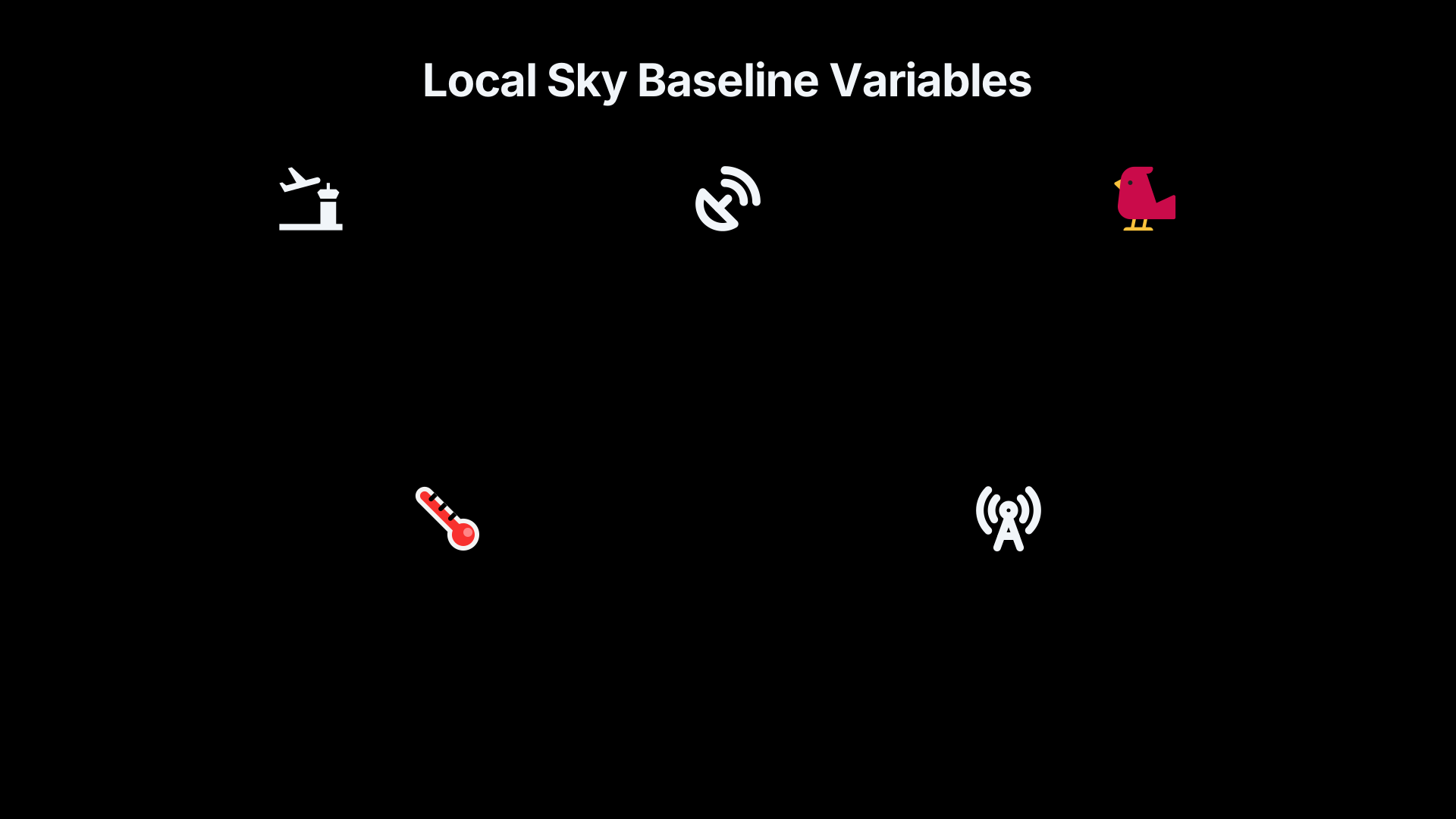
Over months or years, a fixed station records recurring patterns such as:
- regular aircraft routes and their lighting characteristics;
- satellite passes, including changing constellations;
- meteor rates during different seasons;
- astronomical objects near the horizon at different times of year;
- weather effects including cloud reflections, haze and temperature inversions;
- insects, birds and bats crossing close to optical sensors;
- local radio-frequency interference;
- seasonal changes in atmospheric transparency and background illumination.
The aim is to establish the expected behaviour of both the sky and the instruments. Once those expectations are well understood, automated software can identify events that depart significantly from established patterns instead of simply flagging anything visually unusual. This approach underpins the Galileo Project’s concept of a continuous “multimodal census” of aerial phenomena, where optical, infrared and other sensors collectively define normal conditions before attempting to classify anomalies.[World Scientific]worldscientific.comWorld ScientificThe Scientific Investigation of Unidentified Aerial…by WA Watters · 2023 · Cited by 47 — The primary science goal of t…
Importantly, a baseline is location-specific. A coastal station, a mountain observatory and an urban rooftop experience different aircraft traffic, weather, wildlife, light pollution and radio environments. A model trained in one setting cannot simply be transplanted elsewhere without rebuilding local expectations.
Why repeated calibration beats one dramatic clip
An isolated video rarely provides enough information to determine whether an unusual-looking object reflects an extraordinary event or an ordinary measurement problem.
Repeated calibration allows operators to understand how their equipment behaves under real operating conditions. Over time they can measure:
- timing accuracy between multiple sensors;
- camera pointing stability;
- lens contamination or ageing;
- sensor drift caused by temperature;
- changing detection thresholds;
- software updates that alter image processing;
- systematic false detections generated by hardware.
Because these effects develop slowly, they are often invisible in a single observation but obvious across months of archived data.
Modern scientific observatories therefore treat calibration as a continuous process rather than a one-off installation task. The Galileo Project’s published instrument strategy explicitly links physical measurements to calibration requirements and discusses selecting deployment sites where instrument performance can first be characterised before scientific observations begin. More recent work describing the commissioning of its infrared camera array demonstrates calibration against independently verified aircraft positions from ADS-B (Automatic Dependent Surveillance–Broadcast) data, illustrating how routine traffic becomes a valuable calibration reference rather than unwanted clutter.[World Scientific]worldscientific.comWorld ScientificThe Scientific Investigation of Unidentified Aerial…by WA Watters · 2023 · Cited by 47 — The primary science goal of t…
This philosophy mirrors established practice in astronomy and atmospheric science, where long-term sensor stability is considered as important as momentary sensitivity.
How long-term clutter records change anomaly claims
The most valuable product of a fixed station is often its catalogue of ordinary events.
Initially, many detections appear surprising because operators have little experience with the site’s local environment. As observations accumulate, recurring explanations become increasingly obvious:
- identical reflections occurring after rainfall;
- insects producing characteristic out-of-focus streaks near infrared cameras;
- predictable satellite glints;
- seasonal bird migration routes;
- recurring radio interference from nearby infrastructure.
Documenting these effects reduces false positives and improves confidence when something genuinely differs from previous observations.
The Hessdalen Automatic Measurement Station illustrates this principle. Decades of repeated monitoring have produced statistics on when luminous events are reported most frequently, while also revealing the strengths and weaknesses of different sensors. Researchers found that some instruments produced useful long-term measurements whereas others generated excessive noise or ambiguous results, prompting revisions to monitoring strategies rather than stronger anomaly claims. In other words, the station’s credibility grew not because every observation was mysterious, but because repeated measurements clarified which data could and could not be trusted.[Project Hessdalen]hessdalen.orgProject HessdalenA Long-Term Scientific Survey of the…by M TEODORANI · 2004 · Cited by 97 — Abstract—The balls of light which appear i…
When can a baseline be considered mature?
There is no universal threshold measured in weeks or months.
Instead, a baseline becomes increasingly trustworthy when several conditions are met:
- Seasonal coverage. Observations span changing weather, daylight length and astronomical conditions.
- Instrument stability. Sensors have demonstrated repeatable performance or known correction factors.
- Known false positives. Common sources of spurious detections have been catalogued.
- Environmental history. Local air traffic, wildlife and atmospheric behaviour have been observed repeatedly.
- Consistent metadata. Every observation includes reliable timing, location and environmental measurements.
The amount of time required depends on the environment. A remote desert may reach a useful baseline sooner than a busy airport corridor where traffic patterns, construction and lighting conditions change frequently. Likewise, replacing cameras or substantially modifying software may require rebuilding parts of the baseline because the instrument itself has changed.
For this reason, many long-term monitoring projects treat baseline building as an ongoing process rather than a milestone that is permanently completed.

Why baseline quality matters more than event count
A common misunderstanding is that a successful fixed station should maximise the number of unusual detections. Scientific monitoring aims for the opposite: it seeks to minimise uncertainty about ordinary observations so that genuinely exceptional events, if they occur, stand out with stronger evidential support.
A station that has quietly documented thousands of routine nights provides a far firmer foundation for evaluating one unusual recording than a station that appears only after reports begin. The accumulated record allows investigators to ask whether the event differs from established local behaviour, whether the instruments were operating normally, and whether similar signatures have previously received ordinary explanations.
That accumulated context is what allows a fixed UAP detector station to earn its baseline—and, with it, the credibility needed for later anomaly assessments.
Amazon book picks
Further Reading
Books and field guides related to When Does a Fixed Station Earn Trust?. Use these as the next step if you want deeper reading beyond the article.
How to Measure Anything
Matches the page’s focus on calibration, trust, and long-term evidence accumulation.
The Demon-Haunted World
Best general book for evidence standards, skepticism, and resisting dramatic but weak claims.
NightWatch
Supports the fixed-station idea of learning normal local sky behaviour through repeated observation.
The Backyard Astronomer's Guide
Relevant to fixed observing setups, local conditions, optics, and practical sky monitoring.
eBay marketplace picks
Marketplace Samples
Example marketplace items related to this page. Use the search link to explore similar finds on eBay.
Endnotes
1.
Source: worldscientific.com
Link:https://www.worldscientific.com/doi/10.1142/S2251171723400068?srsltid=AfmBOooEQ9WCcMAB3arVZhEgR_titDkDvUVM2Dhs-19rGc4HclT0idHK
Source snippet
World ScientificThe Scientific Investigation of Unidentified Aerial...by WA Watters · 2023 · Cited by 47 — The primary science goal of t...
2.
Source: hessdalen.org
Link:https://hessdalen.org/reports/scex1802217251.pdf
Source snippet
Project HessdalenA Long-Term Scientific Survey of the...by M TEODORANI · 2004 · Cited by 97 — Abstract—The balls of light which appear i...
Additional References
3.
Source: researchgate.net
Link:https://www.researchgate.net/publication/278390344Instrumented_Monitoring_of_Aerial_Anomalies-_A_Scientific_Approach_to_the_Investigation_On_Anomalous_Atmospheric_Light_Phenomena
Source snippet
(PDF) Instrumented Monitoring of Aerial AnomaliesPDF | Anomalous atmospheric light phenomena tend to occur recurrently in several places...
4.
Source: catalogue.leidenuniv.nl
Link:https://catalogue.leidenuniv.nl/permalink/f/n95gpj/UBL_ALMA51256309870002711
Source snippet
leidenuniv.nl[https://catalogue.leidenuniv.nl/permalink/f/n95gpj...No](https://catalogue.leidenuniv.nl/permalink/f/n95gpj...No) information is available for this page...
5.
Source: aurora.unis.no
Link:https://aurora.unis.no/doc/Auroral%20all-sky%20camera%20calibration.pdf
Source snippet
All-Sky Camera Calibrationby F Sigernes · Cited by 20 — A two-step method to calibrate and flat-field correct an all-sky camera is outlin...
6.
Source: mcst.gsfc.nasa.gov
Link:https://mcst.gsfc.nasa.gov/publications?field_authors_target_id=P.+Abel&page=11
Source snippet
MCST - NASAThe use of the Sonoran Desert as a Pseudo-invariant Site for Optical Sensor Cross-Calibration and Long-Term Stability Monito...
7.
Source: arxiv.org
Link:https://arxiv.org/pdf/2305.18566
Source snippet
The Scienti¯c Investigation of Unidenti¯ed Aerial...by WA Watters · 2023 · Cited by 47 — A primary objective of the Galileo Project is t...
8.
Source: arxiv.org
Link:https://arxiv.org/abs/2411.07956
9.
Source: ui.adsabs.harvard.edu
Link:https://ui.adsabs.harvard.edu/abs/2024EGUGA..2613321W/abstract
Source snippet
satellite remote sensing to evaluate and calibrate...by A Widforss · 2024 — In this study we demonstrate how satellite remote sensing al...
10.
Source: mdpi.com
Link:https://www.mdpi.com/2072-4292/14/18/4679
Source snippet
Inter-Calibration and Statistical Validation of Topside...by A Pignalberi · 2022 · Cited by 16 — CSES-01 is a sun-synchronous satellite...
11.
Source: youtube.com
Title: Inside the AI Alien Hunting Project at Harvard
Link:https://www.youtube.com/watch?v=oDAY0_wRjxA
Source snippet
SOMETHING IS HAPPENING — We Are Detecting Anomalous Objects...
12.
Source: youtube.com
Title: [Open Source]({{ ‘open-source/’ | relative_url }}) Astronomy
Link:https://www.youtube.com/watch?v=rf1cyFFtYLs
Source snippet
Inventor says his new radar network could spot UAPs...
Topic Tree