Within Vision Filters
Why Birds Are Harder Than They Look
Birds can look anomalous when they are small, close, fast, warm in infrared or changing shape from frame to frame.
On this page
- Why single frame bird labels are weak
- Motion clues that separate birds from aircraft
- How flocks and close passes create false alarms
Page outline Jump by section
Introduction
Birds are among the most common causes of false alarms in automated UAP (Unidentified Aerial Phenomena) detection systems. A bird that is small, close to the camera, rapidly changing shape or viewed only as a handful of pixels can appear surprisingly unlike a conventional bird. In infrared imagery it may also appear as a warm moving object without obvious wings, while in visible-light footage motion blur and changing wing positions can make successive frames look like entirely different objects. For this reason, modern automated sky-monitoring systems are designed to treat bird identification as a probabilistic tracking problem rather than a single-frame classification task. The objective is not to prove an object is a bird from one image, but to combine appearance, motion, trajectory and, where available, multiple sensors before deciding whether an event deserves further review.[arXiv+2World Scientific]arxiv.org1 Introduction12 Nov 2024 — Galileo Project is designing, building, and commissioning a multi-modal, to continuously monitor the sky…
Why Single-Frame Bird Labels Are Weak
A single image often contains too little information for reliable identification. Birds frequently occupy only a few pixels in wide-field sky cameras, especially those designed to monitor the entire sky continuously rather than zoom in on individual targets.
Several factors make isolated frames unreliable:
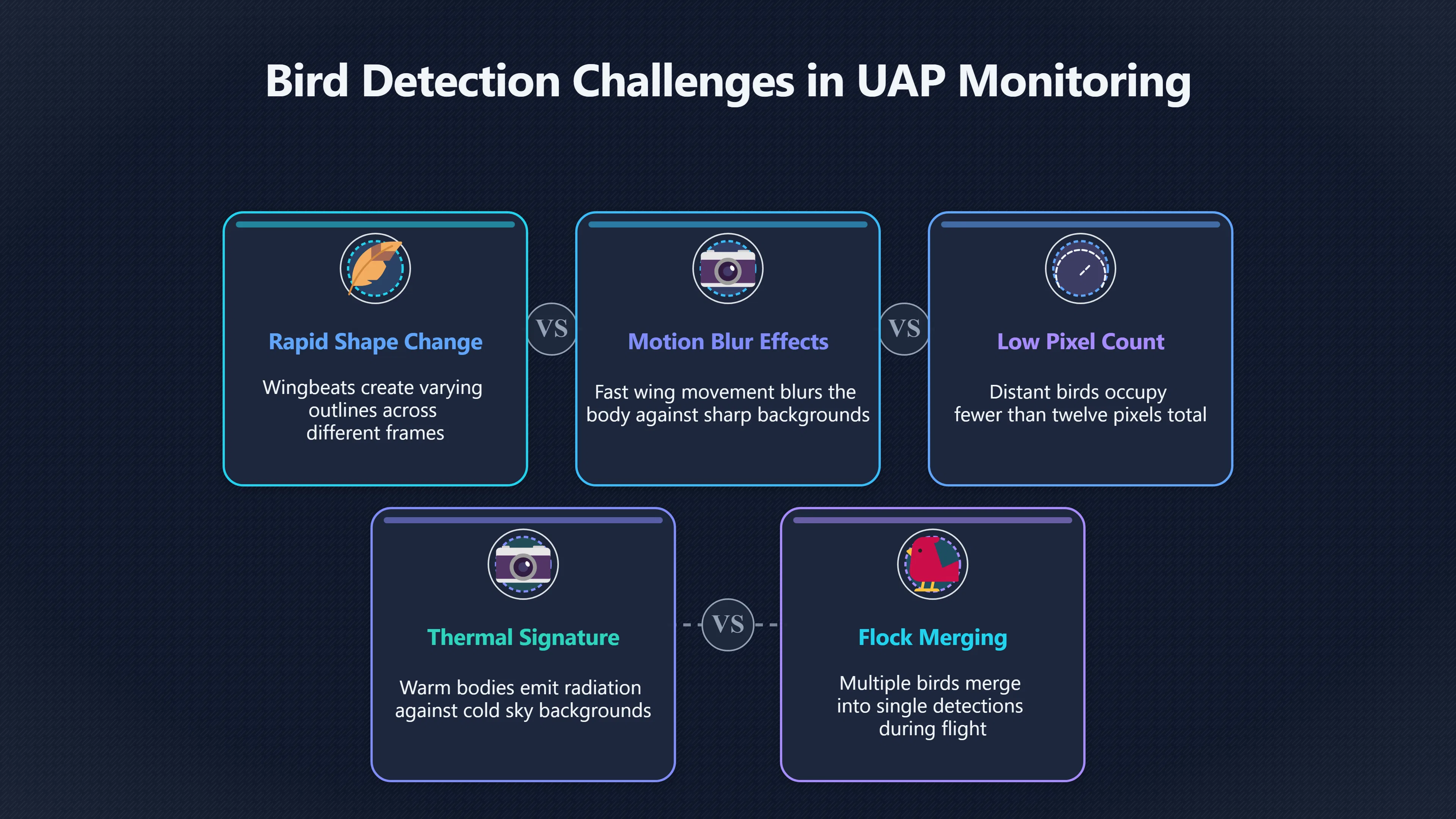
- Rapid shape change. A bird’s outline changes dramatically during every wingbeat. Depending on when the shutter captures the motion, the same bird may resemble a narrow dart, a broad cross or an irregular blob.
- Motion blur. Fast wing movement can blur the body while leaving the background sharp, producing shapes unlike the bird’s true silhouette.
- Changing viewing angle. Banking, climbing or turning continuously alters the apparent size and profile.
- Low pixel count. Distant birds often occupy fewer than a dozen pixels, leaving almost no morphological information for a classifier.
These limitations are well recognised in computer-vision research beyond the UAP field. Bird-detection systems developed for wind farms, airports and wildlife monitoring all report that detecting small airborne birds against large, changing sky backgrounds is intrinsically difficult, requiring specialised datasets and temporal methods rather than static image classification.[Tethys+2PMC]tethys.pnnl.govYOLO Based Model birds wind farmsA Temporal Boosted YOLO-Based Model for Birds…by H Alqaysi · 2021 · Cited by 37 — This paper proposes a YOLOv4-based ensemble mo…
The practical implication for automated UAP cameras is straightforward: a classifier assigning “unknown” to a single frame is not necessarily evidence of an anomalous object. It often reflects insufficient visual information.
Motion Clues That Separate Birds from Aircraft
Motion over time usually provides far more information than appearance in one frame. Instead of asking, “What does this object look like?”, modern tracking systems ask, “How does it behave?”
Birds exhibit several motion characteristics that distinguish them statistically from aircraft.
Variable speed. Birds accelerate and decelerate through wingbeats, glides and turns, whereas aircraft generally maintain smoother apparent motion over short intervals.
Oscillating trajectories. Wingbeats introduce subtle periodic changes in body position that can produce slight side-to-side or vertical oscillations in image space.
Frequent heading changes. Birds respond continuously to wind and local airflow, producing more irregular tracks than conventional aircraft following stable flight paths.
Changing apparent size. A nearby bird can rapidly expand or shrink in the image as it flies toward or away from the camera, something much less common for distant aircraft.
Because of these behaviours, modern systems increasingly rely on object tracking across many frames instead of isolated detections. The Galileo Project’s infrared observatory, for example, combines object detection with multi-frame tracking to reconstruct trajectories and identify statistical outliers for later review rather than treating every unusual-looking frame as an anomalous object. Their commissioning analysis also illustrates why trajectory analysis still requires human review, since unusual image-space motion does not automatically indicate unusual physical motion.[arXiv]arxiv.org1 Introduction12 Nov 2024 — Galileo Project is designing, building, and commissioning a multi-modal, to continuously monitor the sky…
Research on bird monitoring similarly improves performance by incorporating temporal stacking—using information from neighbouring frames—to stabilise detections of rapidly changing birds that would otherwise be missed or misclassified.[Tethys]tethys.pnnl.govYOLO Based Model birds wind farmsA Temporal Boosted YOLO-Based Model for Birds…by H Alqaysi · 2021 · Cited by 37 — This paper proposes a YOLOv4-based ensemble mo…
Why Infrared Can Make Birds Look Unusual
Thermal cameras introduce a different set of challenges.
Birds are warm-bodied animals and therefore emit more long-wave infrared radiation than the surrounding sky. Against a cold background they often appear as bright thermal objects even when their visible-light image is tiny or poorly resolved.[Ganga Knowledge Portal]gyanganga.aiGanga Knowledge PortalIntegrating Thermal UAV Imagery and Deep LearnApril 6, 2024 — Thermal image provides a clearer depiction of the pre…
However, thermal imagery usually contains less fine structural detail than high-resolution optical cameras. At long range, the detector may record little more than a bright moving spot. Wingbeats can intermittently alter the visible thermal shape, while body orientation changes modify the apparent heat signature.
Consequently, an infrared-only system may detect a convincing moving thermal target without enough detail to determine whether it is a bird, drone or another airborne object. This is one reason why serious automated UAP observatories increasingly combine infrared with optical cameras and additional sensor types rather than relying on a single imaging modality.[arXiv]arxiv.org1 Introduction12 Nov 2024 — Galileo Project is designing, building, and commissioning a multi-modal, to continuously monitor the sky…
How Flocks and Close Passes Create False Alarms
Not every false alarm comes from a single bird.
Close Passes
A bird flying very close to a wide-angle camera can generate dramatic apparent motion because angular speed depends strongly on distance. An object only a few metres from the lens can cross the field of view far faster than a distant aircraft despite moving at a much lower true speed.
Without accurate range information, image-space velocity alone can greatly exaggerate perceived performance.
Close birds may also move briefly out of focus, creating irregular bright blobs that automated systems initially flag simply because they differ from expected aircraft appearances.
Flocks
Groups of birds create additional complications.
Individual birds may merge into one detection before separating again. A tracking algorithm can mistakenly:
- merge multiple birds into one object,
- split one flock into several tracks,
- lose identity when birds cross,
- estimate unstable trajectories as group geometry changes.
These behaviours are well known in surveillance and ecological computer vision. Robust bird-monitoring systems therefore devote considerable effort to temporal association, object persistence and multi-frame consistency rather than relying solely on instantaneous detections.[Tethys]tethys.pnnl.govYOLO Based Model birds wind farmsA Temporal Boosted YOLO-Based Model for Birds…by H Alqaysi · 2021 · Cited by 37 — This paper proposes a YOLOv4-based ensemble mo…
Why Better Filters Depend on Time Rather Than Better Labels
One recurring lesson from computer vision is that improving bird rejection is not simply a matter of collecting more bird photographs. The challenge lies in modelling behaviour over time.
Successful approaches increasingly combine:
- detections across many consecutive frames,
- trajectory reconstruction,
- confidence estimates rather than hard classifications,
- infrared and visible-light comparisons,
- contextual information such as environmental conditions,
- multi-sensor corroboration where available.
Research on bird detection around wind farms demonstrates that temporal stacking substantially improves recognition of small flying birds compared with analysing single images alone. Likewise, UAP observatories increasingly treat machine learning as a filtering stage that prioritises events for investigation instead of issuing definitive identifications.[Tethys+2arXiv]tethys.pnnl.govYOLO Based Model birds wind farmsA Temporal Boosted YOLO-Based Model for Birds…by H Alqaysi · 2021 · Cited by 37 — This paper proposes a YOLOv4-based ensemble mo…
What This Means for Automated UAP Detection
Birds remain one of the most persistent sources of apparent anomalies because they combine several characteristics that challenge machine vision simultaneously: they are small, highly deformable, capable of rapid angular motion, warm in infrared and often observed without reliable distance information.
These properties explain why an automated detector may initially assign a bird a low-confidence or even anomalous label. They do not imply that birds are inherently difficult for humans to recognise once sufficient context is available. Instead, they illustrate a broader principle in automated UAP detection: confidence should increase through accumulating evidence across time and multiple sensors, not through the appearance of a single striking frame.
Amazon book picks
Further Reading
Books and field guides related to Why Birds Are Harder Than They Look. Use these as the next step if you want deeper reading beyond the article.
Deep Learning
Rating: 3.5/5 from 6 Google Books ratings
Relevant to image classification and detection.
Programming Computer Vision With Python
Useful for implementing tracking and classification pipelines.
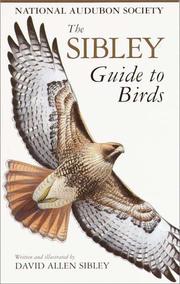
The Sibley Guide to Birds
Provides understanding of bird appearance and behavior causing false alarms.
eBay marketplace picks
Marketplace Samples
Example marketplace items related to this page. Use the search link to explore similar finds on eBay.
Endnotes
1.
Source: arxiv.org
Link:https://arxiv.org/html/2411.07956v1
Source snippet
1 Introduction12 Nov 2024 — Galileo Project is designing, building, and commissioning a multi-modal, to continuously monitor the sky...
2.
Source: arxiv.org
Link:https://arxiv.org/html/2508.18136v1
Source snippet
BirdRecorder's AI on Sky: Safeguarding birds of prey by...25 Aug 2025 — The algorithm developed identifies motion in the sky by detectin...
3.
Source: worldscientific.com
Link:https://www.worldscientific.com/doi/10.1142/S2251171723400068?srsltid=AfmBOopacIUJzHqCla0qxfM1NNca72mWGzvgHxMcuu3BBZeJCDBohl4i
Source snippet
Section 2 describes the motivations for our study, which includes a...Read more...
4.
Source: tethys.pnnl.gov
Title: YOLO Based Model birds wind farms
Link:https://tethys.pnnl.gov/sites/default/files/publications/YOLO_Based_Model_birds_wind_farms.pdf
Source snippet
A Temporal Boosted YOLO-Based Model for Birds...by H Alqaysi · 2021 · Cited by 37 — This paper proposes a YOLOv4-based ensemble mo...
5.
Source: gyanganga.ai
Link:https://gyanganga.ai/admin//fileupload//Bird_monitoring_intelligence_Integrating_Thermal_UAV_Imagery.pdf
Source snippet
Ganga Knowledge PortalIntegrating Thermal UAV Imagery and Deep LearnApril 6, 2024 — Thermal image provides a clearer depiction of the pre...
Published: April 6, 2024
6.
Source: galileo.hsites.harvard.edu
Link:https://galileo.hsites.harvard.edu/activities
Source snippet
The Galileo Project - Harvard UniversityThe Galileo Project research group will aim to identify the nature of UAP and 'Oumuamua-like in...
Additional References
7.
Source: researchgate.net
Link:https://www.researchgate.net/publication/388466760_Commissioning_an_All-Sky_Infrared_Camera_Array_for_Detection_of_Airborne_Objects
Source snippet
(PDF) Commissioning an All-Sky Infrared Camera Array for...10 Jan 2025 — (Abridged) The Galileo Project aims to investigate Unidentified...
8.
Source: kaggle.com
Link:https://www.kaggle.com/datasets/khanaamer/bird-detection-dataset
Source snippet
Bird Detection DatasetIt addresses a key challenge in smart farming: accurately detecting small, fast-moving birds in wide-angle field im...
9.
Source: avi-loeb.medium.com
Link:https://avi-loeb.medium.com/commissioning-data-on-half-a-million-objects-in-the-sky-from-the-galileo-project-observatory-are-a23bd084233a
Source snippet
Data on Half a Million Objects in the Sky from...A collection of sensors in the Galileo Project Observatory at Harvard University monito...
10.
Source: open-access.bcu.ac.uk
Link:https://www.open-access.bcu.ac.uk/16657/1/From_Blurs_to_Birds_Localization_and_Classification_of_Hard-to-See_Bird_Species_in_Norwegian_Wilderness_Camera_Trap_Images.pdf
Source snippet
Birmingham City University Open AccessLocalization and Classification of Hard-to-See Bird Species in...by H Teigen · 2025 — In the first...
11.
Source: digitalcameraworld.com
Link:https://www.digitalcameraworld.com/photography/astrophotography/harvard-researchers-are-using-this-strange-looking-camera-to-look-for-extraterrestrial-evidence-in-the-skies
Source snippet
Harvard researchers are using this strange-looking...11 Apr 2025 — The researchers' goal is to scan the sky across infrared, optical, ra...
12.
Source: drbriankeating.medium.com
Link:https://drbriankeating.medium.com/the-galileo-project-systematically-searching-for-evidence-of-extraterrestrial-technological-cb4535c6f351
Source snippet
Galileo Project: Systematically Searching for Evidence of...The Galileo Project aims to identify the nature of UAP and 'Oumuamua-like in...
13.
Source: skepticalinquirer.org
Link:https://skepticalinquirer.org/2021/10/the-galileo-project/
14.
Source: researchgate.net
Link:https://www.researchgate.net/publication/355707137_A_Temporal_Boosted_YOLO-Based_Model_for_Birds_Detection_around_Wind_Farms
Source snippet
(PDF) A Temporal Boosted YOLO-Based Model for Birds...22 Oct 2021 — This paper proposes a YOLOv4-based ensemble model for bird detection...
15.
Source: instagram.com
Link:https://www.instagram.com/reel/DE5a-5yy2El/?hl=en
Source snippet
syncing with the camera's frame rate, a phenomenon known as the stroboscopic effect or...
16.
Source: mdpi.com
Link:https://www.mdpi.com/2072-4292/15/10/2638
Source snippet
Removing Human Bottlenecks in Bird Classification Using...by C Chalmers · 2023 · Cited by 40 — In this paper, we outline of bird spe...
Topic Tree