Within Sky Detectors
Can Sound Help Identify Sky Objects?
Microphones can help distinguish silent lights, aircraft noise, drones, fireworks, and nearby ground activity.
On this page
- What microphones can capture
- Matching sound to optical tracks
- Noise, delay, and interpretation problems

Page outline Jump by section
Introduction
Microphones can help automated instrumented UFO detectors do something a camera alone cannot: check whether a strange light, fast track or hovering object had a sound signature that fits a known source. A silent point of light may be a satellite, high-altitude aircraft, balloon or camera artefact; a buzzing or whining track may suggest a drone; a delayed rumble may point to a meteor, aircraft, thunder or explosion; a sharp sequence of cracks may belong to fireworks or ground activity. The point is not that sound “identifies” every sky event. It rarely does on its own. Its value is as a supporting channel that adds timing, direction, frequency and environmental context to optical records.
This matters because the main weakness in UAP evidence is still poor measurement. NASA’s UAP independent study said current analysis is limited by poor sensor calibration, missing metadata, lack of multiple measurements and lack of baseline data; it specifically argued for multiple, well-calibrated sensors in future collection efforts.[NASA Science]science.nasa.govNASA Science… In that setting, audio is useful because it can confirm ordinary explanations, expose local contamination, and flag when a visually impressive event lacks the sound a nearby aircraft, drone or explosion should have produced.
What microphones can capture
An acoustic channel in a sky-monitoring station is usually not just a single “audio recorder”. The more serious designs use calibrated microphones, sometimes arranged in arrays, with accurate clocks and software that records frequency content, loudness, direction estimates and uncertainty. The Galileo Project’s proposed multimodal UAP observatory includes microphones covering infrasonic, audible and ultrasonic bands alongside cameras, radio instruments and environmental sensors; its dedicated acoustic concept, AMOS, is described as a multi-band system intended to help validate and characterise aerial phenomena from infrasound through ultrasound.[arXiv]arxiv.orgThe Scientific Investigation of Unidentified Aerial Phenomena (UAP) Using Multimodal Ground-Based ObservatoriesMay 29, 2023…
Those frequency bands matter because different sky events live in different parts of the sound world. Ordinary aircraft and helicopters produce engine, propeller, rotor and airframe noise in the audible range. Drones often produce tonal and broadband propeller noise that can be recognised by acoustic detectors at short ranges. Meteors and bolides can produce low-frequency infrasound after a shock wave or fragmentation event, sometimes travelling far beyond normal human hearing. Fireworks, gunshots and local machinery may produce sharp impulses that coincide with a visual flash but originate near the detector rather than in the sky.
The Galileo acoustic paper gives a practical scale for expectations: audible aerial sources may be detectable out to about a kilometre under favourable conditions, ultrasonic sources tend to be short-range, and infrasound can travel much farther.[arXiv]arxiv.orgarXiv Multi-Band Acoustic Monitoring of Aerial SignaturesarXiv Multi-Band Acoustic Monitoring of Aerial Signatures That spread explains why a microphone can be decisive in one case and nearly useless in another. A small quadcopter above a quiet field may leave a clear acoustic trace; the same drone near traffic, wind, surf, insects or air-conditioning equipment may disappear into background noise.
Audio is especially good at catching the “ordinary but missed” explanations that frustrate UAP review. Aircraft noise is complex: aircraft sound is affected by moving-source timing, Doppler shift, engine and airframe sources, distance, wind, humidity, temperature, terrain, ground reflections and atmospheric layering.[Eagle Pubs]eaglepubs.erau.eduEagle Pubs Aeroacoustics of Flight Vehicles –Eagle PubsAeroacoustics of Flight Vehicles – Introduction to Aerospace Flight Vehicles… Helicopters are also acoustically distinctive because main and tail rotor blade-passage frequencies and blade-vortex interactions can create the familiar pulsing or “thump” pattern.[Eagle Pubs]eaglepubs.erau.eduEagle Pubs Aeroacoustics of Flight Vehicles –Eagle PubsAeroacoustics of Flight Vehicles – Introduction to Aerospace Flight Vehicles… A detector that records those features can turn a puzzling light into a testable aircraft hypothesis rather than a vague witness impression.
Matching sound to optical tracks
The useful question is not simply “was there a noise?” It is “does the recorded sound fit the object’s apparent motion, timing and likely distance?” A fixed UFO detector can time-stamp video frames and audio samples together, then compare an optical track with acoustic clues. If a camera sees a light crossing the sky while microphones record a rising-and-falling engine tone, the system can test whether the sound delay and direction are consistent with an aircraft on that path.
This step requires careful timing because sound arrives late. In ordinary air, sound travels far slower than light; NOAA’s public lightning guidance gives the familiar rule of thumb that sound travels roughly one mile every five seconds, or one kilometre every three seconds.[NOAA]noaa.govLearning Lesson: Determining distance to a Thunderstorm5 Apr 2023 — Sound travels roughly 750 mph (1,200 km/h), or approximately one… For aircraft and other moving sources, the calculation is more complicated because the sound heard at the detector was emitted from the object’s earlier position, not its position in the current video frame; aerospace acoustics texts describe this as a retarded-time problem.[Eagle Pubs]eaglepubs.erau.eduEagle Pubs Aeroacoustics of Flight Vehicles –Eagle PubsAeroacoustics of Flight Vehicles – Introduction to Aerospace Flight Vehicles…
That delay is a powerful clue. A witness may say a light was “silent”, but if the object was several kilometres away, any engine noise would arrive seconds later and from an apparently trailing direction. Conversely, if a bright object seems low and close but produces no nearby sound, that weakens some drone, helicopter or low aircraft explanations and strengthens possibilities such as a distant aircraft, satellite, balloon, meteor, reflection or camera artefact. Audio does not settle the case, but it constrains the geometry.
Microphone arrays improve this by estimating bearing. Commercial and research acoustic drone systems use multiple microphones to detect sound and infer direction; larger or distributed arrays can triangulate an approximate position.[robinradar.com]robinradar.comThe Pros and Cons of Using an Acoustic Detection System Against DronesThe Pros and Cons of Using an Acoustic Detection System Against Drones Modern drone-localisation research also uses time difference of arrival, where tiny timing differences between microphones are converted into a direction or location estimate.[acta-acustica.edpsciences.org]acta-acustica.edpsciences.orgOpen source on edpsciences.org. For an automated sky station, that means a recorded buzz can be checked against the camera’s azimuth and elevation rather than treated as background noise.
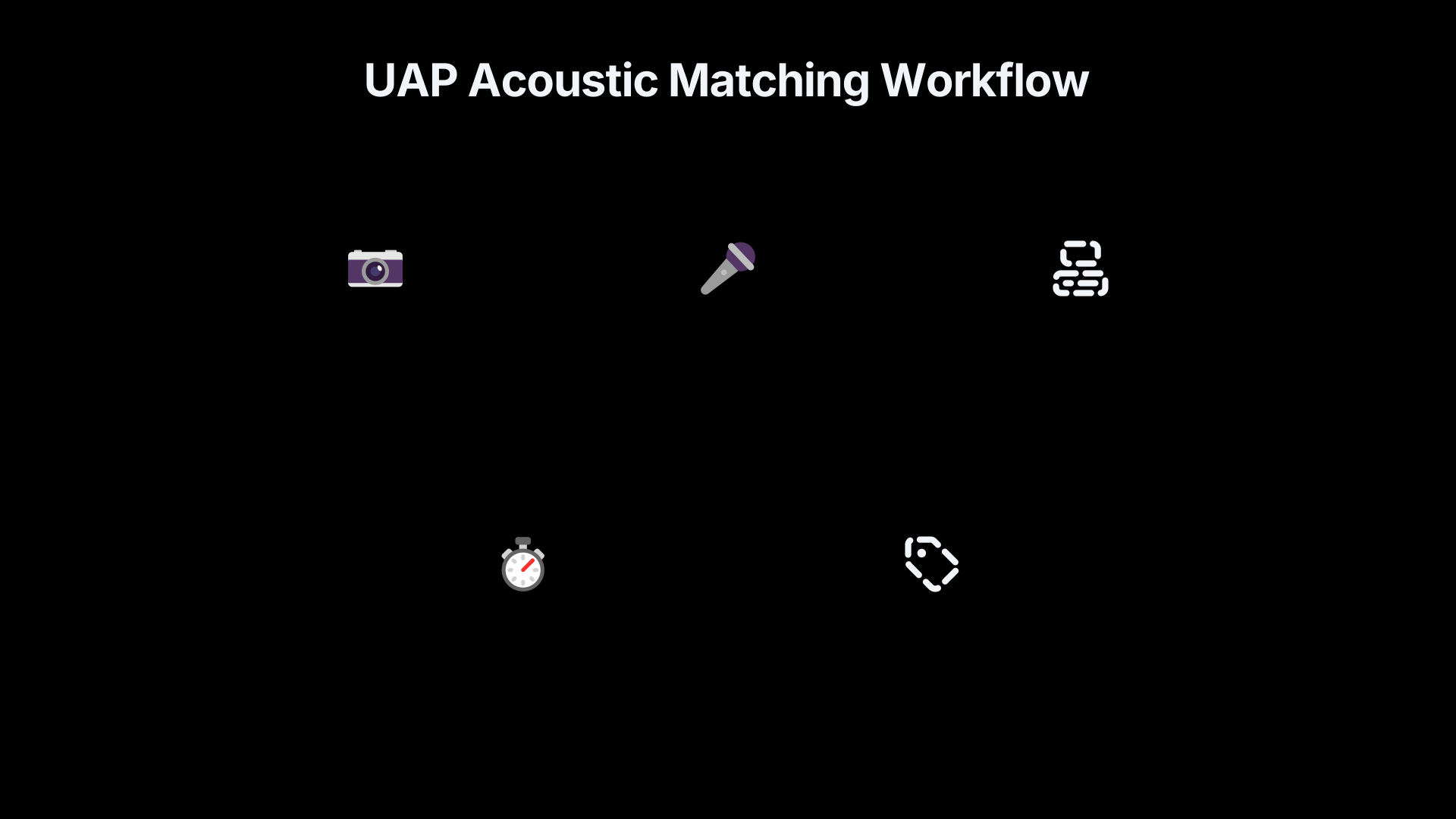
A practical matching workflow looks like this:
- The optical system detects and tracks an object or flash.
- The recorder preserves audio before, during and after the visual event.
- Software searches the audio for impulses, tones, rotor harmonics, broadband noise or low-frequency pressure waves.
- The system compensates for sound delay and checks whether the acoustic bearing agrees with the visual track.
- The event is labelled with confidence and alternatives, not forced into a single explanation.
This is where audio is most valuable for instrumented UAP work: not as a dramatic “sound of a UFO”, but as a way to downgrade false mysteries. A drone should often sound like a drone at close range. A low helicopter should often have rotor signatures. A firework should show an impulse pattern linked to a ground launch area. A meteor may be optically fast but acoustically delayed, sometimes with low-frequency energy rather than a nearby engine tone.
Drones, fireworks and nearby ground activity
Small drones are one of the strongest reasons to include microphones in modern sky detectors. Acoustic drone detection is attractive because it is passive: it listens rather than emitting radar or requiring the drone to transmit a radio signal. Counter-drone systems use microphone arrays to pick up propeller and motor noise, classify signatures, and in some cases estimate direction or rough position.[robinradar.com]robinradar.comThe Pros and Cons of Using an Acoustic Detection System Against DronesThe Pros and Cons of Using an Acoustic Detection System Against Drones
The limitation is range. A vendor-neutral caution from the counter-drone field is that acoustic sensors are not usually a primary long-range solution; one overview gives a typical maximum range of about 300–500 metres and notes that noisy environments, wind direction and temperature reduce performance.[robinradar.com]robinradar.comThe Pros and Cons of Using an Acoustic Detection System Against DronesThe Pros and Cons of Using an Acoustic Detection System Against Drones That range is still useful for UAP detectors because many “mystery drone” reports involve low-altitude lights near observers. If the station hears rotor noise only when the optical object is close, the audio can help distinguish a nearby drone from a distant aircraft or planet-like light.
Fireworks and pyrotechnics pose a different problem. They may look aerial but originate from the ground, and their sound is often a sequence of launches, crackles and reports rather than a moving engine. A good acoustic record can reveal whether the loudest impulses came from a local direction below the camera’s sky track. It can also separate a genuine sky flash from a nearby bang that merely made the observer look up.
Ground activity is the unglamorous but important category. Cars, motorcycles, construction equipment, doors, voices, dogs, insects, wind in trees and the detector’s own housing can contaminate a sky event. NASA’s insistence on metadata and baseline data is directly relevant here: a microphone without known sensitivity, clock synchronisation, wind conditions and ordinary-site noise profiles can create as much confusion as it resolves.[NASA Science]science.nasa.govNASA Science… For a fixed detector, long-term baseline recording is not optional; it is how the system learns what the site normally sounds like at night, in rain, near traffic peaks, during local events and under different wind directions.
Meteors, bolides and delayed low-frequency clues
Meteors are a good example of why “no immediate sound” does not mean “no acoustic evidence”. A bright bolide may cross the sky in seconds, while any shock-generated sound or infrasound arrives later. Infrasound research treats bolides as atmospheric sources whose pressure waves can be detected by specialised low-frequency arrays, including networks originally built for monitoring explosions. A Scientific Reports study of the March 2022 Mediterranean bolide notes that pressure waves from supersonic bolides or explosions can be captured by infrasonic microphone arrays.[Nature]nature.comOpen source on nature.com.
The relevance for UAP detectors is not that every citizen station needs a professional infrasound array. It is that some visually spectacular sky events have acoustic signatures on a different timescale and frequency band from ordinary aircraft. A station that stores only a few seconds of audio around the optical trigger may miss the delayed signal. A better design keeps a rolling buffer long enough to preserve the later rumble, pressure wave or low-frequency arrival.
Recent bolide studies also show why acoustic interpretation must be modest. Infrasound can support estimates of energy, trajectory and shock type when compared with other data, but results can disagree with optical or other “ground truth” measurements. One 2025 study of two bolides found many infrasound interpretations broadly agreed with other modalities, while one yield estimate was significantly lower and one detection suggested an unusual shock geometry.[arXiv]arxiv.orgOpen source on arxiv.org. In other words, acoustic data is powerful, but it is not a magic tape measure.
This same caution applies to thunder and lightning-like events. The flash-to-sound delay can estimate distance, but only when the visual and acoustic events truly belong together. NOAA’s lightning material explains the simple delay principle, while aircraft acoustics literature shows how atmosphere, wind, terrain and reflections complicate sound propagation.[NOAA]noaa.govLearning Lesson: Determining distance to a Thunderstorm5 Apr 2023 — Sound travels roughly 750 mph (1,200 km/h), or approximately one… For automated UAP work, the lesson is to log enough context to test the association rather than assuming the nearest bang belongs to the brightest light.
Noise, delay and interpretation problems
The biggest danger with acoustic evidence is over-reading it. A microphone records pressure changes at one point; it does not automatically know whether a sound came from the visible object, another aircraft outside the camera frame, a road, an animal, a neighbour’s firework or the detector’s own mount vibrating in the wind. Acoustic sensors can be excellent supporting instruments, but weak standalone witnesses.
Several failure modes are common:
- False association: a bang, engine note or buzz happens near the same time as a visual event but comes from another source.
- Wrong distance intuition: the object looks close, but the sound delay indicates a much larger distance, or the reverse.
- Wind masking: wind over a microphone can hide quiet drones and create low-frequency rumble that looks important in a spectrogram.
- Atmospheric bending: temperature gradients and wind can refract aircraft noise, sometimes making it quieter or louder than expected at the ground.[Eagle Pubs]eaglepubs.erau.eduEagle Pubs Aeroacoustics of Flight Vehicles –Eagle PubsAeroacoustics of Flight Vehicles – Introduction to Aerospace Flight Vehicles…
- Site noise: roads, power equipment, insects and buildings create repeatable local signatures that must be learned as baseline.
- Short buffers: systems that save only the visual trigger window may miss delayed thunder, bolide infrasound or aircraft sound.
These problems argue for better instrumentation, not for ignoring sound. The Galileo Project’s multimodal approach is important because it treats microphones as one part of a package that includes optical, radio and environmental channels, not as a replacement for them.[arXiv]arxiv.orgThe Scientific Investigation of Unidentified Aerial Phenomena (UAP) Using Multimodal Ground-Based ObservatoriesMay 29, 2023… NASA’s UAP report makes the same broader point: rare-event detection depends on calibrated sensors, metadata, baselines and multiple measurements.[NASA Science]science.nasa.govNASA Science…
What good acoustic practice adds to a UFO detector
A well-designed acoustic subsystem should do five things. First, it should record synchronised audio continuously or with enough pre- and post-trigger buffering to capture delayed signals. Second, it should preserve raw or lightly processed audio, not only a classifier label. Third, it should log weather, especially wind, temperature and humidity, because these affect propagation and noise. Fourth, it should maintain a site-specific baseline so analysts can recognise ordinary local sounds. Fifth, when possible, it should use more than one microphone so direction can be estimated rather than guessed.
The best outputs are not dramatic conclusions but useful labels: “probable aircraft noise consistent with optical track”, “nearby impulse inconsistent with sky bearing”, “rotor-like acoustic signature at short range”, “no sound detected above baseline”, or “delayed low-frequency arrival possibly consistent with bolide”. Those labels are valuable because they make later review faster and more honest. They also prevent the common mistake of treating silence, delay or a strange noise as inherently mysterious.
For automated instrumented UFO detectors, acoustics is therefore a reality-checking channel. It can catch drones that cameras see as dots, distinguish aircraft from silent lights, expose fireworks and local contamination, and preserve delayed clues from energetic sky events. Its limits are just as important as its strengths: sound is local, delayed, weather-shaped and easily confused. Used carefully, microphones do not make UAP claims more sensational; they make sky-event evidence harder to fool.
Amazon book picks
Further Reading
Books and field guides related to Can Sound Help Identify Sky Objects?. Use these as the next step if you want deeper reading beyond the article.

UFOs : Generals, Pilots, and Government Officials Go on the R...
Provides context for why better sensor evidence is valuable.
Fundamentals of acoustics
Explains sound propagation, microphones, arrays, and measurement principles.
Introduction to sound
Covers core acoustic concepts applicable to environmental sound recording.
UFOs
NEW YORK TIMES BESTSELLER • Impeccably researched, this riveting journalistic investigation separates fact from fiction, and documents th...
eBay marketplace picks
Marketplace Samples
Live-tested eBay searches with available results related to this page.




Endnotes
1.
Source: science.nasa.gov
Link:https://science.nasa.gov/wp-content/uploads/2023/09/uap-independent-study-team-final-report.pdf
Source snippet
NASA Science...
2.
Source: arxiv.org
Link:https://arxiv.org/abs/2305.18566
Source snippet
The Scientific Investigation of Unidentified Aerial Phenomena (UAP) Using Multimodal Ground-Based ObservatoriesMay 29, 2023...
Published: May 29, 2023
3.
Source: arxiv.org
Title: arXiv Multi-Band Acoustic Monitoring of Aerial Signatures
Link:https://arxiv.org/abs/2305.18551
4.
Source: noaa.gov
Link:https://www.noaa.gov/jetstream/lightning/sound-of-thunder/learning-lesson-determining-distance-to-thunderstorm
Source snippet
Learning Lesson: Determining distance to a Thunderstorm5 Apr 2023 — Sound travels roughly 750 mph (1,200 km/h), or approximately one...
5.
Source: robinradar.com
Title: The Pros and Cons of Using an Acoustic Detection System Against Drones
Link:https://www.robinradar.com/blog/acoustic-sensors-drone-detection
6.
Source: acta-acustica.edpsciences.org
Link:https://acta-acustica.edpsciences.org/articles/aacus/full_html/2026/01/aacus250134/aacus250134.html
7.
Source: nature.com
Link:https://www.nature.com/articles/s41598-023-48396-8
8.
Source: arxiv.org
Link:https://arxiv.org/abs/2502.14232
9.
Source: arxiv.org
Link:https://arxiv.org/html/2506.00125v1
10.
Source: science.nasa.gov
Link:https://science.nasa.gov/uap/
11.
Source: grc.nasa.gov
Link:https://www.grc.nasa.gov/www/k-12/airplane/sound2.html
12.
Source: weather.gov
Link:https://www.weather.gov/safety/lightning-science-thunder
13.
Source: eaglepubs.erau.edu
Title: Eagle Pubs Aeroacoustics of Flight Vehicles –
Link:https://eaglepubs.erau.edu/introductiontoaerospaceflightvehicles/chapter/noise-of-flight-vehicles/
Source snippet
Eagle PubsAeroacoustics of Flight Vehicles – Introduction to Aerospace Flight Vehicles...
14.
Source: osinto.com
Title: Acoustic Drone Detection
Link:https://www.osinto.com/the-osborne-report/acoustic-drone-detection/
15.
Source: researchonline.jcu.edu.au
Link:https://researchonline.jcu.edu.au/88537/1/88537.pdf
16.
Source: Wikipedia
Title: The Galileo Project
Link:https://en.wikipedia.org/wiki/The_Galileo_Project
Additional References
17.
Source: youtube.com
Link:http://www.youtube.com/watch?v=kFp3fiAwZd8
Source snippet
Anti-UAV System: How Acoustic Location Beats Radar & RF in Urban Defense...
18.
Source: youtube.com
Title: Anti-UAV System: How Acoustic Location Beats Radar & RF in Urban Defense
Link:http://www.youtube.com/watch?v=3lBHdwowxPM
Source snippet
How Monava's acoustic drone detectors work...
19.
Source: youtube.com
Title: Infrasound (Science@SOEST)
Link:http://www.youtube.com/watch?v=RTutGclzmKw
Source snippet
Acoustic drone detection system How to Recognize Drones by Sound | MilTech Trends 2025...
20.
Source: researchgate.net
Link:https://www.researchgate.net/publication/393724632_The_deployment_of_a_geomagnetic_variometer_station_as_auxiliary_instrumentation_for_the_study_of_Unidentified_Aerial_Phenomena
21.
Source: researchgate.net
Link:https://www.researchgate.net/publication/400185409_Passive_acoustic_detection_and_localization_of_drones_using_MEMS_microphones_and_machine_learning
22.
Source: core.ac.uk
Link:https://core.ac.uk/download/pdf/53034851.pdf
23.
Source: netlinetech.com
Link:https://netlinetech.com/industry/airports-critical-infrastructure/acoustic-drone-detection-2/
24.
Source: zataiot.com
Link:https://www.zataiot.com/acoustic-drone-detection-zd-ear-uav-direction-finder/
25.
Source: drone-warfare.com
Link:https://drone-warfare.com/counter-uas/acoustic-detection/
26.
Source: sqhead.com
Link:https://www.sqhead.com/defense
Topic Tree