Within Review
Why Some UFO Alerts Should Stay Unsolved
An unidentified alert is not stronger evidence when missing range, calibration, metadata, or context makes ordinary explanations impossible to test.
On this page
- Unidentified versus unidentifiable
- Metadata gaps that block review
- How to avoid promoting weak cases
Page outline Jump by section
Introduction
An automated instrumented UFO detector is designed to preserve unusual events for later analysis, not to declare what they are. That distinction is especially important when an alert contains too little information to support any reliable conclusion. A case may remain unresolved not because it is exceptionally mysterious, but because the evidence is too incomplete to test ordinary explanations. Missing timestamps, uncertain calibration, absent range measurements, poor image quality or a lack of supporting sensor data can leave investigators unable to distinguish between an aircraft, balloon, atmospheric effect, sensor artefact or something genuinely unusual. NASA’s independent study of unidentified anomalous phenomena (UAP) identified poor calibration, missing metadata and insufficient multi-sensor observations as major barriers to scientific analysis rather than signs of extraordinary events.[NASA Science]science.nasa.govNASA ScienceIndependent Study Team ReportAt present, analysis of UAP data is hampered by poor sensor calibration, the lack of multiple me…
 For human reviewers working with automated sky-monitoring systems, leaving such cases unresolved is often the most scientifically responsible outcome. An unresolved classification acknowledges uncertainty without turning incomplete evidence into stronger evidence than it deserves.
Unidentified is not the same as unidentifiable
An object is unidentified when available evidence has not yet produced a convincing explanation. An event is effectively unidentifiable when the recorded information is too limited to allow meaningful testing of competing hypotheses.
This distinction matters because automated detectors inevitably generate alerts under imperfect conditions. A brief infrared flash, a blurred optical track or a single-frame anomaly may trigger the system exactly as intended. However, if the detector records neither distance nor supporting context, reviewers cannot reliably estimate the object’s speed, size or altitude.
Without those measurements, multiple explanations remain compatible with the same observation. A nearby insect, a distant aircraft, an optical reflection or an atmospheric effect may all produce similar image characteristics when viewed through incomplete data. Scientific review therefore stops not because every explanation has failed, but because none can be tested adequately.
This is a normal outcome in observational science. Lack of identification is often a statement about the quality of the record rather than the nature of the object itself. NASA’s UAP study repeatedly emphasises that better observations—not stronger speculation—are the path to resolving such cases.[NASA Science]science.nasa.govNASA ScienceIndependent Study Team ReportAt present, analysis of UAP data is hampered by poor sensor calibration, the lack of multiple me…
Which missing metadata prevents meaningful review?
Human reviewers depend as much on contextual information as on the image itself. A visually striking clip with poor metadata is frequently less useful than an ordinary-looking recording with complete documentation.
Common information gaps include:
- No reliable timestamp, preventing comparison with aircraft, satellite or astronomical databases.
- Unknown camera orientation, making trajectory reconstruction impossible.
- Missing calibration records, leaving uncertainty about lens distortion, field of view or sensor response.
- No range information, preventing estimation of true speed or physical size.
- Single-sensor observations, with no independent confirmation from infrared, radar, radio or another optical system.
- Missing environmental data, including weather, cloud cover or atmospheric conditions.
- Incomplete recording, where only the triggered clip survives instead of the seconds before and after the event.
Each missing element increases the number of plausible explanations while decreasing investigators’ ability to eliminate them.
NASA identified exactly these types of deficiencies—poor calibration, missing metadata, lack of multiple measurements and inadequate baseline observations—as primary obstacles to interpreting UAP reports scientifically.[NASA Science]science.nasa.govNASA ScienceIndependent Study Team ReportAt present, analysis of UAP data is hampered by poor sensor calibration, the lack of multiple me…
Why incomplete records can exaggerate apparent anomalies
Ironically, the weakest datasets often appear the most dramatic.
A sharp, well-calibrated recording usually reveals details that allow identification: aircraft navigation lights, bird wingbeats, satellite motion or optical artefacts become apparent during detailed analysis.
By contrast, poor-quality recordings remove exactly the features needed for identification. Motion blur obscures shape. Automatic exposure changes distort brightness. Unknown focal length affects perceived speed. Compression artefacts create false structure. As information disappears, imagination fills the gaps.
This creates a well-known observational bias: ambiguity should increase caution rather than confidence. An unexplained event recorded with little information is generally weaker evidence than an event recorded comprehensively but not yet explained.
Modern observatory designs explicitly attempt to reduce this problem by combining multiple calibrated sensors, preserving data provenance and recording extensive contextual metadata so that later reviewers can reconstruct what actually happened.[arXiv+2arXiv]arxiv.org1 Introduction30 May 2025 — A system designed for the comprehensive scientific study of aerial phenomena which integrates multiple s…
Why “unsolved” is a legitimate scientific category
Leaving an alert unresolved is not a failure of the review process. It is a safeguard against unsupported conclusions.
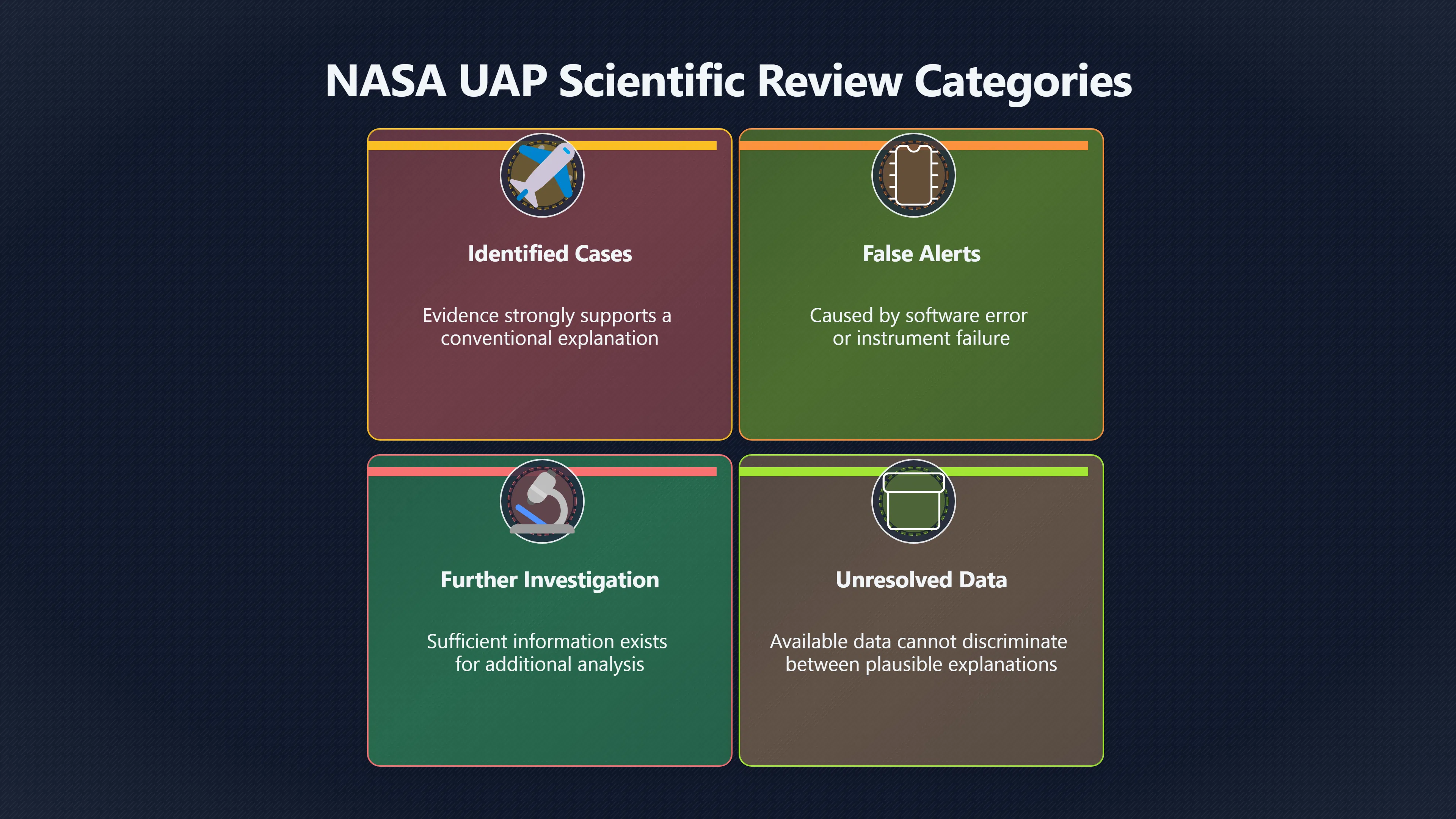
A scientifically useful triage system typically separates cases into categories such as:
- Identified: evidence strongly supports a conventional explanation.
- False alert: caused by software error, instrument artefact or recording failure.
- Requires further investigation: sufficient information exists for additional analysis.
- Unresolved because evidence is insufficient: available data cannot discriminate among multiple plausible explanations.
The last category preserves intellectual honesty. It records that the available evidence does not justify either an ordinary identification or an extraordinary interpretation.
Government review processes follow similar reasoning. The U.S. Department of Defense’s All-domain Anomaly Resolution Office (AARO) has stated that many reports remain unresolved because they lack sufficient scientific data for analysis, and that additional information could allow future resolution. It has also assessed that more complete and higher-quality data would likely explain many currently unresolved cases as ordinary objects or phenomena.[U.S. Department of War]war.govdod examining unidentified anomalous phenomenaDepartment of WarDOD Examining Unidentified Anomalous Phenomena14 Nov 2024 — Over 900 reports lack sufficient scientific data for analysi…
How to avoid promoting weak cases
Human reviewers can reduce the risk of elevating poor-quality alerts by applying consistent standards before treating an event as noteworthy.
Useful practices include:
- Require complete metadata before assigning high analytical priority.
- Preserve raw sensor outputs instead of relying only on compressed video.
- Retain pre-trigger and post-trigger recordings to provide behavioural context.
- Compare every alert against aircraft, satellite, weather and astronomical databases before considering unusual explanations.
- Clearly distinguish “insufficient evidence” from “evidence for an anomaly” in reports and public releases.
- Archive unresolved cases so they can be re-examined if additional observations or improved calibration become available.
These practices encourage reproducibility rather than speculation. They also prevent the gradual inflation of weak observations into stronger claims simply because no explanation could be confirmed.
Why unresolved cases still have value
A low-information alert is not useless simply because it cannot be identified. Archived unresolved cases help developers evaluate detector performance, improve calibration procedures and identify recurring weaknesses in instrumentation or software.
If similar events are later captured simultaneously by multiple calibrated observatories with complete metadata, earlier unresolved recordings may become interpretable in retrospect. Conversely, if no additional evidence ever appears, the unresolved classification remains appropriate.
Within an automated instrumented UFO detection programme, the goal is therefore not to eliminate every unknown. It is to ensure that uncertainty accurately reflects the available evidence. An unresolved alert should represent an honest limit of measurement, not an invitation to assign extraordinary significance where the data cannot support it.
eBay marketplace picks
Marketplace Samples
Live-tested eBay searches with available results related to this page.



Endnotes
1.
Source: science.nasa.gov
Link:https://science.nasa.gov/wp-content/uploads/2023/09/uap-independent-study-team-final-report.pdf
Source snippet
NASA ScienceIndependent Study Team ReportAt present, analysis of UAP data is hampered by poor sensor calibration, the lack of multiple me...
2.
Source: science.nasa.gov
Link:https://science.nasa.gov/uap/
Source snippet
NASA ScienceUAP9 Jun 2022 — The UAP Independent Study shall report on the following questions: What types of scientific data currently co...
3.
Source: arxiv.org
Link:https://arxiv.org/html/2506.00125v1
Source snippet
1 Introduction30 May 2025 — A system designed for the comprehensive scientific study of aerial phenomena which integrates multiple s...
Published: May 2025
4.
Source: arxiv.org
Title: arXiv [Galileo]({{ ‘galileo/’ | relative_url }}) Project Observatory Class System Architecture
Link:https://arxiv.org/abs/2506.00125
5.
Source: arxiv.org
Link:https://arxiv.org/abs/2305.18566
6.
Source: war.gov
Title: dod examining unidentified anomalous phenomena
Link:https://www.war.gov/News/News-Stories/Article/Article/3965403/dod-examining-unidentified-anomalous-phenomena/
Source snippet
Department of WarDOD Examining Unidentified Anomalous Phenomena14 Nov 2024 — Over 900 reports lack sufficient scientific data for analysi...
7.
Source: nasa.gov
Title: to release discuss unidentified anomalous phenomena report
Link:https://www.nasa.gov/news-release/nasa-to-release-discuss-unidentified-anomalous-phenomena-report/
Source snippet
NASA to Release, Discuss Unidentified Anomalous...12 Sept 2023 — NASA commissioned the study to examine UAP from a scientific perspectiv...
8.
Source: nasa.gov
Title: provides coverage of unidentified anomalous phenomena meeting
Link:https://www.nasa.gov/news-release/nasa-provides-coverage-of-unidentified-anomalous-phenomena-meeting/
Source snippet
NASA Provides Coverage of Unidentified Anomalous...12 May 2023 — NASA commissioned the nine-month study to examine UAP from a scientific...
Published: May 2023
9.
Source: science.nasa.gov
Link:https://science.nasa.gov/uap/faqs/
Source snippet
8 May 2026 — The UAP independent study team's main focus for the report was to come up with a way in which to evaluate and study UAPs goi...
Published: May 2026
Additional References
10.
Source: researchgate.net
Link:https://www.researchgate.net/publication/371163445_The_Scientific_Investigation_of_Unidentified_Aerial_Phenomena_UAP_Using_Multimodal_Ground-Based_Observatories
Source snippet
(PDF) The Scientific Investigation of Unidentified Aerial...PDF | (Abridged) The Galileo Project aims to investigate Unidentified Aerial...
11.
Source: reuters.com
Link:https://www.reuters.com/technology/space/pentagon-ufo-report-says-most-sightings-ordinary-objects-phenomena-2024-03-08/
Source snippet
Most sightings were identified as ordinary objects or phenomena. The All-domain Anomaly Resolution Office (AARO) released this conclusion...
12.
Source: reddit.com
Link:https://www.reddit.com/r/UFOs/comments/ou0onn/questions_for_the_galileo_project/
Source snippet
Questions for the Galileo Project: r/UFOsWill the results be made public if UAP is documented, or will there be continued government reg...
13.
Source: usaherald.com
Link:https://usaherald.com/us-government-pentagon-releases-new-ufo-files-sparking-fresh-questions-as-declassified-uap-evidence-surges/
Source snippet
US Government: Pentagon Releases New UFO Files...22 hours ago — The Pentagon's All-domain Anomaly Resolution Office, known as AARO, main...
14.
Source: avi-loeb.medium.com
Link:https://avi-loeb.medium.com/commissioning-data-on-half-a-million-objects-in-the-sky-from-the-galileo-project-observatory-are-a23bd084233a
Source snippet
Data on Half a Million Objects in the Sky from...The GP Observatories offer an array of multi-modal, was commissioned through a novel ex...
15.
Source: thedebrief.org
Link:https://thedebrief.org/galileo-project-releases-commissioning-data-on-half-a-million-aerial-objects-are-any-of-them-uap/
Source snippet
Galileo Project Releases Commissioning Data on Half a...12 Nov 2024 — The Galileo Project has released the commissioning data from its f...
16.
Source: avi-loeb.medium.com
Link:https://avi-loeb.medium.com/nasa-aaro-and-the-galileo-project-agree-on-the-need-for-a-scientific-study-of-uap-58b39c005b57
Source snippet
medium.comNASA, AARO and the Galileo Project Agree on the Need for a...Two years later, in May 2023, the Galileo Project published 8 pee...
Published: May 2023
17.
Source: avi-loeb.medium.com
Link:https://avi-loeb.medium.com/resolving-the-nature-of-unidentified-anomalous-phenomena-uap-by-scientific-evidence-217cb8ac5f72
Source snippet
the Nature of Unidentified Anomalous Phenomena...The council will deliberate honestly and adopt the scientific method in seeking conclus...
18.
Source: drbriankeating.medium.com
Link:https://drbriankeating.medium.com/the-galileo-project-systematically-searching-for-evidence-of-extraterrestrial-technological-cb4535c6f351
Source snippet
Galileo Project: Systematically Searching for Evidence of...The Galileo Project aims to identify the nature of UAP a transparent analysi...
19.
Source: reddit.com
Link:https://www.reddit.com/r/nasa/comments/16ij1ym/nasa_has_released_the_unidentified_anomalous/
Topic Tree