Within Vision Filters
When a Box Finds Something in the Sky
Bounding boxes help a sky camera follow moving targets, but they can also chase insects, leaves, flashes and tiny distant blobs.
On this page
- What a bounding box actually marks
- Why small sky targets confuse trackers
- When a track becomes worth human review
Page outline Jump by section
Introduction
Bounding boxes are one of the simplest but most important mechanisms in an automated sky-monitoring system. They do not identify a UFO, aircraft or bird. Instead, they answer a more basic question: where is the moving object now, and is it still the same object a moment later? By drawing a rectangle around a detected target in each video frame and linking those rectangles over time, the software converts fleeting motion into a coherent track that can be stored as a short reviewable clip rather than hours of uneventful sky footage. This tracking stage is especially important because automated sky cameras encounter countless distractions, including insects close to the lens, moving foliage, atmospheric shimmer, flashing lights and tiny distant objects. A bounding box is therefore a tool for organising evidence, not for deciding what the object is.[UFODAP]ufodap.comDap Camera, Science and TechnologyA number of automatic processes reduce the possibility of triggering recording on false positives, such…

When a Box Finds Something in the Sky
What a bounding box actually marks
A bounding box is simply the smallest practical rectangle that encloses a detected object in an image. As new frames arrive, the detection software predicts a new box around the same target. Tracking software then links successive boxes into a single trajectory, assigning the object a persistent identity until it disappears from view. Modern real-time systems commonly combine an object detector such as YOLO (“You Only Look Once”) with a tracker such as SORT (Simple Online and Realtime Tracking), where the detector proposes boxes and the tracker decides which new detection belongs to which existing track.[MDPI]mdpi.comCommissioning an All-Sky Infrared Camera Array for…by L Domine · 2025 · Cited by 11 — Using a You Only Look Once (YOLO) machine le…
For automated sky observation, this process has a practical consequence. Instead of saving continuous video all day, the system can record only the portion surrounding a sustained track. Metadata such as the time, duration, image coordinates, apparent speed and direction can be attached to the clip, making later human review far more efficient than searching through hours of empty sky.[MDPI]mdpi.comCommissioning an All-Sky Infrared Camera Array for…by L Domine · 2025 · Cited by 11 — Using a You Only Look Once (YOLO) machine le…
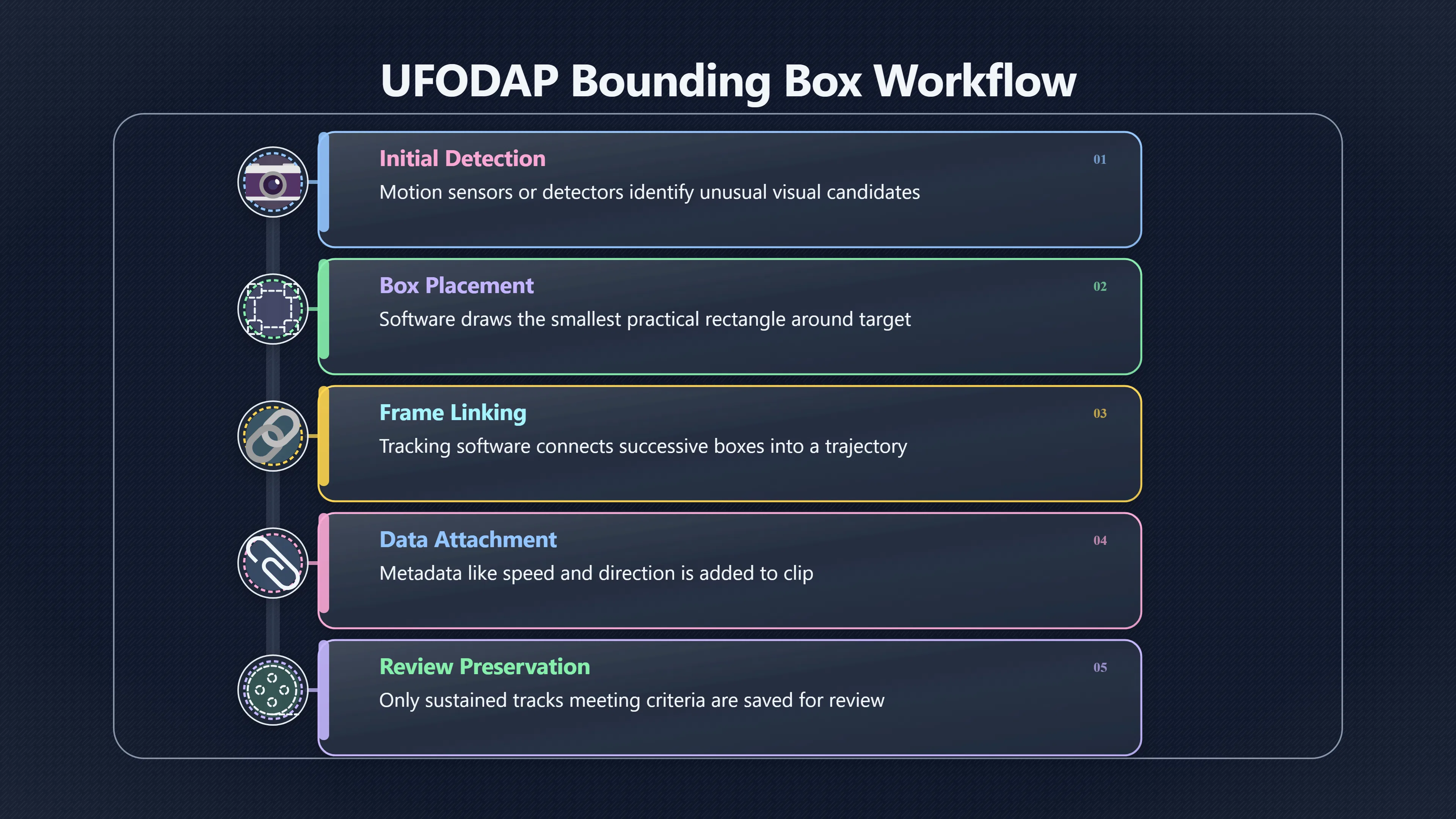
A useful way to think about the process is:
- Motion or an object detector finds something unusual.
- A bounding box is placed around the candidate.
- The box is updated frame by frame.
- The linked boxes become a trajectory.
- If the trajectory satisfies review criteria, the associated video segment is preserved.
The important output is therefore not the rectangle itself but the continuous history created from many rectangles.
Why Small Sky Targets Confuse Trackers
Sky monitoring is an unusually difficult tracking problem because most targets occupy very few pixels. A commercial aircraft many kilometres away may cover only a handful of pixels, while an insect flying centimetres from the camera can occupy a much larger apparent area. A tracker sees only image measurements unless additional information is available.
Several common situations can confuse bounding-box tracking:
- Near-field insects may move rapidly across the frame while appearing large and sharply defined.
- Birds change wing shape continuously, causing the detected box to expand and contract.
- Leaves and branches entering the field of view generate repeated motion that can be mistaken for a moving object.
- Sun glints, cloud edges and atmospheric turbulence briefly create bright features that resemble small moving targets.
- Extremely distant objects may consist of only a few changing pixels, making it difficult to distinguish genuine motion from sensor noise.
These problems illustrate an important limitation: the tracker follows whatever the detector presents. If the detector places a box around a flying insect, the tracker may faithfully build a complete insect trajectory. Good tracking therefore does not automatically imply correct identification.[MDPI]mdpi.comCommissioning an All-Sky Infrared Camera Array for…by L Domine · 2025 · Cited by 11 — Using a You Only Look Once (YOLO) machine le…
This explains why automated UFO detection systems generally treat tracking as an intermediate filtering stage rather than a final classification stage.
Making the Box More Stable
Practical systems use several techniques to stop bounding boxes wandering between unrelated objects or reacting to background motion.
One approach is to tighten the box around the detected target after acquisition. UFODAP, for example, describes shrinking the bounding box around the moving object so that nearby background features are less likely to interfere with continued tracking. The same system also applies automatic filtering to reduce triggers from flickering stars, birds and moving foliage, while sampling the night sky background so persistent static features can be ignored during operation.[UFODAP]ufodap.comDap Camera, Science and TechnologyA number of automatic processes reduce the possibility of triggering recording on false positives, such…
Research systems adopt a similar philosophy with more sophisticated algorithms. In the Galileo Project’s all-sky infrared observatory, YOLO performs object detection while SORT reconstructs trajectories across successive frames. Rather than relying on any single frame, the system evaluates how detections evolve over time, allowing persistent tracks to be reconstructed even when individual detections fluctuate slightly between frames.[MDPI]mdpi.comCommissioning an All-Sky Infrared Camera Array for…by L Domine · 2025 · Cited by 11 — Using a You Only Look Once (YOLO) machine le…
This temporal continuity is often more informative than any individual image. A single frame may contain only a tiny bright spot; a hundred linked frames can reveal whether that spot follows the smooth path expected from an aircraft, the erratic motion typical of an insect or something deserving closer examination.
When a Track Becomes Worth Human Review
Most detected tracks are never seen by a person because they fail simple quality tests. Automated systems typically require evidence that motion persists across multiple frames, remains internally consistent and exceeds minimum thresholds for duration or confidence before creating a review event. Short-lived flashes or isolated detections are often discarded automatically.[MDPI]mdpi.comCommissioning an All-Sky Infrared Camera Array for…by L Domine · 2025 · Cited by 11 — Using a You Only Look Once (YOLO) machine le…
Even after these filters, human review remains essential. The Galileo Project has reported that automated processing can generate large numbers of candidate trajectories, with additional filtering and manual inspection dramatically reducing the set of events considered genuinely ambiguous. Their published commissioning work emphasises that unusual trajectories alone do not establish unusual objects because important information such as distance, true velocity and independent sensor confirmation may still be missing.[MDPI]mdpi.comCommissioning an All-Sky Infrared Camera Array for…by L Domine · 2025 · Cited by 11 — Using a You Only Look Once (YOLO) machine le…
For this reason, the bounding box should be viewed as a bookkeeping device rather than evidence of anomalous behaviour. Its value lies in preserving a coherent sequence that reviewers can inspect alongside timestamps, trajectories and, where available, data from other sensors.
Why Bounding Boxes Matter Despite Their Simplicity
Bounding boxes appear visually simple, but they perform the crucial conversion from raw motion into structured evidence. Without them, an automated sky camera would either save vast amounts of continuous footage or risk missing transient events altogether.
Their greatest strength is efficiency. They allow a monitoring station to reduce countless hours of ordinary sky activity into a manageable collection of short clips with associated motion histories. Their greatest weakness is that they are deliberately agnostic about what they enclose. A perfectly tracked insect, bird or aircraft can produce an excellent bounding-box trajectory.
Within automated instrumented UFO detection, this makes bounding boxes a triage mechanism rather than an identification mechanism. They answer the question, “Has something moved consistently enough to deserve a clip?” The much harder question—what actually moved?—belongs to later stages involving object classification, aircraft correlation, additional sensors and ultimately informed human review.[UFODAP]ufodap.comDap Camera, Science and TechnologyA number of automatic processes reduce the possibility of triggering recording on false positives, such…
Amazon book picks
Further Reading
Books and field guides related to When a Box Finds Something in the Sky. Use these as the next step if you want deeper reading beyond the article.
Deep Learning
Rating: 3.5/5 from 6 Google Books ratings
Provides background for modern object detection systems such as YOLO.

Programming Computer Vision With Python
Includes feature detection, tracking and image analysis concepts.

Multiple view geometry in computer vision
Provides theoretical foundations for tracking objects across image sequences.

Computer Vision
Explains detection, tracking and motion estimation used in automated sky monitoring.
eBay marketplace picks
Marketplace Samples
Example marketplace items related to this page. Use the search link to explore similar finds on eBay.
Endnotes
1.
Source: ufodap.com
Link:https://ufodap.com/technology
Source snippet
Dap Camera, Science and TechnologyA number of automatic processes reduce the possibility of triggering recording on [false positives]({{ 'false-positives/' | relative_url }}), such...
2.
Source: mdpi.com
Link:https://www.mdpi.com/1424-8220/25/3/783
Source snippet
Commissioning an All-Sky Infrared Camera Array for...by L Domine · 2025 · Cited by 11 — Using a You Only Look Once (YOLO) machine le...
3.
Source: mdpi.com
Link:https://www.mdpi.com/2673-4052/6/4/77
Source snippet
Each bounding box can detect only one object. Being a single-stage...Read more...
Additional References
4.
Source: researchgate.net
Link:https://www.researchgate.net/publication/388466760_Commissioning_an_All-Sky_Infrared_Camera_Array_for_Detection_of_Airborne_Objects
Source snippet
(PDF) Commissioning an All-Sky Infrared Camera Array for...10 Jan 2025 — Using a You Only Look Once (YOLO) machine learning model for ob...
5.
Source: facebook.com
Link:https://www.facebook.com/groups/994223882204197/posts/1013020470324538/
Source snippet
otdau softwareA number of automatic processes reduce the possibility of triggering recording on false positives, such as flickering stars...
6.
Source: blog.savant-ai.io
Link:https://blog.savant-ai.io/rotated-objects-tracking-with-angle-aware-detection-model-and-sort-tracker-42a96429898d
Source snippet
Objects Tracking With Angle-Aware Detection Model...26 Dec 2022 — The article demonstrates the usage of one of the SORT implementations...
7.
Source: wscg.zcu.cz
Link:https://wscg.zcu.cz/WSCG2021/FULL/K02.pdf
Source snippet
In Hun169 objects are denoted by bounding boxes, videos were recorded at 15 and 30.Read more...
8.
Source: facebook.com
Title: Body Scanning Technology: Supporting Staff & Reducing
Link:https://www.facebook.com/Nationalsheriffsassociation/posts/body-scanning-technology-supporting-staff-reducing-human-erroreven-with-the-best/984107220418688/
Source snippet
triggering recording on false positives, such as flickering stars, birds and moving foliage. At night, the system samples the background...
9.
Source: arshren.medium.com
Link:https://arshren.medium.com/an-introduction-to-object-tracking-9fd6249a76b6
Source snippet
Introduction to Object Tracking | by Renu KhandelwalObject tracking detects objects in each frame represented as bounding boxes, followed...
10.
Source: img1.wsimg.com
Title: UFODAS System Installation Guide V1.12
Link:https://img1.wsimg.com/blobby/go/3ce70b16-7a5f-4151-a86b-b4e11efe8275/downloads/22870e7f-9117-4b91-98bb-9e1293f89993/UFODAS%20System%20Installation%20Guide%20V1.12.pdf?ver=1763083370510
Source snippet
Installation Guide13 Nov 2025 — UFODAS cameras may be provided mounted on a weatherproof junction box with a sealed Ethernet connector. T...
11.
Source: facebook.com
Link:https://www.facebook.com/DahuaHQ/posts/with-pfa-automatic-focus-and-new-prediction-and-exposure-technology-our-dual_ptz/2317004148409529/
Source snippet
uch as flickering stars, birds and moving foliage...
12.
Source: galileo.hsites.harvard.edu
Link:https://galileo.hsites.harvard.edu/publications
Source snippet
The Galileo ProjectCommissioning An All-Sky Infrared Camera Array for Detection Of Airborne Objects. Sensors 25, 783 (2025).... In thi...
13.
Source: arxiv.org
Link:https://arxiv.org/html/2410.15518v1
Source snippet
TrackMe: A Simple and Effective Multiple Object Tracking...20 Oct 2024 — In TrackMe, we include the bounding box training and prediction...
Topic Tree