Within Vision Filters
Why the Software Should Not Be the Judge
Machine-vision labels are useful triage signals, not final verdicts, because camera conditions and training data shape every result.
On this page
- What an automated label can and cannot prove
- Why training data and camera setup matter
- How multi sensor review protects against overclaiming
Page outline Jump by section
Introduction
Machine-vision software is an essential first filter for automated instrumented UAP detectors, but it cannot by itself determine whether an object is genuinely unexplained. Automated labels such as “aircraft”, “bird”, “unknown” or “anomalous” are statistical predictions based on patterns the software has learned from previous data. They help reduce the overwhelming number of routine detections that continuous sky monitoring generates, but they do not prove what an object is—or is not. In practice, unusual detections require careful human examination alongside additional sensor information before they can reasonably be treated as unexplained events. This distinction is increasingly reflected in published UAP monitoring research, where automated classification is presented as a triage mechanism rather than a final judgement.[arXiv]arxiv.org1 Introduction12 Nov 2024 — To address this deficiency, the Galileo Project is designing, building, and commissioning a multi-modal…
What an automated label can and cannot prove
Machine-vision systems are designed to answer questions such as:
- Does an object appear in the frame?
- Can it be tracked consistently?
- Does it resemble known categories such as aircraft, birds or insects?
- Is its trajectory unusual compared with the background population?
These are valuable questions, but they are not equivalent to identifying the physical nature of an object.
A modern detector such as YOLO assigns probabilities to object categories based on its training data. Even when confidence is high, the output remains a prediction rather than direct evidence. An “unknown” label usually means the software cannot confidently match the observation to one of its learned categories—not that the object possesses extraordinary properties. Likewise, a confident “bird” or “aircraft” prediction can still be incorrect under poor viewing conditions or when only a few pixels represent the target. General computer vision research consistently treats object detection as probabilistic inference whose accuracy depends on image quality, object scale and the training process.[arXiv]arxiv.orgA Comprehensive Review of YOLO Architectures in Computer Vision: From YOLOv1 to YOLOv8 and YOLO-NASApril 2, 2023…
For automated UAP detection, this distinction is particularly important because many interesting events occur precisely where computer vision performs least reliably: distant, low-resolution, low-contrast objects moving against changing backgrounds.
Why training data and camera setup matter
Machine-learning systems learn from examples rather than physical understanding. Consequently, every automated label reflects the strengths and weaknesses of the data used to train the model.
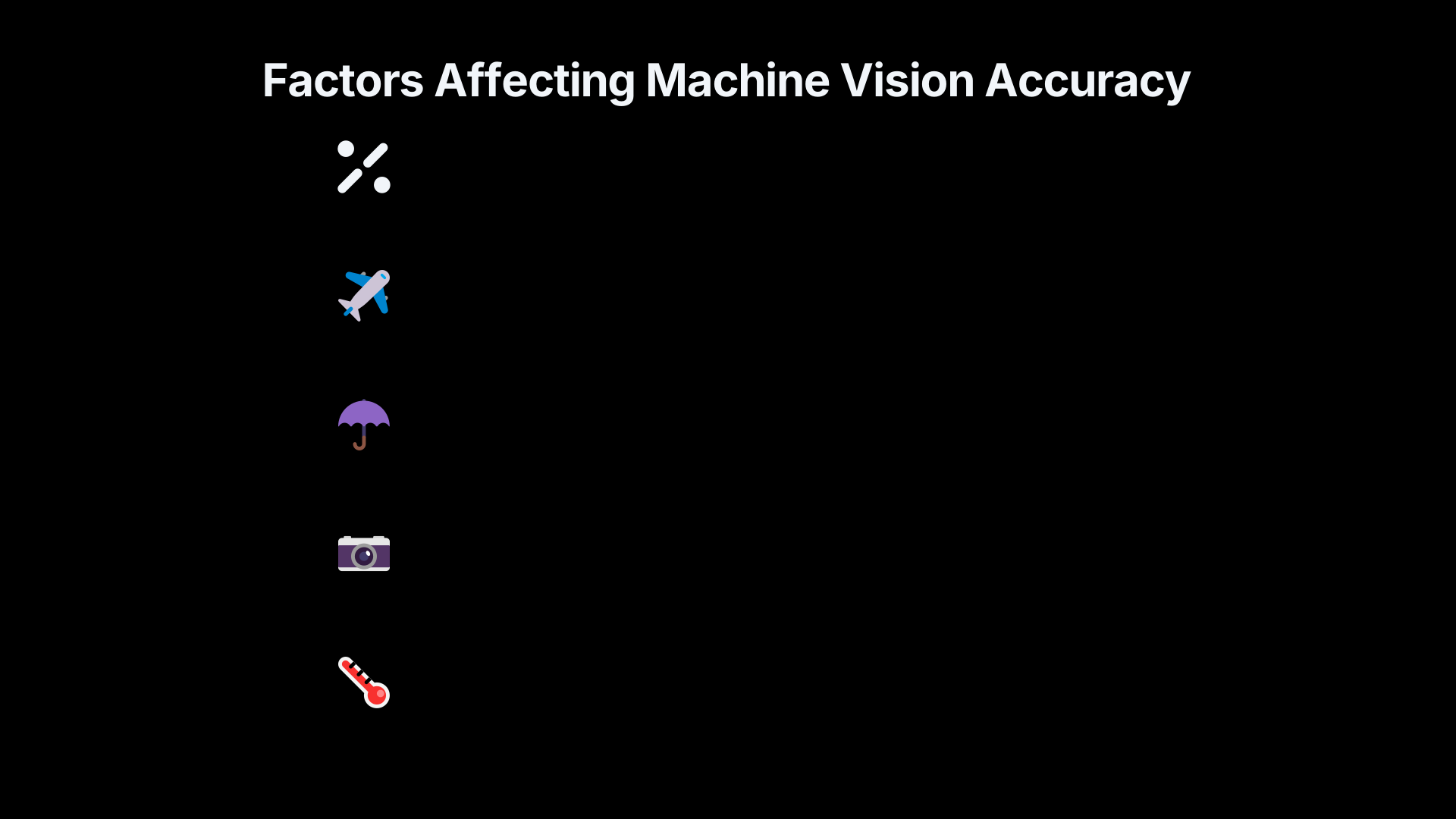
Several factors can alter classification performance:
- Training bias. If birds in the training set mostly appear during daylight, nocturnal infrared observations may be classified less reliably.
- Object size. Very distant aircraft may occupy only a handful of pixels, making them resemble birds, insects or sensor noise.
- Weather. Rain, haze, fog and thermal turbulence reduce contrast and distort apparent shapes.
- Viewing geometry. Camera angle, lens distortion and perspective affect apparent motion and size.
- Sensor characteristics. Infrared cameras record heat rather than visible appearance, so familiar objects can look very different from conventional photographs.
The Galileo Project’s published commissioning results illustrate these practical limitations. Using YOLO detection together with SORT trajectory tracking, the researchers reported that aircraft detection efficiency varied substantially with weather, object distance and target size. Those variations are expected in operational computer vision systems and reinforce why automated classifications require context rather than blind acceptance.[arXiv]arxiv.org1 Introduction12 Nov 2024 — To address this deficiency, the Galileo Project is designing, building, and commissioning a multi-modal…
Calibration also matters. The Galileo system uses known aircraft positions transmitted through Automatic Dependent Surveillance–Broadcast (ADS-B) to calibrate camera geometry. This improves positional accuracy but does not eliminate every source of uncertainty because optical measurements still depend on atmospheric conditions, viewing angle and sensor performance.[arXiv]arxiv.org1 Introduction12 Nov 2024 — To address this deficiency, the Galileo Project is designing, building, and commissioning a multi-modal…
Human review catches failure modes that software cannot
Human analysts contribute information that current automated classifiers do not reliably capture.
Rather than accepting a machine label at face value, reviewers can ask questions such as:
- Does the object’s apparent behaviour change when viewed frame by frame?
- Are there lens artefacts, compression effects or reflections?
- Does the trajectory remain consistent across multiple cameras?
- Are there simultaneous radar, ADS-B or weather observations?
- Could the apparent motion result from camera movement or changing perspective?
Humans also recognise situations where an algorithm is operating outside the conditions represented in its training data. A classifier trained primarily on clear-weather imagery, for example, may assign misleading confidence scores during heavy cloud or thermal distortion even though its internal confidence appears numerically high.
This review process helps distinguish software uncertainty from genuinely unusual observations.
Multi-sensor review protects against overclaiming
The strongest safeguard against misclassification is independent confirmation from multiple calibrated sensors.
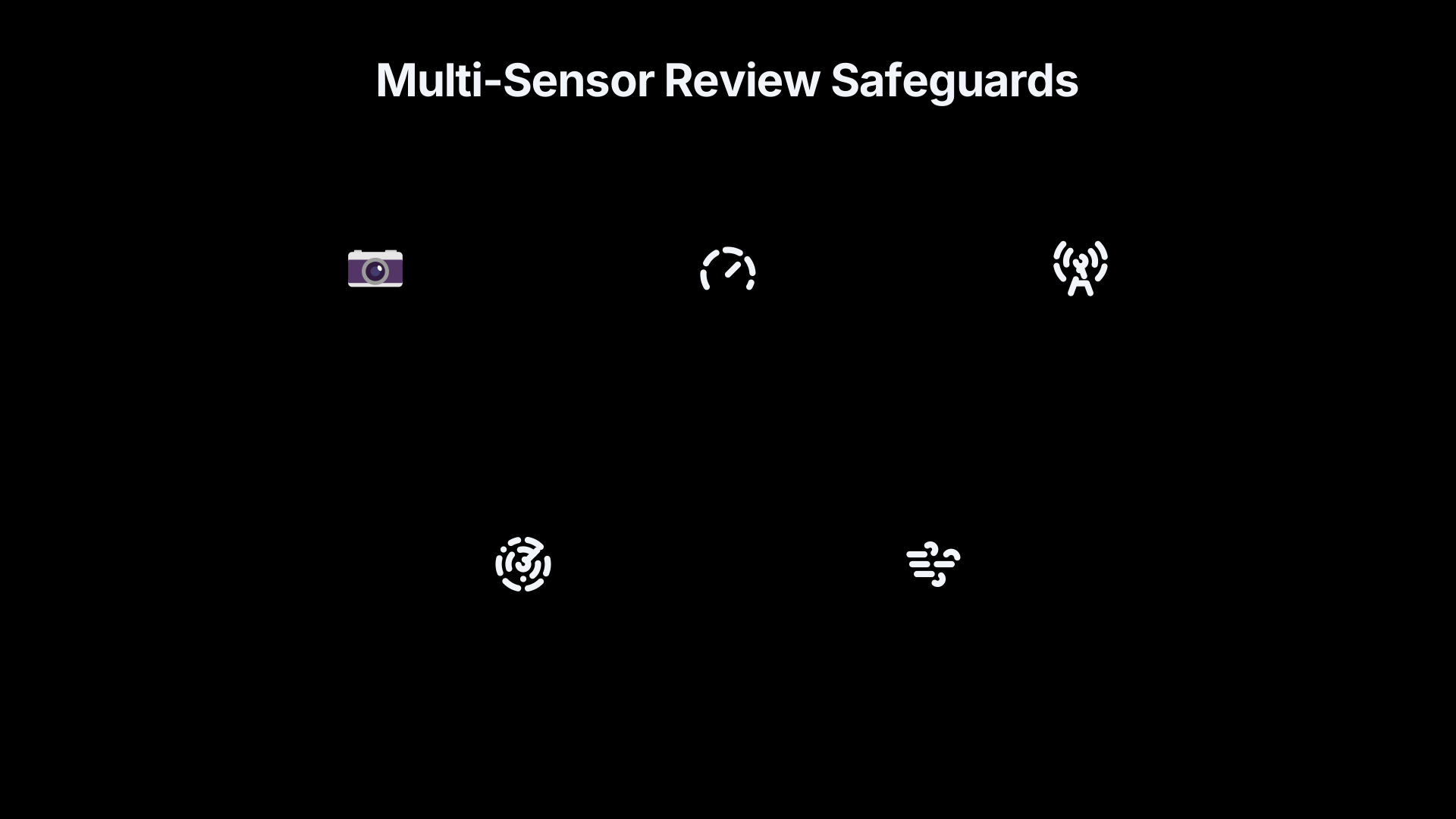
Instead of relying solely on a camera image, an instrumented UAP observatory can compare observations across several sources, including:
- optical cameras;
- infrared cameras;
- ADS-B aircraft broadcasts;
- radar where available;
- environmental and weather measurements;
- precise timing and geographic calibration.
Agreement between independent sensors provides stronger evidence than any single automated image label. Conversely, disagreement often reveals ordinary explanations such as range ambiguity, atmospheric distortion or incomplete tracking.
This philosophy is reflected in published proposals for scientific UAP observatories, which emphasise passive, well-calibrated, multi-modal sensing specifically to reduce ambiguity before interpreting unusual detections.[arXiv]arxiv.orgOpen source on arxiv.org.
A practical example of why manual review remains necessary
The Galileo Project provides a concrete illustration of automated triage followed by human review.
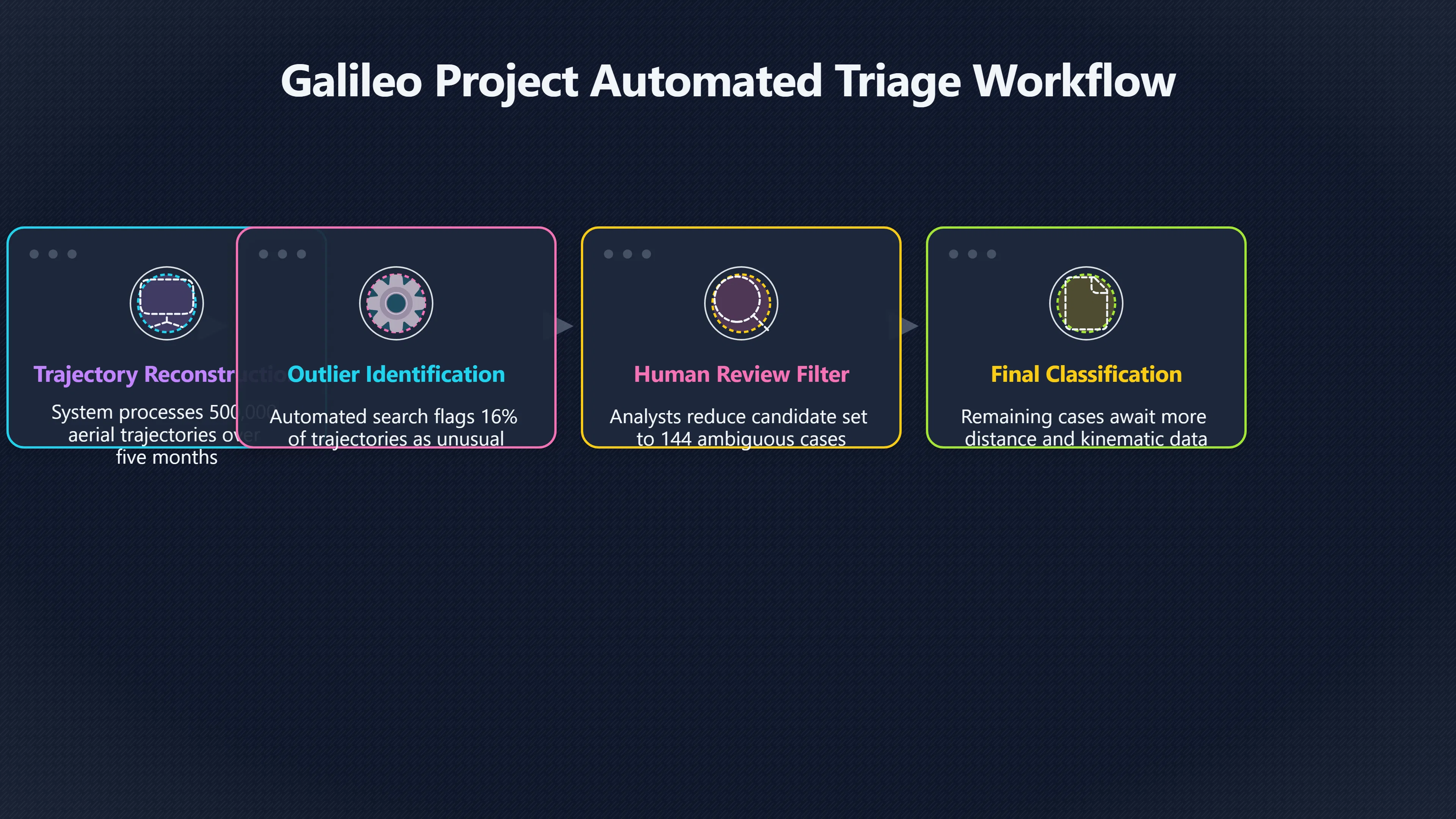
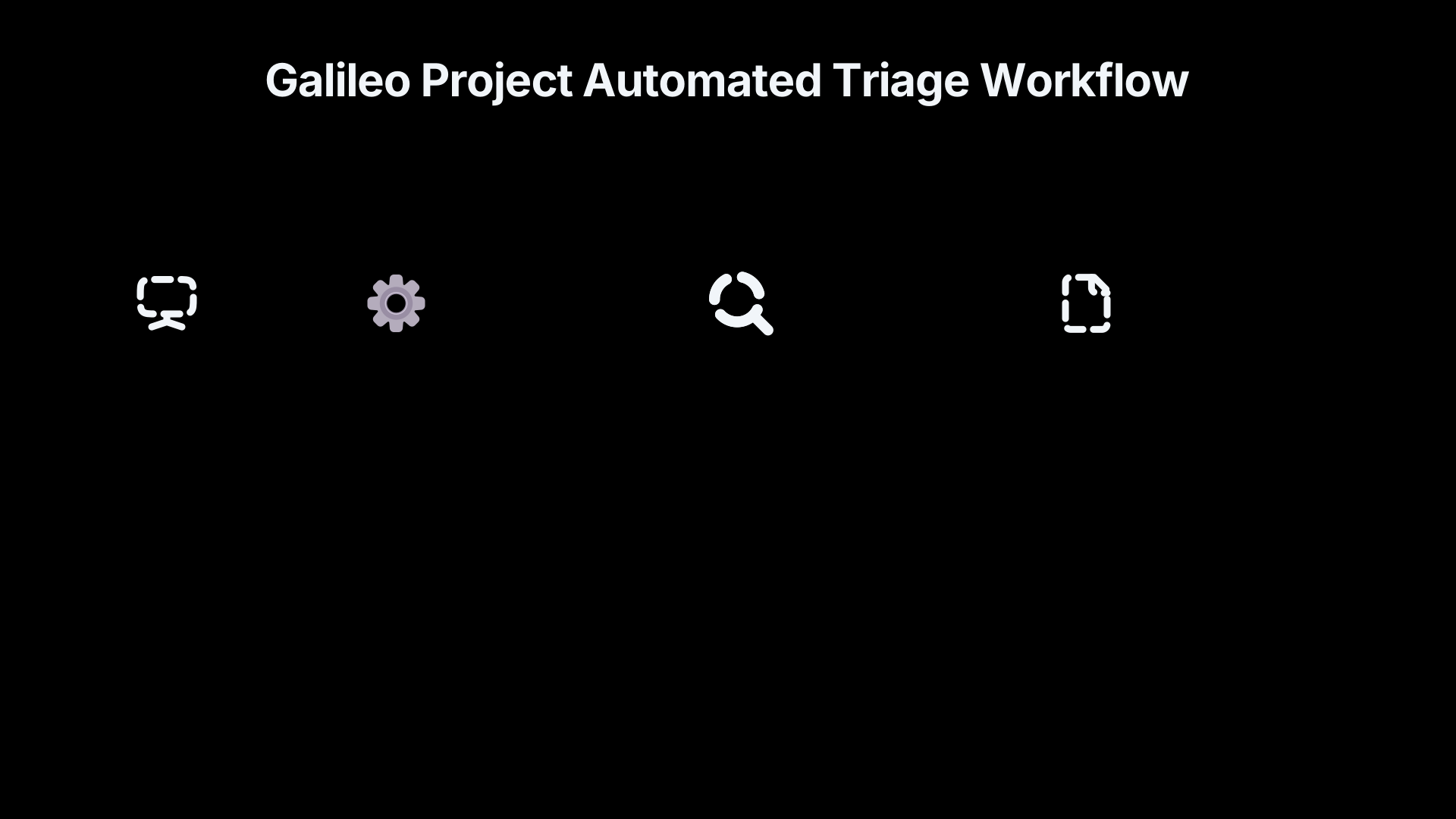
During approximately five months of commissioning observations, the system reconstructed roughly 500,000 aerial trajectories. A simple automated outlier search identified about 16% of trajectories as sufficiently unusual to warrant further examination. Human review then reduced this very large candidate set to only 144 ambiguous trajectories.
Importantly, the researchers did not interpret those remaining cases as evidence of extraordinary objects. Instead, they concluded that the remaining trajectories were most likely mundane phenomena that could not yet be fully identified because key information—particularly accurate distance estimates, complete kinematic reconstruction or additional sensor data—was unavailable. This is an example of a conservative scientific workflow: automated detection narrows the search, while human analysis prevents uncertain cases from being overstated.[arXiv]arxiv.org1 Introduction12 Nov 2024 — To address this deficiency, the Galileo Project is designing, building, and commissioning a multi-modal…
Why the software should not be the judge
Treating automated labels as final decisions introduces several risks:
- False positives, where ordinary objects are incorrectly labelled as anomalous.
- False negatives, where genuinely unusual observations are dismissed because they resemble common classes.
- Overconfidence, where numerical confidence scores are mistaken for certainty.
- Training bias, where unfamiliar environments produce unreliable classifications without obvious warning.
For governance of automated UAP monitoring systems, the safest policy is to treat machine-generated labels as prioritisation signals rather than evidential conclusions. Software excels at processing continuous streams of observations, filtering routine events and highlighting candidates for further analysis. Human reviewers, supported by calibrated multi-sensor data, remain responsible for determining whether an event has an ordinary explanation, requires additional investigation or should remain formally unidentified pending better evidence.
Within an automated instrumented UAP detection system, this division of responsibilities improves both scientific reliability and public credibility. It reduces obvious false alarms without allowing an algorithm’s statistical prediction to become the final arbiter of what is—or is not—an unexplained aerial phenomenon.
Amazon book picks
Further Reading
Books and field guides related to Why the Software Should Not Be the Judge. Use these as the next step if you want deeper reading beyond the article.
Deep Learning
Rating: 3.5/5 from 6 Google Books ratings
Offers foundational understanding of how modern learning systems are trained and why their classifications have inherent limitations.
The Alignment Problem
Discusses how training data and model design affect AI outputs, reinforcing the need for human oversight.
Artificial Intelligence
Rating: 4.5/5 from 10 Google Books ratings
Explains why AI systems produce probabilistic outputs and why human judgment remains essential when interpreting automated classifications.

Computer Vision
Directly covers image analysis, object detection, recognition, and the limitations of vision-based systems.
eBay marketplace picks
Marketplace Samples
Example marketplace items related to this page. Use the search link to explore similar finds on eBay.
Endnotes
1.
Source: arxiv.org
Link:https://arxiv.org/html/2411.07956v1
Source snippet
1 Introduction12 Nov 2024 — To address this deficiency, the Galileo Project is designing, building, and commissioning a multi-modal...
2.
Source: arxiv.org
Link:https://arxiv.org/abs/2305.18566
3.
Source: arxiv.org
Link:https://arxiv.org/abs/2304.00501
Source snippet
A Comprehensive Review of YOLO Architectures in Computer Vision: From YOLOv1 to YOLOv8 and YOLO-NASApril 2, 2023...
Published: April 2, 2023
Additional References
4.
Source: researchgate.net
Link:https://www.researchgate.net/publication/388466760_Commissioning_an_All-Sky_Infrared_Camera_Array_for_Detection_of_Airborne_Objects
Source snippet
(PDF) Commissioning an All-Sky Infrared Camera Array for...10 Jan 2025 — To address this deficiency, the Galileo Project is designing, b...
5.
Source: avi-loeb.medium.com
Link:https://avi-loeb.medium.com/commissioning-data-on-half-a-million-objects-in-the-sky-from-the-galileo-project-observatory-are-a23bd084233a
Source snippet
Data on Half a Million Objects in the Sky from...The GP Observatories offer an array of multi-modal, multi-spectral sensors that continu...
6.
Source: pmc.ncbi.nlm.nih.gov
Title: PMCAutomatic dependent surveillance-broadcast (ADS-B
Link:https://pmc.ncbi.nlm.nih.gov/articles/PMC12192918/
Source snippet
by W Ahmed · 2025 · Cited by 12 — Automatic Dependent Surveillance-Broadcast (ADS-B) is a vital communication protocol within air traf...
7.
Source: youtube.com
Title: Jake Barber And Matt Pines On Skywatcher And Studying UAPs | Unveiled Ep. 13
Link:https://www.youtube.com/watch?v=PNyJPRjITXQ
Source snippet
The Inside the AI Alien Hunting Project at Harvard video is highly relevant because it shows how the Galileo Project uses machine learnin...
8.
Source: leonarddavid.com
Title: Avi Loeb details the Galileo Project effort.Read more
Link:https://www.leonarddavid.com/unidentified-aerial-phenomena-research-paper-offers-insight-on-outing-human-bias-and-error/
Source snippet
Unidentified Aerial Phenomena: Research Paper Offers...9 Mar 2023 — These sensors provide an accurate resolved image of relative thermal...
9.
Source: youtube.com
Title: How the Galileo Project is Changing the Game
Link:https://www.youtube.com/watch?v=56So2gXKFcg
Source snippet
Jake Barber And Matt Pines On Skywatcher And Studying UAPs | Unveiled Ep. 13...
10.
Source: youtube.com
Link:https://www.youtube.com/watch?v=8VUkG1L2EO0
Source snippet
How the Galileo Project is Changing the Game - Abby White | Merged EP0106...
11.
Source: youtube.com
Title: Inside the AI Alien Hunting Project at Harvard
Link:https://www.youtube.com/watch?v=oDAY0_wRjxA
Source snippet
How AI is helping 'alien hunters' like Avi Loeb search for life | Jesse Weber Live...
12.
Source: thedebrief.org
Link:https://thedebrief.org/galileo-project-releases-commissioning-data-on-half-a-million-aerial-objects-are-any-of-them-uap/
Source snippet
Using machine...Read more...
13.
Source: trafikverket.diva-portal.org
Link:https://trafikverket.diva-portal.org/smash/get/diva2%3A2054649/FULLTEXT01.pdf
Source snippet
Learning Based Anomaly Detection for Securing...by JD Kenaudekar · 2026 · Cited by 1 — Rather than manually crafting attacks, a Generati...
Topic Tree