Within Sky Detectors
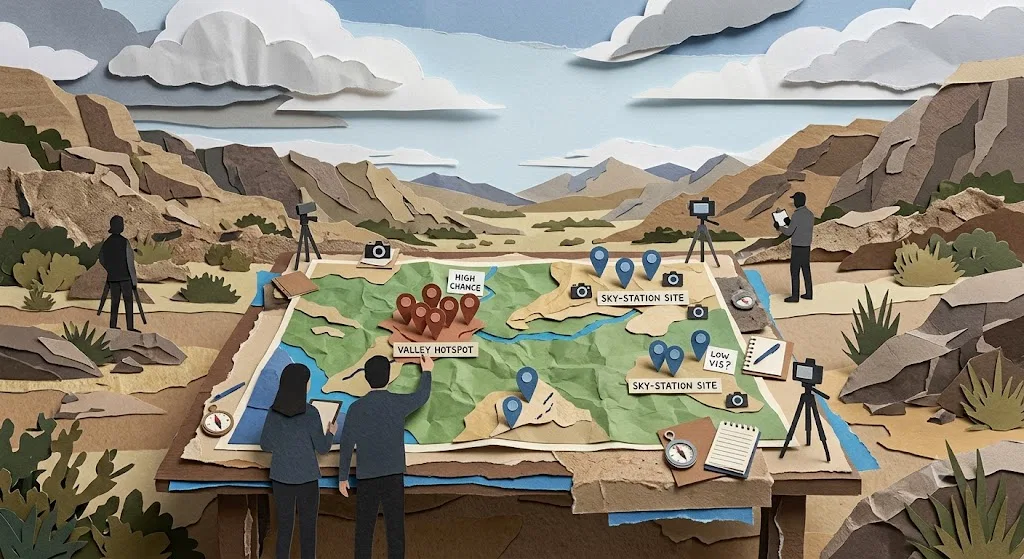
Should UFO Detectors Watch Hotspots or Everywhere?
A station at a famous location may catch repeats, while wider networks ask whether anomalies are broader than local stories.
On this page
- The case for local repeat monitoring
- The case for broad sky networks
- How selection bias affects conclusions
Page outline Jump by section
Introduction
Automated UFO or UAP detectors face a basic placement problem: watch a famous “hotspot” where unusual reports have clustered, or distribute stations across ordinary skies to test whether anomalies are broader than local stories. The answer is not either-or. Hotspot monitoring is the better way to catch repeats, tune instruments, and study a place-specific phenomenon; broad sky coverage is the better way to estimate how often unusual detections occur, compare regions, and avoid mistaking local folklore for a general pattern. The strongest strategy is usually staged: start where repeat observations make detection likely, then expand with standardised stations that can measure a background rate elsewhere. NASA’s UAP study put the larger requirement plainly: future work needs calibrated sensors, metadata, multiple measurements and baseline data, not just isolated sightings.[NASA Science]science.nasa.govNASA Science…
The distinction matters because detector placement shapes what counts as evidence. A station in Hessdalen, Norway, is designed around a valley with repeated luminous reports. A distributed network such as Sky360 or the Galileo Project is designed around comparable, long-term sky records across many places. Both can be scientific, but they answer different questions. Hotspots ask, “Can we measure this recurring local phenomenon well?” Wide networks ask, “Is there a population of unusual aerial events above the normal background of aircraft, satellites, drones, meteors, birds and weather?”
The case for local repeat monitoring
Hotspot monitoring begins with a practical advantage: repeatability. If reports cluster in a valley, ranch, island, military training area or coastal corridor, a fixed instrument has a higher chance of seeing something than a station placed at random. That is why Hessdalen remains the classic example in instrumented UFO monitoring. Project Hessdalen says unusual lights were reported heavily from late 1981 through 1984, with about 20 reports per week at peak activity, and that an Automatic Measurement Station was installed in 1998 after earlier field investigations. The same project now reports a much lower rate, around 20 observations a year, which is still enough to justify long-term local monitoring if the goal is to capture repeats.[old.hessdalen.org]old.hessdalen.orgProject HessdalenHomepage…
The scientific appeal of Hessdalen is not simply that it is famous. It is that the reported phenomenon recurred in a bounded landscape, making it possible to leave instruments running and compare detections over seasons, times of night and environmental conditions. Massimo Teodorani’s long-term survey described the Hessdalen lights as anomalous atmospheric luminous phenomena that recur at some locations, and argued that the presence of an instrumented station made the valley an unusually suitable research site. The Automatic Measurement Station was described as using automatic wide-angle and zoom video cameras, a radar transponder and a magnetometer, and its early records suggested more detections in winter and between about 10 pm and 1 am.[Project Hessdalen]hessdalen.orgProject Hessdalenscex-18-02-15 217..251Project Hessdalenscex-18-02-15 217..251
That is exactly the kind of pattern a hotspot station can investigate. A broad network may detect many more aircraft and satellites, but a local station can ask narrower questions: Do events cluster at particular times? Do they correlate with humidity, geomagnetic conditions, terrain, power lines, mining history, road traffic or astronomical objects? Do they recur in the same azimuths? Are apparent “lights” actually car headlights, aircraft routes, reflections, atmospheric plasma, ball lightning-like events or camera artefacts? The Hessdalen survey is a useful caution here because it found local regularities without settling the underlying cause; early statistics helped challenge some artificial-source explanations, yet did not by themselves explain the origin or nature of the lights.[Project Hessdalen]hessdalen.orgProject Hessdalenscex-18-02-15 217..251Project Hessdalenscex-18-02-15 217..251
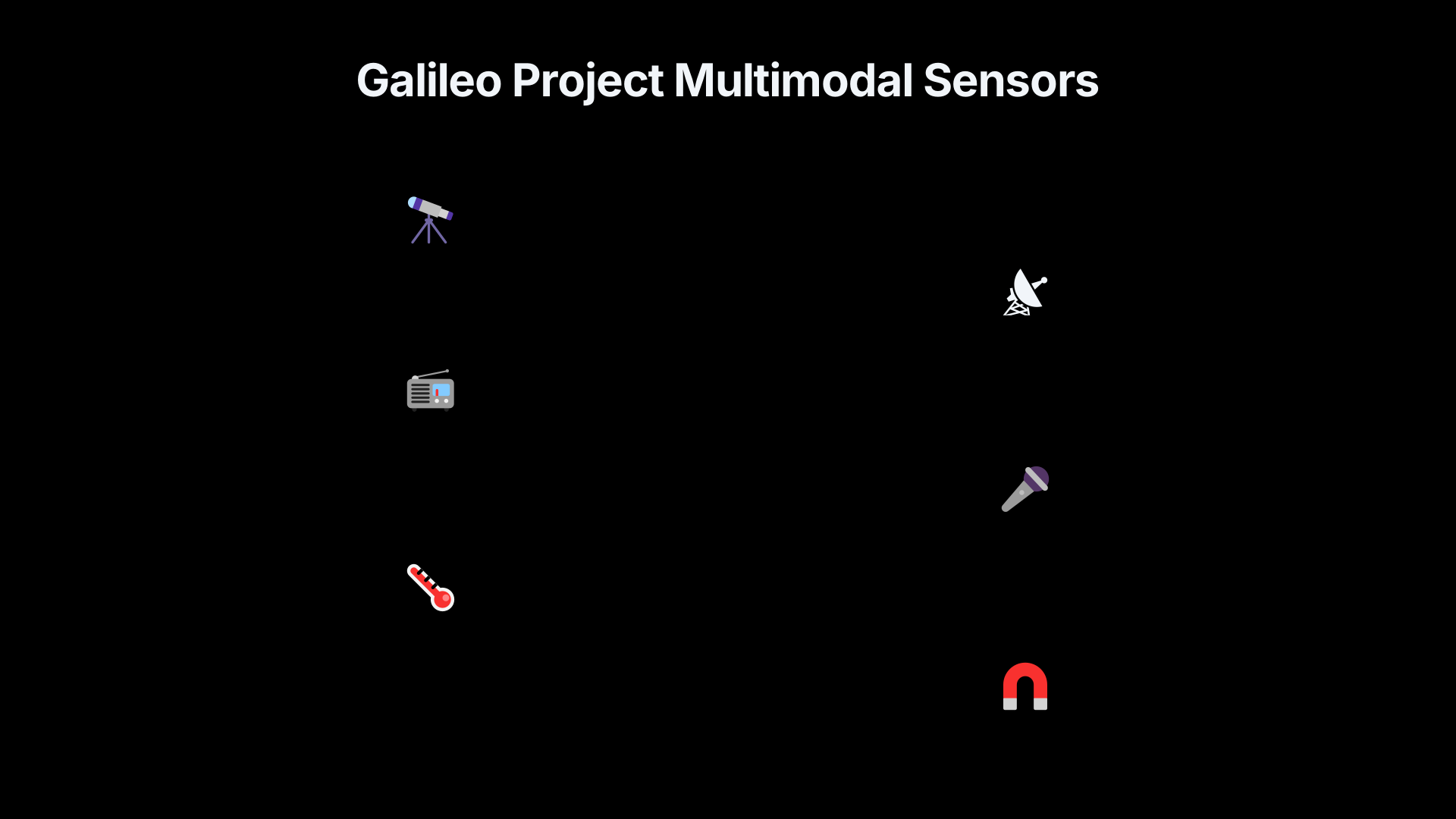
Hotspot work is also cheaper per useful detection. High-quality UAP instruments are not just webcams. The Galileo Project’s observatory concept includes wide-field cameras, narrow-field follow-up instruments, passive radar-style receivers, radio spectrum analysers, microphones, environmental sensors and magnetic or energetic-particle measurements. Putting that whole package everywhere is expensive; putting a fuller instrument set at one or two high-yield sites may produce better early data than spreading thin, weak stations across many quiet locations.[Galileo Project]galileo.hsites.harvard.eduOpen source on harvard.edu.

The case for broad sky networks
Broad sky coverage answers a different question: not “What is happening at this famous place?” but “What happens when comparable instruments watch many ordinary skies?” That matters because a local hotspot cannot establish whether a phenomenon is rare, regional, global or mainly a product of local reporting culture. NASA’s report criticised the current UAP evidence base for lacking baseline data, and baseline data is exactly what broad monitoring is meant to build: a record of what normal sky traffic looks like under known sensor conditions, across different locations and times.[NASA Science]science.nasa.govNASA Science…
The Galileo Project’s framing is closer to a census than a chase. Its stated aim is to build an integrated software and instrumentation system for a multimodal census of aerial phenomena and anomaly recognition. That word “census” is important. A census does not begin with the assumption that a celebrated location is special; it measures ordinary and unusual objects together so that outliers can be defined against a known background. The project also emphasises triangulation, multi-sensor corroboration and data fusion, which are easier to validate when multiple stations use comparable hardware and procedures.[Galileo Project]galileo.hsites.harvard.eduOpen source on harvard.edu.
Sky360 represents the citizen-science version of the same network logic. Its public materials describe an open-source global sky-observation network using affordable 24/7 stations to detect, track, identify and analyse aerial phenomena, including stars, meteors, satellites, planes, drones, birds, weather phenomena and UAP. That broad target list is not a distraction from UAP research; it is the point. A detector that cannot learn the ordinary sky will over-report the unusual one.[Sky360]sky360.orgObservational Citizen Science of Earth's Atmosphere…
Networked monitoring also creates possibilities that a single hotspot cannot. Two or more stations can triangulate distance and altitude; stations in different environments can compare false positives; and long-term records can show whether unusual detections scale with population density, air routes, weather, terrain, military activity or sensor type. Without those comparisons, a hotspot can become a self-confirming story: a place is watched because it is famous, then it remains famous because it is watched.
The drawback is yield. Random or broadly distributed stations may collect enormous volumes of mundane data before anything truly puzzling appears. The Galileo Project’s all-sky infrared camera work illustrates that reality: it is designed to monitor the sky continuously and conduct a long-term census of natural and human-made aerial phenomena, with calibration methods using ADS-B aircraft position data. That kind of work is valuable precisely because it is patient and systematic, but it is not optimised for quick dramatic cases.[arXiv]arxiv.orgOpen source on arxiv.org.
What hotspots reveal that networks can miss
A hotspot can reveal local physics, local misperceptions or local infrastructure effects that would be diluted in a general survey. Hessdalen is again the clearest example. The phenomenon has been discussed not only as a UFO case but as a possible anomalous atmospheric light phenomenon, with hypotheses involving plasma-like behaviour, terrain, humidity, magnetic perturbations and other environmental factors. The evidence does not support a settled explanation, but it does show why one place can deserve intensive monitoring even if the results do not generalise to the world.[Project Hessdalen]hessdalen.orgProject Hessdalenscex-18-02-15 217..251Project Hessdalenscex-18-02-15 217..251
Local monitoring also makes it easier to improve the observing setup through experience. A station can be aimed at known sightlines, shielded from known sources of glare, compared against local traffic routes and adjusted after false detections. In a hotspot, every misidentification teaches something about the place. A broad network can also learn this way, but its first challenge is standardisation: each station has different horizons, weather, light pollution, nearby airports, insects, birds, clouds and camera artefacts.
The best hotspot argument is therefore not “famous places are magical”. It is “recurring reports create a test bed”. A detector placed at a reputed location can test whether the reputation survives instrumented observation. If it does not, that is useful. If it does, researchers can ask whether the detections are local natural phenomena, recurring human activity, sensor effects or something genuinely harder to classify.

What networks reveal that hotspots can distort
Broad coverage is a defence against selection bias. A hotspot is already selected because people have reported strange things there. That means the sample is not neutral. It may reflect real recurrence, but it may also reflect tourism, media attention, local identity, historical reporting habits, military presence, clear skies, unusual geography or simply the fact that more people are looking.
This affects conclusions in three common ways.
First, hotspots inflate apparent frequency. If a station is placed where reports are already common, a detection rate from that site cannot be used as a general UAP rate. Hessdalen’s peak of about 20 reports per week in the early 1980s and later rate of about 20 observations per year are meaningful for Hessdalen, not for the sky as a whole.[old.hessdalen.org]old.hessdalen.orgProject HessdalenHomepage…
Second, hotspots blur phenomenon and reputation. A famous site attracts observers, documentaries, tourists, hobbyists and expectations. Those social effects can increase reporting without increasing the underlying phenomenon. Automated stations reduce witness subjectivity, but they do not erase the original selection problem: the station is there because the place is already believed to matter.
Third, hotspots can overfit instruments to one kind of event. A valley-light detector may be excellent at catching luminous nocturnal events near the horizon, yet poor at estimating fast high-altitude objects, daylight anomalies or rare events outside that local geometry. Conversely, a wide-field network may be better for broad anomaly detection but less sensitive to a low, faint, recurring local light unless it has the right optics and siting.
The UAPx Catalina expedition shows the practical middle ground between hotspot-style targeting and scientific caution. The team chose a field setting associated with UAP interest, deployed visible-light and infrared cameras plus other sensors, recorded more than 600 hours of untriggered far-infrared video and 55 hours of background radiation measurements, and then resolved several initially ambiguous observations before focusing on one remaining ambiguity. The important lesson is not that a hotspot produced proof; it is that targeted fieldwork still needs background recording, calibration and a willingness to explain away weak candidates.[arXiv]arxiv.orgOpen source on arxiv.org.
A practical decision model for detector placement
For automated instrumented UFO detectors, the placement choice should follow the research question rather than the mythology of the site.
A hotspot-first strategy makes sense when the goal is to maximise the chance of repeat capture, study a bounded local phenomenon, test a specific claim about a place, or justify expensive sensors by putting them where events are most likely. It is strongest when researchers publish negative as well as positive results, document local ordinary traffic, and avoid treating a local detection rate as a global one.
A broad-network strategy makes sense when the goal is to estimate background rates, compare regions, identify rare outliers in large datasets, test whether reports correlate with population or infrastructure, or build a public evidence base that does not depend on one celebrated location. It is strongest when stations are standardised, calibrated and paired with aircraft, satellite, weather and astronomical reference data.
A hybrid strategy is the most defensible path for a young field. The UFODATA automatic-station proposal explicitly imagined a future network of stations scattered across territory, while also noting that hotspots could receive more advanced equipment first, with additional detectors later extended to all locations. That is a sensible allocation model: put richer instruments where detection odds are higher, but keep simpler standardised stations elsewhere to measure the ordinary sky.[ufodata.net]ufodata.netUFOAC MT Project REVISED(6UFOAC MT Project REVISED(6
The same staged logic protects against two opposite errors. One error is chasing famous locations forever and never learning whether the pattern is local. The other is spreading instruments so thinly that the network collects mostly mundane traffic and cannot afford the sensors needed for a decisive event. A mature programme would use hotspots as laboratories and broad coverage as the control group.
Why the placement debate changes the evidence
Detector placement is not a minor operations detail. It determines the denominator: how many hours of sky were watched, where, under what conditions, and compared with what background. A hotspot detection without a baseline may be intriguing but hard to interpret. A broad survey without enough sensitivity may be statistically clean but miss the rare events people care about. The strongest evidence would combine both: a well-characterised local detection, captured by multiple calibrated sensors, compared against ordinary-sky data from similar stations elsewhere.
That is why NASA’s emphasis on calibration, metadata, multiple measurements and baseline data is so central to the hotspot-versus-network debate. Baselines tell researchers what the detector normally sees. Multiple sensors reduce artefacts. Metadata makes later review possible. Distributed stations test whether a local mystery is local at all.[NASA Science]science.nasa.govNASA Science…
The question, then, is not whether UFO detectors should watch hotspots or everywhere. They should watch hotspots when repeatability is the goal, and they should watch ordinary skies when population-level inference is the goal. Evidence from a hotspot can make a case worth studying; evidence from a network can show whether that case is exceptional, common, local, instrumental or simply one bright point in a much larger sky.
Amazon book picks
Further Reading
Books and field guides related to Should UFO Detectors Watch Hotspots or Everywhere?. Use these as the next step if you want deeper reading beyond the article.
UFOs : Generals, Pilots, and Government Officials Go on the R...
Broad overview of credible cases and evidence.
eBay marketplace picks
Marketplace Samples
Live-tested eBay searches with available results related to this page.


Endnotes
1.
Source: science.nasa.gov
Link:https://science.nasa.gov/wp-content/uploads/2023/09/uap-independent-study-team-final-report.pdf
Source snippet
NASA Science...
2.
Source: old.hessdalen.org
Title: Project Hessdalen
Link:https://old.hessdalen.org/index_e.shtml
Source snippet
Homepage...
3.
Source: hessdalen.org
Title: Project Hessdalenscex-18-02-15 217..251
Link:https://hessdalen.org/reports/scex1802217251.pdf
4.
Source: sky360.org
Link:https://www.sky360.org/
Source snippet
Observational Citizen Science of Earth's Atmosphere...
5.
Source: arxiv.org
Link:https://arxiv.org/abs/2411.07956
6.
Source: arxiv.org
Link:https://arxiv.org/html/2312.00558v3
7.
Source: ufodata.net
Title: UFOAC MT Project REVISED(6)
Link:https://www.ufodata.net/resources/UFOAC_MT_Project_REVISED%286%29.pdf
8.
Source: old.hessdalen.org
Link:https://old.hessdalen.org/station/
9.
Source: old.hessdalen.org
Title: 2025 2502.06794v2
Link:https://old.hessdalen.org/reports/2025-2502.06794v2.pdf
10.
Source: ufodata.net
Title: UFODAT A Project
Link:https://www.ufodata.net/faq.html
11.
Source: nasa.gov
Title: update nasa shares uap independent study report names director
Link:https://www.nasa.gov/news-release/update-nasa-shares-uap-independent-study-report-names-director/
12.
Source: science.nasa.gov
Link:https://science.nasa.gov/uap/
13.
Source: science.nasa.gov
Link:https://science.nasa.gov/uap/faqs/
14.
Source: arxiv.org
Link:https://arxiv.org/html/2506.00125v1
15.
Source: arxiv.org
Link:https://arxiv.org/html/2411.02401v1
16.
Source: youtube.com
Link:http://www.youtube.com/watch?v=i1rc-Z6RwTU
Source snippet
Project Hessdalen automated ufo tracking Mysterious Norwegian lights caught on camera New Scientist...
17.
Source: galileo.hsites.harvard.edu
Link:https://galileo.hsites.harvard.edu/publications/scientific-investigation-unidentified-aerial-phenomena-uap-using-multimodal
18.
Source: ui.adsabs.harvard.edu
Link:https://ui.adsabs.harvard.edu/abs/2012EGUGA..14.5967Z/abstract
19.
Source: ui.adsabs.harvard.edu
Link:https://ui.adsabs.harvard.edu/abs/2025PrAeS.15601099S/abstract
20.
Source: Wikipedia
Title: Hessdalen lights
Link:https://en.wikipedia.org/wiki/Hessdalen_lights
21.
Source: thedebrief.org
Link:https://thedebrief.org/galileo-project-releases-commissioning-data-on-half-a-million-aerial-objects-are-any-of-them-uap/
Additional References
22.
Source: youtube.com
Title: MYSTERIOUS LIGHTS over Norway | The Proof is Out There (Season 2) | History
Link:http://www.youtube.com/watch?v=7hBUk13yE8s
Source snippet
Scientist explains how he hunts for alien life in space | Hot Take with Jesse Weber...
23.
Source: youtube.com
Title: Public Meeting on Unidentified Anomalous Phenomena (Official NASA Broadcast)
Link:http://www.youtube.com/watch?v=bQo08JRY0iM
Source snippet
The Hessdalen Lights — The Valley Where Scientists Built a UFO Research Station...
24.
Source: youtube.com
Title: The Hessdalen Lights — The Valley Where Scientists Built a UFO Research Station
Link:http://www.youtube.com/watch?v=1njXL_v3k48
Source snippet
Harvard's Avi Loeb and the Galileo Project...
25.
Source: youtube.com
Title: Harvard’s Avi Loeb and the Galileo Project
Link:http://www.youtube.com/watch?v=ac3nLzIbbk4
Source snippet
MYSTERIOUS LIGHTS over Norway | The Proof is Out There (Season 2) | History...
26.
Source: researchgate.net
Link:https://www.researchgate.net/publication/371163445_The_Scientific_Investigation_of_Unidentified_Aerial_Phenomena_UAP_Using_Multimodal_Ground-Based_Observatories
27.
Source: reddit.com
Link:https://www.reddit.com/r/UFOs/comments/1hvg988/247_aipowered_uap_research_station_live_sky/
28.
Source: researchgate.net
Link:https://www.researchgate.net/publication/278390344Instrumented_Monitoring_of_Aerial_Anomalies-_A_Scientific_Approach_to_the_Investigation_On_Anomalous_Atmospheric_Light_Phenomena
29.
Source: researchgate.net
Link:https://www.researchgate.net/publication/391817538_Initial_results_from_the_first_field_expedition_of_UAPx_to_study_unidentified_anomalous_phenomena
30.
Source: researchgate.net
Link:https://www.researchgate.net/publication/404942120_PROPOSAL_Project_Dark-Track_Integration_of_Uncorrelated_Radar-Transponder_Telemetry_into_the_Galileo_Project_EXECUTIVE_SUMMARY
31.
Source: adsbexchange.com
Link:https://www.adsbexchange.com/
Topic Tree