Within Hotspots
Do UFO Hotspots Really Give Better Data?
Hotspots can raise the chance of repeat detections, but they also risk turning local reputation into biased evidence.
On this page
- Why repeat reports improve the odds of capture
- How local fame can bias what gets watched
- When a hotspot result can be generalized
Page outline Jump by section
Introduction
Famous UFO hotspots do not automatically produce better detector data, but they often produce more opportunities to collect it. That distinction is important. A location with repeated reports can justify leaving calibrated instruments in place for months or years, increasing the chance of recording unusual events under controlled conditions. However, a site’s reputation can also introduce powerful biases: more people watch the sky, more ambiguous events are reported, and researchers may devote disproportionate attention to one location. The strongest scientific approach is therefore not to treat hotspots as proof of an unusual phenomenon, but as high-priority field laboratories whose findings must be tested against observations from ordinary locations.[NASA Science+2World Scientific]science.nasa.govScience Independent Study Team ReportNASA ScienceIndependent Study Team ReportSeptember 13, 2023 — The study of Unidentified Anomalous Phenomena (UAP) presents a unique scien…

Why repeat reports improve the odds of capture
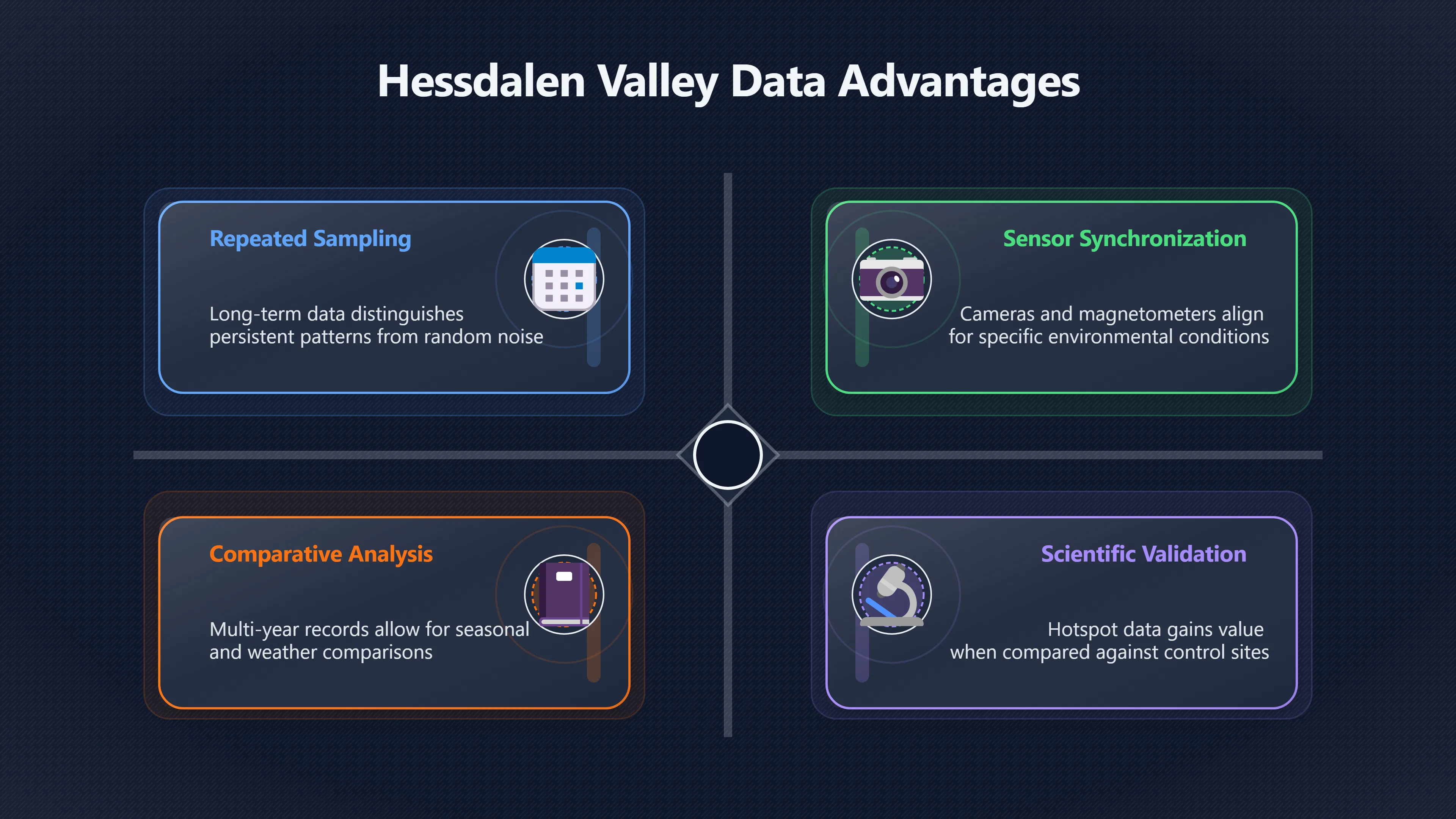
The chief advantage of a hotspot is statistical rather than extraordinary. If unusual aerial reports genuinely recur in one area, a permanently instrumented station has a better chance of recording multiple examples than a detector placed at a random location with no history of reports.
The best-known example is Hessdalen in Norway. Reports of unusual lights became frequent during the early 1980s, leading researchers to establish repeated field campaigns and, in 1998, an Automatic Measurement Station. Because observations continued over many years, investigators could compare detections across seasons, weather conditions, viewing directions and time of night instead of relying on isolated eyewitness accounts.[old.hessdalen.org+2Project Hessdalen]old.hessdalen.orgDatabase AnalysisHessdalen Database AnalysisNovember 26, 2017 — 26 Nov 2017 — An automatic measurement station was put up in Hessdalen in August 1998. In…
Repeated observations also make it possible to improve instrumentation. When researchers know that events are most likely during particular hours or environmental conditions, they can synchronise optical cameras, magnetometers, radio receivers and other sensors to maximise useful recordings. Even if the underlying cause remains uncertain, repeated measurements provide a richer dataset than scattered reports collected from unrelated places.[Project Hessdalen]hessdalen.orgThe apparent correlation of…
This is the same logic used in many branches of field science. Long-term monitoring sites are chosen because repeated sampling allows researchers to distinguish persistent patterns from random variation. The location itself is valuable because it supports repeated measurement, not because it proves an exceptional phenomenon exists.[PMC]pmc.ncbi.nlm.nih.govSite selection algorithms for optimal ecological monitoring…by KE Norman · 2025 · Cited by 3 — Many algorithms support additional f…
How local fame can bias what gets watched
The main weakness of hotspot monitoring is that popularity changes behaviour.
Once a location becomes known for unusual sightings, several forms of bias become more likely:
- More observers visit specifically expecting to see something unusual.
- Cameras remain pointed at one area for far longer than comparable locations.
- Ordinary aircraft, satellites, astronomical objects or atmospheric effects receive greater scrutiny than they would elsewhere.
- Researchers may unconsciously devote more effort to analysing ambiguous detections from famous sites than similar observations from ordinary skies.
These effects are well understood in other monitoring disciplines. Ecological and citizen-science research consistently finds that observer behaviour and preferential site selection can distort estimates if sampling effort is concentrated in famous or convenient locations rather than being systematically distributed. The problem is not dishonesty but unequal observation effort.[Frontiers+2NERC Open Research Archive]frontiersin.orgFrontiers A Framework of Observer-Based Biases in Citizen ScienceFrontiersA Framework of Observer-Based Biases in Citizen Science…July 19, 2021 — by O Arazy · 2021 · Cited by 65 — The goal of this st…
For automated UFO detectors, instrumentation reduces some human biases but does not eliminate sampling bias. A camera operating continuously is objective in recording photons, yet the decision about where to install that camera remains subjective. If nearly every sophisticated detector is placed in famous hotspots, the resulting database cannot easily answer whether similar events occur elsewhere but go unrecorded.
When hotspot detections become scientifically useful
A hotspot observation becomes much more valuable when it can be compared with suitable controls.
Several features increase confidence in the usefulness of hotspot data:
- Identical instruments operating at both hotspot and non-hotspot locations.
- Standardised calibration and identical detection thresholds.
- Continuous recording rather than event-triggered operation.
- Environmental measurements such as weather, magnetic field and sky conditions.
- Independent verification using multiple sensor types rather than a single camera.
NASA’s independent UAP study emphasised precisely these requirements, arguing that future progress depends on calibrated sensors, metadata, reproducible observations and baseline measurements that distinguish rare events from the normal background of aircraft, satellites, weather and astronomical objects.[NASA Science]science.nasa.govScience Independent Study Team ReportNASA ScienceIndependent Study Team ReportSeptember 13, 2023 — The study of Unidentified Anomalous Phenomena (UAP) presents a unique scien…
In other words, hotspot observations gain scientific value when they can be compared against equivalent measurements collected elsewhere.
Can hotspot results be generalised?
This is where hotspot studies become limited.
A successful detector at one famous location may demonstrate that a recurring local phenomenon exists, but it does not automatically show that the same process occurs globally. Hessdalen illustrates this distinction well. Decades of monitoring have documented recurring luminous events and generated a substantial instrumental record, yet researchers continue to debate the physical mechanisms involved. Even if every Hessdalen observation were eventually explained, those findings would not necessarily apply to reports from deserts, coastlines or military airspace with completely different environmental conditions.[Project Hessdalen]hessdalen.orgThe apparent correlation of…
Likewise, if an unusual event were confirmed at a hotspot, it would still require replication under comparable observational standards before broader conclusions could be drawn.
This is why projects designed around distributed sensor networks pursue a complementary goal. Rather than concentrating only where reports are already common, they aim to build a population-level picture of ordinary aerial activity and identify genuine statistical outliers across many environments. Their objective is not merely to capture anomalies but to establish how often apparently anomalous events occur relative to the normal background.[World Scientific+2arXiv]worldscientific.comWorld ScientificThe Scientific Investigation of Unidentified Aerial…by WA Watters · 2023 · Cited by 47 — A primary objective of the Ga…
The strongest strategy combines hotspots with broad coverage
Hotspots are most valuable as intensive field laboratories rather than as standalone proof of unusual phenomena.
An effective automated detector programme therefore uses two complementary layers:
- Focused hotspot stations to maximise the chance of repeated, multi-sensor recordings and investigate whether local patterns are stable over time.
- Distributed comparison stations using identical equipment to measure ordinary sky conditions and reveal whether hotspot detections are genuinely exceptional.
This combined design separates two different scientific questions. One asks whether a particular location contains a recurring phenomenon worth characterising. The other asks whether similar events occur elsewhere at comparable rates. Only by answering both can researchers judge whether a hotspot reflects a unique local environment or simply the place where observations have been concentrated most intensely.
Amazon book picks
Further Reading
Books and field guides related to Do UFO Hotspots Really Give Better Data?. Use these as the next step if you want deeper reading beyond the article.

UFOs : Generals, Pilots, and Government Officials Go on the R...
Emphasizes evidence quality over anecdotes.

eBay marketplace picks
Marketplace Samples
Example marketplace items related to this page. Use the search link to explore similar finds on eBay.




Endnotes
1.
Source: science.nasa.gov
Title: Science Independent Study Team Report
Link:https://science.nasa.gov/wp-content/uploads/2023/09/uap-independent-study-team-final-report.pdf
Source snippet
NASA ScienceIndependent Study Team ReportSeptember 13, 2023 — The study of Unidentified Anomalous Phenomena (UAP) presents a unique scien...
Published: September 13, 2023
2.
Source: arxiv.org
Link:https://arxiv.org/abs/2305.18566
3.
Source: old.hessdalen.org
Title: Database Analysis
Link:https://old.hessdalen.org/reports/Hessdalen_Database_English_Nov2017.pdf
Source snippet
Hessdalen Database AnalysisNovember 26, 2017 — 26 Nov 2017 — An automatic measurement station was put up in Hessdalen in August 1998. In...
Published: November 26, 2017
4.
Source: hessdalen.org
Link:https://hessdalen.org/reports/scex1802217251.pdf
Source snippet
The apparent correlation of...
5.
Source: pmc.ncbi.nlm.nih.gov
Link:https://pmc.ncbi.nlm.nih.gov/articles/PMC7618705/
Source snippet
Site selection algorithms for optimal ecological monitoring...by KE Norman · 2025 · Cited by 3 — Many algorithms support additional f...
6.
Source: arxiv.org
Link:https://arxiv.org/html/2411.02401v1
Source snippet
A Civilian Astronomer's Guide to UAP Research5 Nov 2024 — This [review]({{ 'review/' | relative_url }}) explores how astronomers can enhance our understanding of these eni...
7.
Source: old.hessdalen.org
Title: 2025 2502.06794v2
Link:https://old.hessdalen.org/reports/2025-2502.06794v2.pdf
Source snippet
New Science of Unidentified Aerospace-Undersea...1 Apr 2025 — We dispel the common misconception that UAPs are an American phenomenon an...
8.
Source: portal.rare.org
Title: ecological monitoring updated 040521
Link:https://portal.rare.org/wp-content/uploads/2021/05/ecological-monitoring-_-updated-040521.pdf
Source snippet
Monitoring - Fish Forever○ Teams should monitor the same sampling sites over time. ○ To minimize variability as a results of observer err...
9.
Source: worldscientific.com
Link:https://www.worldscientific.com/doi/10.1142/S2251171723400068?srsltid=AfmBOoqgTjlZjDRXF1JECggcd6UF2wPi_s41F4jIhFGIJFfRFXIh51Uj
Source snippet
World ScientificThe Scientific Investigation of Unidentified Aerial...by WA Watters · 2023 · Cited by 47 — A primary objective of the Ga...
10.
Source: frontiersin.org
Title: Frontiers A Framework of Observer-Based Biases in Citizen Science
Link:https://www.frontiersin.org/journals/ecology-and-evolution/articles/10.3389/fevo.2021.693602/full
Source snippet
FrontiersA Framework of Observer-Based Biases in Citizen Science...July 19, 2021 — by O Arazy · 2021 · Cited by 65 — The goal of this st...
Published: July 19, 2021
11.
Source: nora.nerc.ac.uk
Link:https://nora.nerc.ac.uk/id/eprint/529270/1/N529270JA.pdf
Source snippet
NERC Open Research ArchiveObserver retention, site selection and population dynamics...by LI Dambly · 2021 · Cited by 29 — These results...
Additional References
12.
Source: researchgate.net
Link:https://www.researchgate.net/publication/371163445_The_Scientific_Investigation_of_Unidentified_Aerial_Phenomena_UAP_Using_Multimodal_Ground-Based_Observatories
Source snippet
(PDF) The Scientific Investigation of Unidentified Aerial...PDF | (Abridged) The [Galileo]({{ 'galileo/' | relative_url }}) Project aims to investigate Unidentified Aerial...
13.
Source: researchgate.net
Link:https://www.researchgate.net/publication/228609015_A_long-term_scientific_survey_of_the_Hessdalen_phenomenon
Source snippet
A long-term scientific survey of the Hessdalen phenomenonPDF | The balls of light which appear in the Hessdalen valley in Norway are exem...
14.
Source: facebook.com
Link:https://www.facebook.com/groups/AstroCosmoNews/posts/3393796120925937/
Source snippet
Evaluating unidentified aerial phenomena scientificallyGOVERNMENT SUPPRESSION/STIGMATIZATION OF UFO/UAP SIGHTINGS AND RESEARCH PREVENTS M...
15.
Source: researchgate.net
Link:https://www.researchgate.net/publication/38013432_Observer_bias_and_the_detection_of_low-density_populations
Source snippet
Observer bias and the detection of low-density populationsOur findings reveal a potential issue with site occupancy models that can arise...
16.
Source: facebook.com
Title: hessdalen valley norway remote rural area population 150historical reports light
Link:https://www.facebook.com/100094408532133/posts/hessdalen-valley-norway-remote-rural-area-population-150historical-reports-light/828087327014878/
Source snippet
Hessdalen Valley. Norway. Remote rural...An automatic measurement station was put up in Hessdalen in August 1998. Both data and alarm-pi...
Published: August 1998
17.
Source: Wikipedia
Title: NASA Unidentified Anomalous Phenomena Independent Study Team
Link:https://en.wikipedia.org/wiki/NASA_Unidentified_Anomalous_Phenomena_Independent_Study_Team
Source snippet
NASA Unidentified Anomalous Phenomena Independent...UAPs are defined as phenomena or observations of events in the air, sea, space, a...
18.
Source: metabunk.org
Title: is there a “uap phenomenon” worth studying.14943
Link:https://www.metabunk.org/threads/is-there-a-%E2%80%9Cuap-phenomenon%E2%80%9D-worth-studying.14943/
Source snippet
Is there a “UAP phenomenon” worth studying?10 Jun 2026 — To address this deficiency, the Galileo Project is designing, building, and comm...
19.
Source: research-collection.ethz.ch
Title: ch To Investigate or Not to Investigate?
Link:https://www.research-collection.ethz.ch/server/api/core/bitstreams/67dcdf4d-15f9-4538-95c7-201fad80ca03/content
Source snippet
Researchers' Views on...by E Caron · Cited by 1 — Here, we present the results of a survey indicating a significant support from a subse...
20.
Source: facebook.com
Link:https://www.facebook.com/61583174895936/videos/the-hessdalen-lights-have-stumped-scientists-for-40-yearsin-a-remote-valley-in-n/1607905727171889/
Source snippet
observation since nineteen eighty-four. Over 40 years, [radar]({{ 'radar/' | relative_url }})...
21.
Source: ecoevorxiv.org
Link:https://ecoevorxiv.org/repository/view/7661/
Source snippet
Adaptive sampling for ecological monitoring using biased...by OL Pescott · 2024 · Cited by 2 — Adaptive sampling for ecological monitori...
Topic Tree