Within Sky Detectors
Should UAP Sensors Stay Put or Move?
Fixed stations build baselines, while portable systems can chase hotspots, tests, and national-security needs.
On this page
- Strengths of fixed observatories
- When portable deployments make sense
- Power, weatherproofing, and setup tradeoffs
Page outline Jump by section
Introduction
A UAP detector station can either stay in one place for months or years, or move to wherever reports, tests, exercises, weather patterns or national-security concerns make collection most urgent. The choice changes almost everything: what the station can learn, how well its data can be calibrated, how much power and weather protection it needs, and whether it can distinguish a genuinely unusual event from the ordinary clutter of aircraft, satellites, birds, insects, clouds, camera artefacts and local radio noise.
The practical answer is not “fixed is better” or “portable is better”. Fixed observatories are strongest at building baselines: they learn what a normal sky looks like from the same location, with the same instruments, night after night. Portable systems are strongest when the question is urgent or place-specific: a military range, a reported hotspot, a field expedition, or a controlled test. NASA’s UAP study made the underlying problem clear: useful UAP work needs calibrated sensors, multiple measurements, good metadata and baseline data, not just dramatic imagery.[NASA Science]science.nasa.govOpen source on nasa.gov.
Fixed stations build the boring data that makes anomalies meaningful
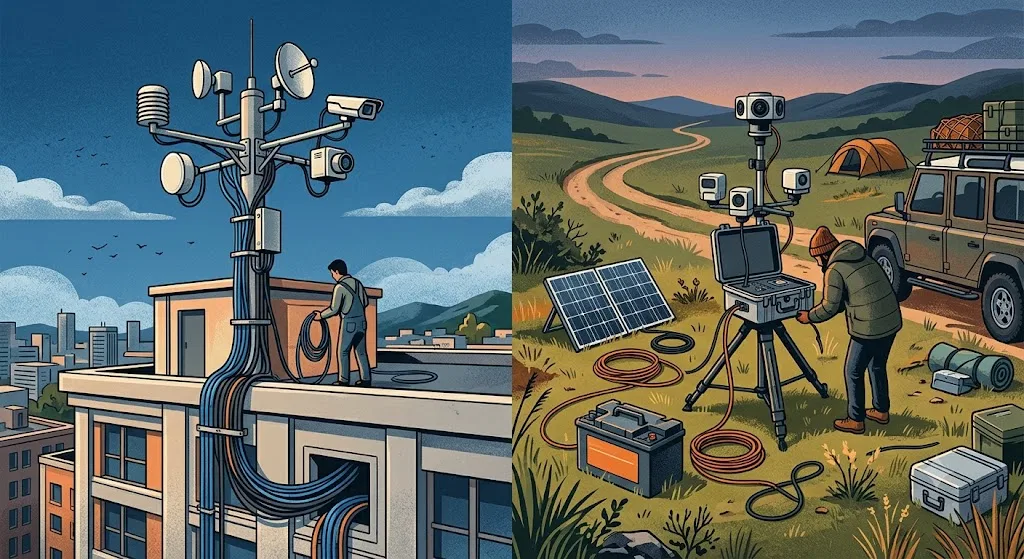
A fixed detector station earns its keep by watching the same patch of sky long enough to learn the local “normal”. That normality is not trivial. A station may repeatedly see aircraft approach lights, Starlink flares, meteors, birds, insects near the lens, drifting balloons, drones, planets near the horizon, cloud-edge reflections, lens glare, radio interference and weather effects. Without months of comparable records, an apparently strange track may be little more than an unfamiliar member of that local background.
This is why permanent or semi-permanent systems are attractive for scientific UAP work. The Galileo Project’s ground-based observatory concept is built around a “multimodal census” of aerial phenomena: wide-field cameras, narrow-field instruments, passive radar-style receivers, radio spectrum monitors, acoustic sensors and environmental instruments working together to recognise outliers. Its published design explicitly links sensor choices to physical observables and discusses how to decide where instruments should be located for testing and final deployment.[The Galileo Project]galileo.hsites.harvard.eduOpen source on harvard.edu.
The fixed-station model also makes calibration less chaotic. Once the station is installed, operators can repeatedly check camera pointing, sensor timing, field of view, weather readings, aircraft context and local obstructions. If a camera lens, mast, enclosure, power supply or software update introduces a fault, that change can be compared against a long record. In UAP work, this matters because many “events” are not objects at all; they are consequences of how an instrument, algorithm or environment behaved at a particular moment.
Project Hessdalen is the clearest historical example of the fixed approach. The Hessdalen Automatic Measurement Station in Norway was set up in the late 1990s to monitor recurring light phenomena in one valley. Later system notes describe expansion with a weather station, a high-sensitivity camera and a sensor mast, but also document a sobering lesson: a radar screen produced so much noise that the team judged it too unreliable to publish as useful evidence.[Hessdalen]old.hessdalen.orgAutomatic Measurement Station (AMSAutomatic Measurement Station (AMS That is exactly the kind of lesson a fixed station can reveal. It does not merely record odd lights; it exposes which instruments are trustworthy, which are too noisy, and which environmental measurements need improvement.
Fixed stations are especially valuable when they are networked. Sky360’s citizen-science model is built around affordable 24/7 stations, harmonised hardware and a global network of sky awareness sites. Its own materials stress outdoor operation, standardised open-source hardware and software, and the need to protect sensitive electronics from all weather conditions.[Sky360]sky360.orgObservational Citizen Science of Earth's Atmosphere… In principle, a network of fixed stations can do what a single camera cannot: compare sightings across geography, triangulate tracks, estimate altitude or range, and test whether a report is local, atmospheric, orbital or sensor-specific.
Portable systems make sense when the question moves
Portable detector stations are useful because UAP reports are not evenly distributed across a map, and some of the most important questions arise at temporary sites. A field team may want to observe a coastal channel during a short expedition, a defence office may want to instrument a restricted area after repeated reports, or researchers may want to test sensors against known aircraft, drones, balloons or satellites before committing to a permanent installation.
The UAPx field expedition around Laguna Beach and Catalina Island in July 2021 shows both the promise and the pain of portability. The team used a small, portable, multi-spectral suite with visible-light imaging, infrared cameras, night-vision equipment, radiation measurements and other instruments. It operated from more than one location, including a rooftop and a moving vehicle, and recorded approximately one hour of triggered visible or night-vision video, more than 600 hours of untriggered far-infrared video, and 55 hours of background radiation measurements.[arXiv]arxiv.orgOpen source on arxiv.org.[arXiv]arxiv.orgOpen source on arxiv.org.
That same expedition also illustrates the weakness of temporary deployment: there is little time to debug. The paper’s lessons learned are unusually candid. It reports that the UFODAP hardware appeared good enough for scientific instrumentation, but the software was unreliable for tracking and identification; ancillary data such as GPS location and ADS-B aircraft exchange were not recorded; aircraft transponders alone were not enough because satellites and rocket launches also had to be checked; multiple identical cameras were still necessary; and all clocks needed sub-second synchronisation with carefully recorded sensor positions.[arXiv]arxiv.orgOpen source on arxiv.org.
Portable systems therefore shine when the goal is rapid, targeted learning rather than long-baseline certainty. They can be carried to a hotspot, placed near a military range, used to compare two viewpoints, or deployed for a 90-day campaign. But every move creates new risks: changed horizons, changed radio noise, unknown insect behaviour, different power constraints, untested mounts, new weather exposure and fresh calibration problems.
AARO’s GREMLIN programme sits firmly in this portable or deployable category. The office’s FY2024 report says GREMLIN is a prototype sensor system for detecting, tracking and characterising UAP; it successfully collected data during a March 2024 test event and was next planned for a 90-day “pattern of life” collection at a national-security site.[U.S. Department of War]media.defense.govFY24 CONSOLIDATED ANNUAL REPORT ON UAP 508FY24 CONSOLIDATED ANNUAL REPORT ON UAP 508 That phrase, “pattern of life”, is important. It is not just about waiting for a spectacular object. It is about learning the ordinary traffic, sensor clutter and environmental rhythms of a sensitive site so that later anomalies can be judged against a local baseline.
Power, weatherproofing and setup are not minor details
The fixed-versus-portable decision often looks like a science question, but it quickly becomes an engineering question. A fixed station can justify heavier mounts, permanent cabling, weatherproof enclosures, stable network connections, larger batteries, mains power, solar backup and routine maintenance visits. A portable station must be carried, assembled, aligned, powered, secured and debugged under time pressure.
Sky360’s outdoor-station materials make the fixed-site burden visible: a 24/7 sky observatory needs weather protection for sensitive electronics because it is exposed continuously.[Sky360]sky360.orgObservational Citizen Science of Earth's Atmosphere… UFODAP’s commercial configuration guidance shows the same issue from a modular angle. Cameras may be mounted on walls, poles or tripods; fixed and pan-tilt-zoom cameras require different mounts; multi-sensor units may need tripod or pole mounts; Power over Ethernet injectors, long cables, software and optional radio-frequency receivers all become part of the deployment design.[UFODAP]ufodap.myshopify.comUFODAPHow to Configure a UFODAP SystemUFODAPHow to Configure a UFODAP System
Weatherproofing is not just about keeping rain out. It affects data quality. A sealed enclosure can trap heat, fog, condensation or pressure changes. A mast can vibrate in wind. A dome can attract insects or collect dust. A weather station can give misleading readings if mounted in the wrong place. Hessdalen’s station notes, for example, state that one weather station was mounted in a tree, influencing wind measurement and making recorded wind speed lower than the actual local value.[Hessdalen]old.hessdalen.orgProject HessdalenProject Hessdalen For UAP analysis, that kind of detail matters because wind, humidity, cloud base and visibility can decide whether a light, blob or track is ordinary or unexplained.
Portable stations add another constraint: power discipline. UAPx reported that no second camera captured its most puzzling UFODAP ambiguity, and some FLIR cameras pointed in the relevant direction were not active at the time because of the power needs of film equipment.[arXiv]arxiv.orgOpen source on arxiv.org. That is a practical warning for any mobile skywatch: a sensor that is technically present but not powered, synchronised or recording is not corroboration.
UFODAP’s multi-sensor unit illustrates the compromise. Its MSDAU is described as a waterproof enclosure containing a Raspberry Pi, sensors, GPS, optional software-defined radio, waterproof connectors and Power over Ethernet, with low power draw below 4W.[UFODAP]ufodap.myshopify.comUFODAPMulti-Sensor Data Acquisition Unit (MSDAUUFODAP… That is attractive for field use, but the system still needs planning: cabling, network access, clocks, mounts, software setup, storage and a clear decision about what counts as a trigger.

The decision is really about the kind of uncertainty being reduced
A fixed station reduces uncertainty about place. Over time, it learns the local sky, the local aircraft routes, the local weather artefacts, the local insect problems, the local radio noise and the local failure modes of its own instruments. It is the right choice when the aim is baseline science, long-term transparency, public data, trend analysis, and repeatable instrument behaviour.
A portable station reduces uncertainty about timing and access. It can go where the reports are, where a test is happening, where a defence site needs coverage, or where researchers can establish two or more temporary viewpoints. It is the right choice when the opportunity is short-lived, the location is sensitive, or the team needs to compare instruments before building a permanent site.
The practical distinction can be summarised this way:
Decision questionFixed station advantagePortable station advantageWhat does “normal” look like here?Strong: months or years of baseline dataWeak at first; improves during longer campaignsCan the system respond to a hotspot?Only if the hotspot is already nearbyStrong: can move to reports, exercises or test sitesIs calibration repeatable?Stronger after installation and maintenanceHarder because each move changes geometry and conditionsIs weatherproofing easier?Easier to justify robust permanent enclosuresHarder because equipment must stay transportableIs triangulation possible?Strong in a planned networkPossible, but requires careful field geometryIs national-security response possible?Useful for known fixed sitesStrong for deployable site-specific campaignsIs public science possible?Strong when data are open and standardisedStrong for expeditions, but harder to reproduce
Neither approach removes the need for sceptical analysis. NASA’s report warns that UAP data are weakened by poor calibration, missing metadata, lack of multiple measurements and lack of baseline data.[NASA Science]science.nasa.govOpen source on nasa.gov. A portable detector that captures a dramatic clip but lacks timing, aircraft context and corroborating sensors may add another ambiguous case. A fixed station that runs for years but uses noisy, poorly understood instruments may simply create a larger archive of confusion.
A hybrid network is the most realistic future
The strongest implementation path is likely a hybrid: fixed observatories for baseline and validation, portable units for targeted collection and rapid response. The fixed sites establish sensor behaviour, false-positive rates and ordinary-sky patterns. The portable kits borrow those lessons, then apply them to hotspots, exercises, coastal corridors, military ranges or national-security sites.
That hybrid model is already visible in separate parts of the field. Galileo’s observatory concept emphasises calibrated, multimodal ground-based census work.[The Galileo Project]galileo.hsites.harvard.eduOpen source on harvard.edu. Sky360 aims at distributed 24/7 citizen stations using harmonised open-source designs.[Sky360]sky360.orgObservational Citizen Science of Earth's Atmosphere… UAPx demonstrates expeditionary fieldwork with portable sensors, including the hard lessons of power, synchronisation, calibration and missed corroboration.[arXiv]arxiv.orgOpen source on arxiv.org. AARO’s GREMLIN points towards deployable government sensor suites for specific areas of interest and short-to-medium “pattern of life” campaigns.[U.S. Department of War]media.defense.govFY24 CONSOLIDATED ANNUAL REPORT ON UAP 508FY24 CONSOLIDATED ANNUAL REPORT ON UAP 508
For automated instrumented UFO detectors, the important implementation lesson is simple: mobility is not a substitute for baseline, and baseline is not a substitute for access. A well-designed fixed station can tell researchers what is ordinary in one sky. A well-designed portable station can test whether a reported pattern follows the place, the people, the instruments or the environment. The more the two designs share calibration standards, metadata formats, timing discipline and analysis tools, the more useful both become.
Amazon book picks
Further Reading
Books and field guides related to Should UAP Sensors Stay Put or Move?. Use these as the next step if you want deeper reading beyond the article.

UFOs : Generals, Pilots, and Government Officials Go on the R...
Connects instrumented collection debates to the broader public UAP evidence problem.
How to Measure Anything
Fits tradeoffs between fixed baselines, portable deployments, uncertainty, and measurement value.
The Demon-Haunted World
Anchors the page’s theme that reliable conclusions require disciplined evidence, not exciting footage.
NightWatch
Useful for understanding what fixed or portable skywatching stations must routinely observe.
eBay marketplace picks
Marketplace Samples
Live-tested eBay searches with available results related to this page.




Endnotes
1.
Source: science.nasa.gov
Link:https://science.nasa.gov/wp-content/uploads/2023/09/uap-independent-study-team-final-report.pdf
2.
Source: old.hessdalen.org
Title: Automatic Measurement Station (AMS)
Link:https://old.hessdalen.org/station/second.shtml
3.
Source: sky360.org
Link:https://www.sky360.org/
Source snippet
Observational Citizen Science of Earth's Atmosphere...
4.
Source: arxiv.org
Link:https://arxiv.org/html/2312.00558v3
5.
Source: ufodap.myshopify.com
Title: UFODAPHow to Configure a UFODAP System
Link:https://ufodap.myshopify.com/collections/how-to-configure-a-ufodap-system
6.
Source: old.hessdalen.org
Title: Project Hessdalen
Link:https://old.hessdalen.org/station/
7.
Source: ufodap.myshopify.com
Title: UFODAPMulti-Sensor Data Acquisition Unit (MSDAU)
Link:https://ufodap.myshopify.com/collections/multi-sensor-data-acquisition-unit-msdau
Source snippet
UFODAP...
8.
Source: ufodap.com
Title: UFODA P
Link:https://ufodap.com/technology
9.
Source: ufodap.com
Title: UFODA P
Link:https://ufodap.com/
10.
Source: ufodap.com
Link:https://ufodap.com/faq
11.
Source: science.nasa.gov
Link:https://science.nasa.gov/uap/
12.
Source: nasa.gov
Title: nasa to release discuss unidentified anomalous phenomena report
Link:https://www.nasa.gov/news-release/nasa-to-release-discuss-unidentified-anomalous-phenomena-report/
13.
Source: nasa.gov
Title: update nasa shares uap independent study report names director
Link:https://www.nasa.gov/news-release/update-nasa-shares-uap-independent-study-report-names-director/
14.
Source: aaro.mil
Link:https://www.aaro.mil/
15.
Source: arxiv.org
Link:https://arxiv.org/html/2506.00125v1
16.
Source: arxiv.org
Link:https://arxiv.org/html/2312.00558v4
17.
Source: sky360.org
Link:https://www.sky360.org/development
18.
Source: hessdalen.org
Link:https://www.hessdalen.org/
19.
Source: war.gov
Title: dod announces the establishment of the all domain anomaly resolution office
Link:https://www.war.gov/News/Releases/Release/Article/3100053/dod-announces-the-establishment-of-the-all-domain-anomaly-resolution-office/
20.
Source: avi-loeb.medium.com
Link:https://avi-loeb.medium.com/commissioning-data-on-half-a-million-objects-in-the-sky-from-the-galileo-project-observatory-are-a23bd084233a
21.
Source: medium.com
Link:https://medium.com/skyhub10/building-a-sky-hub-uap-tracker-95e1750f2c63
22.
Source: avi-loeb.medium.com
Link:https://avi-loeb.medium.com/the-second-half-of-2025-offers-exciting-new-opportunities-to-search-our-cosmic-mailbox-fe43dbaa40a9
23.
Source: medium.com
Link:https://medium.com/%40jdxm21/bob-the-universal-object-tracker-82082916b016
24.
Source: galileo.hsites.harvard.edu
Link:https://galileo.hsites.harvard.edu/publications/scientific-investigation-unidentified-aerial-phenomena-uap-using-multimodal
25.
Source: media.defense.gov
Title: FY24 CONSOLIDATED ANNUAL REPORT ON UAP 508
Link:https://media.defense.gov/2024/Nov/14/2003583603/-1/-1/0/FY24-CONSOLIDATED-ANNUAL-REPORT-ON-UAP-508.PDF
26.
Source: Wikipedia
Title: The Galileo Project
Link:https://en.wikipedia.org/wiki/The_Galileo_Project
27.
Source: Wikipedia
Title: Hessdalen lights
Link:https://en.wikipedia.org/wiki/Hessdalen_lights
28.
Source: Wikipedia
Title: Hessdalen AMS
Link:https://en.wikipedia.org/wiki/Hessdalen_AMS
29.
Source: galileo.hsites.harvard.edu
Link:https://galileo.hsites.harvard.edu/FAQ
30.
Source: galileo.hsites.harvard.edu
Link:https://galileo.hsites.harvard.edu/
31.
Source: galileo.hsites.harvard.edu
Link:https://galileo.hsites.harvard.edu/activities
32.
Source: ufodap.myshopify.com
Link:https://ufodap.myshopify.com/
33.
Source: ufodap.myshopify.com
Title: Cameras for UFO/UAP tracking and data collection
Link:https://ufodap.myshopify.com/collections/cameras
34.
Source: societyforuapstudies.org
Title: project hessdalen
Link:https://www.societyforuapstudies.org/project-hessdalen
35.
Source: youtube.com
Link:https://www.youtube.com/watch?v=uJtER5ahdPY
36.
Source: discoveryuk.com
Title: hessdalen lights natural phenomenon or extraterrestrial signals
Link:https://www.discoveryuk.com/mysteries/hessdalen-lights-natural-phenomenon-or-extraterrestrial-signals/
37.
Source: github.com
Link:https://github.com/Sky360-Repository/sky360
Additional References
38.
Source: youtube.com
Title: Unidentified Anomalous Phenomena Independent Study Report
Link:https://www.youtube.com/watch?v=TQcqOW39ksk
Source snippet
Inside the AI Alien Hunting Project at Harvard - YouTube Inside the AI Alien Hunting Project at Harvard - YouTube...
39.
Source: youtube.com
Title: SOMETHING IS HAPPENING — We Are Detecting Anomalous Objects
Link:https://www.youtube.com/watch?v=op_wCAep23o
Source snippet
Unidentified Anomalous Phenomena Independent Study Report...
40.
Source: youtube.com
Title: Inside the AI Alien Hunting Project at Harvard
Link:https://www.youtube.com/watch?v=oDAY0_wRjxA
Source snippet
AI & Aliens: New Eyes on Ancient Questions // Richard Cloete...
41.
Source: researchgate.net
Link:https://www.researchgate.net/publication/371163445_The_Scientific_Investigation_of_Unidentified_Aerial_Phenomena_UAP_Using_Multimodal_Ground-Based_Observatories
42.
Source: researchgate.net
Link:https://www.researchgate.net/publication/391817538_Initial_results_from_the_first_field_expedition_of_UAPx_to_study_unidentified_anomalous_phenomena
43.
Source: campbellsci.de
Link:https://www.campbellsci.de/automated-weather-stations
44.
Source: vaisala.com
Link:https://www.vaisala.com/en/products/weather-environmental-sensors/automatic-weather-stations
45.
Source: reddit.com
Link:https://www.reddit.com/r/UFOs/comments/1h9jv3p/building_an_aipowered_247_ufo_detection_system/
46.
Source: academia.edu
Link:https://www.academia.edu/123649529/Exploring_Unidentified_Aerospace_Phenomena_through_Instrumented_Field_Studies_Historical_Insights_Current_Challenges_and_Future_Directions
47.
Source: scirp.org
Link:https://www.scirp.org/journal/paperinformation?paperid=135539
Topic Tree